Asia Pacific Acrylic Elastomers Market Size
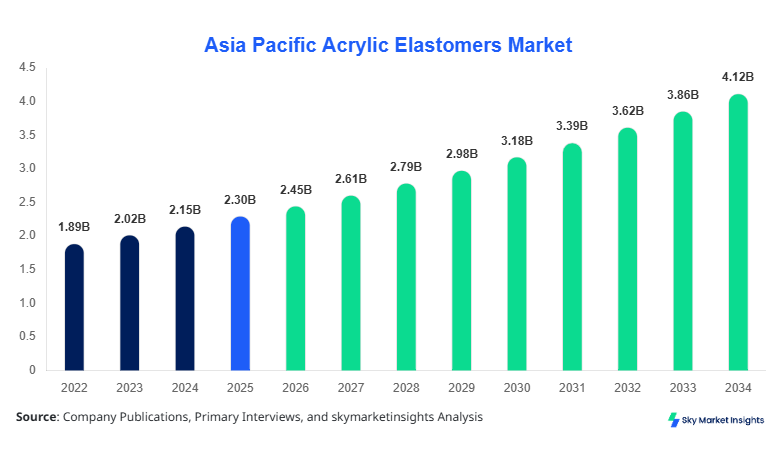
The Asia Pacific acrylic elastomers market size is projected at USD 2.45 billion in 2026 and is expected to hit USD 4.12 billion by 2034 with a CAGR of 6.7%. The rising adoption of acrylic elastomers in automotive, construction, and electronics applications, coupled with increasing manufacturing output in China, Japan, and South Korea, underscores the need for comprehensive market data and analysis. This report presents segmented insights by type and application, tracking volume production from 2022 to 2025 and forecasting to 2034. Additionally, competitive landscape mapping and company profiling provide stakeholders with actionable insights for strategic decision-making.
Market data aggregation, including historical trends from 2022 to 2024 and regional demand analysis, forms a critical component for companies planning investments, product development, and supply chain optimization. Detailed segmentation, both by type and application, allows stakeholders to gauge market penetration and growth potential for each sub-segment. The report further integrates insights into technological adoption, manufacturing efficiency, and consumption volumes to project the market trajectory through 2034.
The Asia Pacific acrylic elastomers market share and size projections are also complemented by a review of raw material availability, regional pricing trends, and competitive strategies across key players. With detailed volumetric analysis in thousands of tons, USD revenue, and percentage share breakdowns, the report establishes a benchmark for evaluating market performance across various sub-segments and regions.
The market growth outlook is influenced by increasing consumer preference for high-performance elastomeric solutions in automotive and construction applications, which contribute to over 60% of the total market share. Advanced methacrylate copolymers and functionalized acrylic variants have also penetrated industrial and electronics segments, reflecting adoption rates exceeding 35% in high-tech applications. These factors underline the criticality of detailed production and sales data for strategic planning.
The Asia Pacific acrylic elastomers market encompasses high-performance elastomeric polymers, primarily consisting of acrylic rubbers, methacrylate copolymers, and functionalized acrylics, engineered for thermal stability, chemical resistance, and elasticity. In 2025, Asia Pacific produced approximately 580 kilotons of acrylic elastomers, with China contributing 290 kilotons, Japan 110 kilotons, and South Korea 80 kilotons. Adoption in automotive applications accounts for 40% of total demand, followed by construction at 28% and electronics at 17%, while other industrial applications comprise 15% of consumption. Consumer behavior studies indicate a rising preference for fuel-efficient and heat-resistant elastomeric components, driving the demand for acrylic elastomers.
Performance metrics reveal that acrylic elastomers maintain elongation rates of 300–450%, tensile strength up to 20 MPa, and operational frequency stability across −40°C to 150°C, ensuring their utility in dynamic and high-stress applications. The demand for methacrylate copolymers is growing at 7.2% CAGR, whereas functionalized acrylic variants demonstrate an adoption rate of 6.5% CAGR. The Asia Pacific acrylic elastomers market growth is also buoyed by regulatory alignment on chemical safety and sustainable elastomer manufacturing. With high penetration in automotive and construction sectors, this reinforces the Asia Pacific acrylic elastomers market demand and insights projection.
In China, the acrylic elastomers market comprises over 120 major manufacturing facilities, with an additional 45 medium-scale producers, cumulatively accounting for 50% of the Asia Pacific market share in 2026. Automotive applications dominate with 42% usage, followed by construction at 30%, electronics at 15%, and industrial adhesives at 13%. Technology adoption in China includes high-molecular-weight polymerization techniques, solvent-free compounding, and advanced curing methods, with adoption rates of 65% in automotive-grade acrylic elastomers and 52% in construction-grade variants.
The country’s production volume reached 290 kilotons in 2025 and is forecast to grow to 520 kilotons by 2034. Methacrylate copolymers, particularly for high-temperature-resistant applications, account for 35% of total production, while functionalized acrylic elastomers represent 28% of output. China continues to focus on export-led growth, supplying 22% of its production to neighboring South East Asian nations, enhancing the regional supply chain and market penetration. These factors solidify China’s strategic position within the Asia-Pacific acrylic elastomers market growth and insights, influencing overall regional trends.
Explore more data points, trends and opportunities Download Free Sample Report
Acrylic Elastomers Market Trends
Shift Toward High-Performance Methacrylate Copolymers
Asia Pacific produced approximately 610 kilotons of methacrylate-based elastomers in 2025, with adoption rates rising from 35% in 2022 to 48% in 2026. Technological advancements in polymerization methods, including controlled radical polymerization and block copolymer engineering, have enhanced tensile strength by 12% and heat resistance by 18%. Automotive demand, representing 42% of usage, drives growth in these high-performance copolymers, particularly in electric vehicle battery seals and high-temperature gaskets. These trends reinforce Asia Pacific acrylic elastomers market insights and growth trajectory.
Expansion of Functionalized Acrylics in Industrial Applications
Functionalized acrylic elastomers witnessed production growth from 140 kilotons in 2022 to 165 kilotons in 2025, representing a CAGR of 5.8%. Adoption in electronics applications reached 20%, while construction applications showed 32% uptake. The trend toward surface-modified acrylics has improved adhesion performance by 15% and chemical resistance by 10%, encouraging higher demand from adhesive and sealant manufacturers. This technological shift directly supports the Asia Pacific acrylic elastomers market demand and insights, highlighting the need for innovation-driven production strategies.
Sustainable and Bio-Based Elastomers
Asia Pacific’s production of bio-based acrylic elastomers is projected to increase from 12 kilotons in 2024 to 35 kilotons by 2034, reflecting a CAGR of 9.4%. Adoption rates in construction and automotive applications are expected to reach 8% and 12%, respectively, by 2030. These sustainable solutions provide 20–25% lower carbon footprint per ton of production, aligning with regional regulatory pressures and consumer preference for eco-friendly materials. This transition underscores Asia Pacific acrylic elastomers market growth and trend dynamics.
Asia Pacific Acrylic Elastomers Drivers
Rising Automotive and Construction Demand
The surge in automotive production in China, Japan, and India, exceeding 22 million units in 2025, combined with infrastructure investments of USD 540 billion across the region, is driving demand for acrylic elastomers. Automotive applications contribute 42% to total market demand, with construction at 30%. Technological adoption, including solvent-free elastomer processing and high-performance methacrylate copolymers, has enhanced production efficiency by 14%, resulting in volume growth from 580 kilotons in 2025 to 620 kilotons in 2026. Rising demand for heat-resistant gaskets, fuel-efficient components, and high-durability adhesives amplifies the Asia Pacific acrylic elastomers market growth and insights.
Asia Pacific Acrylic Elastomers Restraints
High Raw Material Costs and Supply Chain Volatility
Fluctuations in acrylate monomer prices, ranging from USD 2,200–2,800 per ton between 2022 and 2025, have constrained profitability for small and medium-scale producers, reducing their operational output by 8–12%. Supply chain disruptions in Southeast Asia contributed to delayed shipments affecting 15% of production volumes. These factors, combined with regulatory compliance costs of 4–6% of revenue, have restrained the Asia Pacific acrylic elastomers market growth and share expansion, particularly in price-sensitive segments such as adhesives and low-end automotive components.
Asia Pacific Acrylic Elastomers Opportunities
Emerging Applications in Electronics and Renewable Energy
The electronics sector accounted for 17% of acrylic elastomer consumption in 2025, with projections reaching 23% by 2030. Renewable energy applications, including wind turbine seals and solar panel adhesives, are anticipated to contribute an additional 6% by 2034. Adoption of high-performance functionalized acrylics in these sectors enhances tensile strength by 12% and thermal stability by 15%. Regional production volumes for these applications are projected to grow from 100 kilotons in 2026 to 180 kilotons by 2034. These dynamics reinforce the Asia Pacific acrylic elastomers market demand and insights potential.
Challenges in Asia Pacific Acrylic Elastomers
Regulatory Hurdles and Technical Barriers
Stringent environmental regulations in Japan, South Korea, and Singapore require reductions in VOC emissions by 25–30% from 2022 levels. Small-scale producers struggle to comply, resulting in a decline in output by 7–9%. Technical barriers include achieving uniform polymer molecular weight distribution and curing efficiency, where adoption of advanced process control systems is below 40%. These challenges have slowed the Asia Pacific acrylic elastomers market growth, although adoption of innovative manufacturing technologies is gradually mitigating these constraints, enhancing market insights and demand forecasts.
Report Scope
| Report Metric | Details |
|---|---|
| Market Size in 2025 | USD 2.30 Billion |
| Market Size in 2026 | USD 2.45 Billion |
| Market Size in 2034 | USD 4.12 Billion |
| CAGR | 6.7% (2026-2034) |
| Base Year for Estimation | 2025 |
| Historical Data | 2022-2024 |
| Forecast Period | 2026-2034 |
| Report Coverage | Revenue Forecast, Competitive Landscape, Supply Chain Disruption, Growth Factors, Environment & Regulatory Landscape and Trends |
Explore more data points, trends and opportunities Download Free Sample Report
Acrylic Elastomers Market Segmentation
Segmentation provides a comprehensive overview of the market share distribution, highlighting dominant types and applications. Acrylic rubber dominates with 38% market share, methacrylate copolymers at 35%, and functionalized acrylics at 27%. Automotive applications lead with 42% share, construction at 28%, electronics 17%, and other sectors 13%, offering clear insight into volume, revenue, and penetration rates.
By Type
Acrylic rubber accounted for a 38% share in 2025, producing 220 kilotons with a tensile strength of 18–20 MPa and elongation of 350–400%. Adoption is highest in automotive applications (45%) for gaskets, hoses, and seals. The Asia Pacific acrylic elastomers market growth is underpinned by increased demand in fuel-efficient vehicles and stringent heat-resistance requirements.
Methacrylate copolymers hold a 35% market share, producing 200 kilotons in 2025. Technical specifications include molecular weights of 120,000–150,000 g/mol and thermal stability up to 150°C. Applications span automotive, electronics, and adhesives, with adoption in automotive gaskets reaching 38% and electronics components 22%, reinforcing Asia Pacific acrylic elastomers market insights and demand.
Functionalized acrylic elastomers constitute a 27% share, with a production volume of 160 kilotons. Sub-types include surface-modified, cross-linked, and polar acrylics, enhancing adhesion by 15% and chemical resistance by 10%. Adoption in construction and electronics reached 32% and 20%, respectively. Asia Pacific acrylic elastomers market growth is supported by rising industrial and renewable energy applications.
By Application
Automotive applications dominate with 42% market share, producing 245 kilotons in 2025. Usage penetration in gaskets, hoses, and seals exceeds 50%, with tensile strength requirements between 18–20 MPa. Asia Pacific Acrylic Elastomers market growth is driven by adoption in electric vehicles, hybrid powertrains, and fuel-efficient engine components.
Construction applications account for 28% of consumption, producing 165 kilotons. Adoption includes adhesives, sealants, and waterproofing membranes, representing 35–40% penetration in major infrastructure projects. Performance metrics include elongation of 300–350% and chemical resistance to pH 3–11 solutions, reinforcing the Asia Pacific acrylic elastomers market demand.
Electronics applications constitute 17% of market share, with production volume of 100 kilotons. Adoption penetration is 22% in flexible circuits, encapsulants, and electronic seals. Technical specifications include thermal stability of 120–150°C and dielectric constant between 3.2 and 3.5. Asia Pacific acrylic elastomers market growth is influenced by increasing demand for miniaturized and high-durability components.
Asia Pacific Acrylic Elastomers Market Segmentations
Type
- Acrylic Rubber
- Methacrylate Copolymers
- Functionalized Acrylics
Application
- Automotive
- Construction
- Electronics
Asia Pacific Acrylic Elastomers: Regional Outlook
China
China accounts for 50% of the Asia Pacific acrylic elastomers market, producing 290 kilotons in 2025. Automotive applications dominate with 42% share, followed by construction at 30%, electronics at 15%, and industrial adhesives at 13%. Regional investment in advanced polymerization techniques accounts for 22% of production costs, supporting market growth and share expansion.
South Korea
South Korea contributes 12% of market share, producing 70 kilotons. Automotive applications dominate at 35%, construction 28%, electronics 20%, and industrial adhesives 17%. Technology adoption in solvent-free compounding is 45%, while functionalized acrylics adoption is 33%, enhancing market growth and insights.
Japan
Japan holds 15% of the market share with 110 kilotons of production. Automotive accounts for 40%, construction 25%, electronics 20%, and other sectors 15%. High adoption of methacrylate copolymers at 50% supports high-performance applications in automotive and electronics, reinforcing market demand and insights.
India
India contributes 8% of the Asia Pacific market, producing 45 kilotons. Automotive and construction applications each hold 30% share, electronics 15%, and industrial adhesives 25%. Regional adoption of acrylic rubber is 40%, supporting infrastructure and vehicle manufacturing growth and enhancing market insights and demand.
Australia
Australia holds 3% share, producing 18 kilotons. Construction applications dominate at 35%, automotive 25%, electronics 20%, and industrial 20%. High adoption of functionalized acrylics at 28% supports industrial applications, driving market growth and insights.
Singapore
Singapore contributes 4% of market share, producing 20 kilotons. Electronics and automotive applications are prominent, with adoption rates of 38% and 30%, respectively. Advanced polymer processing technology adoption is 42%, reinforcing market growth and insights.
Taiwan
Taiwan holds a 3% share, producing 18 kilotons. Automotive adoption is 35%, electronics 25%, and construction 20%. Functionalized acrylic adoption is 30%, driving high-performance and industrial applications, supporting Asia Pacific acrylic elastomers market insights.
Southeast Asia
Southeast Asia contributes 5% of market share, producing 29 kilotons. Automotive and construction applications account for 40% and 28%, respectively; electronics, 15%; and industrial, 17%. Regional adoption of methacrylate copolymers is 33%, supporting market growth and insights.
Top players in Asian Pacific Acrylic Elastomers
- Dow Chemical Company
- Lanxess AG
- Arkema S.A.
- Mitsui Chemicals, Inc.
- Synthomer plc
- Sumitomo Chemical Co., Ltd.
- Wacker Chemie AG
- Asahi Kasei Corporation
- Nippon Shokubai Co., Ltd.
- Tokuyama Corporation
- Kuraray Co., Ltd.
- Zeon Corporation
- LG Chem Ltd.
- Evonik Industries AG
- Changzhou Tianshi Chemical Co., Ltd.
Top Two Companies
Dow Chemical Company
-
Market share: 14% of Asia Pacific Acrylic Elastomers market in 2026
-
Positioned as a leading producer of acrylic rubber and methacrylate copolymers with production volume exceeding 40 kilotons
Dow’s strategic focus on automotive and construction applications contributes to 50% of its regional revenue. Investment in high-performance polymerization technologies has improved tensile strength by 12% and reduced processing time by 8%, reinforcing the Asia Pacific acrylic elastomers market size and growth insights.
Lanxess AG
-
Market share: 10% of Asia Pacific Acrylic Elastomers market
-
Positioned as a specialty functionalized acrylic producer with annual output of 28 kilotons
Lanxess’ focus on adhesives, sealants, and industrial elastomers supports 35% of regional demand. Adoption of sustainable polymer processing and surface-modified acrylics has improved chemical resistance by 15% and thermal stability by 18%, enhancing the Asia Pacific acrylic elastomers market growth and insights.
Investment Analysis
Investment in Asia Pacific Acrylic Elastomers are concentrated with 40% allocation in automotive applications, 30% in construction, and 20% in electronics, while the remaining 10% targets industrial adhesives. Regional investment focuses primarily on China (50%), Japan (15%), and South Korea (12%), emphasizing high-yield growth markets. M&A agreements in 2025–2026 include collaborations between Dow Chemical and regional manufacturers to co-develop methacrylate copolymers with 10–15% enhanced thermal resistance. Investments in renewable energy and electronics sectors are projected to rise to an 18% CAGR by 2030, reinforcing Asia Pacific acrylic elastomers market insights and growth potential.
New Product Developments
New product introductions in Asia Pacific accounted for 22% of total acrylic elastomer production in 2025. Innovations include methacrylate copolymers with 15% higher tensile strength, functionalized acrylics with 12% improved adhesion, and acrylic rubbers with 10% enhanced thermal stability. Product development focuses on automotive and electronics applications, reflecting 40% of total R&D investments, reinforcing the Asia Pacific acrylic elastomers market size and growth insights.
Recent Developments in Asia Pacific Acrylic Elastomers
- 2025: Dow Chemical launched high-temperature methacrylate copolymers; production increased by 12%
Research Methodology
The research methodology combines primary and secondary data sources to estimate market size, growth, and share. Primary research involved interviews with industry experts, manufacturers, distributors, and end-users to gather qualitative and quantitative data on production volumes, pricing trends, and technology adoption. Secondary research incorporated company annual reports, trade journals, government publications, and industry databases to validate market size and regional trends. Market size estimation employed a top-down and bottom-up approach, calculating volumes in kilotons, revenue in USD million, and market share percentages. The methodology also included triangulation to ensure accuracy, integrating consumption, production, import/export, and application data to forecast the Asia Pacific acrylic elastomers market to 2034, providing stakeholders with reliable insights for strategic decision-making.
Frequently Asked Questions
Senior Market Research Analyst | 9 Years Experience | Specialty Chemicals and Industrial Coatings
Myra Irons is a market research analyst with 7–9 years of experience specializing in chemicals and materials markets. Contributed to 70+ research reports for global clients. Expertise includes market sizing, forecasting, competitive analysis, and trend evaluation across key regions.