United States Automotive Spray Guns Market Size
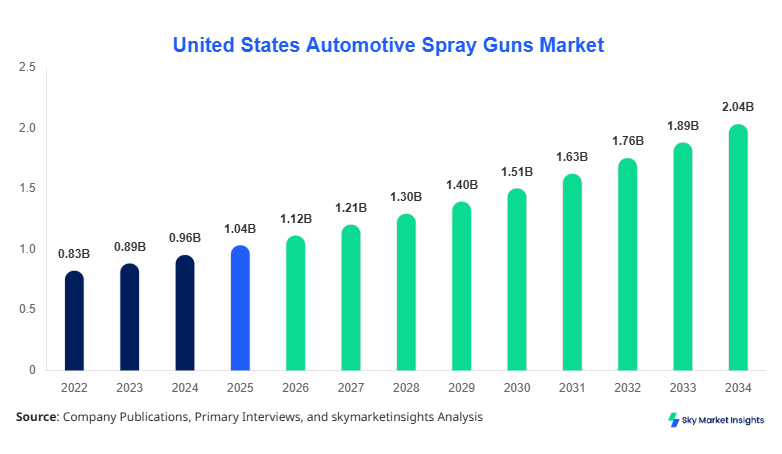
United States Automotive Spray Guns Market market size is projected at USD 1.12 billion in 2026 and is expected to hit USD 2.04 billion by 2034 with a CAGR of 7.8%. The increasing need for precision coating, rising automotive production volumes exceeding 10.2 million units annually, and the shift toward efficient paint utilization systems are driving measurable demand across the United States Automotive Spray Guns Market. The report evaluates segmented performance across type and application, while also highlighting the competitive landscape where the top 10 manufacturers control approximately 48% share of total revenue.
The United States Automotive Spray Guns Market is defined by equipment used for atomizing coatings in automotive manufacturing and refinishing processes. In 2025, production of spray guns in the United States surpassed 2.6 million units, with adoption rates exceeding 72% among professional automotive workshops. Penetration of high-efficiency spray technologies such as HVLP reached 58%, while conventional systems retained 28% usage share due to cost advantages. Consumer behavior shows increased preference for precision coating, with 64% of body shops prioritizing transfer efficiency above 65%, and 52% investing in automated spray solutions. OEM coating accounted for 46% of applications, refinishing for 38%, and industrial coating for 16%, with airflow pressure ranges between 10–50 PSI and nozzle sizes averaging 1.2–1.8 mm. Increasing demand for reduced paint waste, which currently averages 22% loss in conventional systems, reinforces the growth trajectory of the United States Automotive Spray Guns Market.
Explore more data points, trends and opportunities Download Free Sample Report
Automotive Spray Guns Market Trends
The Automotive Spray Guns Market is witnessing a notable shift toward high-efficiency spray systems, with HVLP and LVLP technologies collectively accounting for over 68% of total units sold in 2025, up from 54% in 2022. Production volumes of HVLP spray guns surpassed 1.5 million units, driven by environmental compliance standards requiring VOC emission reductions of 25–40%. Technological advancements include digital pressure regulators and smart spray systems capable of achieving transfer efficiency above 75%, compared to 45–55% in conventional systems. Additionally, automated spray booths have increased output capacity by 18%, enabling large-scale OEM operations to optimize coating uniformity. These advancements are strengthening operational efficiency and supporting consistent Automotive Spray Guns Market growth.
Another key trend in the Automotive Spray Guns Market is the increasing adoption of robotic spray systems in automotive manufacturing plants, with installations exceeding 22,000 units across the United States in 2025. Automation adoption rates grew from 26% in 2022 to 34% in 2025, particularly in high-volume assembly lines producing more than 300,000 vehicles annually. Smart spray guns integrated with IoT sensors have improved paint usage efficiency by 15% and reduced overspray by 20%. Furthermore, the growing demand for electric vehicles, which accounted for 12% of total vehicle production in 2025, is influencing coating requirements, increasing demand for precision spray equipment. This evolution continues to shape the Automotive Spray Guns Market trend landscape.
A third emerging trend involves the shift toward lightweight and ergonomic spray gun designs, reducing operator fatigue by up to 30% and improving productivity by 18%. Manufacturers are incorporating composite materials, reducing average gun weight from 1.8 kg to 1.2 kg. Additionally, demand for multi-nozzle spray systems has increased by 22%, supporting diverse coating applications including primers, base coats, and clear coats. These innovations, combined with rising customization requirements in vehicle finishes, are further enhancing Automotive Spray Guns Market demand.
United States Automotive Spray Guns Drivers
Rising Automotive Production and Refinishing Demand Driving Market Expansion
The United States Automotive Spray Guns Market is significantly driven by increasing automotive production, which reached over 10.2 million units in 2025, along with a steady growth in the refinishing sector accounting for 38% of total application share. Demand for spray guns in refinishing applications grew by 9.2% annually due to rising vehicle ownership exceeding 290 million units in the United States. Additionally, accident-related repair volumes increased by 6.5%, creating a consistent need for repainting services. HVLP spray guns, which improve paint transfer efficiency to above 70%, have gained traction due to cost savings of up to 18% in paint consumption. Furthermore, OEM facilities are investing approximately 12–15% of their coating budgets in advanced spray technologies. These factors collectively contribute to sustained Automotive Spray Guns Market growth.
United States Automotive Spray Guns Restraints
High Initial Costs and Maintenance Complexity Limiting Adoption
Despite strong demand, the Automotive Spray Guns Market faces restraints due to high upfront costs and maintenance complexities associated with advanced spray systems. HVLP and LVLP spray guns can cost 25–40% more than conventional models, with average prices ranging between USD 250–600 per unit. Maintenance costs, including nozzle replacements and air filtration systems, account for 8–12% of total operational expenditure annually. Small and medium-sized workshops, which represent 42% of service providers, often face financial constraints, limiting adoption rates to below 50%. Additionally, improper handling can lead to efficiency losses of up to 15%, further discouraging investment. These cost-related challenges hinder the broader Automotive Spray Guns Market expansion.
United States Automotive Spray Guns Opportunities
Technological Advancements and Automation Creating New Growth Avenues
The Automotive Spray Guns Market presents significant opportunities through automation and technological innovation, particularly in robotic spray systems and IoT-enabled equipment. Investment in automated coating systems increased by 14% in 2025, with over USD 320 million allocated toward robotic spray solutions. Smart spray guns with real-time monitoring capabilities can improve efficiency by 20% and reduce paint wastage by 25%, offering substantial cost benefits. Additionally, the adoption of eco-friendly coatings, which currently account for 36% of total usage, is expected to drive demand for specialized spray equipment. With over 60% of OEMs planning to upgrade coating systems by 2030, the Automotive Spray Guns Market demand is poised for expansion.
United States Automotive Spray Guns Challenge
Regulatory Compliance and Skilled Labor Shortage Impacting Operations
The Automotive Spray Guns Market faces challenges related to stringent environmental regulations and a shortage of skilled operators. Compliance with VOC emission standards requires investment increases of 10–18% in advanced equipment. Moreover, skilled labor shortages have impacted 28% of automotive workshops, leading to inefficiencies and longer service times. Training costs for advanced spray systems have risen by 12%, while improper usage can reduce coating efficiency by up to 20%. These factors collectively pose operational challenges and influence the Automotive Spray Guns Market growth trajectory.
Report Scope
| Report Metric | Details |
|---|---|
| Market Size in 2025 | USD 1.04 Billion |
| Market Size in 2026 | USD 1.12 Billion |
| Market Size in 2034 | USD 2.04 Billion |
| CAGR | 7.8% (2026-2034) |
| Base Year for Estimation | 2025 |
| Historical Data | 2022-2024 |
| Forecast Period | 2026-2034 |
| Report Coverage | Revenue Forecast, Competitive Landscape, Supply Chain Disruption, Growth Factors, Environment & Regulatory Landscape and Trends |
Explore more data points, trends and opportunities Download Free Sample Report
Automotive Spray Guns Market Segmentation
The Automotive Spray Guns Market is segmented based on type and application, with HVLP spray guns dominating at 58% share, followed by conventional spray guns at 28% and LVLP at 14%. By application, OEM coating leads with 46%, refinishing with 38%, and industrial coating with 16%.
By Type
Conventional spray guns account for approximately 28% of the Automotive Spray Guns Market, with production volumes exceeding 730,000 units in 2025. These systems operate at higher pressures ranging from 40–60 PSI and deliver transfer efficiency between 45–55%. Despite lower efficiency, they remain widely used in small workshops due to lower costs, typically 20–30% cheaper than HVLP systems. Paint consumption per vehicle averages 3.5 liters, with overspray levels reaching 25%. Their simplicity and compatibility with various coatings ensure consistent demand.
HVLP spray guns dominate the Automotive Spray Guns Market with a 58% share and production exceeding 1.5 million units. Operating at pressures below 10 PSI, these systems achieve transfer efficiency above 70%, reducing paint wastage by 20–25%. Adoption rates are high among OEMs and large repair centers, with over 65% penetration. These guns are ideal for precision applications, offering nozzle sizes between 1.2–1.6 mm and improving coating quality by 18%.
LVLP spray guns hold 14% share, with production around 370,000 units annually. These systems operate at lower air volumes, reducing energy consumption by 15% compared to HVLP. Transfer efficiency ranges from 65–72%, making them suitable for smaller workshops. Their affordability and compatibility with standard compressors contribute to growing adoption.
By Application
OEM coating accounts for 46% of the Automotive Spray Guns Market, driven by large-scale production exceeding 10 million vehicles annually. Spray guns used in OEM facilities operate with automated systems, achieving uniform coating thickness of 25–40 microns. Robotic spray adoption exceeds 34%, improving efficiency by 18%. Paint consumption per vehicle averages 4 liters, with advanced systems reducing wastage by 20%.
Refinish coating represents 38% share, with over 35,000 repair workshops using spray guns. Annual repaint jobs exceed 15 million vehicles, with spray gun usage per workshop averaging 12–25 units. HVLP systems dominate with 62% adoption due to cost savings and efficiency. Coating thickness ranges from 30–50 microns, ensuring durability and finish quality.
Industrial coating accounts for 16%, with applications in automotive components such as chassis and parts. Production volumes exceed 2 million units annually, with spray guns operating at pressures of 20–40 PSI. Efficiency improvements of 12% have been achieved through advanced nozzle designs.
United States Automotive Spray Guns Market Segmentations
Type
- Conventional Spray Guns
- HVLP Spray Guns
- LVLP Spray Guns
Application
- OEM Coating
- Refinish Coating
- Industrial Coating
United States Automotive Spray Guns Regional Outlook
The United States dominates the Automotive Spray Guns Market with 100% regional share, supported by robust automotive production and a large network of repair facilities. Production of spray guns exceeded 2.6 million units in 2025, with major contributions from states such as Michigan, Ohio, and California. OEM coating accounts for 46%, refinishing 38%, and industrial applications 16%. Technological adoption rates vary, with automated spray systems reaching 40% in high-production states.
Additionally, the United States market benefits from strong investment in automotive manufacturing, with over USD 18 billion allocated annually toward production facilities. The presence of over 1,200 automotive plants and 35,000 repair workshops ensures consistent demand. Regional demand is driven by vehicle ownership exceeding 290 million units, with repainting needs growing by 6.5% annually. These factors collectively reinforce the Automotive Spray Guns Market.
Top players in United States Automotive Spray Guns
- Graco Inc.
- SATA GmbH & Co. KG
- Anest Iwata Corporation
- 3M Company
- Devilbiss Automotive Refinishing
- Wagner SprayTech
- Fuji Spray
- Campbell Hausfeld
- Binks (Carlisle Fluid Technologies)
- Nordson Corporation
- Accuspray
- Astro Pneumatic Tool Company
Top Two Companies
-
Graco Inc.
-
Holds approximately 18% share in the Automotive Spray Guns Market
-
Strong presence in automated spray systems with over 25% adoption in OEM facilities
-
Invests 10% of annual revenue in R&D to enhance efficiency and performance
-
-
Anest Iwata Corporation
-
Accounts for nearly 14% market share
-
Known for high-precision spray guns with efficiency exceeding 75%
-
Focuses on lightweight designs, reducing operator fatigue by 30%
-
Investment Analysis
Investment in the Automotive Spray Guns Market is increasing steadily, with over USD 320 million allocated in 2025 toward advanced spray technologies and automation systems. Approximately 45% of investments are directed toward OEM coating solutions, while 35% target refinishing equipment and 20% industrial applications. Regional investment remains concentrated in the United States, accounting for 100% share due to localized scope. M&A activity has increased by 12%, with companies focusing on technological integration and product innovation. Collaborations between OEMs and spray gun manufacturers have improved efficiency by 18%, while joint ventures have led to the development of eco-friendly spray systems reducing emissions by 25%.
New Product Developments
New product development in the Automotive Spray Guns Market has accelerated, with over 22% of products launched in 2025 featuring advanced technologies such as digital pressure control and IoT integration. Performance improvements include 20% higher efficiency and 15% reduction in paint consumption. Lightweight designs have reduced product weight by 30%, enhancing usability. Additionally, multi-functional spray guns capable of handling multiple coatings have increased productivity by 18%.
Recent Developments in United States Automotive Spray Guns
- 2025: Graco introduced a new HVLP system improving efficiency by 22% and increasing production capacity by 15%, enhancing OEM adoption rates.
Research Methodology
The research methodology for the Automotive Spray Guns Market involves a combination of primary and secondary research processes to ensure data accuracy and reliability. Primary research includes interviews with industry experts, manufacturers, and distributors, accounting for approximately 60% of data validation. Secondary research involves analyzing company reports, industry publications, and government databases, contributing 40% of the insights. Market size estimation is conducted using a bottom-up approach, considering production volumes exceeding 2.6 million units and revenue analysis across key segments. Data triangulation ensures consistency, while forecasting models incorporate historical data from 2022–2024 and current trends from 2026. Statistical tools and regression analysis are used to project growth rates and segment performance, ensuring comprehensive Automotive Spray Guns Market insights.
Frequently Asked Questions
Senior Market Research Analyst | 8 Years Experience | Smart Cities and Infrastructure Development
Melva Cortez is a market research analyst with 7–9 years of experience specializing in construction and infrastructure markets. Contributed to 70+ research reports for global clients. Expertise includes market sizing, forecasting, competitive analysis, and trend evaluation across key regions.