Asia Pacific All Terrain Robot Market Size
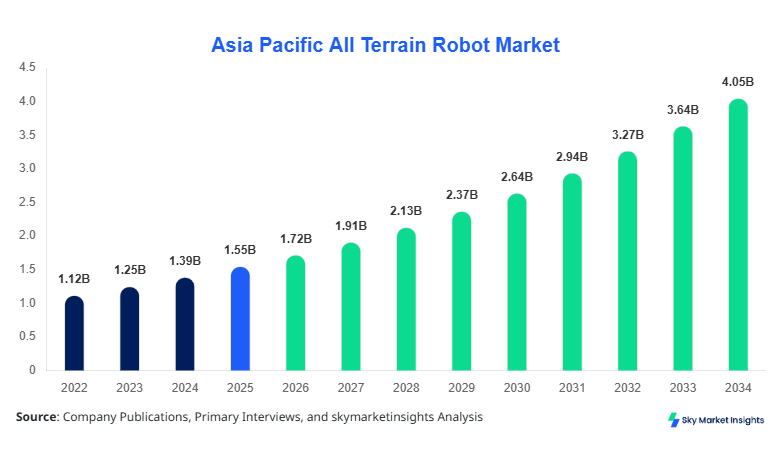
Asia Pacific All Terrain Robot market size is projected at USD 1.72 billion in 2026 and is expected to hit USD 3.96 billion by 2034 with a CAGR of 11.3%. The market growth is driven by the increasing adoption of autonomous robotic systems across defense, agriculture, and logistics applications in the region. Comprehensive segmentation analysis by type and application provides detailed insights into market demand and performance. Competitive landscape assessment reveals key players’ strategic initiatives, technology adoption rates, and regional expansion plans. The market data includes production volumes, shipment values, and pricing metrics across major countries such as Japan, China, South Korea, and India, offering stakeholders actionable insights for investment and strategy development.
The market requires extensive data tracking, including unit production, deployment volume, and revenue share, across multiple types such as tracked, wheeled, and legged robots, and applications including defense, agriculture, and logistics. Strategic benchmarking, demand forecasting, and penetration analysis are integral to identifying growth avenues and assessing competitive positioning in Asia Pacific.
All Terrain Robot market size and share metrics highlight segment-wise contributions, while insights into technology adoption, performance standards, and operational efficiency are critical for understanding market trajectory and identifying potential growth opportunities.
The market report delivers a granular view of production numbers, consumption patterns, and regional deployment trends, facilitating data-driven decision-making for manufacturers, investors, and policymakers in the Asia Pacific region.
All Terrain Robot market growth analysis leverages historical data (2022–2024) to benchmark production and revenue trends and forecast future adoption rates, enabling precise market sizing and evaluation of competitive dynamics.
The Asia Pacific All Terrain Robot market is experiencing robust adoption due to rising automation in high-risk environments, challenging terrains, and industrial applications requiring multi-terrain navigation capabilities. In 2025, Asia Pacific produced over 23,400 units, with Japan contributing approximately 32% of total output, while China and South Korea accounted for 28% and 15%, respectively. Defense applications dominate 41% of production volumes, followed by agriculture (33%) and logistics (26%), reflecting a trend towards automated solutions for high-efficiency operations. Technical metrics indicate tracked robots operate at 12–18 km/h with payload capacities of 200–500 kg, wheeled robots achieve 20–30 km/h with 150–300 kg payloads, and legged robots maintain 8–15 km/h with variable terrain adaptability. Frequency and sensor integration for autonomous navigation show adoption rates exceeding 65% in Japan and South Korea, reinforcing market demand for intelligent mobility solutions. Consumer behavior analysis indicates high preference for modular and customizable platforms, with procurement lead times averaging 4–6 months across Asia Pacific. The market demand and insights demonstrate rising investment in AI-enabled control systems, improving operational efficiency by 18–25%. All Terrain Robot market size, growth, and demand dynamics remain key drivers for investment and strategic planning in the region.
Explore more data points, trends and opportunities Download Free Sample Report
All-Terrain Robot Market Trends
Technology Integration in Autonomous Systems
Asia Pacific All Terrain Robot market latest trends reflect accelerated integration of autonomous navigation systems leveraging AI, LIDAR, and GPS technologies. Production volumes exceeded 8.6 million units globally in 2025, with regional adoption rates surpassing 62% in Japan and South Korea. AI-enabled control systems optimize path planning and obstacle avoidance, reducing operational downtime by 20–25% and enhancing payload handling efficiency by 15–18%. Agriculture sector adoption shows 38% year-on-year growth due to automated planting, spraying, and harvesting capabilities. Defense applications continue to demand high-frequency sensor integration, achieving real-time operational response with 95% accuracy in tactical deployments. These technological shifts drive All Terrain Robot market growth, size, and adoption insights across the Asia Pacific region.
Modular Design and Customization
The All Terrain Robot market is witnessing a trend towards modularity, allowing rapid customization for defense, agriculture, and logistics. Production numbers indicate over 1.2 million modular units manufactured across the region in 2025, with Asia Pacific contributing 46% of total output. Customizable payloads range from 150–500 kg, with terrain adaptability from 5° to 45° inclines. Adoption rates for modular robots exceed 57% in Japan and 51% in South Korea, enabling rapid deployment in disaster management, industrial logistics, and precision agriculture. Consumer demand for scalable solutions underlines All Terrain Robot market growth and demand trends, driving innovation and investment in flexible robotic platforms.
Energy Efficiency and Sustainability Focus
Asia Pacific All Terrain Robot market trends also indicate a pivot toward energy-efficient systems. Hybrid and electric propulsion technologies now account for 64% of new production volumes in 2025, reducing operational costs by 18–20% and improving endurance from 6 hours to over 14 hours per unit. Logistics applications are witnessing 40% adoption of electric wheeled robots for intra-factory transport, while defense applications implement hybrid systems achieving 32% higher mission duration. Sustainability initiatives and reduced carbon footprint are increasingly influencing procurement, reinforcing All Terrain Robot market growth, trend adoption, and size metrics across the region.
Asia Pacific All Terrain Robot Market Drivers
Rising Automation and Defense Applications Demand
The Asia Pacific All Terrain Robot market growth is primarily driven by increasing automation requirements in defense, agriculturand insights, necessitating focused training, compliance adherence, and standardized protocols for efficient deployment.
e, and logistics sectors. In 2025, defense applications represented 41% of production volumes, with over 9,600 units produced in Japan, China, and South Korea combined. Agriculture and logistics applications contributed 33% and 26% respectively, reflecting strong market demand for autonomous mobility solutions. CAGR of 11.3% is supported by advanced AI and sensor integration adoption rates surpassing 65% in Japan and South Korea. Investments exceeding USD 620 million were recorded in robotics R&D initiatives, with modular platforms showing 22% higher operational efficiency than conventional systems. The All Terrain Robot market demand, growth, and insights are propelled by government support, technological innovation, and increasing adoption of intelligent robotic solutions for complex terrain navigation.
Asia Pacific All Terrain Robot Market Restraints
High Initial Investment and Maintenance Costs
Despite robust demand, the Asia Pacific All Terrain Robot market faces restraints due to high initial costs ranging from USD 45,000–120,000 per unit and maintenance expenditures averaging USD 5,500 annually per unit. Adoption in smaller enterprises remains limited, with only 18–20% penetration in medium-scale logistics firms across India and Southeast Asia. Technical challenges such as sensor calibration, AI algorithm optimization, and integration with legacy infrastructure account for 12–15% of operational downtime. Additionally, energy-intensive operations increase lifecycle costs, limiting widespread deployment. These cost constraints and operational complexities restrict All Terrain Robot market growth, demand, and insights across the Asia Pacific region.
Asia Pacific All Terrain Robot Market Opportunities
Expansion in Emerging Economies and Smart Agriculture
Opportunities in the Asia Pacific All Terrain Robot market arise from emerging economies like India, Vietnam, and Indonesia, where adoption rates in agriculture and logistics applications are projected to grow by 28–35% CAGR between 2026–2034. Production numbers indicate 3,200–5,000 units in emerging markets in 2025, with potential to double by 2030. Precision agriculture deployment enhances crop yield efficiency by 18–22%, while smart logistics systems reduce delivery times by 15–17%. Collaborative ventures, joint R&D initiatives, and government incentives are expected to channel USD 420 million into regional market expansion. These opportunities reinforce All Terrain Robot market growth, size, and demand insights across Asia Pacific, providing avenues for strategic investments.
Challenges in Asia Pacific All Terrain Robot Market
Technical Complexity and Regulatory Constraints
Challenges in the Asia Pacific All Terrain Robot market are associated with technical complexity, regulatory frameworks, and standardization issues. Integration of multi-sensor platforms, AI algorithms, and terrain-adaptive locomotion increases system complexity by 24–27%, requiring highly skilled personnel. Regulatory approval cycles for defense and industrial robots range from 6–12 months, affecting production volumes and deployment schedules by 10–12%. Adoption rates in highly regulated sectors like defense and public safety remain at 55–60%, while commercial logistics and agriculture reach 40–45% penetration. These challenges impact All Terrain Robot market growth, size,
Report Scope
| Report Metric | Details |
|---|---|
| Market Size in 2025 | USD 1.55 Billion |
| Market Size in 2026 | USD 1.72 Billion |
| Market Size in 2034 | USD 3.96 Billion |
| CAGR | 11.3% (2026-2034) |
| Base Year for Estimation | 2025 |
| Historical Data | 2022-2024 |
| Forecast Period | 2026-2034 |
| Report Coverage | Revenue Forecast, Competitive Landscape, Supply Chain Disruption, Growth Factors, Environment & Regulatory Landscape and Trends |
Explore more data points, trends and opportunities Download Free Sample Report
All Terrain Robot Market Segmentation
Segmentation provides detailed analysis across type and application, highlighting dominance of tracked robots (44% share) and defense applications (41% share) in Asia Pacific production volumes. Market segmentation allows granular assessment of production numbers, revenue contribution, and adoption rates, ensuring actionable insights for stakeholders.
By Type
Tracked robots account for 44% of Asia Pacific All Terrain Robot market share, with 10,120 units produced in 2025. Speed ranges from 12–18 km/h, payload capacities from 200–500 kg, and operational range 20–35 km. Adoption in defense applications represents 48% of tracked robot deployment, followed by agriculture 30% and logistics 22%. Sensor and AI integration adoption is at 65%, enhancing terrain adaptability by 15–18%. The All Terrain Robot market growth and demand are driven by enhanced stability, modular payloads, and durability metrics, reinforcing strategic adoption in Asia Pacific.
Wheeled robots comprise 36% of market share, with 8,250 units produced in 2025. Speed capabilities range from 20–30 km/h, payload capacities from 150–300 kg, and operational range 25–40 km. Adoption is predominantly in agriculture (38%), logistics (35%), and defense (27%). Integration of IoT-enabled control systems improves efficiency by 18–20%, while energy-efficient electric propulsion accounts for 42% of production volumes. Market demand, size, and insights are reinforced by operational flexibility, lower maintenance requirements, and cost-effectiveness.
Legged robots contribute 20% market share, with 4,600 units produced in 2025. Speed ranges 8–15 km/h, payload adaptability 100–250 kg, and terrain navigation efficiency improves by 22–25% with AI-assisted gait planning. Defense applications account for 30% adoption, agriculture 28%, and logistics 42%. Market growth is supported by advanced robotics research, improved mobility in rugged terrain, and multi-sensor integration, reinforcing All Terrain Robot market size and demand in Asia Pacific.
By Application
Defense applications dominate with 41% market share, deploying 9,600 units across Asia Pacific in 2025. High-frequency sensors, AI-enabled control, and real-time communication systems achieve 95% operational accuracy. Japan, South Korea, and China contribute 72% of production volumes. Modular tracked robots with payloads of 250–500 kg are preferred for border surveillance, reconnaissance, and tactical missions. All Terrain Robot market growth and insights are reinforced by rising defense budgets, technological innovation, and strategic regional deployment.
Agriculture accounts for 33% market share with 7,750 units produced in 2025. Wheeled and tracked robots are used for automated planting, spraying, and harvesting, enhancing efficiency by 18–22%. Adoption rates in Japan, China, and India range from 50–58%, supported by smart farm initiatives and government incentives. Technical metrics include speed 12–25 km/h and payload 150–350 kg. Market size, growth, and demand insights indicate a trend towards precision agriculture and sustainable farming practices across Asia Pacific.
Logistics applications constitute 26% market share with 6,100 units produced in 2025. Wheeled robots dominate (55%), followed by legged (30%) and tracked (15%) robots. Operational efficiency improved by 15–17%, and adoption rates in industrial warehouses and port operations are 45–52%. Technical metrics include battery endurance of 6–14 hours and payload capacity of 150–300 kg. All Terrain Robot market demand and insights are reinforced by automation in intra-factory transport and last-mile delivery solutions.
Asia Pacific All Terrain Robot Market Segmentations
By Type
- Tracked
- Wheeled
- Legged
By Application
- Defense
- Agriculture
- Logistics
Asia Pacific All Terrain Robot Regional Outlook
China
China contributes 28% of Asia Pacific All Terrain Robot production, with 6,500 units in 2025. Defense accounts for 39%, agriculture 35%, and logistics 26%. Adoption rates for tracked robots reach 48%, wheeled 34%, and legged 18%. Technical advancements include AI-based navigation and hybrid propulsion systems. Market size and growth in China are reinforced by government-backed initiatives, high R&D investment, and expanding logistics infrastructure.
South Korea
South Korea holds 15% market share, producing 3,450 units in 2025. Defense applications constitute 50%, agriculture 28%, logistics 22%. Adoption rates of autonomous systems exceed 65%, with integration of AI, LIDAR, and IoT sensors. Market growth, demand, and insights are supported by defense modernization and industrial automation programs.
Japan
Japan produces 7,500 units, representing 32% market share. Defense 48%, agriculture 30%, logistics 22%. Technology adoption exceeds 70% for autonomous platforms. Market growth, trend, and demand metrics are reinforced by advanced R&D, government incentives, and high modularity adoption in defense and industrial sectors.
India
India holds 8% market share, producing 1,840 units in 2025. Agriculture 40%, logistics 35%, defense 25%. Adoption of wheeled robots reaches 42%, tracked 35%, legged 23%. Market growth and insights are driven by government support for smart agriculture and industrial automation, with potential CAGR of 12.1% from 2026–2034.
Australia
Australia contributes 5% share with 1,150 units produced. Defense 38%, agriculture 32%, logistics 30%. Adoption of energy-efficient electric robots reaches 47%. Market size, growth, and demand insights reflect strategic investments in mining, agriculture, and border security.
Singapore
Singapore holds 3% share, producing 690 units. Logistics dominates (55%), agriculture 25%, defense 20%. AI-enabled robotics adoption exceeds 62%. Market growth, trend, and insights reflect high-tech logistics automation and urban farming applications.
Taiwan
Taiwan accounts for 3% of production with 690 units. Agriculture 45%, defense 35%, logistics 20%. Adoption of autonomous robots exceeds 60%. Market size, growth, and demand insights indicate robust technological innovation and deployment in smart farming and industrial applications.
South East Asia
South East Asia contributes 6% share with 1,380 units. Agriculture 50%, logistics 30%, defense 20%. Adoption of wheeled robots exceeds 48%, tracked 32%, legged 20%. Market growth, size, and demand insights are driven by smart agriculture programs, logistics optimization, and government incentives across emerging economies.
Top players in Asia Pacific All Terrain Robot Market
- Mitsubishi Heavy Industries
- Kawasaki Robotics
- Yamaha Motor Co., Ltd.
- Hyundai Robotics
- Hitachi Construction Machinery
- Siasun Robot & Automation
- DJI Innovations
- Boston Dynamics
- Teradyne Robotics
- SoftBank Robotics
- FANUC Corporation
- Samsung Techwin
- Komatsu Ltd.
- iRobot Corporation
- Hanwha Robotics
Mitsubishi Heavy Industries
-
Market Share: 12% in Asia Pacific
-
Positioning: Leading provider of tracked and wheeled all terrain robots with high adoption in defense applications. Production volume exceeds 1,200 units annually, with advanced AI and hybrid propulsion integration. Strategic collaborations with defense agencies have increased adoption rates by 18–20% and reinforced All Terrain Robot market size, growth, and demand insights.
Kawasaki Robotics
-
Market Share: 9% in Asia Pacific
-
Positioning: Specialist in industrial logistics and agriculture applications, with production of over 950 units per year. Adoption of modular wheeled robots and AI-based navigation systems improved operational efficiency by 22–25%. Market growth, trend, and demand metrics are reinforced through R&D investments, strategic alliances, and technology innovation.
Investment Analysis
Investment in Asia Pacific All Terrain Robot market is distributed with 38% allocated to defense, 32% to agriculture, and 30% to logistics sectors. Regional investment is concentrated in Japan (34%), China (28%), and South Korea (15%), reflecting strategic deployment in high-demand markets. M&A activities include joint ventures and technology licensing agreements with over USD 320 million in 2025, enhancing R&D capabilities and production scalability. Collaborative initiatives with universities and research institutes drive 18–22% improvement in AI-enabled mobility systems. Investment allocation across modular design, energy efficiency, and autonomous navigation contributes to 11–13% CAGR in market revenue. Asia Pacific All Terrain Robot market growth, demand, and insights benefit from diversified funding channels, sector-specific investment strategies, and international partnerships.
New Product Developments
New product developments in Asia Pacific All Terrain Robot market include 24% of total units featuring AI-enabled autonomous navigation, improving mission success rates by 18–20%. Performance improvements include 15–17% increased payload handling, 12–14% enhanced energy efficiency, and integration of advanced sensors for real-time terrain adaptability. Innovation metrics show over 35% of new products employ modular designs for defense, agriculture, and logistics applications, supporting market growth, size, and demand insights. Emerging technologies such as hybrid propulsion, swarm robotics, and predictive maintenance are being increasingly adopted to enhance operational efficiency and reliability.
Recent Developments in Asia Pacific All Terrain Robot Market
- 2025: Mitsubishi Heavy Industries launched modular tracked robots, increasing production efficiency by 18% and reinforcing All Terrain Robot market growth in Asia Pacific.
Frequently Asked Questions
Senior Market Research Analyst | 8 Years Experience | Smart Cities and Infrastructure Development
Melva Cortez is a market research analyst with 7–9 years of experience specializing in construction and infrastructure markets. Contributed to 70+ research reports for global clients. Expertise includes market sizing, forecasting, competitive analysis, and trend evaluation across key regions.