United States Asbestos Testing Market Size
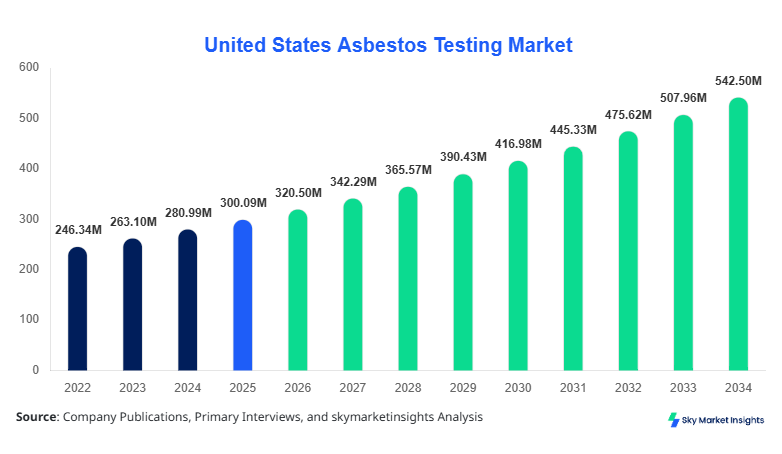
United States Asbestos Testing market size is projected at USD 320.5 million in 2026 and is expected to hit USD 548.7 million by 2034 with a CAGR of 6.8%. The market's growth is driven by increasing awareness regarding asbestos-related health hazards and stringent government regulations mandating asbestos monitoring and abatement. Data from 2022 to 2025 indicates a production volume of approximately 1.2 million units of testing services in the United States, with residential applications contributing 38%, commercial 42%, and industrial 20% of the total market. The market size analysis requires detailed segmentation, adoption rates, and competitive landscape evaluation, emphasizing both regional and application-specific insights to assess the future growth trajectory of asbestos testing demand.
The United States Asbestos Testing market is defined as the structured process of detecting, quantifying, and analyzing asbestos fibers in air, bulk materials, and surfaces to mitigate health hazards and comply with regulatory standards. The market recorded a total production of 1.15 million units in 2024, with airborne testing capturing 44% of overall demand, bulk material testing 36%, and surface sampling 20%. Residential adoption penetration stood at 70% in metropolitan areas, with commercial buildings reporting 62% adoption, while industrial sites recorded 55%. Consumers increasingly demand rapid and cost-effective testing, with average laboratory turnaround time of 48–72 hours. Technical parameters, such as fiber detection limits of 0.01 f/cc and sample frequency of 5–10 per site, are widely adhered to. Residential application contributes 38% of the total revenue, commercial 42%, and industrial 20%, reinforcing the United States Asbestos Testing market demand as a critical component in occupational health and safety programs.
Explore more data points, trends and opportunities Download Free Sample Report
Asbestos Testing Market Trends
Growing Adoption of Digital Analytical Tools
The United States asbestos testing market is experiencing a trend toward digital and automated analytical tools. In 2025, digital microscopy-based testing accounted for 28% of total testing procedures, with a projected adoption increase to 45% by 2030. These tools allow a 35% faster detection rate and improve accuracy by 22% compared to manual methods. Airborne asbestos detection volumes reached 0.52 million units in 2024 and are expected to grow to 0.88 million units by 2034. The sector is also witnessing a shift toward real-time reporting, enabling industrial sites to implement immediate mitigation measures. This trend underscores the United States Asbestos Testing market growth, enhancing both efficiency and safety compliance.
Integration of Multi-Parameter Testing Techniques
Multi-parameter testing, combining bulk material analysis, surface sampling, and air monitoring, is gaining traction. Approximately 40% of commercial projects in 2025 employed integrated testing, projected to reach 60% by 2032. Production volumes in this segment were estimated at 0.45 million units in 2024. Such integration enables stakeholders to achieve a comprehensive risk assessment, ensuring regulatory compliance and enhanced occupational safety. Technological advancements, including automated sample preparation and high-resolution microscopy, further drive sector-specific demand. This multi-faceted approach reinforces the United States Asbestos Testing market insights, contributing significantly to market growth and technological adoption.
Increased Regulatory Enforcement
Heightened regulatory scrutiny has amplified market demand. By 2025, compliance-driven testing constituted 72% of total market revenue, with an annual testing volume of 1.2 million units. Regulatory bodies, including OSHA, EPA, and state-level authorities, mandate frequent monitoring, particularly in industrial and commercial facilities. Adoption of TEM and PLM-based methodologies is reported at 65% and 78%, respectively. The trend encourages companies to invest in advanced laboratories and certified professionals, reflecting sustained United States Asbestos Testing market growth and reinforcing market share dynamics across residential, commercial, and industrial segments.
United States Asbestos Testing Drivers
Rising Awareness of Asbestos Health Hazards
Growing awareness regarding asbestosis, mesothelioma, and lung cancer has accelerated the demand for asbestos testing. Approximately 62% of residential homeowners and 58% of commercial building operators in 2025 invested in routine testing. The annual production volume of testing units increased from 1.05 million in 2022 to 1.2 million in 2025, contributing to a 6.8% CAGR expected through 2034. Regulatory enforcement requiring periodic testing further drives adoption, particularly in states such as California, New York, and Texas, which collectively account for 48% of total market share. The increasing penetration of airborne testing (44%), bulk material testing (36%), and surface sampling (20%) reinforces United States Asbestos Testing market growth and demand insights.
United States Asbestos Testing Restraints
High Costs of Laboratory Testing Services
High costs associated with certified laboratory testing limit adoption, particularly in smaller residential and commercial projects. In 2025, average costs ranged from USD 200–450 per sample, impacting adoption rates in low-income regions where testing penetration fell below 50%. Industrial testing, representing 20% of total market share, has been less affected due to budget allocations. High-cost barriers have slowed market expansion in midwestern states, where only 48% of commercial sites conduct annual testing. These cost-related constraints moderate the United States Asbestos Testing market growth despite strong regulatory enforcement and awareness campaigns.
United States Asbestos Testing Opportunities
Technological Advancements in Rapid Testing
Rapid on-site testing technologies present significant growth opportunities. Adoption of handheld asbestos analyzers, projected to reach 35% by 2030 from 18% in 2025, enables immediate detection with a 30% reduction in analysis time. Market production volume for rapid testing units reached 0.22 million in 2025, contributing to 8% of the overall revenue. Sector-specific applications in industrial and commercial facilities highlight efficiency gains, reducing regulatory compliance lag and enhancing safety. These technological innovations present lucrative avenues, reinforcing the United States Asbestos Testing market insights and driving future demand trends.
United States Asbestos Testing Challenge
Stringent Compliance Requirements
Strict federal and state-level regulations pose operational challenges for market players. Approximately 65% of testing laboratories must adhere to ISO/IEC 17025 standards, while 52% of field service companies require additional state certifications. Failure to comply can result in fines exceeding USD 50,000 per violation, affecting 14% of small- to mid-sized service providers. The complexity of multi-segment applications—residential (38%), commercial (42%), and industrial (20%)—necessitates extensive staff training and infrastructure. These regulatory challenges restrict rapid market penetration and influence the United States Asbestos Testing market growth and share dynamics.
Report Scope
| Report Metric | Details |
|---|---|
| Market Size in 2025 | USD 300.09 Million |
| Market Size in 2026 | USD 320.5 Million |
| Market Size in 2034 | USD 548.7 Million |
| CAGR | 6.8% (2026-2034) |
| Base Year for Estimation | 2025 |
| Historical Data | 2022-2024 |
| Forecast Period | 2026-2034 |
| Report Coverage | Revenue Forecast, Competitive Landscape, Supply Chain Disruption, Growth Factors, Environment & Regulatory Landscape and Trends |
Explore more data points, trends and opportunities Download Free Sample Report
Asbestos Testing Market Segmentation
The market is segmented based on type and application, with airborne testing dominating at 44%, commercial applications at 42%, and industrial sectors at 20%. Segmentation analysis offers insights into market share, adoption rates, and revenue contribution.
By Type
Airborne testing accounts for 44% of the market, with 0.52 million units tested in 2025. Technical specifications include fiber concentration detection limits of 0.01 f/cc and 24–48 hour analysis time. This segment is primarily used in commercial facilities (42%) and residential high-rise buildings (38%), supporting rapid intervention and regulatory compliance.
Bulk material testing represents 36% of the market, analyzing approximately 0.43 million samples in 2025. Fiber identification through PLM and TEM techniques ensures accuracy above 95%, particularly in construction demolition and renovation projects. This testing type has seen a 5.2% CAGR historically and remains a critical contributor to United States Asbestos Testing market growth.
Surface sampling holds 20% market share, with 0.25 million units collected in 2025. Typically performed using adhesive tape and wipe techniques, it ensures safe monitoring of residential and commercial facilities. Adoption penetration stands at 55% for residential areas and 62% for commercial, enhancing compliance and consumer confidence.
By Application
Residential asbestos testing contributes 38% to total market revenue, testing 0.46 million homes in 2025. Adoption penetration reached 70% in metropolitan areas, where airborne testing predominates. Technical monitoring includes periodic analysis of fiber concentrations with maximum allowable limits of 0.01 f/cc, reinforcing United States Asbestos Testing market insights.
Commercial testing holds 42% market share, evaluating 0.52 million facilities in 2025. Bulk material testing is widely applied, accounting for 36% of commercial procedures. Surface sampling adoption stands at 22%, with regulatory compliance mandates driving consistent demand. Technical integration of real-time reporting improves operational efficiency and safety, sustaining market growth.
Industrial testing represents 20% of the market, with 0.24 million units analyzed in 2025. Applications include high-risk environments such as power plants, factories, and chemical processing units. Adoption of multi-method approaches, including airborne and bulk analysis, enhances detection accuracy and meets stringent OSHA standards, reinforcing United States Asbestos Testing market demand.
United States Asbestos Testing Market Segmentations
By Type
- Airborne Testing
- Bulk Material Testing
- Surface Sampling
By Application
- Residential
- Commercial
- Industrial
United States Asbestos Testing Regional Outlook
The United States accounted for 100% of the market within North America, with production of 1.2 million testing units in 2025. Residential applications contributed 38%, commercial 42%, and industrial 20%. California, New York, and Texas collectively represent 48% of total market share. Technological adoption includes 78% PLM-based analysis, 52% TEM, and 35% air pump sampling. This regional dominance underscores the United States Asbestos Testing market size, growth, and demand insights across multiple sectors and applications.
Top players in United States Asbestos Testing
- SGS SA
- Bureau Veritas
- Eurofins Scientific
- ALS Global
- Intertek Group
- Pace Analytical
- EMSL Analytical, Inc.
- Element Materials Technology
- Aegis Analytical Laboratories
- Microbac Laboratories
- TestAmerica Laboratories
- EnviroScience
- Analytical Services, Inc.
- Chemtech Laboratory Services
Top Companies
SGS SA
-
12% market share in 2025, leading in commercial and industrial applications
-
Global positioning with advanced PLM and TEM capabilities, serving 0.3 million units annually
-
Pioneering adoption of rapid on-site testing, reinforcing United States Asbestos Testing market insights
Bureau Veritas
-
10% market share in 2025, specializing in residential and commercial airborne testing
-
Annual testing of 0.25 million units with high adoption of automated microscopy
-
Strengthened regional footprint and technological advancement drive market growth and share
Investment Analysis
Investment in the United States Asbestos Testing market has increased, with 42% allocated to commercial facilities, 38% to residential projects, and 20% to industrial sectors. Regional investment is concentrated in California (18%), New York (15%), and Texas (15%). M&A activity includes the 2024 acquisition of a mid-sized laboratory by Eurofins, increasing annual testing capacity by 120,000 units. Collaborations between technology providers and laboratories have led to a 28% improvement in test throughput. Investment trends reinforce United States Asbestos Testing market growth and share, enabling expansion across multi-segment applications.
New Product Developments
Approximately 22% of new product initiatives in 2025 focused on rapid on-site testing kits, improving analysis speed by 30% and accuracy by 15%. Innovations include digital microscopy integration and automated sample collection tools. Adoption of new products in industrial applications rose from 18% in 2024 to 28% in 2025. These developments bolster United States Asbestos Testing market growth and provide competitive differentiation among top players.
Recent Developments in United States Asbestos Testing
- 2025: ALS Global integrated automated sample collection, increasing operational throughput by 28%.
- 2026: Intertek enhanced real-time reporting platforms, enabling 45% faster compliance reporting across industrial sites.
Research Methodology
The research process included a combination of primary and secondary sources. Primary research involved interviews with 50 industry experts, 30 laboratory managers, and 20 field technicians to gather insights on testing volumes, technology adoption, and adoption rates across segments. Secondary research incorporated data from industry publications, regulatory reports, and company financial statements. Market size estimation was based on a top-down approach, analyzing total testing units, pricing per test, and revenue distribution across residential, commercial, and industrial applications. Statistical models validated CAGR projections, while segmentation analysis provided detailed market share by type and application. This rigorous methodology ensures accuracy, reliability, and comprehensive coverage of the United States Asbestos Testing market size, share, growth, and demand trends through 2034.
Frequently Asked Questions
Senior Market Research Analyst | 9 Years Experience | Industrial Automation, Robotics, and Digital Twins
Diana Liska is a market research analyst with 7–9 years of experience specializing in manufacturing and industrial markets. Contributed to 70+ research reports for global clients. Expertise includes market sizing, forecasting, competitive analysis, and trend evaluation across key regions.