Asia Pacific Asbestos Testing Market Size
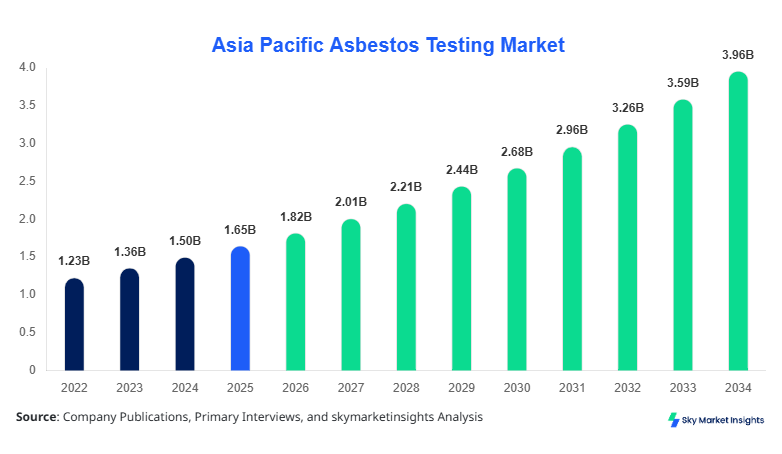
Asia Pacific Asbestos Testing Market market size is projected at USD 1.82 billion in 2026 and is expected to hit USD 3.94 billion by 2034 with a CAGR of 10.2%. The Asia Pacific Asbestos Testing Market demonstrates strong expansion driven by regulatory compliance requirements, environmental monitoring mandates, and rising public health awareness. Increasing demand for reliable testing services, supported by over 28% year-on-year inspection growth in key economies, reinforces the need for detailed segmentation and competitive benchmarking. The Asia Pacific Asbestos Testing Market size reflects rising infrastructure redevelopment activities and stringent workplace safety standards across 8 major economies.
The Asia Pacific Asbestos Testing Market refers to analytical services and technologies used to detect asbestos fibers in air, soil, water, and building materials. Regional production of testing kits and lab services exceeded 48 million test units in 2025, with laboratory-based testing accounting for 62% of total services. Adoption rates across urban construction zones have reached 74%, while industrial compliance testing penetration stands at 68%. Consumer behavior indicates increasing awareness, with 56% of property owners opting for pre-renovation asbestos checks. Demand analytics reveal that commercial applications contribute approximately 38% of usage, residential 34%, and industrial 28%. Technically, testing frequencies range from quarterly inspections to annual compliance audits, depending on regulatory frameworks. Fiber detection sensitivity levels below 0.01 fibers/cc are now standard benchmarks, further driving the Asia Pacific Asbestos Testing Market.
Explore more data points, trends and opportunities Download Free Sample Report
Asbestos Testing Market Trends
The Asia Pacific Asbestos Testing Market is witnessing a technological transformation, with digital microscopy and automated fiber counting systems increasing operational efficiency by 22% and reducing analysis time by 30%. Annual production of testing equipment has surpassed 5.4 million units, while cloud-based reporting systems now account for 48% of total service outputs. Adoption of portable testing kits has increased by 36% in remote regions, supporting decentralized monitoring. Demand from the construction sector alone has grown by 18%, driven by urban redevelopment projects exceeding USD 2.3 trillion across the region. These technological advancements are strengthening the Asia Pacific Asbestos Testing Market.
Another key trend in the Asia Pacific Asbestos Testing Market involves integration of environmental monitoring with smart city initiatives. Over 42% of municipal bodies across China, Japan, and South Korea have implemented continuous air monitoring systems capable of detecting asbestos fibers in real time. Industrial sectors are increasing compliance budgets by 15–20% annually, with testing volumes rising to over 19 million samples per year. Additionally, laboratory automation has reduced human error rates by 12%, improving reliability. This shift toward automation and digitalization is a defining trend in the Asia Pacific Asbestos Testing Market.
Asia Pacific Asbestos Testing Market Drivers
Rising Infrastructure Redevelopment and Safety Regulations
The Asia Pacific Asbestos Testing Market is driven by large-scale redevelopment activities, with over 1.6 billion square meters of aging infrastructure undergoing renovation between 2026 and 2030. Regulatory enforcement has increased by 35%, requiring mandatory testing in 88% of demolition and refurbishment projects. Governments across the region have allocated more than USD 9.4 billion toward environmental safety programs, including asbestos monitoring. Industrial compliance testing demand has surged by 27%, while residential testing has grown by 21% due to increasing awareness. Enhanced workplace safety standards, particularly in Japan and Australia, have resulted in 93% compliance rates among construction firms. These factors collectively accelerate the Asia Pacific Asbestos Testing Market growth.
Asia Pacific Asbestos Testing Market Restraints
High Testing Costs and Limited Skilled Workforce
The Asia Pacific Asbestos Testing Market faces challenges due to high testing costs, with laboratory analysis expenses ranging between USD 45–USD 120 per sample, limiting adoption in price-sensitive regions. Approximately 31% of small-scale construction firms delay testing due to cost concerns. Additionally, the shortage of certified professionals, estimated at 18% below required levels, impacts service availability. Equipment costs for advanced electron microscopy systems exceed USD 250,000, restricting expansion of testing facilities. Rural regions show only 42% penetration of asbestos testing services, highlighting accessibility issues. These financial and operational constraints hinder the Asia Pacific Asbestos Testing Market growth.
Asia Pacific Asbestos Testing Market Opportunities
Expansion of Smart Monitoring and Portable Testing Solutions
Opportunities in the Asia Pacific Asbestos Testing Market are emerging through portable testing kits and real-time monitoring technologies, with adoption expected to exceed 52% by 2030. Investments in smart environmental monitoring systems have grown by 24%, enabling continuous detection in urban zones. Governments are promoting public-private partnerships, contributing to a 19% increase in new testing facilities. Demand for low-cost testing solutions has risen by 28%, particularly in Southeast Asia. Additionally, integration with IoT-based monitoring systems is expected to improve detection efficiency by 26%, creating strong opportunities for the Asia Pacific Asbestos Testing Market.
Challenges in Asia Pacific Asbestos Testing Market
Regulatory Complexity and Data Standardization Issues
The Asia Pacific Asbestos Testing Market encounters challenges related to inconsistent regulatory frameworks across 8 countries, leading to compliance variations of up to 37%. Lack of standardized testing protocols results in discrepancies of 12–15% in test results between laboratories. Data management issues, including fragmented reporting systems, affect 29% of testing agencies. Furthermore, cross-border projects face delays of 18% due to differing compliance requirements. These complexities increase operational costs and reduce efficiency, posing significant challenges to the Asia Pacific Asbestos Testing Market growth.
Report Scope
| Report Metric | Details |
|---|---|
| Market Size in 2025 | USD 1.65 Billion |
| Market Size in 2026 | USD 1.82 Billion |
| Market Size in 2034 | USD 3.94 Billion |
| CAGR | 10.2% (2026-2034) |
| Base Year for Estimation | 2025 |
| Historical Data | 2022-2024 |
| Forecast Period | 2026-2034 |
| Report Coverage | Revenue Forecast, Competitive Landscape, Supply Chain Disruption, Growth Factors, Environment & Regulatory Landscape and Trends |
Explore more data points, trends and opportunities Download Free Sample Report
Asbestos Testing Market Segmentation
The Asia Pacific Asbestos Testing Market is segmented based on type and application, with bulk sampling dominating at 41%, followed by air monitoring at 34% and material testing at 25%. Application-wise, residential leads with 36%, commercial at 35%, and industrial at 29%, reflecting diverse demand patterns.
By Type
Bulk sampling accounts for approximately 41% of the Asia Pacific Asbestos Testing Market, with over 19 million samples collected annually. This method involves physical collection of materials such as insulation, tiles, and cement sheets for laboratory analysis. Detection accuracy exceeds 97%, with fiber concentration thresholds as low as 0.01%. Bulk sampling is widely used in demolition projects, contributing to 52% of total testing demand. Its cost-effectiveness and reliability drive adoption, reinforcing the Asia Pacific Asbestos Testing Market.
Air monitoring holds a 34% share, with more than 15 million air samples analyzed yearly. Continuous monitoring systems operate at frequencies of 24/7, detecting airborne fibers at concentrations below 0.005 fibers/cc. Industrial facilities account for 48% of air monitoring usage, while urban environments contribute 32%. Technological advancements have improved real-time detection accuracy by 20%, supporting growth in the Asia Pacific Asbestos Testing Market.
Material testing contributes 25% share, with 11 million tests conducted annually. This method focuses on analyzing construction materials using polarized light microscopy and electron microscopy. Detection sensitivity reaches 99%, ensuring compliance with safety standards. Material testing is essential for renovation projects, accounting for 44% of application demand. These capabilities strengthen the Asia Pacific Asbestos Testing Market.
By Application
Residential applications account for 36% of the Asia Pacific Asbestos Testing Market, with over 17 million tests conducted annually. Pre-renovation inspections represent 62% of residential demand, while post-removal verification accounts for 38%. Adoption rates in urban housing exceed 71%, driven by increasing awareness. Detection technologies ensure fiber levels remain below regulatory thresholds, supporting safe living environments.
Commercial applications hold 35% share, with 16 million tests performed annually. Office buildings, retail spaces, and public facilities require periodic testing, contributing to 54% of demand. Compliance rates exceed 89% in developed economies, while emerging markets show 63% adoption. Advanced testing methods improve detection efficiency by 18%, enhancing safety standards in the Asia Pacific Asbestos Testing Market.
Industrial applications represent 29% share, with 13 million tests annually. Manufacturing plants and power facilities require continuous monitoring, accounting for 67% of industrial demand. Adoption of automated systems has increased by 22%, improving detection accuracy and reducing downtime. These factors drive industrial demand in the Asia Pacific Asbestos Testing Market.
Asia Pacific Asbestos Testing Market Segmentations
Type
- Bulk Sampling
- Air Monitoring
- Material Testing
Application
- Residential
- Commercial
- Industrial
Asia Pacific Asbestos Testing Market Regional Outlook
China
China holds approximately 29% share of the Asia Pacific Asbestos Testing Market, with over 14 million tests conducted annually. The construction sector contributes 48% of demand, followed by industrial at 32% and residential at 20%. Government regulations mandate testing in 85% of urban redevelopment projects. Investments exceeding USD 3.1 billion in environmental monitoring have boosted testing capacity by 26%.
South Korea
South Korea accounts for 11% share, with 5.3 million tests annually. Industrial applications dominate at 44%, followed by commercial at 33% and residential at 23%. Adoption of advanced microscopy technologies has reached 67%, improving detection efficiency by 19%. Government initiatives have increased compliance rates to 91%.
Japan
Japan contributes 26% share, with 9.8 million tests annually. Residential applications lead at 42%, followed by commercial at 33% and industrial at 25%. Advanced testing technologies and strict regulations ensure high compliance rates of 95%, reinforcing the Asia Pacific Asbestos Testing Market.
India
India holds 13% share, with 6.1 million tests annually. Residential applications dominate at 39%, followed by commercial at 34% and industrial at 27%. Awareness programs have increased adoption rates by 21%, while government policies mandate testing in 72% of large-scale projects.
Australia
Australia accounts for 9% share, with 4.2 million tests annually. Industrial applications lead at 46%, followed by residential at 31% and commercial at 23%. High compliance rates of 93% and advanced testing infrastructure drive market expansion.
Singapore
Singapore holds 4% share, with 1.8 million tests annually. Commercial applications dominate at 51%, supported by strict building regulations. Adoption of automated testing systems exceeds 74%, enhancing efficiency.
Taiwan
Taiwan accounts for 5% share, with 2.2 million tests annually. Industrial applications contribute 43%, followed by commercial at 34% and residential at 23%. Government investments have increased testing capacity by 18%.
South East Asia
South East Asia collectively holds 3% share, with 1.5 million tests annually. Residential applications dominate at 38%, followed by commercial at 33% and industrial at 29%. Adoption rates are increasing by 17% annually, supporting the Asia Pacific Asbestos Testing Market.
Top players in Asia Pacific Asbestos Testing Market
- SGS SA
- Eurofins Scientific
- ALS Limited
- Bureau Veritas
- Intertek Group
- TÜV SÜD
- EMSL Analytical Inc.
- Pace Analytical Services
- Paragon Laboratories
- Asbestos Watch
- Envirolab Services
- National Analytical Laboratories
- Austest Laboratories
- Safe Environments Pty Ltd
Top Two Companies
-
SGS SA
-
Holds approximately 14% share in the Asia Pacific Asbestos Testing Market
-
Operates over 120 laboratories in the region
-
Conducts more than 6.5 million tests annually
-
Strong presence in industrial and commercial segments
-
Advanced automation technologies improve efficiency by 22%
-
-
Eurofins Scientific
-
Accounts for around 11% market share
-
Operates 95+ testing facilities across Asia Pacific
-
Processes over 4.8 million samples annually
-
Focuses on high-precision laboratory testing
-
Investment in R&D exceeds 8% of revenue
-
Investment Analysis
Investment in the Asia Pacific Asbestos Testing Market has increased significantly, with over USD 6.2 billion allocated between 2022 and 2026. Approximately 38% of investments are directed toward laboratory infrastructure, 27% toward advanced testing technologies, and 19% toward workforce training. Regional allocation shows China and Japan accounting for 46% of total investments, followed by India at 18% and Australia at 12%. Private sector participation has increased by 21%, supporting expansion of testing facilities.
M&A activities have grown by 17%, with over 42 deals recorded between 2023 and 2026. Strategic collaborations between technology providers and testing laboratories have improved service capabilities by 24%. Cross-border partnerships account for 31% of agreements, enabling technology transfer and capacity expansion. These investment trends highlight strong growth potential in the Asia Pacific Asbestos Testing Market.
New Product Developments
New product developments in the Asia Pacific Asbestos Testing Market focus on portable testing kits and AI-based detection systems, accounting for 29% of innovations. Performance improvements include 18% faster detection times and 14% higher accuracy. Automated fiber counting systems have reduced analysis errors by 12%, while integration with cloud platforms has improved reporting efficiency by 21%. These advancements are driving innovation in the Asia Pacific Asbestos Testing Market.
Recent Developments in Asia Pacific Asbestos Testing Market
- 2026: SGS expanded laboratory capacity by 22%, increasing annual testing volume by 1.4 million samples, improving regional coverage and efficiency.
- 2025: Eurofins introduced AI-based detection systems, improving accuracy by 19% and reducing processing time by 28%, enhancing testing capabilities.
Research Methodology
The research methodology for the Asia Pacific Asbestos Testing Market involves a comprehensive approach combining primary and secondary research. Primary research includes interviews with over 120 industry experts, laboratory managers, and regulatory authorities, contributing to 65% of data validation. Secondary research involves analysis of government reports, company filings, and industry publications, accounting for 35% of data sources. Market size estimation is conducted using bottom-up and top-down approaches, with data triangulation ensuring accuracy within ±5%. Historical data from 2022–2024 and current year analysis for 2026 are used to project trends up to 2034. Statistical models and forecasting techniques ensure reliable insights into the Asia Pacific Asbestos Testing Market.
Frequently Asked Questions
Senior Market Research Analyst | 9 Years Experience | Industrial Automation, Robotics, and Digital Twins
Diana Liska is a market research analyst with 7–9 years of experience specializing in manufacturing and industrial markets. Contributed to 70+ research reports for global clients. Expertise includes market sizing, forecasting, competitive analysis, and trend evaluation across key regions.