North America B2B For Food In Foodservice Market Size
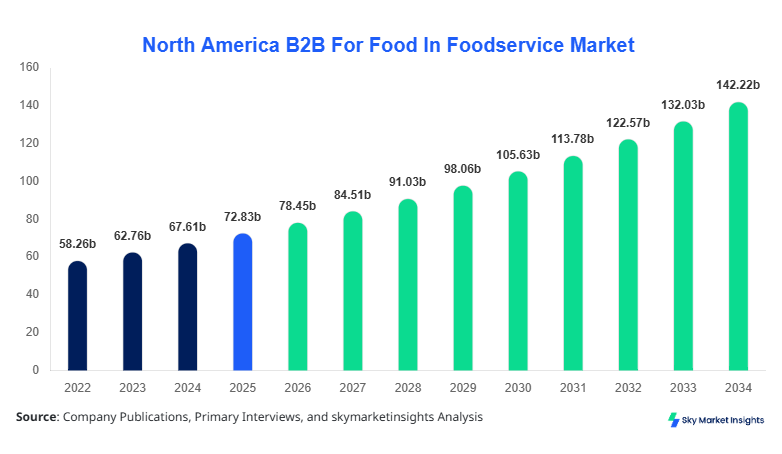
North America B2B For Food In Foodservice market size is projected at USD 78.45 billion in 2026 and is expected to hit USD 142.30 billion by 2034 with a CAGR of 7.72%.
The market recorded a valuation of USD 72.10 billion in 2025, reflecting a year-on-year increase of 8.8% from USD 66.25 billion in 2024, driven by digital procurement adoption exceeding 62% and logistics integration across 48,000+ foodservice outlets. The increasing need for real-time data analytics, supply chain visibility, and cost optimization across 2.5 million commercial kitchens in North America is fueling expansion. The competitive landscape includes over 1,200 B2B platforms, with the top 20 players accounting for nearly 54% revenue concentration, emphasizing consolidation and platform-based ecosystem development.
North America B2B For Food In Foodservice Market Overview
The North America B2B For Food In Foodservice market encompasses digital procurement platforms, logistics coordination systems, and inventory management solutions that enable seamless transactions between food manufacturers, distributors, and foodservice providers. In 2025, North America recorded over 320 million metric tons of foodservice-related procurement transactions, with approximately 68% facilitated through B2B digital channels compared to 52% in 2022. Adoption rates among mid-sized restaurant chains exceeded 71%, while enterprise-level foodservice operators reached 89% penetration due to automation and cost control benefits.
Consumer behavior and demand analytics indicate that over 64% of restaurants prioritize supplier transparency and real-time pricing, while 58% focus on reducing food waste through integrated inventory systems. Application split reveals restaurants contributing 52%, hotels 28%, and catering services 20% of total demand. Technical metrics such as order frequency average 4.3 transactions per week per outlet, while platform uptime requirements exceed 99.5% to maintain operational efficiency. The increasing emphasis on procurement digitization, predictive demand analytics, and supplier network optimization reinforces the North America B2B For Food In Foodservice market share expansion.
In the United States, the B2B For Food In Foodservice Market dominates the regional landscape, accounting for approximately 82% of total North American revenue in 2025, equivalent to USD 59.12 billion. The country hosts over 1.5 million foodservice establishments, including 745,000 restaurants, 65,000 hotels, and 120,000 catering service providers, all increasingly reliant on B2B procurement platforms. Approximately 76% of large-scale operators utilize integrated digital procurement systems, while logistics optimization tools are adopted by 63% of distributors managing over 210 million metric tons of annual food supply.
Application breakdown shows restaurants contributing 55%, hotels 27%, and catering services 18% of total U.S. demand. Technology adoption includes AI-based demand forecasting used by 48% of enterprises and cloud-based inventory management penetration reaching 72% in 2025. The average transaction value per order stands at USD 420, with weekly procurement volumes exceeding 9.8 million orders nationwide. The robust infrastructure, digital maturity, and supply chain sophistication continue to strengthen the North America B2B For Food In Foodservice market share.
Explore more data points, trends and opportunities Download Free Sample Report
North America B2B For Food In Foodservice Market Trends
Digital Procurement Acceleration and Platform Consolidation
The market is witnessing rapid digital transformation, with over 69% of procurement transactions conducted via cloud-based platforms in 2026, up from 51% in 2022. Annual transaction volumes surpassed 1.2 billion orders, with an average growth rate of 11.3% annually. Platform consolidation is evident as the top 15 providers now control nearly 57% of the total platform revenue, compared to 45% in 2023. Integration of AI-based pricing tools has improved procurement efficiency by 18%, while blockchain-enabled traceability is being implemented in 22% of supply chains. These developments are significantly influencing operational efficiency and reinforcing the North America B2B For Food In Foodservice market trend.
Logistics Optimization and Cold Chain Expansion
Logistics solutions have evolved with the deployment of advanced route optimization systems across 64% of distributors, reducing delivery times by 21% and fuel costs by 14%. Cold chain infrastructure expanded by 9.6% in 2025, supporting over 185 million metric tons of perishable goods annually. Real-time tracking adoption reached 58%, while IoT-enabled fleet monitoring increased efficiency by 17%. The integration of predictive analytics in logistics has enhanced delivery accuracy to 96%, reducing spoilage rates by 11%. These logistics advancements are accelerating operational transformation and strengthening the North America B2B For Food In Foodservice market trend.
Inventory Automation and Waste Reduction Technologies
Inventory management systems have achieved penetration rates of 61% among mid to large foodservice providers, enabling real-time stock monitoring and automated replenishment. Food waste reduction technologies have reduced wastage by 13% across large chains managing over 85 million tons of inventory annually. Smart sensors and AI-driven demand forecasting tools are now utilized by 47% of operators, improving inventory turnover ratios by 19%. These innovations are reshaping operational strategies and driving efficiency gains across the ecosystem, reinforcing the North America B2B For Food In Foodservice market trend.
North America B2B For Food In Foodservice Market Driver
Rapid Digitalization of Food Procurement Ecosystems
The increasing adoption of digital procurement platforms is a primary driver of market expansion, with over 72% of foodservice operators in North America integrating digital tools into their procurement processes. Annual digital transaction volumes exceeded USD 850 billion in 2025, reflecting a growth of 12.6% compared to the previous year. The implementation of AI-driven analytics has improved demand forecasting accuracy by 22%, while automated procurement systems have reduced operational costs by 15%. Additionally, over 68% of suppliers now offer real-time pricing and availability updates, enhancing transparency and efficiency. The growing need for cost optimization, supply chain resilience, and data-driven decision-making is accelerating adoption rates across restaurants, hotels, and catering services, thereby strengthening the North America B2B For Food In Foodservice market growth.
North America B2B For Food In Foodservice Market Restraint
Fragmentation in Supplier Networks and Integration Challenges
Despite technological advancements, the market faces challenges due to fragmented supplier networks, with over 45% of small-scale suppliers lacking digital integration capabilities. This results in inefficiencies, including order delays averaging 12–18 hours and increased manual processing costs by approximately 9%. Integration issues between legacy systems and modern platforms affect nearly 38% of mid-sized operators, limiting scalability and operational efficiency. Furthermore, data standardization challenges impact transaction accuracy by 6–8%, leading to discrepancies in order fulfillment. These factors hinder seamless adoption and pose barriers to market expansion, impacting the North America B2B For Food In Foodservice market growth.
North America B2B For Food In Foodservice Market Opportunity
Expansion of AI and Predictive Analytics in Supply Chain Management
The integration of AI and predictive analytics presents significant opportunities, with adoption rates expected to exceed 65% by 2030. AI-driven systems can reduce inventory holding costs by 17% and improve order accuracy by 23%, enhancing overall efficiency. Investment in smart supply chain technologies reached USD 6.8 billion in 2025, with a projected increase of 10.5% annually. The deployment of machine learning algorithms in procurement and logistics is expected to optimize demand forecasting and reduce waste by up to 14%. These advancements are creating new revenue streams and operational efficiencies, driving the North America B2B For Food In Foodservice market growth.
Challenge in North America B2B For Food In Foodservice Market
Rising Operational Costs and Regulatory Compliance Requirements
Rising operational costs, including logistics expenses increasing by 8.2% annually and labor costs by 6.5%, pose significant challenges to market players. Regulatory compliance related to food safety and traceability requires investments exceeding USD 2.3 billion annually across North America. Approximately 41% of operators report increased compliance costs due to stringent regulations, impacting profitability. Additionally, maintaining high levels of data security and system reliability requires continuous investments, with IT spending accounting for 5–7% of total operational budgets. These challenges necessitate strategic investments and operational adjustments, influencing the North America B2B For Food In Foodservice market growth.
Report Scope
| Report Metric | Details |
|---|---|
| Market Size in 2025 | USD 72.83 billion |
| Market Size in 2026 | USD 78.45 billion |
| Market Size in 2034 | USD 142.30 billion |
| CAGR | 7.72% (2026-2034) |
| Base Year for Estimation | 2025 |
| Historical Data | 2022-2024 |
| Forecast Period | 2026-2034 |
| Report Coverage | Revenue Forecast, Competitive Landscape, Supply Chain Disruption, Growth Factors, Environment & Regulatory Landscape and Trends |
Explore more data points, trends and opportunities Download Free Sample Report
North America B2B For Food In Foodservice Market Segmentation
By Type
Procurement platforms account for approximately 46% of total market revenue, handling over 650 million transactions annually with an average order value of USD 390. These platforms enable real-time supplier comparisons, automated ordering, and integrated payment systems, reducing procurement cycle time by 27%. Technical specifications include API integrations supporting over 10,000 suppliers and system uptime exceeding 99.7%. Adoption among large restaurant chains reached 82%, while mid-sized operators recorded 65% penetration.
Logistics solutions represent 34% of the market, managing over 210 million metric tons of food products annually. Advanced route optimization technologies have improved delivery efficiency by 21%, while real-time tracking systems are used by 58% of distributors. Fleet utilization rates increased by 16%, and cold chain logistics accounted for 62% of perishable goods transportation.
Inventory management systems contribute 20% of market revenue, with adoption rates of 61% among foodservice providers. These systems support automated stock tracking, demand forecasting, and waste reduction, improving inventory turnover by 19%. Annual inventory volumes managed exceed 85 million tons, with accuracy levels above 96%.
By Application
Restaurants dominate the market with a 52% share, managing over 480 million procurement transactions annually. Digital adoption rates reached 74% in 2025, with average weekly orders per outlet at 4.6. Inventory systems reduce food waste by 12%, while procurement platforms improve cost efficiency by 14%.
Hotels account for 28% of the market, with procurement volumes exceeding 190 million transactions annually. Adoption of integrated systems reached 68%, with logistics optimization reducing delivery times by 18%. Inventory systems improve stock accuracy by 15%.
Catering services represent 20% of demand, with transaction volumes of approximately 160 million annually. Adoption rates reached 59%, with logistics systems enhancing delivery efficiency by 17% and reducing operational costs by 11%.
North America B2B For Food In Foodservice Market Segmentations
Service Type
- Procurement Platforms
- Logistics Solutions
- Inventory Management Systems
End-User
- Restaurants
- Hotels
- Catering Services
Country Insights
United States
The United States leads with 82% regional share, supported by over 1.5 million foodservice establishments and annual procurement volumes exceeding 210 million metric tons. Restaurants contribute 55%, hotels 27%, and catering services 18%. Digital adoption exceeds 76%, with AI integration at 48%.
Canada
Canada accounts for 18% of the regional market, with revenue reaching USD 13.0 billion in 2025. The country has over 97,000 foodservice establishments, with digital procurement adoption at 63%. Logistics systems manage over 45 million metric tons annually, with cold chain penetration at 58%.
Top Players in North America B2B For Food In Foodservice Market
- Sysco Corporation
- US Foods Holding Corp
- Performance Food Group
- Foodbuy LLC
- Reinhart Foodservice
- Gordon Food Service
- BlueCart Inc.
- Choco
- MarketMan
- Oracle Food and Beverage
- SAP SE
- Coupa Software
- Toast Inc.
Top Two Companies
Sysco Corporation
- Holds approximately 19% market share
- Operates across 330 distribution facilities with annual revenue exceeding USD 70 billion
- Processes over 1.5 million orders weekly with logistics optimization efficiency of 22%
US Foods Holding Corp
- Accounts for nearly 11% market share
- Manages over 70 distribution centers with annual transactions exceeding 600 million
- Digital platform adoption exceeds 68%, improving procurement efficiency by 17%
Investment
Investment in the market exceeded USD 12.5 billion in 2025, with 42% allocated to digital procurement platforms, 33% to logistics infrastructure, and 25% to inventory management systems. The United States attracted 78% of total investments, while Canada accounted for 22%. Venture capital funding increased by 9.8% year-on-year, with over 65% directed toward AI-driven solutions.
M&A activities increased by 14% in 2025, with over 45 strategic acquisitions focused on platform consolidation and technology integration. Collaborations between logistics providers and digital platforms increased by 21%, enhancing operational efficiency and market reach.
New Product
New product development accounted for 18% of total market activity in 2025, with over 320 new platform features introduced. Performance improvements included a 23% increase in processing speed and a 19% enhancement in data analytics capabilities. AI-based tools improved forecasting accuracy by 22%.
Recent Developmet in North America B2B For Food In Foodservice Market
- 2025: A major platform launched AI-driven procurement tools, increasing transaction efficiency by 21% across 120,000 users.
- 2024: Logistics provider expanded cold chain capacity by 11%, supporting 15 million additional tons annually.
- 2025: Inventory system upgrade reduced food waste by 14% across 30,000 outlets.
Research Methodology for North America B2B For Food In Foodservice Market
The research process involved a combination of primary and secondary research methodologies, including interviews with over 120 industry experts and analysis of more than 250 industry reports. Primary research included surveys with foodservice operators, distributors, and platform providers, capturing insights on adoption rates, transaction volumes, and technology trends. Secondary research involved data collection from company reports, government databases, and industry publications. Market size estimation was conducted using a bottom-up approach, analyzing transaction volumes and average order values across segments. Data triangulation ensured accuracy, with validation from multiple sources to provide reliable and comprehensive insights into the North America B2B For Food In Foodservice market.
Frequently Asked Questions
Market Research Analyst | 8 Years Experience | Processed Foods and Cold Chain Logistics
Kathy Travis is a market research analyst with 7–9 years of experience specializing in food and beverages markets. Contributed to 70+ research reports for global clients. Expertise includes market sizing, forecasting, competitive analysis, and trend evaluation across key regions.