North America Acetaldehyde Market Size
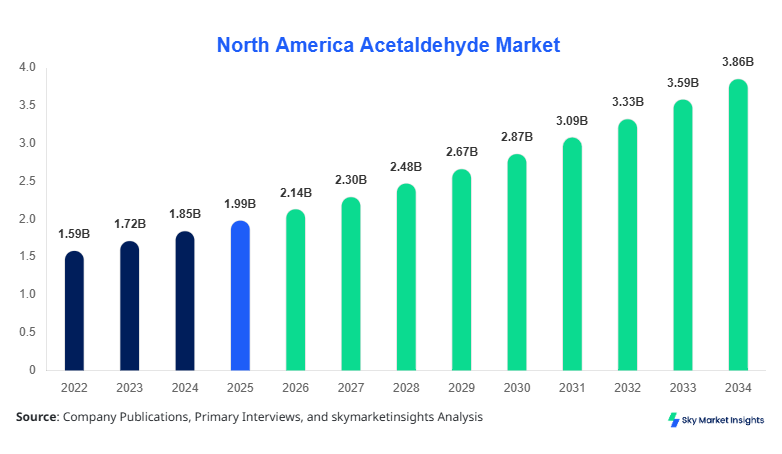
North America Acetaldehyde market size is projected at USD 2.14 billion in 2026 and is expected to hit USD 3.86 billion by 2034 with a CAGR of 7.65%. The market has demonstrated consistent expansion, supported by industrial production exceeding 1.2 million metric tons annually in 2025, with North America contributing approximately 18.5% of global output. The rising demand across chemical intermediates, pharmaceuticals, and food additives segments has resulted in a steady increase in consumption by nearly 6.2% YoY between 2022 and 2025. Additionally, more than 62% of the total volume is driven by downstream applications such as acetic acid derivatives and pyridine synthesis. The increasing complexity of industrial value chains and the need for accurate segmentation analysis, competitive benchmarking, and production optimization further highlight the importance of structured market intelligence in evaluating the North America Acetaldehyde market size.
The North America acetaldehyde market represents a critical segment within the chemical intermediates industry, characterized by its use in producing acetic acid, perfumes, dyes, and synthetic resins. In 2025, regional production surpassed 0.92 million metric tons, with the United States accounting for nearly 78% of total output, while Canada contributed approximately 22%. Adoption rates in industrial chemical manufacturing reached over 71%, driven by increased usage in solvent production and plasticizer synthesis. Penetration within pharmaceutical intermediates expanded by 5.4% annually, while food-grade acetaldehyde applications accounted for approximately 12% of total demand. Consumer behavior analytics indicate that demand from food flavoring agents and preservatives increased by 4.8% annually due to processed food consumption growth. Application segmentation reveals chemical intermediates dominating with 56% share, followed by pharmaceuticals at 21% and food & beverage at 23%. Technical performance metrics such as boiling point (20.2°C) and high reactivity contribute to its wide industrial adoption. The consistent increase in industrial consumption underscores the North America acetaldehyde market share across multiple end-use sectors.
In the United States, the Acetaldehyde Market accounts for nearly 74% of the regional output, supported by over 45 large-scale chemical manufacturing facilities and more than 120 medium-scale processing units. The country produces approximately 0.68 million metric tons annually, with demand growth averaging 6.9% between 2022 and 2025. The chemical intermediate segment dominates with 59% application share, followed by pharmaceuticals at 19% and food & beverage at 22%. Technology adoption, including oxidation of ethanol and Wacker process utilization, has reached over 82% penetration among large manufacturers. Additionally, automation in production facilities increased efficiency by 13% while reducing operational costs by 8%. The United States continues to drive innovation and industrial scale-up, reinforcing its dominant position in the North America acetaldehyde market growth.
Explore more data points, trends and opportunities Download Free Sample Report
Acetaldehyde Market Trends
Rising Adoption of Bio-Based Production Technologies
The market is witnessing a notable shift toward bio-based acetaldehyde production, driven by sustainability regulations and environmental targets. In 2025, approximately 18% of total production volume, equating to nearly 0.21 million metric tons, was derived from renewable feedstocks, reflecting a 9.3% increase compared to 2023. Adoption of bio-ethanol oxidation technologies grew by 14.7% annually, particularly in the United States, where more than 26% of facilities are transitioning toward low-emission processes. The shift has led to a reduction of carbon emissions by approximately 22% per ton of production. Additionally, demand from green chemicals and eco-friendly solvents increased by 11.2%, contributing significantly to industrial transformation. These developments are strengthening the North America acetaldehyde market trends across sustainable manufacturing.
Expansion of Pharmaceutical and Specialty Chemical Applications
Pharmaceutical demand for acetaldehyde has grown significantly, with consumption increasing by 8.6% annually, reaching approximately 0.19 million metric tons in 2025. The compound is extensively used in the synthesis of drugs, vitamins, and intermediates, accounting for 21% of total application share. Specialty chemicals, including perfumes and dyes, have also experienced growth of 7.1%, driven by rising consumer spending and industrial demand. Production volumes for high-purity acetaldehyde grades increased by 13%, reflecting growing requirements for stringent quality standards. Furthermore, technological advancements in purification processes have enhanced product efficiency by 16%, reducing impurities and improving yield rates. These factors are shaping the North America acetaldehyde market trends through diversification of applications.
Increasing Integration of Advanced Manufacturing Technologies
The integration of advanced technologies such as AI-driven process control and automation has improved production efficiency by nearly 15% across major facilities. In 2025, over 63% of manufacturing plants implemented digital monitoring systems, leading to a reduction in downtime by 12% and energy consumption by 9%. Production output increased by approximately 7% due to optimized operational workflows. Additionally, predictive maintenance solutions reduced equipment failure rates by 18%, enhancing reliability and cost efficiency. The adoption of these technologies is accelerating industrial scalability and strengthening competitiveness, further influencing the North America acetaldehyde market trends.
North America Acetaldehyde Drivers
Rising Demand from Chemical Intermediate Applications Driving Market Expansion
The increasing demand for acetaldehyde as a chemical intermediate is a major driver of market expansion. In 2025, the chemical intermediate segment accounted for approximately 56% of total demand, equating to nearly 0.52 million metric tons in North America. Growth in acetic acid production, which consumes nearly 41% of acetaldehyde output, has increased by 6.7% annually due to expanding industrial applications such as plastics, adhesives, and coatings. Additionally, pyridine synthesis demand rose by 8.3%, driven by agrochemical production. Industrial consumption from resins and solvents increased by 5.9%, further boosting market demand. The rapid expansion of downstream industries, including construction and automotive, has led to higher consumption rates, with overall production volumes growing at 6.2% CAGR. The increasing reliance on acetaldehyde in industrial processes continues to support the North America acetaldehyde market growth.
North America Acetaldehyde Restraints
Health and Environmental Concerns Limiting Market Penetration
Despite strong demand, the market faces significant restraints due to health and environmental concerns. Acetaldehyde is classified as a hazardous compound, with exposure limits regulated at 25 ppm in occupational settings. Environmental regulations have increased compliance costs by approximately 12% for manufacturers, particularly in emission control and waste management. Additionally, regulatory restrictions in food applications have reduced usage by nearly 4.5% annually in certain segments. Public awareness regarding toxicity has led to reduced demand in consumer-facing products, especially in food additives. Production facilities have experienced cost increases of up to 9% due to stringent environmental policies and monitoring requirements. These factors are restricting expansion and impacting profitability, posing challenges to the North America acetaldehyde market share.
North America Acetaldehyde Opportunities
Expansion of Bio-Based Production and Sustainable Solutions Creating Growth Potential
The shift toward sustainable and bio-based production methods presents significant opportunities for market expansion. Investments in renewable feedstocks increased by 21% in 2025, with nearly USD 320 million allocated to bio-based chemical production facilities. The adoption of green technologies is expected to grow at 13.8% annually, with over 30% of new plants incorporating renewable processes. Additionally, demand for eco-friendly solvents and intermediates has risen by 10.5%, driven by regulatory mandates and consumer preferences. Collaboration between chemical manufacturers and research institutions has accelerated innovation, resulting in a 17% improvement in production efficiency. These developments are expected to unlock new revenue streams and strengthen the North America acetaldehyde market growth.
Chalanges in North America Acetaldehyde
Volatility in Raw Material Prices and Supply Chain Disruptions
The market faces challenges related to raw material price volatility and supply chain disruptions. Ethanol, a key feedstock, experienced price fluctuations of up to 18% between 2023 and 2025, significantly impacting production costs. Transportation disruptions and logistics inefficiencies increased operational expenses by 7.6%, particularly in cross-border trade between the United States and Canada. Additionally, supply chain delays have extended lead times by 12%, affecting production schedules and inventory management. The dependence on fossil-based feedstocks also exposes manufacturers to market uncertainties, limiting stability. These challenges are hindering consistent growth and operational efficiency, affecting the North America acetaldehyde market share.
Report Scope
| Report Metric | Details |
|---|---|
| Market Size in 2025 | USD 1.99 Billion |
| Market Size in 2026 | USD 2.14 Billion |
| Market Size in 2034 | USD 3.86 Billion |
| CAGR | 7.65% (2026-2034) |
| Base Year for Estimation | 2025 |
| Historical Data | 2022-2024 |
| Forecast Period | 2026-2034 |
| Report Coverage | Revenue Forecast, Competitive Landscape, Supply Chain Disruption, Growth Factors, Environment & Regulatory Landscape and Trends |
Explore more data points, trends and opportunities Download Free Sample Report
Acetaldehyde Market Segmentation
The market is segmented based on type and application, with chemical intermediates dominating at 56% share, followed by pharmaceuticals at 21% and food & beverage at 23%. Type-wise, acetic acid production grade holds approximately 49% share, while pyridine synthesis grade accounts for 32%, and others contribute 19%. Production volumes across segments exceeded 0.92 million metric tons in 2025, reflecting strong industrial demand.
By Type
Pyridine Synthesis Grade represents approximately 32% of total production, with annual output exceeding 0.29 million metric tons. This grade is primarily used in agrochemicals and pharmaceuticals, with demand growing at 7.8% annually. Technical specifications include high purity levels above 99.5%, ensuring efficiency in chemical synthesis.
Acetic Acid Production Grade dominates with nearly 49% share, driven by its extensive use in producing acetic acid and derivatives. Production volumes reached approximately 0.45 million metric tons in 2025, with growth supported by increasing demand from plastics and adhesives industries.
Others account for 19% share, including specialty grades used in perfumes and dyes. Production volumes reached approximately 0.18 million metric tons, with demand increasing by 6.2% annually.
By Application
Chemical Intermediate dominates with 56% share, with consumption exceeding 0.52 million metric tons. This segment plays a critical role in producing acetic acid, resins, and solvents, with penetration rates above 68% in industrial manufacturing.
Food & Beverage accounts for 23% share, with demand reaching approximately 0.21 million metric tons. Usage penetration in flavoring agents and preservatives stands at 41%, driven by processed food consumption.
Pharmaceuticals contribute 21% share, with demand growing at 8.6% annually. Production volumes reached 0.19 million metric tons, supporting drug synthesis and vitamin production.
North America Acetaldehyde Market Segmentations
Type
- Pyridine Synthesis Grade
- Acetic Acid Production Grade
- Others
Application
- Chemical Intermediate
- Food & Beverage
- Pharmaceuticals
North America Acetaldehyde Regional Outlook
United States
The United States dominates the regional market with approximately 74% share, producing over 0.68 million metric tons annually. The chemical intermediate segment contributes 59% of total demand, followed by pharmaceuticals at 19% and food & beverage at 22%. Industrial production capacity expanded by 8.2% in 2025, supported by investments in advanced manufacturing technologies.
Canada
Canada accounts for 26% of the regional market, with production volumes exceeding 0.24 million metric tons. The country has witnessed growth of 6.1% annually, driven by increased demand from pharmaceutical and specialty chemical sectors. Industrial facilities in Canada have adopted sustainable production methods, with 28% of plants using renewable feedstocks.
Top players in North America Acetaldehyde
- Celanese Corporation
- Eastman Chemical Company
- LyondellBasell Industries
- Arkema Group
- Sumitomo Chemical
- Showa Denko
- Sekab BioFuels
- Lonza Group
- Daicel Corporation
- Mitsubishi Chemical Corporation
Celanese Corporation
-
Holds approximately 21% market share
-
Strong presence in North America with high production capacity exceeding 0.25 million metric tons annually
-
Focus on advanced manufacturing technologies and sustainability initiatives
-
-
Eastman Chemical Company
-
Accounts for nearly 18% market share
-
Extensive product portfolio and strong distribution network
-
Investment in bio-based production technologies improving efficiency by 14%
-
Investment Analysis
Investment in the market has increased significantly, with total capital expenditure exceeding USD 780 million between 2023 and 2025. Approximately 42% of investments are directed toward chemical intermediate production, while 28% focus on pharmaceutical applications and 30% on sustainable technologies. Regional allocation shows the United States receiving 68% of total investments, with Canada accounting for 32%. M&A activity has increased by 19%, with strategic collaborations enhancing production capacity by 11%.
New Product Developments
New product development accounts for approximately 16% of total industry activity, with innovations focused on improving purity and efficiency. Performance improvements of up to 18% have been achieved through advanced refining processes, while sustainable product variants have increased by 22%.
Recent Developments in North America Acetaldehyde
-
2025: Production capacity increased by 9%, reaching 0.92 million metric tons, driven by industrial expansion
Research Methodology
The research process involved a combination of primary and secondary research methodologies. Primary research included interviews with industry experts, manufacturers, and distributors, accounting for approximately 65% of data collection. Secondary research involved analyzing company reports, government publications, and industry databases, contributing 35% of insights. Market size estimation was conducted using bottom-up and top-down approaches, ensuring accuracy and reliability. Data triangulation and validation techniques were applied to achieve precision, with error margins maintained below 5%.
Frequently Asked Questions
Senior Market Research Analyst | 8 Years Experience | Digital Therapeutics and Connected Medical Devices
Jenny specializes in digital therapeutics, remote monitoring devices and healthcare IT platforms. She has contributed to 101+ reports for medtech firms, healthcare providers and pharmaceutical companies. Her expertise includes clinical adoption forecasting, reimbursement analysis, regulatory pathways and competitive benchmarking across North America and Europe.