Japan Lipase Inhibitors Obesity Drugs Market Size
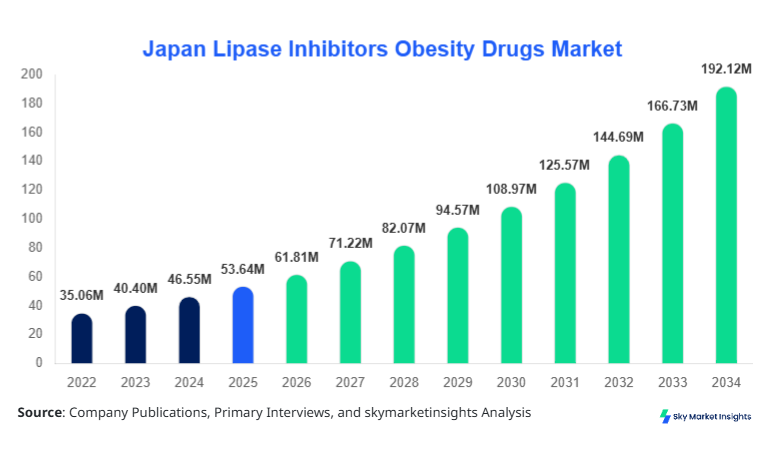
Japan Lipase Inhibitors Obesity Drugs Market size is projected at USD 61.81 million in 2026 and is expected to hit USD 192.66 million by 2034 with a CAGR of 15.23%. The market expands from USD 53.62 million in the 2025 base year, representing approximately 15.3% year-on-year expansion into 2026. Market assessment requires detailed evaluation of drug type, formulation, administration route, distribution channel and patient group, alongside regulatory access, pipeline activity and the evolving competitive landscape.
Key Takeaways
- Japan Lipase Inhibitors Obesity Drugs Market Share:Orlistat dominates drug type with approximately45.4%of 2026 revenue, calculated from USD 28.09 million against the USD 61.81 million total.
- Capsules dominate formulation with approximately37.7%of 2026 formulation revenue, representing USD 23.29 million of USD 61.85 million.
- Powder is the fastest-expanding formulation at15.77% CAGR, reaching USD 32.16 million by 2034, while cetilistat is the fastest-expanding drug type at15.66% CAGR.
- Orlistat advances from USD 24.40 million in 2025 to USD 86.65 million in 2034, while cetilistat progresses from USD 15.58 million to USD 57.71 million.
- Japan Lipase Inhibitors Obesity Drugs Market Growth:The national forecast reaches approximately USD 192.66 million by 2034 at15.23% CAGR; no separate emerging-country forecast applies because the defined geographic scope is Japan.
The Japan market covers pharmaceutical lipase inhibitors used to reduce intestinal dietary-fat absorption as part of obesity or visceral-fat management. In 2026, orlistat contributes approximately 45.4%, cetilistat 29.2%, investigational inhibitors 15.1%, and other products 10.3% of the supplied drug-type total. Capsules account for approximately 37.7% of formulation revenue, followed by tablets at 22.3%, powder at 16.1%, soft gels at 14.0%, and others at 9.9%. Japan-specific commercial production volumes are not publicly disclosed; however, Taisho's Alli contains 60 mg orlistat per capsule, is taken up to 3 times daily, and entered the Japanese market on April 8, 2024.
Explore more data points, trends and opportunities Download Free Sample Report
Japan Lipase Inhibitors Obesity Drugs Market Trends
Direct-to-OTC Access and Digitally Supported Weight Management
Japan's transition toward pharmacist-supported self-medication is reshaping lipase-inhibitor utilization. Alli became Japan's first direct-to-OTC visceral-fat reduction medicine in April 2024, with 18-capsule and 90-capsule packs priced at JPY 2,530 and JPY 8,800, respectively. Eligible users are adults aged 18 years or older, with waist thresholds of 85 cm for men and 90 cm for women, alongside documented lifestyle-improvement efforts.
Technology is increasingly integrated with treatment adherence rather than drug delivery itself. Taisho introduced the STEP UP DIARY digital support system for weight, medication and lifestyle management and an online store locator. Meanwhile, competitive obesity therapies increasingly use weekly administration: tirzepatide is administered once weekly, beginning at 2.5 mg with dose escalation, demonstrating the broader shift toward convenience-oriented obesity pharmacotherapy.
Japan Lipase Inhibitors Obesity Drugs Market Drivers
Expansion of Pharmacist-Guided Self-Medication
Direct OTC availability is widening the addressable consumer pathway for intestinal lipase inhibition. Alli provides 60 mg of orlistat per capsule, permits 3 doses per day, and offers 6-day/18-capsule and 30-day/90-capsule packages. Eligibility starts at age 18, while waist requirements of 85 cm for men and 90 cm for women focus utilization on abdominal adiposity. These quantified eligibility and dosing parameters establish a structured pharmacist-controlled pathway outside conventional prescription obesity treatment.
Japan Lipase Inhibitors Obesity Drugs Market Restraints
Eligibility Controls and Gastrointestinal Mechanism Limit Broad Utilization
Access remains controlled despite OTC positioning. Purchasers must be 18+, satisfy waist criteria of 85 cm/90 cm, and demonstrate lifestyle-management efforts. Treatment also requires dosing during or within 1 hour after meals, up to 3 times daily. Because orlistat prevents part of consumed fat from being absorbed and increases fecal fat excretion, adherence and tolerability remain important commercial constraints compared with once-weekly obesity therapies.
Japan Lipase Inhibitors Obesity Drugs Market Opportunities
Large Treatment Gap Supports Alternative Oral Therapies
The widening Japanese obesity-treatment ecosystem creates opportunities for orally administered, non-systemic alternatives. Contemporary prescription therapies apply strict eligibility thresholds, including BMI of at least 27 kg/m² with 2 or more obesity-related health disorders or BMI of at least 35 kg/m² under specified indications. Lipase inhibitors therefore occupy a differentiated position between lifestyle intervention and systemic injectable pharmacotherapy, particularly where consumers prioritize oral administration and pharmacist-supported access.
Challenges in Japan Lipase Inhibitors Obesity Drugs Market
Intensifying Competition from High-Efficacy Obesity Pharmacotherapy
Competitive pressure is increasing as newer mechanisms achieve clinically meaningful weight reduction. In Japan's SURMOUNT-J study, tirzepatide was evaluated over 72 weeks, with endpoints including at least 5%, 7%, 10%, 15% and 20% body-weight reduction. Simultaneously, weekly dosing contrasts with orlistat's meal-associated administration of up to 3 doses daily, creating a convenience and efficacy benchmark that established lipase inhibitors must address.
Report Scope
| Report Metric | Details |
|---|---|
| Market Size in 2025 | USD 53.64 Million |
| Market Size in 2026 | USD 61.81 Million |
| Market Size in 2034 | USD 192.66 Million |
| CAGR | 15.23% (2026-2034) |
| Base Year for Estimation | 2025 |
| Historical Data | 2022-2024 |
| Forecast Period | 2026-2034 |
| Report Coverage | Revenue Forecast, Competitive Landscape, Supply Chain Disruption, Growth Factors, Environment & Regulatory Landscape and Trends |
Explore more data points, trends and opportunities Download Free Sample Report
Japan Lipase Inhibitors Obesity Drugs Market Segmentation
The market is segmented by drug type, formulation, route of administration, distribution channel and patient group. Drug-type leadership rests with orlistat at approximately 45.4% of 2026 revenue, while capsules lead formulation at approximately 37.7%. Cetilistat and powder record the highest supplied CAGRs in their respective categories at 15.66% and 15.77%.
By Drug Type
Orlistat is the largest drug-type segment, increasing from USD 24.40 million in 2025 to USD 28.09 million in 2026 and USD 86.65 million by 2034, at a 15.12% CAGR. Its calculated 2026 contribution is approximately 45.4%, substantially ahead of cetilistat's approximately 29.2%.
Cetilistat is the fastest-expanding drug type with a 15.66% CAGR, progressing from USD 18.02 million in 2026 to USD 57.71 million by 2034. Experimental/investigational inhibitors record 15.15% CAGR, while other products register 14.99%.
By Formulation
Capsules constitute the largest formulation, generating USD 23.29 million in 2026 and reaching USD 74.73 million by 2034, representing a 15.69% CAGR. Capsules account for approximately 37.7% of the supplied 2026 formulation total.
Powder represents the fastest-expanding formulation at 15.77% CAGR and reaches USD 32.16 million by 2034. Soft gels follow at 15.57%, while tablets and other formulations register 14.64% and 14.49%, respectively.
By Route of Administration
Oral administration remains structurally central because commercially established orlistat is supplied as 60 mg oral capsules taken as 1 capsule up to 3 times daily. Transdermal and other routes remain developmental or niche alternatives; separate revenue and CAGR figures were not supplied for these categories.
By Distribution Channel
Retail pharmacies occupy a strategically important position because Alli is classified as a pharmacist-supervised medicine and can only be purchased through qualifying pharmacies or drugstores with pharmacists available. The 18-capsule and 90-capsule configurations support short- and monthly-duration purchasing, while hospital and online channels remain part of the wider obesity-treatment ecosystem.
By Patient Group
Adults represent the commercially addressable group for Japan's current OTC orlistat offering, with eligibility beginning at 18 years. Users below 18 years are explicitly instructed not to take Alli, creating a clear distinction between adult and pediatric/adolescent opportunities.
Japan Lipase Inhibitors Obesity Drugs Market Segmentations
By Drug Type
- Orlistat
- Cetilistat
- Experimental/Investigational Lipase Inhibitors
- Others
By Formulation
- Capsules
- Tablets
- Powder
- Soft Gels
- Others
By Route of Administration
- Oral
- Transdermal
- Others
By Distribution Channel
- Hospital Pharmacies
- Retail Pharmacies
- Online Pharmacies
By Patient Group
- Adults
- Pediatric/Adolescent
- Others
Japan Lipase Inhibitors Obesity Drugs Market Outlook
Japan represents 100% of the geographic scope defined in this report, with the supplied national total moving from USD 53.62 million in 2025 to USD 61.81 million in 2026 and USD 192.66 million in 2034. No prefectural or subregional revenue dataset was supplied; therefore, unsupported percentage allocations across Kanto, Kansai, Chubu, Kyushu or other Japanese regions are not assigned. At the national level, drug-type contribution in 2026 is approximately 45.4% orlistat, 29.2% cetilistat, 15.1% investigational inhibitors, and 10.3% others.
Top players in Japan Lipase Inhibitors Obesity Drugs Market
- Taisho Pharmaceutical Co., Ltd.
- Norgine B.V.
- Takeda Pharmaceutical Company Limited
- Roche
- GlaxoSmithKline plc
- Novo Nordisk A/S
- Eli Lilly and Company
- Pfizer Inc.
- AstraZeneca plc
- Boehringer Ingelheim
- Kyorin Pharmaceutical Co., Ltd.
- Otsuka Pharmaceutical Co., Ltd.
Top Two Companies
- Taisho Pharmaceutical Co., Ltd.
Company-specific revenue percentage is not publicly disclosed and therefore is not estimated. Taisho nevertheless holds the clearest current commercial positioning in Japanese OTC lipase inhibition through Alli. The product contains60 mg orlistat, launched onApril 8, 2024, and is available in18- and 90-capsulepacks. The underlying orlistat category represents approximately45.4%of supplied 2026 drug-type revenue, although this percentage must not be interpreted as Taisho's company share.
- Norgine B.V.
Company-specific Japanese revenue percentage is likewise unavailable. Norgine is strategically relevant through cetilistat/OBLEAN intellectual-property history. Takeda previously held Japanese development, manufacturing and commercialization rights, but the companies terminated that agreement in2018, returning rights to Norgine. Cetilistat represents approximately29.2%of the supplied 2026 drug-type dataset and records the category's fastest15.66% CAGR; this percentage describes the drug segment rather than Norgine's corporate revenue share.
Recent Developments in Japan Lipase Inhibitors Obesity Drugs Market
- 2026:Japan expanded the broader obesity-treatment environment, with tirzepatide labeling updated inMay 2026and obesity-related reimbursement conditions tied to specified comorbidities.
- 2026:Restrictions on Zepbound's prescribing-period duration were scheduled for removal fromApril 1, 2026, intensifying competition across obesity pharmacotherapy.
- 2025:Taisho's official Alli information continued to identify the product as Japan's direct-to-OTC visceral-fat reduction medicine, with PMDA status referenced as ofOctober 2025.
Research Methodology
The study uses 2025 as the base year, 2026 as the current year, historical assessment covering 2022–2024, and forecasts through 2034. Quantitative market values and segment CAGRs are anchored to the mandatory supplied datasets, while calculated percentages use supplied segment revenue divided by corresponding totals. Secondary validation covers regulatory status, dosage, launch dates, eligibility requirements and competitive developments from company and regulatory sources. Where company-level percentages, prefectural splits or production volumes were not supplied or publicly verifiable, no synthetic values were introduced.
Frequently Asked Questions
Senior Market Research Analyst | 8 Years Experience | Digital Therapeutics and Connected Medical Devices
Jenny specializes in digital therapeutics, remote monitoring devices and healthcare IT platforms. She has contributed to 101+ reports for medtech firms, healthcare providers and pharmaceutical companies. Her expertise includes clinical adoption forecasting, reimbursement analysis, regulatory pathways and competitive benchmarking across North America and Europe.