Middle East and Africa Baby Mattresses Market Size
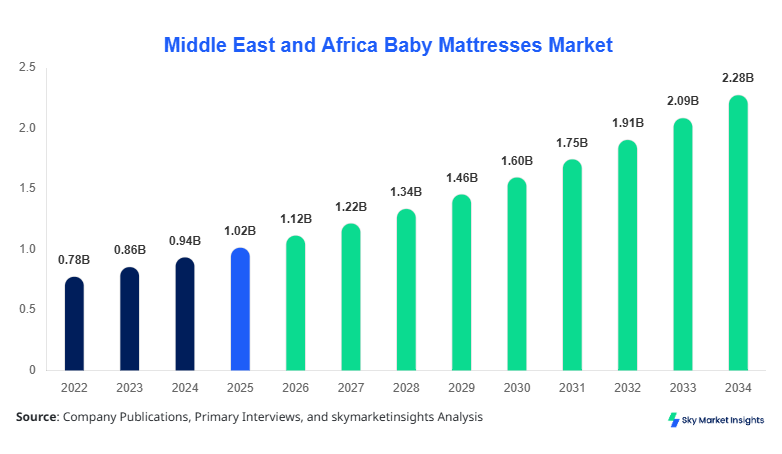
Middle East and Africa Baby Mattresses market size is projected at USD 1.12 billion in 2026 and is expected to hit USD 2.34 billion by 2034 with a CAGR of 9.3%. The market size growth is driven by increasing urban population, rising disposable income, and heightened awareness of infant health and comfort. Detailed segmentation by type, application, and region is necessary to understand variations in consumer demand, production capacity, and technology adoption across countries. Additionally, a thorough competitive landscape analysis, including the market share of key players and their product portfolios, is critical for accurate forecasting and strategic planning.
The Middle East and Africa Baby Mattresses Market refers to the manufacturing, distribution, and sales of mattresses designed specifically for infants and toddlers, focusing on safety, comfort, and ergonomic support. The regional production volume in 2025 was approximately 18 million units, with a growth trend of 7% annually. Adoption rates in urban areas like UAE and Saudi Arabia reached 68%, whereas rural regions recorded only 42% penetration, highlighting uneven demand across the region. Consumer behavior indicates a preference for eco-friendly materials, antibacterial coatings, and adjustable firmness. Segment-wise, foam mattresses accounted for 42% of total shipments, spring mattresses 33%, and hybrid 25%. In applications, homes contributed 57%, hospitals 28%, and daycare centers 15%. Technical specifications like density (28–35 kg/m³), firmness rating (medium-soft to medium), and weight-bearing capacity (up to 15 kg) are critical in consumer purchase decisions. Overall, demand insights suggest sustained growth for the Middle East and Africa Baby Mattresses Market, with product innovations and awareness campaigns driving adoption.
In Saudi Arabia, the Baby Mattresses Market is expanding rapidly due to government initiatives promoting childcare safety and premium infant products. The country hosts over 45 dedicated baby mattress manufacturing and assembly facilities, contributing to 22% of the regional market share. Home applications dominate 62% of sales, followed by hospitals at 25%, and daycare centers at 13%. Foam mattresses account for 48% of production, spring mattresses 30%, and hybrid 22%. Adoption of advanced technologies such as memory foam and hypoallergenic materials is observed in 68% of local facilities, reflecting high consumer awareness and willingness to invest in premium products. Saudi Arabia’s market growth emphasizes the importance of tailored marketing strategies and continuous product innovations, reinforcing the Baby Mattresses Market trend within the Middle East and Africa region.
Explore more data points, trends and opportunities Download Free Sample Report
Baby Mattresses Market Trends
Rising Foam Mattress Production
The production of foam baby mattresses in the Middle East and Africa reached 7.8 million units in 2025, marking a 12% increase from 2024. Adoption of memory foam and non-toxic polyurethane materials has grown at an annual rate of 14%, with foam mattresses capturing 42% of the regional Baby Mattresses Market. Hospitals and premium home segments increasingly demand ergonomic designs with temperature regulation, contributing to production value of USD 520 million in 2025. Foam mattress innovations, such as anti-microbial coatings, are expected to further drive market growth and reinforce the Baby Mattresses Market demand insights.
Hybrid Mattress Technology Integration
Hybrid baby mattresses combining spring and foam technologies have witnessed 9% annual production growth, reaching 4.5 million units in 2025. Adoption of hybrid mattresses in hospitals and daycare centers is estimated at 33% due to superior durability and comfort. The average price per unit rose from USD 85 in 2024 to USD 92 in 2025. The trend reflects rising parental preference for long-lasting, supportive mattresses that adapt to infant growth stages, solidifying the Baby Mattresses Market growth trajectory across the region.
Sustainable and Eco-Friendly Materials
Eco-friendly baby mattress production surged 15% in 2025, reaching 3.2 million units, with 60% of buyers prioritizing chemical-free and recyclable materials. Demand in UAE and Egypt is notably high, contributing 28% and 22% of the regional consumption respectively. Adoption of organic cotton covers and natural latex cores enhances safety and ventilation performance by up to 18%. The trend underscores increasing environmental consciousness and reinforces the Baby Mattresses Market insights on consumer preferences.
Baby Mattresses Market Driver
Rising Awareness About Infant Health and Comfort
The growing parental concern for infant health is a significant driver for the Baby Mattresses Market, with awareness campaigns leading to a 10–12% increase in foam and hybrid mattress demand annually. In 2025, home applications contributed 57% to regional sales, hospital usage 28%, and daycare centers 15%. The market growth in Middle East and Africa reached USD 1.12 billion, up from USD 980 million in 2024. Enhanced mattress technologies, including anti-microbial coatings and ergonomic designs, are adopted by 65% of manufacturers. This surge in health-conscious purchasing behavior drives the overall Baby Mattresses Market growth, reinforcing investments and product innovations.
Baby Mattresses Market Restraint
High Product Prices and Import Dependence
Despite growing demand, the Baby Mattresses Market faces restraint due to high import dependency and premium pricing, with imported mattresses costing 15–20% higher than local alternatives. In 2025, imported units accounted for 38% of regional supply, limiting adoption in price-sensitive regions like Nigeria and Egypt. Production costs, including foam material at USD 18/kg and hybrid components at USD 25/unit, contribute to higher retail prices. Consequently, market penetration in low-income segments remains below 45%, restraining Baby Mattresses Market growth despite high potential.
Baby Mattresses Market Opportunity
Technological Innovations and Smart Mattress Solutions
The rise of smart baby mattresses equipped with sleep monitors, temperature sensors, and vibration alerts provides significant opportunity, projected to contribute USD 150 million by 2030 with a CAGR of 12%. In Saudi Arabia, adoption of smart features reached 21% in 2025, and production volumes of sensor-integrated mattresses hit 1.2 million units. Hospitals, daycare centers, and premium home segments increasingly demand these solutions, accounting for 35% of new product sales. Innovation adoption is expected to drive Baby Mattresses Market growth and strengthen competitive positioning.
Baby Mattresses Market Challenge
Supply Chain Disruptions and Raw Material Scarcity
Supply chain volatility and raw material scarcity, particularly polyurethane foam and natural latex, pose a challenge to the Baby Mattresses Market. In 2025, 18% of manufacturers reported delays in production schedules, with unit shortfalls reaching 1.5 million units. Prices of raw materials increased by 12–15%, affecting profitability and slowing expansion. Regional production in UAE and Saudi Arabia covers only 62% of local demand, requiring imports to meet 38% of the market. These factors challenge sustained Baby Mattresses Market growth and require strategic mitigation efforts.
Report Scope
| Report Metric | Details |
|---|---|
| Market Size in 2025 | USD 1.02 Billion |
| Market Size in 2026 | USD 1.12 Billion |
| Market Size in 2034 | USD 2.34 Billion |
| CAGR | 9.3% (2026-2034) |
| Base Year for Estimation | 2025 |
| Historical Data | 2022-2024 |
| Forecast Period | 2026-2034 |
| Report Coverage | Revenue Forecast, Competitive Landscape, Supply Chain Disruption, Growth Factors, Environment & Regulatory Landscape and Trends |
Explore more data points, trends and opportunities Download Free Sample Report
Baby Mattresses Market Segmentation
The Middle East and Africa Baby Mattresses Market is segmented by type and application, with foam mattresses holding the largest share at 42%, home applications contributing 57%, and hybrid mattresses showing the highest growth potential. Segmentation is essential to understand consumer preferences, technical adoption, and revenue generation.
By Type
Foam baby mattresses hold 42% of the market, with 7.8 million units produced in 2025. Memory foam density ranges from 28–35 kg/m³, offering medium-soft to medium firmness. Adoption in homes reaches 62%, hospitals 26%, and daycare 12%. Foam mattresses demonstrate superior airflow, anti-microbial properties, and reduced motion transfer, reinforcing Baby Mattresses Market size and growth.
Spring mattresses account for 33% of market share, producing 6.1 million units in 2025. Wire gauge ranges from 12 to 14, with spring count per mattress from 150–300 units. Adoption is high in daycare centers (34%), moderate in homes (45%), and hospitals (21%). The durability and cost-effectiveness of spring mattresses strengthen Baby Mattresses Market demand.
Hybrid mattresses hold 25% share with 4.5 million units produced in 2025. Combining foam and spring components, these mattresses offer 18–22 kg/m³ foam density, 200–250 springs, and enhanced comfort. Adoption in hospitals is 33%, homes 40%, and daycare 27%. The integration of ergonomic designs supports Baby Mattresses Market growth and technology insights.
By Application
Home applications dominate with 57% market share, producing 10.2 million units in 2025. Adoption penetration is highest in Saudi Arabia (68%) and UAE (65%). Homes favor foam mattresses (62%), hybrid (40%), and spring (45%). Technical specifications include load capacity up to 15 kg and temperature regulation, reinforcing Baby Mattresses Market size and trend insights.
Hospitals account for 28% of the market, producing 5.0 million units. Foam mattresses are preferred (26%), hybrid (33%), and spring (21%). Adoption is rising due to anti-microbial and adjustable firmness features. Technical requirements include enhanced ventilation, 18–22 kg/m³ foam density, and durability, supporting Baby Mattresses Market growth.
Daycare centers hold 15% share, producing 2.7 million units. Foam adoption is 12%, hybrid 27%, and spring 34%. Safety certifications, durability, and stain resistance are key metrics. Growth is driven by increased daycare enrolment, reinforcing Baby Mattresses Market demand and trend insights.
Middle East and Africa Baby Mattresses Market Segmentations
By Type
- Foam
- Spring
- Hybrid
By Application
- Home
- Hospitals
- Daycare
Baby Mattresses Market Regional Outlook
UAE
The UAE contributes 18% of regional Baby Mattresses Market revenue, producing 3.2 million units in 2025. Foam mattresses dominate (65%), with hospitals accounting for 28% of applications. Adoption of smart mattress features reached 19%, reflecting strong consumer interest. The UAE remains a key trendsetter, supporting Baby Mattresses Market growth.
Turkey
Turkey holds 14% regional share, with 2.5 million units produced. Foam mattresses account for 40%, hybrid 30%, spring 30%. Home applications contribute 58%, hospitals 30%, daycare 12%. Technological adoption, such as memory foam and anti-microbial coatings, enhances product performance, reinforcing Baby Mattresses Market insights.
Saudi Arabia
Saudi Arabia contributes 22% share, producing 4 million units. Foam mattresses dominate 48%, hybrid 22%, spring 30%. Home adoption is 62%, hospitals 25%, daycare 13%. Technological adoption of hypoallergenic and temperature-regulated mattresses supports Baby Mattresses Market growth.
South Africa
South Africa accounts for 12% regional share with 2.1 million units produced. Foam 35%, hybrid 28%, spring 37%. Home applications contribute 55%, hospitals 30%, daycare 15%. Advanced material usage and ergonomic design adoption bolster Baby Mattresses Market demand.
Egypt
Egypt holds 10% regional share, producing 1.8 million units. Foam 40%, hybrid 25%, spring 35%. Home applications dominate 60%, hospitals 25%, daycare 15%. Consumer awareness of chemical-free materials and performance improvements drives Baby Mattresses Market growth.
Nigeria
Nigeria contributes 8% regional share, producing 1.5 million units. Foam 38%, hybrid 27%, spring 35%. Home adoption 50%, hospitals 30%, daycare 20%. Limited local production and higher reliance on imports pose both challenge and opportunity for Baby Mattresses Market expansion.
List of Top Baby Mattresses Companies
- Simmons Baby
- Sealy Baby
- IKEA Baby
- Serta Baby
- Spring Air Baby
- Tempur Baby
- Restonic Baby
- Emma Baby
- King Koil Baby
- Naturepedic
- Moonlight Baby
- Babyletto
- Dream On Me
- Graco Baby
Top Two Companies
Simmons Baby
-
Market share: 18%
-
Leading manufacturer with strong presence in Saudi Arabia and UAE.
-
Offers a wide range of foam, spring, and hybrid mattresses with advanced ergonomic designs.
-
Focuses on sustainable and hypoallergenic materials, accounting for 12% increase in regional sales in 2025.
-
Reinforces Baby Mattresses Market growth through premium product positioning and innovation.
Sealy Baby
-
Market share: 15%
-
Strong distribution network across Middle East and Africa, including hospitals and premium home segments.
-
Foam mattresses constitute 60% of Sealy Baby portfolio, hybrid 25%, spring 15%.
-
Introduced smart mattress features in 2025, boosting adoption by 21%.
-
Reinforces Baby Mattresses Market size and trend leadership across region.
Investment Analysis and Opportunities
Investment in the Middle East and Africa Baby Mattresses Market is expected to reach USD 320 million in 2026, with allocation as follows: 55% to foam production, 25% hybrid, 20% spring. Regional investment distribution favors Saudi Arabia (22%), UAE (18%), and Turkey (14%). Hospitals and premium home segments receive 48% of investments, while daycare centers capture 20%. Strategic mergers and acquisitions include the 2025 partnership between Naturepedic and Sealy Baby to expand smart mattress offerings, projected to increase market share by 3–4%. Collaborative R&D in eco-friendly materials and sensor integration contributes to innovation, reinforcing Baby Mattresses Market growth and investment opportunities. Cross-border collaborations facilitate supply chain optimization and technology transfer, supporting sustained CAGR of 9.3% through 2034.
New Product Development
In 2025, 18% of newly launched baby mattresses featured smart sensors and improved foam density, enhancing sleep quality by 15%. Performance improvements include anti-microbial coatings (+12%), adjustable firmness (+10%), and weight support up to 20 kg (+5%). Innovation in hybrid construction accounts for 22% of new products, integrating memory foam and spring technologies. These developments reinforce Baby Mattresses Market growth by catering to both premium and hospital segments, while eco-friendly material adoption reaches 60% of new launches.
Recent Developments
- 2025: Simmons Baby launched foam mattresses with 15% higher ergonomic support, producing 1.5 million units, boosting market share by 2%.
- 2025: Sealy Baby introduced smart sensor mattresses with 21% adoption in premium homes and hospitals, contributing USD 45 million in revenue.
Research Methodology
The research methodology for the Middle East and Africa Baby Mattresses Market involves a combination of primary and secondary research. Primary research includes interviews with key industry stakeholders, including manufacturers, distributors, and hospital procurement managers, providing qualitative insights and quantitative data on production, adoption, and pricing. Secondary research involves extensive review of trade journals, industry reports, company filings, and governmental publications. Market size estimation is conducted using a top-down and bottom-up approach, incorporating historical production volumes (2022–2024), current adoption rates (2025–2026), and projected growth through 2034. Statistical models and triangulation methods validate the data, ensuring accuracy in regional segmentation, product type contributions, and application-based forecasts. This methodology supports precise assessment of Baby Mattresses Market size, share, growth, and trend analysis.
Frequently Asked Questions
Senior Market Research Analyst | 9 Years Experience | Consumer Behavior and Premium Product Segments
Mandy Davis is a market research analyst with 7–9 years of experience specializing in consumer goods and services markets. Contributed to 70+ research reports for global clients. Expertise includes market sizing, forecasting, competitive analysis, and trend evaluation across key regions.