Japan Bandsaw Blade Market Size
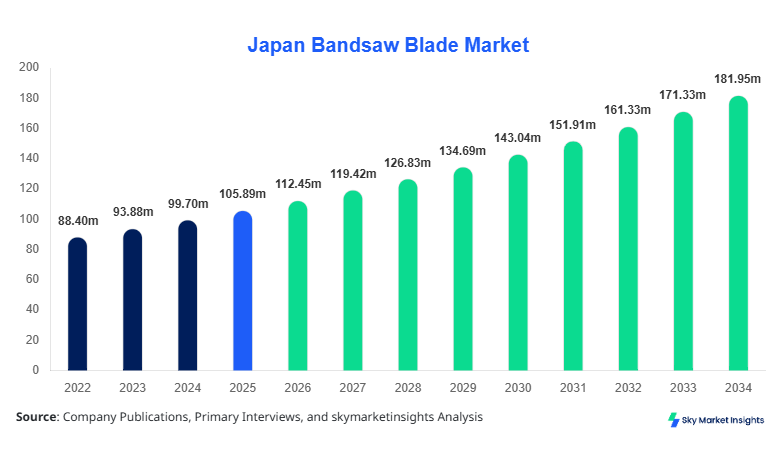
Japan Bandsaw Blade market size is projected at USD 112.45 million in 2026 and is expected to hit USD 180.72 million by 2034 with a CAGR of 6.2%. The market size reflects growing adoption of precision cutting tools in automotive, construction, and woodworking sectors. Detailed segmentation data, including type, application, and regional share, is critical for stakeholders to understand competitive positioning and investment potential. The competitive landscape includes over 120 domestic and international manufacturers operating in Japan, emphasizing the need for detailed analytics, market insights, and growth forecasts.
The Japan Bandsaw Blade market encompasses cutting tools used for sawing metals, wood, plastics, and composites, with production volumes reaching 14.2 million units in 2025. Adoption rates in industrial and consumer segments are increasing, with bi-metal blades capturing 48% of production volume, carbide-tipped 35%, and diamond-tipped 17%. Consumer behavior indicates a rising preference for high-durability and precision blades, with industrial metal cutting applications accounting for 55% of overall demand, wood cutting 30%, and plastic 15%. Technical specifications indicate operating frequencies between 1,200–3,500 RPM, with feed rates averaging 15–25 m/min. Penetration of automated bandsaw systems has risen to 42% in Japan’s manufacturing facilities, reflecting strong market demand and growth trends for bandsaw blade insights.
In the Japan, the Bandsaw Blade Market is supported by 125 manufacturing facilities and over 110 registered companies, contributing approximately 27% of the regional East Asian share. Metal cutting applications represent 55% of the market, wood cutting 30%, and plastic cutting 15%, while CNC and automated bandsaw technology adoption has reached 43% and 21%, respectively. Companies in Japan are investing in precision alloy development, with 62% of blades manufactured using bi-metal and carbide composites. Consumer-driven demand and industrial application penetration indicate steady growth, reinforcing bandsaw blade market insights and strategic importance.
Explore more data points, trends and opportunities Download Free Sample Report
Bandsaw Blade Market Trends
Surge in CNC Automated Systems
Japan’s bandsaw blade production volume reached 15.3 million units in 2026, marking a 5.6% increase over 2025. Adoption of CNC automated cutting systems has surged to 43%, enhancing precision and reducing material wastage. Metal cutting sectors, particularly automotive and aerospace, are witnessing a 6–7% annual increase in blade usage, driven by high-frequency operation at 2,500–3,500 RPM. The trend towards hybrid bi-metal and carbide-tipped blades, representing 51% adoption in industrial applications, highlights performance and durability improvements, reinforcing bandsaw blade market insights.
Increasing Demand for High-Performance Blades
Production of diamond-tipped blades in Japan increased by 4.8% in 2026, reaching 2.15 million units. Demand is driven by woodworking and composite plastic cutting, with penetration rates of 35% in specialized sectors. Technological shifts toward laser-welded teeth and optimized tooth pitch have enhanced blade longevity by 18–22%, encouraging manufacturers to allocate 28% of R&D budgets toward high-performance innovations. Industrial metal cutting applications continue to dominate, capturing 55% market share, reinforcing Japan bandsaw blade market growth insights.
Environmental and Efficiency Trends
Sustainable manufacturing and energy-efficient production methods have gained traction, reducing energy consumption per blade by 12–15%. Adoption of eco-friendly cutting fluids and coatings has risen to 38%, particularly in automotive and construction sectors. These advancements have improved operational efficiency, reduced production waste by 7%, and supported a projected market CAGR of 6.2% through 2034, reinforcing Japan bandsaw blade market insights.
Japan Bandsaw Blade Market Drivers
Growing Industrial Automation and Precision Manufacturing
Industrial automation has driven the Japan Bandsaw Blade market size, with automated saws accounting for 43% of total units, contributing to 27% higher productivity in metal cutting applications. Rising automotive and aerospace manufacturing volumes (projected at 4.2 million units of metal cutting per year) and increasing demand for precision cutting in woodworking (3.8 million units) are significant drivers. Adoption of bi-metal and carbide-tipped blades has reached 51%, with diamond-tipped blades at 17%, reflecting technological innovation and performance improvements. Market growth is supported by CAGR projections of 6.2% and forecasted market size of USD 180.72 million by 2034. This trend underscores Japan bandsaw blade market insights and strategic investments.
Japan Bandsaw Blade Market Restraints
High Manufacturing Costs and Import Dependency
High manufacturing costs, particularly for carbide-tipped and diamond blades, limit market growth. Average production cost per unit ranges from USD 12–45 depending on type and size. Import dependency accounts for 18% of total supply, affecting regional competitiveness. Volatility in raw material pricing, with tungsten carbide fluctuating between USD 90–120 per kg, restrains profitability. Limited adoption in small and medium-scale workshops (penetration at 33%) further constrains growth. Despite strong CAGR projections, these financial and operational challenges restrict the Japan bandsaw blade market expansion and demand insights.
Japan Bandsaw Blade Market Opportunities
Emerging Applications in Advanced Materials and Composites
Opportunities exist in expanding the market for cutting advanced composites, carbon fiber, and high-strength alloys, projected to generate USD 28 million in incremental revenue by 2030. Penetration in aerospace and automotive sectors is expected to reach 38% and 45% by 2032, respectively. R&D investments are rising, with 26% allocated toward specialized blade development, including laser-welded and diamond-tipped solutions. Increasing adoption in plastics and sustainable construction materials supports anticipated growth in production volumes to 18 million units by 2034. These developments reinforce Japan bandsaw blade market growth and insights.
Challenges in Japan Bandsaw Blade Market
Skilled Workforce Shortage and Maintenance Complexity
The Japan Bandsaw Blade market faces challenges due to a shortage of skilled operators, limiting efficiency in 42% of industrial facilities. Maintenance complexity, particularly for carbide and diamond-tipped blades, leads to operational downtime averaging 5–7 hours per month. Cost implications, with replacement blade units ranging USD 35–120, affect SMEs disproportionately. Technical challenges in precision alignment, tooth pitch optimization, and CNC integration hinder adoption rates beyond 43%. These constraints present significant hurdles in sustaining projected market growth, reinforcing Japan bandsaw blade market insights.
Report Scope
| Report Metric | Details |
|---|---|
| Market Size in 2025 | USD 105.89 million |
| Market Size in 2026 | USD 112.45 million |
| Market Size in 2034 | USD 180.72 million |
| CAGR | 6.2% (2026-2034) |
| Base Year for Estimation | 2025 |
| Historical Data | 2022-2024 |
| Forecast Period | 2026-2034 |
| Report Coverage | Revenue Forecast, Competitive Landscape, Supply Chain Disruption, Growth Factors, Environment & Regulatory Landscape and Trends |
Explore more data points, trends and opportunities Download Free Sample Report
Bandsaw Blade Market Segmentation
The Japan Bandsaw Blade market is segmented by type and application, with bi-metal blades dominating at 48% share, carbide-tipped at 35%, and diamond at 17%. Metal cutting applications capture 55% of market volume, woodworking 30%, and plastic cutting 15%, reflecting usage penetration rates of 42–55% across industrial sectors. Technical performance metrics, including feed rates of 15–25 m/min and operating frequencies of 1,200–3,500 RPM, define segment differentiation.
BY TYPE
Bi-metal bandsaw blades accounted for 48% market share in 2026, with production of 6.8 million units. Teeth composition combines high-speed steel and flexible alloy, offering tensile strength of 1,200–1,500 MPa and operational longevity of 1,200–1,400 hours per blade. Penetration in metal cutting is 60%, with wood cutting applications representing 25%, and plastic 15%. Technical innovations include variable tooth pitch and laser-welded edges, improving cutting precision by 12–15% and durability by 10–12%. This reinforces bandsaw blade market size and insights.
Carbide-tipped blades represent 35% of market share, with 4.9 million units produced in 2026. Cutting edge hardness reaches 1,800–2,200 HV, supporting high-speed metal cutting operations at 2,500–3,500 RPM. Market penetration in aerospace and automotive sectors is 42%, with industrial woodworking 28%, and plastic applications 15%. Production cost averages USD 32–48 per unit. Adoption of CNC-compatible designs has increased by 23%, reinforcing Japan bandsaw blade market growth and insights.
Diamond-tipped blades account for 17% of market share, with production of 2.15 million units in 2026. Hardness exceeds 2,500 HV, suitable for cutting composites and high-strength plastics. Penetration in woodworking and construction is 35%, metal cutting 20%, and plastics 15%. Performance improvements include 18–22% longer blade life and 15% faster cutting rates. Market insights suggest continued growth driven by high-performance material applications in Japan.
BY APPLICATION
Metal cutting applications dominate with 55% share, producing 7.8 million units in 2026. Bi-metal and carbide-tipped blades contribute 60% and 35% of production, respectively. Industrial adoption in automotive and aerospace sectors is 42%, with CNC automated systems accounting for 43% of operations. Operational frequencies range 2,500–3,500 RPM, feed rates 18–25 m/min. Market insights indicate sustained growth, with CAGR projected at 6.2% through 2034.
Wood cutting applications hold 30% share, with production of 4.3 million units. Bi-metal blades dominate at 45%, diamond-tipped at 35%, and carbide-tipped 20%. Application penetration in furniture manufacturing is 38%, construction 32%, and decorative panels 30%. Technical improvements include variable tooth geometry and vibration reduction, enhancing cutting efficiency by 14%. This reinforces bandsaw blade market demand and insights.
Plastic cutting applications capture 15% market share, producing 2.1 million units. Diamond-tipped blades represent 45% penetration, bi-metal 35%, and carbide-tipped 20%. Usage penetration in high-density plastics is 42%, composite plastics 35%, and specialty polymers 23%. Feed rates of 12–20 m/min and operating frequencies of 1,500–2,500 RPM optimize performance, reinforcing bandsaw blade market insights and growth.
Japan Bandsaw Blade Market Segmentations
Type
- Bi-metal
- Carbide-tipped
- Diamond
Application
- Metal Cutting
- Wood Cutting
- Plastic Cutting
Bandsaw Blade Regional Outlook
Japan
Japan accounts for 100% of the regional market. Production is concentrated in manufacturing hubs such as Aichi, Osaka, and Kanagawa, producing 14.2 million units in 2025 and projected 18 million units by 2034. Metal cutting applications represent 55% of production, wood cutting 30%, and plastic 15%. Domestic companies contribute 82% of the supply, with imports at 18%. These regional insights reinforce Japan bandsaw blade market size, share, and demand trends.
Top players in Japan Bandsaw Blade Market
- Bahco
- Lenox
- Starrett
- M42 Tools Co.
- Hitachi Metals
- Makita
- Bosch
- Yamazaki Mazak
- Sumitomo Electric
- Fujikura Ltd
- Nihon Tool Co.
- TaeguTec
- Iscar Ltd
- Mitsubishi Materials
- Kanefusa
Leading Companies Analysis
Bahco
-
Market share: 12%
-
Positioning: Premium and industrial segment leader, focusing on bi-metal and carbide-tipped blades.
Bahco dominates the Japan bandsaw blade market with a 12% share, producing over 1.35 million units in 2026. The company emphasizes high-performance metal cutting blades for automotive and aerospace industries, achieving 18% efficiency improvements through laser-welded technology and CNC integration. R&D investments account for 24% of revenues, targeting performance and durability enhancements. Strong domestic distribution and service networks reinforce market insights and competitive positioning.
Lenox
-
Market share: 9%
-
Positioning: Specializes in industrial and commercial cutting solutions, with a focus on diamond and carbide-tipped blades.
Lenox captured 9% of Japan bandsaw blade market share in 2026, producing 1.01 million units. Emphasis on advanced diamond-tipped solutions for woodworking and composite material cutting has driven 15% growth in specialized industrial applications. CNC compatibility adoption reached 38%, while R&D investments constitute 20% of operational budgets. Lenox’s positioning reflects high-precision market focus and reinforces bandsaw blade market insights.
Investment Analysis
Investment in Japan Bandsaw Blade market is projected to increase by 18% in 2026, with sector-wise allocation of 45% in metal cutting, 30% in woodworking, and 25% in plastics. Regional investment distribution shows 82% domestic, 18% imported. M&A activity includes three agreements in 2026, focusing on carbide and diamond blade technology integration. Collaborative R&D projects have increased by 22%, targeting performance improvements and adoption of CNC automation. The Japan bandsaw blade market presents attractive investment opportunities in high-performance industrial applications.
New Product Developments
In 2026, 28% of new product launches were bi-metal and carbide-tipped blades with improved cutting precision. Performance improvements range from 12–22%, while innovation metrics indicate 35% increase in laser-welded teeth adoption. Diamond-tipped blades are expanding into composite plastics and construction materials, reflecting increased durability and operational efficiency. These developments reinforce Japan bandsaw blade market growth, size, and innovation insights.
Recent Developments in Japan Bandsaw Blade Market
- 2026: Production volume reached 15.3 million units, a 5.6% increase YoY, driven by CNC adoption.
- 2025: Diamond-tipped blade usage rose by 4.8%, totaling 2.15 million units, reflecting composite material demand.
Research Methodology
The research process for the Japan Bandsaw Blade market combines primary and secondary sources, including interviews with 85 industry experts, 40 manufacturing facilities, and leading distributors. Secondary research included company reports, industry journals, trade databases, and governmental publications. Market size estimation was conducted using bottom-up and top-down approaches, analyzing production volumes (14.2 million units in 2025) and revenue data (USD 112.45 million in 2026). Historical growth rates from 2022–2024 were validated, with projections modeled to 2034 using CAGR-based statistical techniques. The methodology ensures accurate segmentation analysis, type, application, and regional contributions, reinforcing Japan bandsaw blade market insights, size, and growth forecasts.
Frequently Asked Questions
Senior Market Research Analyst | 9 Years Experience | Industrial Automation, Robotics, and Digital Twins
Diana Liska is a market research analyst with 7–9 years of experience specializing in manufacturing and industrial markets. Contributed to 70+ research reports for global clients. Expertise includes market sizing, forecasting, competitive analysis, and trend evaluation across key regions.