South Korea Decanter Centrifuge Market Size
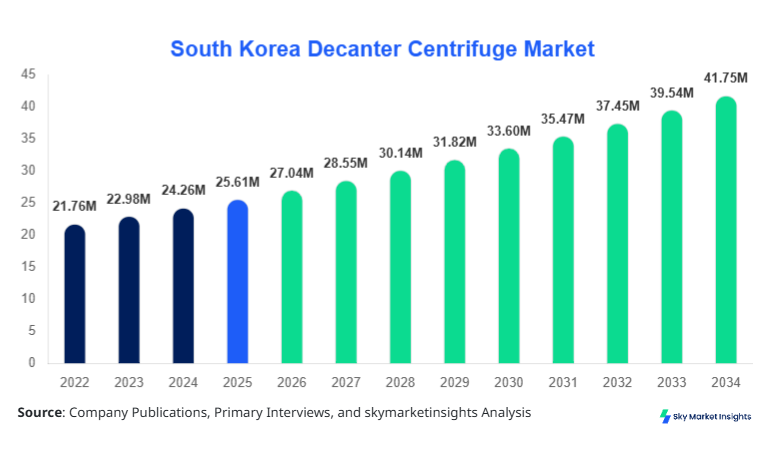
South Korea Decanter Centrifuge Market size is projected at USD 27.04 million in 2026 and is expected to hit USD 41.60 million by 2034 with a CAGR of 5.58%. The industry is supported by wastewater-treatment modernization, industrial solids management, food processing, chemicals, pharmaceuticals, mining, and oil-processing requirements. The report evaluates 6 segmentation dimensions alongside technology adoption, operating conditions, demand factors, and the competitive landscape.
Key Takeaways
- Design leadership:2-Phase Decanter Centrifuges dominate design-type revenue with USD 17.43 million in 2026, equivalent to64.46%, and are forecast at USD 26.55 million by 2034 with a5.40% CAGR.
- Fastest design category:3-Phase Decanter Centrifuges represent35.54%of 2026 design-type revenue and record the fastest CAGR at5.76%, reaching USD 15.05 million in 2034.
- Bowl leadership:Conical Bowl systems account for45.12%of bowl-design revenue in 2026, valued at USD 12.21 million, and reach USD 18.84 million by 2034 at5.58% CAGR.
- Fastest bowl category:Peeler Bowl Design records the highest bowl-design CAGR at5.70%, rising from USD 6.28 million in 2026 to USD 9.78 million by 2034.
- Geographic concentration:South Korea represents100%of the geographic scope of this country study; nationwide revenue increases from USD 27.04 million in 2026 to USD 41.60 million in 2034.
A decanter centrifuge is a continuous or batch-operated mechanical separation system using centrifugal force to separate solids from liquids or multiple liquid phases. South Korea's 2-phase category contributes 64.46% of design-type revenue in 2026 versus 35.54% for 3-phase equipment. Within bowl designs, conical systems contribute 45.12%, cylindrical-conical systems 31.67%, and peeler designs 23.21%. Domestic wastewater infrastructure provides an established adoption base: South Korean supplier ARK reports installations in approximately 300 of 600 water, wastewater, and sludge-treatment plants, while its decanter lineup handles slurry flows of up to 70 m³/hour.
Explore more data points, trends and opportunities Download Free Sample Report
South Korea Decanter Centrifuge Market Trends
Automation, Continuous Processing and High-Efficiency Separation
South Korean industrial separation is shifting toward automated, continuously operated equipment capable of handling variable solids concentrations with lower manual intervention. The country's broader waste-management environment remains substantial: total waste generation reached approximately 179.53 million tonnes in 2024, up 1.9% year over year, with industrial facility waste accounting for 46.7%, construction waste 36.5%, and household waste 9.5%. These volumes reinforce demand for efficient solids-management and dewatering technologies across municipal and industrial processing chains.
Technology development increasingly emphasizes variable differential-speed control, modular designs, energy efficiency, automated process adjustment, reduced maintenance, and higher product recovery. Continuous solid-bowl equipment is particularly relevant where plants operate 24 hours or handle tens of cubic metres of slurry per hour. Commercial food-processing decanters can achieve up to 99.5 vol.% oil/fat purity, illustrating the performance level available from modern separation technology.
South Korea Decanter Centrifuge Market Drivers
Wastewater Modernization and Industrial Solids Management Accelerate Equipment Deployment
South Korea generated approximately 179.53 million tonnes of waste during 2024, a 1.9% annual increase, while industrial facility waste represented 46.7% of total generation. Household waste represented another 9.5%, creating substantial requirements for treatment, sludge thickening, and dewatering infrastructure. Domestic equipment providers already offer sludge-processing capacities reaching 70 m³/hour, and one supplier reports systems installed across roughly 300 Korean treatment facilities. These operating volumes strengthen replacement and modernization requirements for high-throughput centrifugal separation.
South Korea Decanter Centrifuge Market Restraints
Capital Intensity and Energy Requirements Limit Rapid Replacement Cycles
High-speed rotating equipment requires precision bowls, scroll conveyors, abrasion-resistant materials, drives, controls, and scheduled maintenance, raising ownership costs relative to simpler mechanical dewatering systems. Plants processing 50–70 m³/hour can also face meaningful electricity and polymer consumption, while equipment operating for 20–24 hours/day requires rigorous maintenance planning. Even a 5–10% deterioration in process efficiency can affect sludge dryness, downstream disposal volume, and operating economics, encouraging some users to extend existing equipment lifecycles rather than pursue immediate replacement.
South Korea Decanter Centrifuge Market Opportunities
Smart Controls and Resource Recovery Expand High-Value Separation Applications
Digital monitoring, automated differential-speed adjustment, predictive maintenance, and resource recovery create opportunities beyond conventional sludge dewatering. Advanced food-processing equipment can deliver oil/fat purity of up to 99.5 vol.%, while Korean sludge-dewatering equipment is available at capacities reaching 70 m³/hour. Deployments capable of improving recovery by 2–5%, reducing downtime by 5–10%, or increasing throughput by 10% can materially improve lifecycle economics in food, chemicals, pharmaceuticals, and industrial wastewater processing.
Challenges in South Korea Decanter Centrifuge Market
Feed Variability, Wear and Process Optimization Increase Operational Complexity
Decanter performance depends on solids concentration, particle size, density difference, temperature, feed rate, bowl speed, and differential scroll speed. Industrial facilities may experience feed variations exceeding 10–20% during production cycles, while abrasive mineral or chemical streams can shorten wear-component lifetimes. Equipment handling up to 70 m³/hour requires stable controls because even 5% throughput variation can influence cake dryness and centrate quality. Skilled maintenance and process optimization therefore remain important operational requirements.
Report Scope
| Report Metric | Details |
|---|---|
| Market Size in 2025 | USD 25.61 Million |
| Market Size in 2026 | USD 27.04 Million |
| Market Size in 2034 | USD 41.6 Million |
| CAGR | 5.58% (2026-2034) |
| Base Year for Estimation | 2025 |
| Historical Data | 2022-2024 |
| Forecast Period | 2026-2034 |
| Report Coverage | Revenue Forecast, Competitive Landscape, Supply Chain Disruption, Growth Factors, Environment & Regulatory Landscape and Trends |
Explore more data points, trends and opportunities Download Free Sample Report
South Korea Decanter Centrifuge Market Segmentation
The industry is segmented by design type, bowl design, operation type, application, capacity, and end-user. Based on supplied quantitative data, 2-phase equipment accounts for 64.46% of 2026 design-type revenue, while conical bowls represent 45.12% of bowl-design revenue.
By Design Type
2-Phase Decanter Centrifuges are the largest subsegment, increasing from USD 16.54 million in 2025 to USD 17.43 million in 2026 and USD 26.55 million by 2034. The category represents 64.46% of 2026 revenue and records a 5.40% CAGR.
3-Phase Decanter Centrifuges are the fastest-growing design category at 5.76% CAGR. Revenue increases from USD 9.61 million in 2026 to USD 15.05 million in 2034, reflecting rising requirements for simultaneous solid and two-liquid-phase separation.
By Bowl Design
Conical Bowl equipment leads with USD 12.21 million in 2026, representing 45.12% of bowl-design revenue, and is projected to reach USD 18.84 million in 2034 at a 5.58% CAGR.
Peeler Bowl Design is the fastest-growing bowl configuration at 5.70% CAGR, increasing from USD 6.28 million in 2026 to USD 9.78 million by 2034. Cylindrical-Conical Bowl equipment contributes USD 8.57 million in 2026 and reaches USD 13.13 million in 2034 at 5.47% CAGR.
By Operation Type
Continuous Operation Centrifuges represent the operationally prominent category because decanter technology inherently supports continuous solids discharge and high-throughput processing. Systems capable of processing up to 70 m³/hour are commercially available in Korea, supporting municipal and industrial installations.
Batch Operation Centrifuges remain applicable where controlled residence time, flexible campaigns, or specialized product handling is required. Plants operating 8–24 hours/day assess batch versus continuous configurations according to throughput, solids loading, cleaning frequency, and product-change requirements.
By Application
Wastewater Treatment is a core application, supported by approximately 300 reported Korean treatment-plant installations from one domestic sludge-dewatering supplier and equipment capacities reaching 70 m³/hour. Oil and gas, food and beverage, chemicals, pharmaceuticals, mining, minerals, and pulp and paper collectively broaden the addressable equipment base.
Food and Beverage applications increasingly emphasize product recovery, with advanced decanter technology capable of achieving up to 99.5 vol.% oil/fat purity. Chemical and Pharmaceutical applications prioritize containment and separation precision, while Mining and Minerals emphasize abrasion resistance and high solids throughput.
By Capacity
Medium- and High-Capacity equipment forms an important industrial deployment class, particularly for continuous municipal and manufacturing operations. Commercial Korean systems can handle slurry throughput up to 70 m³/hour, while lower-capacity configurations serve decentralized or specialized processes.
Small Capacity equipment supports lower-throughput installations where flexibility and footprint are important. Medium Capacity systems balance throughput and capital requirements, while High Capacity units are positioned for facilities operating multiple shifts and potentially 20–24 hours/day.
By End-User
Municipalities and Utilities constitute a major installed-user group because sludge thickening and dewatering are essential stages of wastewater management. A Korean supplier reports deployment across approximately 300 of 600 domestic water, wastewater, and sludge-treatment facilities, indicating substantial penetration of mechanical dewatering technologies.
Oil and Gas Companies, Food Processing Companies, Chemical Manufacturers, Mining and Metals Companies, and Pharmaceutical Manufacturers constitute the industrial end-user base. Facilities requiring 24-hour processing, high solids loading, or product recovery increasingly favor continuous centrifugal systems to reduce handling stages and stabilize output.
South Korea Decanter Centrifuge Market Segmentations
By Design Type
- 2-Phase Decanter Centrifuges
- 3-Phase Decanter Centrifuges
By Bowl Design
- Conical Bowl
- Cylindrical-Conical Bowl
- Peeler Bowl Design
By Operation Type
- Batch Operation Centrifuges
- Continuous Operation Centrifuges
By Application
- Wastewater Treatment
- Oil and Gas
- Food and Beverage
- Chemical and Pharmaceutical
- Mining and Minerals
- Pulp and Paper
By Capacity
- Small Capacity
- Medium Capacity
- High Capacity
By End-User
- Municipalities and Utilities
- Oil and Gas Companies
- Food Processing Companies
- Chemical Manufacturers
- Mining and Metals Companies
- Pharmaceutical Manufacturers
South Korea Decanter Centrifuge Market Outlook
South Korea constitutes 100% of the geographic revenue scope. Nationwide revenue is USD 27.04 million in 2026 and is forecast to reach USD 41.60 million in 2034 at a 5.58% CAGR. No province-level revenue allocation was supplied; therefore, regional monetary shares are not estimated or substituted.
Demand is distributed across South Korea's municipal wastewater and industrial production centers, including the Seoul metropolitan area and major manufacturing corridors around Busan, Ulsan, Incheon, Gyeonggi, Chungcheong, and Gyeongsang. Nationwide waste generation reached approximately 179.53 million tonnes in 2024, with industrial facility waste contributing 46.7%, construction waste 36.5%, and household waste 9.5%, supporting geographically dispersed solids-treatment requirements.
Top players in South Korea Decanter Centrifuge Market
- Alfa Laval AB
- GEA Group AG
- ANDRITZ AG
- Flottweg SE
- Pieralisi
- IHI Corporation
- Mitsubishi Kakoki Kaisha
- FLSmidth
- Elgin Separation Solutions
- HAUS Centrifuge Technologies
- Centrisys/CNP
- Tomoe Engineering
- Hiller Separation & Process
- ARK Co., Ltd.
- Woomin Technology Co., Ltd.
Top Two Companies
- Alfa Laval AB
Alfa Laval maintains strong positioning through broad decanter coverage spanning wastewater, food, beverage, industrial fermentation, oils, and process applications. Advanced Foodec systems can achieve up to99.5 vol.%oil/fat purity, while continuous separation architecture supports high-throughput production. A verified South Korea-specific company revenue percentage was not supplied; therefore, no fabricated company percentage is assigned. Its competitive positioning is supported by global installed experience, application engineering, energy-efficiency improvements, and integrated separation portfolios.
- Flottweg SE
Flottweg is positioned as a specialist in solid-bowl decanter technology, with applications extending from sludge dewatering and thickening to classification and industrial solid-liquid separation. Its systems operate continuously and use high centrifugal forces to separate fine particles from suspensions. A verified South Korea-specific company percentage is unavailable in the supplied dataset, so no unsupported percentage is introduced. Competitive differentiation centers on application-specific configuration, automation, wear protection, process flexibility, and lifecycle service.
Recent Developments in South Korea Decanter Centrifuge Market
- 2026:South Korean decanter demand entered the forecast period at USD27.04 million, with the supplied outlook indicating expansion to USD41.60 millionby 2034.
- 2026:2-Phase Decanter Centrifuges reached USD17.43 million, maintaining leadership over 3-phase systems at USD9.61 million.
- 2026:Conical Bowl equipment reached USD12.21 million, compared with USD8.57 millionfor Cylindrical-Conical Bowl and USD6.28 millionfor Peeler Bowl equipment.
- 2025:South Korea recorded approximately179.53 million tonnesof waste generated during 2024, according to statistics published in 2025, representing1.9%year-over-year expansion and reinforcing the solids-management requirement.
- 2024–2026:Separation suppliers continued emphasizing modular, continuous-operation platforms with automated differential-speed control, reduced maintenance requirements, higher recovery efficiency, and application-specific configurations for sludge, food, and industrial processing.
Research Methodology
The study uses 2025 as the base year, 2026 as the current year, historical assessment covering 2022–2024, and a forecast horizon extending through 2034. The supplied mandatory tables serve as the primary quantitative source: design-type totals equal USD 25.63 million in 2025, USD 27.04 million in 2026, and USD 41.60 million in 2034, with a stated 5.58% CAGR. Bowl-design data totals USD 25.63 million, USD 27.06 million, and USD 41.75 million, respectively, reflecting a minor supplied-table variance that has been retained rather than overwritten. Segment percentages are calculated directly from these supplied values. Secondary evidence is used only for industry context, technology characteristics, operating capacity, waste volumes, competitive participation, and adoption indicators; unsupported regional or company revenue percentages are not fabricated.
Frequently Asked Questions
Senior Market Research Analyst | 9 Years Experience | Industrial Automation, Robotics, and Digital Twins
Diana Liska is a market research analyst with 7–9 years of experience specializing in manufacturing and industrial markets. Contributed to 70+ research reports for global clients. Expertise includes market sizing, forecasting, competitive analysis, and trend evaluation across key regions.