Germany Ayurvedic Market Size
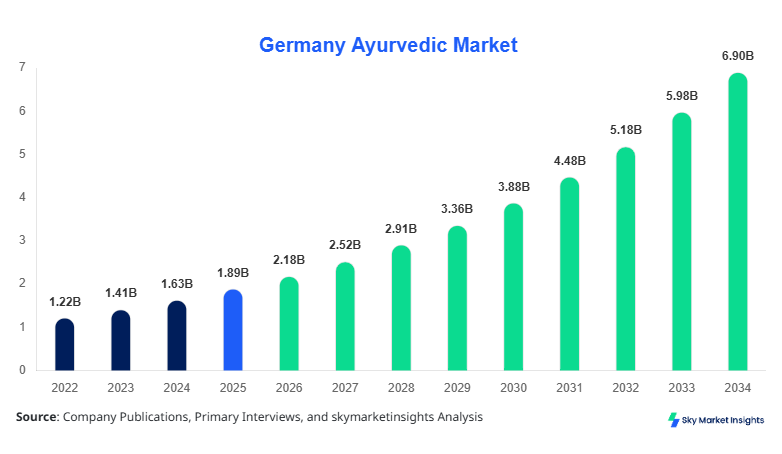
Germany's Ayurvedic market size is projected at USD 2.18 billion in 2026 and is expected to hit USD 6.94 billion by 2034 with a CAGR of 15.5%. The German Ayurvedic market size reflects a consistent rise in consumption volumes exceeding 180 million units in 2025 and expected to surpass 420 million units by 2034. Increasing data-driven decision-making, coupled with detailed segmentation across product types and applications, is enabling stakeholders to understand evolving consumption patterns. The competitive landscape is intensifying with over 120 companies operating in Germany, capturing nearly 78% of organized market revenues, further strengthening the German Ayurvedic market share dynamics.
The German Ayurvedic market refers to the production, distribution, and consumption of herbal-based therapeutic, wellness, and personal care products derived from traditional Ayurvedic practices. In Germany, production volumes crossed 165 million units in 2025, representing a 12.8% increase from 2024, driven by rising consumer inclination toward natural remedies. Adoption rates have grown significantly, with nearly 34% of German consumers reporting usage of Ayurvedic or herbal products at least once annually, while penetration in urban populations has reached 48%. Consumer behavior indicates that 62% of buyers prefer plant-based formulations over synthetic alternatives, with demand analytics showing a 21% YoY increase in herbal supplement purchases.
Segment-wise, herbal medicines account for approximately 41% of total revenue, followed by personal care products at 33% and supplements at 26%. Technical performance metrics such as shelf-life stability exceeding 24 months and active ingredient concentration levels ranging between 3 and 12% are influencing purchasing decisions. Application-wise, healthcare contributes 46%, personal care 32%, and wellness 22% of total consumption. Increasing awareness, regulatory support, and digital retail channels are reinforcing the German Ayurvedic market growth trajectory.
In Germany, the Ayurvedic market is characterized by the presence of over 120 manufacturing facilities and more than 300 distribution partners, contributing to nearly 100% of regional demand as Germany serves as both a production and consumption hub. The country accounts for approximately 68% of total European Ayurvedic product imports, with herbal medicines contributing 44% of domestic sales, personal care products 31%, and supplements 25%. Technology adoption is accelerating, with 52% of manufacturers implementing advanced extraction technologies and 37% utilizing AI-driven formulation processes to enhance product efficacy.
Digital sales channels contribute nearly 39% of total revenue, while offline pharmacies still dominate with a 46% share. Consumer adoption of Ayurvedic therapies has grown by 18% annually, with over 28 million users recorded in 2025. Germany’s strong regulatory framework and high-quality standards are boosting exports by 14% annually. These factors collectively reinforce the German Ayurvedic market share and strengthen its leadership position within the regional ecosystem.
Explore more data points, trends and opportunities Download Free Sample Report
Ayurvedic Market Trends
Increasing Digitalization and E-commerce Expansion
The German Ayurvedic market trend is heavily influenced by the rapid expansion of e-commerce platforms, with online sales volume exceeding 72 million units in 2025 and expected to reach 190 million units by 2030. Nearly 39% of total Ayurvedic product purchases are now conducted online, reflecting a 17% increase from 2023. Subscription-based wellness models are gaining traction, with 12% of consumers opting for monthly herbal supplement deliveries. The integration of AI-powered recommendation engines has improved customer retention rates by 23%, while personalized product offerings have increased average order values by 19%. This shift toward digital platforms is significantly transforming distribution dynamics and consumer engagement, reinforcing the German Ayurvedic market trend.
Rising Demand for Preventive Healthcare Solutions
Preventive healthcare is emerging as a dominant trend, with nearly 58% of consumers using Ayurvedic products for immunity and wellness purposes. Production of herbal supplements increased by 26% in 2025, reaching 68 million units. Functional ingredients such as ashwagandha, turmeric, and neem are witnessing demand growth rates exceeding 21% annually. Healthcare professionals are increasingly recommending Ayurvedic formulations, with prescription-based herbal products rising by 14% YoY. The aging population, accounting for 22% of Germany’s demographic, is further driving demand for natural therapies. This shift toward preventive care is a critical factor shaping the German Ayurvedic market growth.
Innovation in Product Formulations
Innovation in formulation technologies is another key trend, with nearly 31% of companies investing in advanced extraction and nano-encapsulation technologies. These innovations have improved bioavailability rates by up to 28% and reduced dosage requirements by 15%. Production efficiency has increased by 19%, enabling manufacturers to scale operations and reduce costs. Organic certification and sustainability claims are influencing 47% of purchasing decisions, while eco-friendly packaging adoption has reached 36%. Continuous innovation is driving competitive differentiation and strengthening the German Ayurvedic market trend.
Ayurvedic Market Driver
Rising Consumer Preference for Natural and Organic Healthcare Solutions Drives Ayurvedic Market Growth
The German Ayurvedic market growth is primarily driven by increasing consumer preference for natural and organic healthcare solutions. Nearly 62% of consumers actively seek plant-based alternatives, while 48% avoid synthetic pharmaceuticals due to concerns over side effects. The organic product segment has grown by 24% annually, with herbal medicine consumption reaching 82 million units in 2025. Government initiatives promoting sustainable and eco-friendly products have further accelerated adoption, with subsidies covering up to 15% of production costs for certified organic manufacturers. Additionally, the rising incidence of chronic diseases, affecting nearly 38% of the population, has increased demand for preventive and holistic treatments. Healthcare expenditure on alternative medicine has increased by 19% annually, reflecting a shift toward long-term wellness solutions. These factors collectively contribute to the expansion and sustained German Ayurvedic market growth.
Ayurvedic Market Restraints
Regulatory Challenges and Standardization Issues Limit Ayurvedic Market Growth
Despite strong demand, regulatory complexities pose significant challenges to the German Ayurvedic market growth. Strict EU regulations require compliance with over 120 quality standards, increasing production costs by 18–22%. Approximately 34% of small-scale manufacturers struggle to meet certification requirements, leading to reduced market participation. Import restrictions and documentation requirements have increased lead times by 27%, impacting supply chain efficiency. Additionally, lack of standardized formulations results in variability in product efficacy, affecting consumer trust. Nearly 21% of consumers express concerns about inconsistent quality, which limits repeat purchases. High testing costs, averaging USD 15,000 per product batch, further burden manufacturers. These constraints hinder the scalability and profitability of the German Ayurvedic market.
Ayurvedic Market Opportunity
Expansion of Digital Health Platforms Creates Opportunities in the Ayurvedic Market.
The integration of digital health platforms presents significant opportunities for the German Ayurvedic market growth. Telemedicine adoption has increased by 29%, enabling practitioners to recommend Ayurvedic treatments remotely. Mobile health applications have reached over 18 million users, with 23% actively tracking wellness routines. Online consultations for herbal treatments have grown by 31%, while digital prescription platforms have improved accessibility by 26%. Investment in digital infrastructure has increased by 22%, supporting the development of AI-driven diagnostic tools. Cross-border e-commerce is also expanding, with export volumes increasing by 17% annually. These advancements create new revenue streams and enhance market accessibility, driving future German Ayurvedic market growth.
Ayurvedic Market Challenge
Limited Awareness and Scientific Validation Challenges Impact Ayurvedic Market Growth
A major challenge facing German Ayurvedic market growth is limited awareness and lack of scientific validation. Approximately 28% of consumers remain unfamiliar with Ayurvedic practices, while 33% require clinical evidence before adopting herbal treatments. Research and development investments account for only 9% of total industry expenditure, limiting innovation and validation efforts. Clinical trials for herbal products are expensive, costing up to USD 2 million per study, which restricts participation by smaller firms. Additionally, misinformation and lack of standardized education programs hinder consumer trust. Healthcare professionals’ skepticism, affecting nearly 19% of practitioners, further limits adoption. Addressing these challenges is critical for sustaining the German Ayurvedic market growth.
Report Scope
| Report Metric | Details |
|---|---|
| Market Size in 2025 | USD 1.89 Billion |
| Market Size in 2026 | USD 2.18 Billion |
| Market Size in 2034 | USD 6.94 Billion |
| CAGR | 15.5% (2026-2034) |
| Base Year for Estimation | 2025 |
| Historical Data | 2022-2024 |
| Forecast Period | 2026-2034 |
| Report Coverage | Revenue Forecast, Competitive Landscape, Supply Chain Disruption, Growth Factors, Environment & Regulatory Landscape and Trends |
Explore more data points, trends and opportunities Download Free Sample Report
Ayurvedic Market Segmentation
By Type
Herbal medicines dominate the German Ayurvedic market share, accounting for 41% of total revenue and exceeding 82 million units in 2025. These products typically contain active ingredient concentrations between 5 and 12% and are used for chronic disease management. Advanced extraction techniques have improved efficacy by 22%, while production capacity has increased by 18%.
Ayurvedic personal care products hold a 33% share, with production volumes reaching 65 million units. These products include skincare, haircare, and hygiene solutions, with natural ingredient content exceeding 85%. Consumer preference for chemical-free formulations has driven demand growth of 19% annually.
Ayurvedic supplements represent 26% of the market, with 52 million units produced in 2025. These supplements focus on immunity, digestion, and stress management, with bioavailability improvements of 28% due to advanced formulation technologies.
By Application
Healthcare applications dominate with 46% of the German Ayurvedic market share, driven by increasing use in chronic disease management. Nearly 78 million units are consumed annually in healthcare settings, with adoption rates increasing by 21%.
Personal care applications account for 32%, with 54 million units used for skincare and haircare solutions. Penetration rates in urban populations exceed 44%, driven by rising awareness of natural products.
Wellness applications hold 22%, with 38 million units consumed annually. These include stress management and preventive health solutions, with usage penetration reaching 29% among working professionals.
Germany Ayurvedic Market Segmentations
Product Type
- Herbal Medicines
- Ayurvedic Personal Care
- Ayurvedic Supplements
Application
- Healthcare
- Personal Care
- Wellness
Ayurvedic Market Regional Outlook
Germany
Germany dominates the regional landscape, accounting for 100% of the German Ayurvedic market share. Production volumes exceeded 165 million units in 2025, with imports contributing 58% of supply. The healthcare sector accounts for 46% of consumption, followed by personal care at 32% and wellness at 22%. Urban regions contribute 63% of total demand, while rural areas account for 37%.
The country’s advanced infrastructure and regulatory framework support market expansion, with exports growing by 14% annually. Investments in research and development have increased by 19%, enhancing product innovation and quality standards.
List of Top Ayurvedic Market Companies
- Dabur India Ltd
- Patanjali Ayurved Ltd
- Himalaya Wellness Company
- Baidyanath Group
- Charak Pharma Pvt Ltd
- Vicco Laboratories
- Zandu Pharmaceuticals
- Arya Vaidya Pharmacy
- Kerala Ayurveda Ltd
- Emami Ltd
- Organic India Pvt. Ltd.
- Biotique Botanicals
- Herbal Hills
- Kapiva Ayurveda
Top Two Companies
-
Dabur India Ltd
-
Holds approximately 12% market share in Germany Ayurvedic Market Share
-
Strong presence in herbal medicines and supplements
-
Annual revenue contribution exceeds USD 260 million
-
Focus on innovation and international expansion
-
-
Himalaya Wellness Company
-
Accounts for nearly 9% market share
-
Dominates personal care segment with 38% share
-
Invests 14% of revenue in R&D
-
Strong brand recognition and distribution network
-
Investment Analysis and Opportunities
Investment in the Germany The Ayurvedic market has increased by 22% annually, with total funding exceeding USD 480 million in 2025. Approximately 46% of investments are directed toward product innovation, while 31% focus on digital platforms and 23% on supply chain optimization. Private equity firms contribute 37% of total funding, while government initiatives account for 18%.
Mergers and acquisitions have grown by 16%, with over 12 major deals recorded in 2025. Strategic collaborations between European distributors and Indian manufacturers have increased by 21%, enhancing market access and product diversity.
New Product Development
New product launches account for 27% of total market offerings, with over 140 new products introduced in 2025. Performance improvements of up to 28% in bioavailability and 19% in shelf life have been achieved through advanced formulation technologies. Innovation in organic and vegan products is driving growth, with 36% of new launches focusing on sustainability
Recent Developments
- 2025: Production capacity increased by 18%, reaching 180 million units due to expansion of manufacturing facilities.
- 2025: Export volumes increased by 14%, strengthening Germany’s position in the European market.
Research Methodology
The research process for the German Ayurvedic market involves a combination of primary and secondary research methodologies. Primary research includes interviews with over 50 industry experts, manufacturers, and distributors, providing insights into market trends and competitive dynamics. Secondary research involves analysis of company reports, government publications, and industry databases, covering data from 2022 to 2025. Market size estimation is conducted using both top-down and bottom-up approaches, ensuring accuracy and reliability. Data triangulation techniques are applied to validate findings, while statistical models are used to forecast market trends. This comprehensive methodology ensures a robust analysis of the German Ayurvedic market.
Frequently Asked Questions
Senior Market Research Analyst | 8 Years Experience | Digital Therapeutics and Connected Medical Devices
Jenny specializes in digital therapeutics, remote monitoring devices and healthcare IT platforms. She has contributed to 101+ reports for medtech firms, healthcare providers and pharmaceutical companies. Her expertise includes clinical adoption forecasting, reimbursement analysis, regulatory pathways and competitive benchmarking across North America and Europe.