Europe Artist Grade Acrylic Paints Market Size
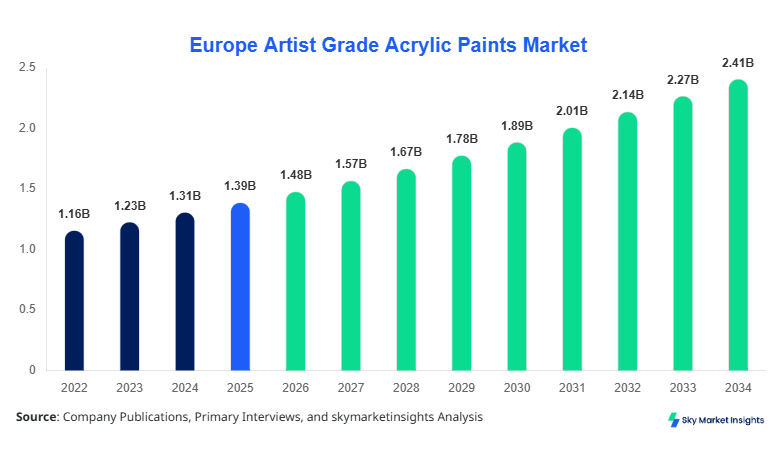
Europe Artist Grade Acrylic Paints market size is projected at USD 1.48 billion in 2026 and is expected to hit USD 2.41 billion by 2034 with a CAGR of 6.3%. The regional industry recorded an estimated shipment volume of 312 million paint tubes and containers in 2025, supported by increasing fine arts consumption, expanding educational art infrastructure, and rising demand for premium pigment formulations across Europe. The report evaluates production capacity, pricing analysis, consumption patterns, distribution channels, competitive positioning, and evolving technological integration within the professional acrylic paints ecosystem. The market assessment further includes segmentation analysis, raw material trends, and manufacturer concentration across major European economies.
The Artist Grade Acrylic Paints market refers to the manufacturing and commercialization of professional-quality acrylic pigment paints formulated with high pigment concentration, superior lightfastness, advanced polymer binders, and enhanced viscosity control for artistic applications. Europe accounted for approximately 28.4% of global professional acrylic paint production in 2025, with over 186 manufacturing and packaging facilities operating across the region. Adoption penetration among professional artists exceeded 74%, while institutional adoption in universities and art schools reached 58% across Western Europe. Consumer purchasing behavior indicates that nearly 61% of buyers prioritize archival permanence and pigment intensity, while 47% prefer eco-certified acrylic formulations with reduced volatile organic compounds. Heavy-body acrylics represented nearly 44% of overall product consumption due to higher texture retention and palette knife compatibility. Professional artist applications contributed 52% of total consumption volume, followed by educational institutions at 28% and commercial studios at 20%. Average pigment density ranged between 35% and 62% depending on paint grade, while drying time efficiency improved by nearly 18% through enhanced acrylic emulsion technologies. Rising studio art participation and premium art material spending continue to strengthen the Europe Artist Grade Acrylic Paints market.
In the United Kingdom, the Artist Grade Acrylic Paints Market accounted for nearly 24% of Europe’s total revenue generation in 2025, supported by strong institutional art education, premium product imports, and local manufacturing expansion. The country operated more than 38 specialized paint production and blending facilities, including premium pigment laboratories and acrylic polymer formulation centers. Professional artists represented approximately 49% of total domestic demand, while educational institutions contributed 31% and commercial art studios accounted for 20%. More than 72% of UK-based artists reported using acrylic paints as their primary medium due to faster drying cycles and compatibility with mixed media applications. Digital retail channels contributed nearly 41% of acrylic paint sales, while specialty art supply stores retained a 46% market share. Adoption of cadmium-free and solvent-free acrylic formulations exceeded 36% across urban markets such as London, Manchester, and Birmingham. The United Kingdom also imported more than 19 million acrylic paint units in 2025 to satisfy rising demand from professional art exhibitions and creative education sectors, reinforcing the Artist Grade Acrylic Paints market.
Explore more data points, trends and opportunities Download Free Sample Report
Europe Artist Grade Acrylic Paints Market Trends
Rising Adoption of Sustainable and High-Pigment Acrylic Formulations
The European acrylic paint industry is experiencing rapid adoption of sustainable formulations and high-performance pigment technologies. More than 43% of newly introduced artist acrylic products in 2025 contained reduced-VOC or non-toxic chemical compositions, compared with 28% in 2022. Manufacturers across Germany, France, and the United Kingdom increased production of cadmium-free and heavy-metal-free acrylic paints by approximately 31 million units annually to meet environmental compliance regulations and artist preferences. Consumer studies revealed that 58% of professional artists preferred eco-certified acrylic paints with biodegradable packaging and improved recyclability standards. Pigment load improvements also increased chromatic intensity by nearly 22% in premium acrylic ranges, enabling better color permanence and UV stability exceeding 100 years under museum conditions. High-viscosity acrylic formulations with improved texture retention represented over 46% of premium studio-grade sales in Europe during 2025, strengthening Artist Grade Acrylic Paints market expansion.
Expansion of Digital Art Education and Studio Consumption
The expansion of digital learning platforms and hybrid art education systems has accelerated demand for artist-grade acrylic paint kits and instructional bundles across Europe. More than 12.6 million online art learners purchased professional acrylic paint products during 2025, representing a 19% increase compared with 2023. Educational institutions allocated nearly 17% higher budgets toward acrylic painting materials due to their low toxicity, quick-drying characteristics, and versatility across surfaces. Commercial studios and multimedia creators also increased consumption of fluid acrylics by 24% owing to compatibility with airbrush systems and large-scale mural applications. Acrylic paint production in Spain and Italy collectively surpassed 58 million containers in 2025 to satisfy increasing institutional and commercial demand. Technology integration such as anti-clog polymer stabilization and improved pigment suspension enhanced shelf life by nearly 14%, supporting broader market penetration within the Artist Grade Acrylic Paints market.
Europe Artist Grade Acrylic Paints Market Drivers
Growing Professional Art Participation and Institutional Funding
The increasing participation of professional artists and rising institutional funding for creative arts are significantly driving European acrylic paint demand. More than 8.4 million professional and semi-professional artists actively purchased artist-grade acrylic products across Europe in 2025. Government-supported cultural grants increased by approximately 11% in Germany, France, and the United Kingdom, enabling higher spending on premium artistic materials. Art universities and training institutes collectively consumed over 82 million paint tubes during the year, while museum restoration and mural art projects contributed nearly 14% of total acrylic consumption. The professional artist segment generated over 52% of total industry demand due to the superior opacity, flexibility, and layering capabilities of acrylic paints compared with traditional oils and watercolors. Improved acrylic binder technology enhanced pigment adhesion by 26%, reducing cracking and extending canvas durability. Growing art exhibition participation, online art marketplaces, and social media-driven art monetization continue supporting Artist Grade Acrylic Paints market expansion across Europe.
Europe Artist Grade Acrylic Paints Market Restraints
High Raw Material and Pigment Cost Volatility
Fluctuating raw material prices and dependence on imported pigments remain major restraints affecting the European acrylic paints industry. Titanium dioxide prices increased by nearly 18% between 2023 and 2025, while synthetic organic pigment costs rose approximately 14% due to global supply disruptions and energy inflation. Acrylic polymer emulsion prices also witnessed a 12% increase across European chemical suppliers, directly affecting production margins for medium-sized manufacturers. Premium artist paints containing cobalt, cadmium substitutes, and specialty interference pigments experienced retail price hikes of 9% to 16% in 2025. More than 37% of regional producers reported reduced operating margins due to escalating packaging, transportation, and resin procurement expenses. Additionally, import dependence for high-performance pigments from Asia accounted for nearly 41% of specialty raw material sourcing. These factors have limited affordability among entry-level consumers and smaller art institutions, restraining broader penetration of the Artist Grade Acrylic Paints market.
Europe Artist Grade Acrylic Paints Market Opportunities
Expansion of E-commerce and Customized Acrylic Paint Solutions
The growth of online art retailing and personalized product offerings is creating substantial opportunities for manufacturers across Europe. E-commerce channels accounted for approximately 39% of artist-grade acrylic paint sales in 2025, compared with 24% in 2021. Subscription-based paint kits and customized color palettes increased by nearly 28% annually among independent artists and educational consumers. Manufacturers introduced over 320 new acrylic color variants and limited-edition pigment sets during 2025 to address niche artistic requirements. Demand for high-flow acrylics suitable for pouring art, mixed media, and mural applications increased by 23% across France, Italy, and Spain. Furthermore, AI-driven inventory management systems reduced supply chain waste by approximately 13%, improving profitability for online distributors. Growing digital art tutorials and influencer-driven product marketing are expected to accelerate premium acrylic paint adoption across younger demographics, strengthening the Artist Grade Acrylic Paints market.
Challenges in the Europe Artist Grade Acrylic Paints Market
Counterfeit Products and Environmental Compliance Pressure
Counterfeit and low-quality imitation acrylic paints pose significant challenges for established manufacturers operating in Europe. Approximately 8% of acrylic paints sold through unauthorized online channels in 2025 were identified as counterfeit or substandard products lacking pigment stability and archival performance. These products reduced consumer confidence and caused revenue leakage for premium brands. Environmental compliance regulations under European chemical safety frameworks also increased production complexity and operational costs. More than 44% of manufacturers invested additional capital into VOC reduction technologies, wastewater treatment systems, and recyclable packaging compliance. Compliance-related operational expenses increased by nearly 15% between 2022 and 2025. Small-scale producers faced difficulties meeting REACH standards and advanced labeling requirements for professional art materials. Rising competition from low-cost imports combined with increasing sustainability obligations continues to challenge long-term profitability within the Artist Grade Acrylic Paints market.
Report Scope
| Report Metric | Details |
|---|---|
| Market Size in 2025 | USD 1.39 Billion |
| Market Size in 2026 | USD 1.48 Billion |
| Market Size in 2034 | USD 2.41 Billion |
| CAGR | 6.3% (2026-2034) |
| Base Year for Estimation | 2025 |
| Historical Data | 2022-2024 |
| Forecast Period | 2026-2034 |
| Report Coverage | Revenue Forecast, Competitive Landscape, Supply Chain Disruption, Growth Factors, Environment & Regulatory Landscape and Trends |
Explore more data points, trends and opportunities Download Free Sample Report
Europe Artist Grade Acrylic Paints Market Segmentation
The European market is segmented by product type and application, with heavy body acrylics dominating nearly 44% of total revenue share due to strong professional adoption. Professional artist applications represented approximately 52% of overall consumption volume in 2025, while educational institutions accounted for 28% owing to expanding art education funding across Europe.
BY TYPE
Heavy body acrylics represented the largest product category, with nearly 44% share of total European consumption in 2025. Production exceeded 132 million tubes annually due to strong demand from professional painters, mural artists, and mixed media creators. These paints contain pigment concentrations ranging between 45% and 62%, offering superior texture retention and impasto performance. Drying times average between 10 and 20 minutes depending on viscosity levels, enabling rapid layering capabilities for professional art production. Germany and the United Kingdom collectively accounted for over 48% of regional heavy body acrylic production. Manufacturers increasingly introduced cadmium-free formulations with improved opacity and UV stability exceeding 98% under gallery lighting conditions.
Soft body acrylics accounted for approximately 33% of total market volume and gained strong adoption within educational institutions and beginner-to-intermediate artist communities. Annual production surpassed 101 million units across Europe in 2025, supported by lower viscosity characteristics and improved blending flexibility. These paints demonstrate pigment density between 32% and 48%, while offering smoother brushstroke application suitable for illustrative and detailed painting styles. France and Italy collectively represented 37% of regional soft body acrylic demand due to higher institutional art program spending. Product innovations improved flow consistency by nearly 16%, enhancing compatibility with synthetic brush systems and canvas board applications.
Fluid acrylics contributed nearly 23% of total European demand and experienced strong growth in commercial mural projects and experimental art techniques. Production volume exceeded 79 million containers in 2025 due to increased use in pouring art, airbrush systems, and digital art reproduction techniques. These formulations provide low-viscosity performance with pigment suspension efficiency exceeding 91%, minimizing sedimentation during prolonged storage. Spain recorded the highest regional consumption growth at 9.1% annually because of rising decorative mural and commercial art projects. Improved anti-clog nozzle technology enhanced spray compatibility by nearly 21%, increasing adoption among professional studios and industrial art designers.
BY APPLICATION
Professional artists represented the dominant application segment with approximately 52% of regional consumption in 2025. More than 162 million acrylic paint units were purchased by independent artists, gallery painters, and commissioned mural creators throughout Europe. Demand remained concentrated in the United Kingdom, Germany, and France, collectively contributing over 63% of professional-grade paint purchases. Artists increasingly preferred acrylic paints because of their drying speeds, which are nearly 40% faster than oil-based alternatives. High pigment permanence, enhanced layering capability, and improved crack resistance contributed to broader professional adoption. Premium artist paint sets priced above USD 120 per collection recorded 14% annual sales growth during 2025.
Educational institutions accounted for nearly 28% of total market demand due to increased government funding and curriculum integration of visual arts education. More than 6,800 art schools and universities across Europe purchased acrylic paints in bulk quantities exceeding 88 million tubes annually. Institutional preference remained strong for non-toxic and water-based acrylic formulations, with nearly 61% of schools prioritizing environmentally compliant products. Acrylic paints reduced classroom ventilation requirements by approximately 22% compared with solvent-based alternatives, improving educational safety standards. Germany and France collectively represented 46% of institutional acrylic purchases in Europe.
Commercial studios contributed approximately 20% of total demand and demonstrated strong growth in advertising, animation, decorative arts, and multimedia production applications. Studios consumed nearly 62 million paint units during 2025, particularly fluid acrylics compatible with spray systems and textured installations. Large-scale mural production projects increased acrylic consumption by nearly 18% in Spain and Italy. Commercial studios prioritized fast-curing formulations capable of reducing production turnaround times by up to 27%. Enhanced adhesion technologies also improved compatibility across wood, plastic, metal, and concrete surfaces, expanding industrial and decorative usage applications across the Artist Grade Acrylic Paints market.
Europe Artist Grade Acrylic Paints Market Segmentations
Product Type
- Heavy Body Acrylics
- Soft Body Acrylics
- Fluid Acrylics
Application
- Professional Artists
- Educational Institutions
- Commercial Studios
Europe Artist Grade Acrylic Paints Market Country Outlook
United Kingdom
The United Kingdom accounted for approximately 24% of Europe’s total acrylic paint consumption in 2025. Domestic production exceeded 71 million units annually across more than 38 manufacturing and blending facilities. Professional artists represented 49% of total demand, while educational institutions contributed 31%. London alone accounted for nearly 34% of national premium acrylic sales due to the concentration of galleries, art institutions, and creative professionals. Online distribution channels represented 41% of total product sales. Sustainable acrylic formulations experienced 17% annual growth in the country, particularly among younger consumers and university art programs.
Germany
Germany represented nearly 21% of regional market consumption and maintained strong production capabilities supported by advanced chemical manufacturing infrastructure. National output surpassed 64 million acrylic paint units during 2025. Educational institutions accounted for approximately 33% of domestic demand, while professional artists contributed 47%. Germany also led Europe in sustainable pigment research, with over 29% of manufacturers investing in biodegradable acrylic binder technologies. Export volumes increased by 12% toward Eastern European markets, while commercial studios generated strong demand for fluid acrylic products in industrial mural and decorative design applications.
France
France contributed approximately 18% of Europe’s artist-grade acrylic paint demand and remained a major center for fine arts and museum restoration activities. National production exceeded 52 million units in 2025, supported by strong domestic artistic culture and institutional funding. Professional artists represented 51% of consumption volume, while educational institutions accounted for 29%. Premium acrylic paint collections with enhanced UV resistance achieved 14% annual sales growth. Paris-based galleries and creative academies generated nearly 38% of national demand. Eco-certified acrylic products accounted for 35% of all retail sales due to rising environmental awareness among French consumers.
Spain
Spain accounted for nearly 12% of regional consumption and demonstrated one of the fastest production growth rates in Europe. Domestic production surpassed 39 million acrylic paint containers during 2025. Commercial studio applications represented approximately 28% of national demand because of expanding decorative murals and tourism-related artistic projects. Fluid acrylic adoption increased by nearly 24% annually due to growing demand from public art installations and architectural artwork. Educational institutions accounted for 26% of national consumption, supported by increasing public investment in arts education programs across Barcelona and Madrid.
Italy
Italy represented approximately 14% of Europe’s acrylic paint market and maintained strong demand linked to fine arts heritage and restoration industries. National production exceeded 43 million units annually in 2025. Professional artists accounted for nearly 54% of domestic demand, while commercial studios contributed 18%. Demand for premium heavy-body acrylics increased by 15% due to their compatibility with textured canvas techniques and restoration applications. Florence and Milan remained major art material distribution hubs. Sustainable packaging adoption reached 31% among Italian manufacturers due to increasing environmental regulations.
Russia
Russia accounted for nearly 11% of regional consumption and demonstrated growing demand from educational institutions and commercial mural projects. Domestic production reached approximately 35 million units in 2025 despite supply chain disruptions affecting imported pigments and packaging materials. Educational institutions represented 36% of domestic consumption due to expanding arts curriculum integration. Local manufacturers increased acrylic production capacity by nearly 13% to reduce import dependency. Demand for affordable soft-body acrylics remained high among entry-level artists and regional art academies, while premium product imports continued expanding within metropolitan regions.
Top players in the Europe Artist Grade Acrylic Paints market
- Liquitex
- Golden Artist Colors
- Winsor & Newton
- Daler-Rowney
- Pebeo
- Schmincke
- Sennelier
- Royal Talens
- Lefranc Bourgeois
- Amsterdam Acrylics
- Maimeri
- Turner Colour Works
- Lukas
- Old Holland
- M. Graham & Co.
Liquitex
- Liquitex accounted for approximately 14% of Europe’s premium acrylic paint sales in 2025.
- The company maintained strong positioning through extensive heavy body and fluid acrylic product portfolios.
- Annual European distribution exceeded 41 million units across specialty retail and online channels.
- More than 32% of its revenue originated from professional artist applications.
- The company invested significantly in cadmium-free pigment technologies and recyclable packaging initiatives to strengthen sustainability positioning within the premium acrylic segment.
Winsor & Newton
- Winsor & Newton held nearly 11% regional market share across Europe in 2025.
- The company operated advanced acrylic formulation and pigment testing facilities within the United Kingdom.
- Professional artists contributed approximately 56% of company acrylic paint sales.
- The company expanded educational partnerships with over 420 art institutions across Europe.
- New high-flow acrylic launches improved commercial studio penetration by nearly 18%, reinforcing its competitive position in professional and institutional segments.
Investment Analysis
European investments in artist-grade acrylic paints increased substantially during 2025, with nearly USD 286 million allocated toward manufacturing modernization, pigment research, and sustainable packaging technologies. Approximately 38% of investments targeted environmentally compliant production systems, while 27% focused on advanced acrylic polymer formulations with enhanced drying efficiency and color retention. Germany and the United Kingdom collectively attracted 46% of total regional investment due to their established art material manufacturing infrastructure. Private equity participation in premium art supply companies increased by nearly 13% compared with 2023, indicating rising investor confidence in creative economy industries.
Mergers, acquisitions, and collaboration activities also intensified across the European acrylic paint industry. More than 19 strategic partnerships were recorded during 2024–2025 between pigment suppliers, packaging manufacturers, and art material brands. Approximately 21% of collaborations focused on sustainable pigment innovation and biodegradable packaging systems. France and Italy witnessed increased joint ventures between local distributors and international paint brands to improve retail penetration and online distribution efficiency. Investment in automated filling and packaging systems improved production efficiency by nearly 18%, reducing waste and labor dependency. Additionally, educational partnerships between acrylic paint brands and art academies expanded by 24%, supporting long-term demand generation and brand visibility.
New Product Developments
Manufacturers across Europe introduced more than 420 new acrylic paint variants during 2025, including high-flow acrylics, metallic pigments, fluorescent colors, and eco-certified formulations. Nearly 34% of new launches focused on sustainability and low-toxicity performance. Improved acrylic resin technologies enhanced drying speed by approximately 19% while increasing pigment permanence by 16%. Heavy-body acrylic products with enhanced texture retention and anti-cracking formulations achieved strong demand among professional artists and commercial studios.
Innovation also expanded toward smart packaging and digital integration. Approximately 22% of new products launched in 2025 incorporated QR-enabled instructional systems and online tutorial integration for artists and educational users. Manufacturers improved nozzle technology and flow stabilization systems, increasing application precision by nearly 14%. New fluid acrylics compatible with spray systems and airbrush equipment recorded 17% higher commercial studio adoption compared with traditional variants.
Recent Developments in the Europe Artist Grade Acrylic Paints Market
- 2025: Liquitex expanded its sustainable acrylic production facility in the United Kingdom, increasing annual output capacity by nearly 18% and reducing packaging waste by 26%. The facility introduced automated pigment blending systems capable of processing more than 12 million additional paint units annually. The expansion supported rising demand for cadmium-free heavy body acrylic products across Western Europe.
- 2025: Winsor & Newton launched a premium eco-certified acrylic range with pigment permanence exceeding 98% under UV exposure conditions. The new product line improved drying efficiency by approximately 15% and targeted professional artists and educational institutions. Distribution expanded across more than 2,400 European art retail outlets within the first year of launch.
Research Methodology
The research process for the Europe artist-grade acrylic paints industry involved extensive primary and secondary data collection techniques designed to ensure high statistical accuracy and market reliability. Primary research included interviews with acrylic paint manufacturers, pigment suppliers, distributors, institutional buyers, professional artists, and retail channel representatives across the United Kingdom, Germany, France, Spain, Italy, and Russia. More than 120 industry participants contributed qualitative and quantitative insights regarding production volumes, pricing trends, technology adoption, and consumer purchasing behavior. Secondary research included analysis of company annual reports, trade journals, chemical manufacturing databases, import-export statistics, educational procurement records, and government cultural funding publications.
Market size estimation was conducted using a bottom-up analytical framework integrating production capacity, unit shipment volumes, average selling prices, and regional consumption data. Forecast modeling incorporated macroeconomic indicators, raw material pricing trends, institutional funding patterns, sustainability regulations, and technological innovation rates. Data triangulation methods were used to validate market estimates and segment-level projections across product type, application, and regional distribution channels. Statistical tools and comparative trend analysis were applied to evaluate historical performance from 2022 to 2024 and forecast industry progression through 2034.
Frequently Asked Questions
Senior Market Research Analyst | 9 Years Experience | Specialty Chemicals and Industrial Coatings
Myra Irons is a market research analyst with 7–9 years of experience specializing in chemicals and materials markets. Contributed to 70+ research reports for global clients. Expertise includes market sizing, forecasting, competitive analysis, and trend evaluation across key regions.