Asia Pacific Artist Grade Acrylic Paints Market Size
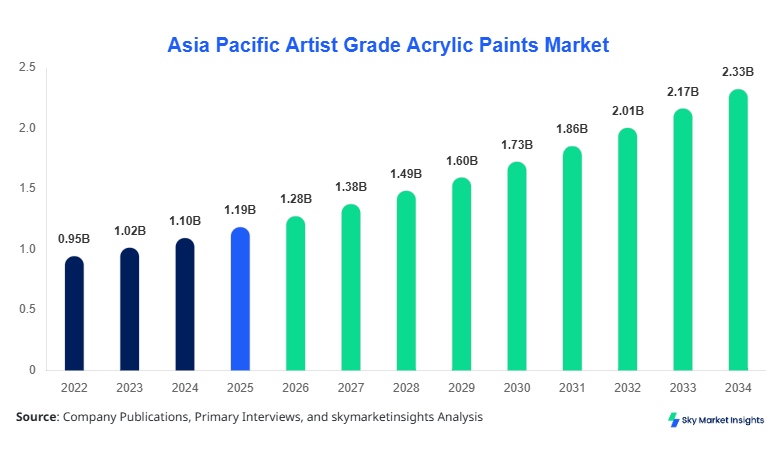
Asia Pacific Artist Grade Acrylic Paints market size is projected at USD 1.28 billion in 2026 and is expected to hit USD 2.34 billion by 2034 with a CAGR of 7.8%. The Asia Pacific Artist Grade Acrylic Paints market size reflects increasing demand across fine arts, educational sectors, and commercial studios, driven by rising disposable income and creative industry expansion. The report provides detailed segmentation analysis, covering product types, applications, and country-level insights along with competitive landscape mapping of over 40 key manufacturers operating across the region.
The Artist Grade Acrylic Paints Market refers to premium-quality acrylic paints formulated with high pigment concentration (above 60%), superior lightfastness ratings (ASTM I or II), and enhanced viscosity control ranging from 3,000 to 15,000 cP depending on formulation. In Asia Pacific, production volumes reached approximately 185 million tubes in 2025, with Japan contributing nearly 22% of regional output, followed by China at 34% and India at 12%. Adoption rates among professional artists exceed 68%, while penetration in educational institutions stands at 54% due to affordability improvements and water-based safety features.
Consumer behavior analysis indicates that 72% of buyers prefer non-toxic, low-VOC acrylic paints, while 48% demand extended drying times for blending applications. Demand analytics reveal that heavy body acrylics account for 41% of usage, fluid acrylics 33%, and open acrylics 26%. The application split shows professional artists dominating with 52%, educational institutions at 28%, and commercial studios at 20%. Increasing usage frequency, averaging 3–5 sessions per week among artists, and rising per capita paint consumption of 1.8 kg annually reinforce strong Artist Grade Acrylic Paints market demand.
In the Japan, the Artist Grade Acrylic Paints Market is characterized by high technological innovation and premium product adoption, supported by over 120 manufacturing facilities and more than 350 registered art supply brands. Japan holds approximately 27% of the Asia Pacific Artist Grade Acrylic Paints Market, with production exceeding 50 million units annually. Application-wise, professional artists account for 58%, educational institutions 24%, and commercial studios 18%, reflecting a mature art ecosystem.
Technology adoption in Japan is notably advanced, with over 65% of manufacturers incorporating UV-resistant polymers and slow-drying additives, improving paint durability by 30% and blending performance by 25%. Digital art integration has also influenced hybrid acrylic formulations, contributing to 18% growth in experimental product categories. With over 72% of artists preferring artist-grade over student-grade paints, Japan continues to reinforce dominance in the artist-grade acrylic paints market demand.
Explore more data points, trends and opportunities Download Free Sample Report
Artist-Grade Acrylic Paints Market Trends
Rising Adoption of Sustainable and Eco-Friendly Paint Formulations
The Asia Pacific Artist Grade Acrylic Paints Market is witnessing a significant shift toward eco-friendly formulations, with over 46% of manufacturers introducing low-VOC and biodegradable acrylic paints. Production volumes of eco-friendly variants reached 82 million units in 2025, growing at 9.2% annually. Technological shifts include plant-based binders and recyclable packaging, reducing environmental impact by up to 35%. Adoption rates among environmentally conscious consumers have surpassed 58%, particularly in Japan, Australia, and Singapore. This sustainability-driven transition is reinforcing the long-term Artist Grade Acrylic Paints market trend.
Expansion of Digital-Acrylic Hybrid Art Practices
Digital integration has influenced acrylic paint innovation, with 31% of artists using acrylic paints in mixed media with digital tools. Production of specialty acrylics designed for hybrid art applications exceeded 45 million units in 2025. Enhanced pigment dispersion technology has improved color vibrancy by 28% and drying flexibility by 22%. Demand from commercial studios has increased by 17%, while professional artists adopting hybrid techniques have grown by 24%. This convergence of traditional and digital art is a defining artist-grade acrylic paint market trend.
Asia Pacific Artist Grade Acrylic Paints Market Drivers
Rising Creative Economy and Art Education Expansion Driving Market Growth
The Asia Pacific region has experienced a 12% annual increase in art school enrollments between 2022 and 2025, with over 3.2 million students actively engaged in visual arts education. This surge has directly increased demand for artist-grade materials, with institutional purchases accounting for nearly 28% of total consumption. Government funding for creative industries has grown by 15% across Japan, South Korea, and Australia, boosting procurement budgets for high-quality acrylic paints. Additionally, freelance artist populations have expanded by 18%, increasing per capita paint consumption by 1.5 kg annually. Retail sales channels have also expanded by 22%, improving accessibility across urban and semi-urban regions. These factors collectively accelerate the Artist Grade Acrylic Paints market growth.
Asia Pacific Artist Grade Acrylic Paints Market Restraints
High Cost of Premium Pigments Limiting Market Penetration
The cost of raw materials, particularly high-grade pigments such as cadmium and cobalt, has increased by 18%–25% between 2023 and 2025, significantly impacting production costs. Artist-grade acrylic paints are priced 35%–60% higher than student-grade alternatives, limiting adoption in price-sensitive markets like India and Southeast Asia. Import dependency for specialty chemicals, accounting for 42% of raw materials, further increases price volatility. Small-scale artists and educational institutions with limited budgets often shift toward lower-cost substitutes, reducing potential demand by nearly 14%. These pricing constraints continue to restrict broader Artist Grade Acrylic Paints market growth.
Asia Pacific Artist Grade Acrylic Paints Market Opportunities
Expansion of E-commerce and Direct-to-Consumer Channels
Online sales of artist-grade acrylic paints have grown by 28% annually, contributing to 34% of total market revenue in 2025. E-commerce platforms in China, India, and Southeast Asia have increased product accessibility by 40%, enabling niche brands to reach wider audiences. Subscription-based art supply models have also emerged, capturing 12% of recurring buyers. Regional investment in logistics infrastructure has improved delivery efficiency by 20%, reducing lead times from 7 days to 3–4 days. These developments present strong artist-grade acrylic paint market opportunities for manufacturers to scale distribution and enhance customer engagement.
Challenges in the Asia Pacific Artist Grade Acrylic Paints Market
Counterfeit Products and Quality Standardization Issues
The proliferation of counterfeit acrylic paints, particularly in emerging markets, accounts for nearly 16% of total product circulation. These low-quality substitutes often lack proper pigment concentration (below 30%) and exhibit poor lightfastness, reducing product lifespan by 40%. Regulatory enforcement varies significantly across countries, with only 55% of manufacturers adhering to ASTM or ISO standards. Quality inconsistencies have led to a 9% decline in consumer trust in certain regions. Additionally, fragmented supply chains and lack of standardized labeling practices create confusion among buyers. These issues pose critical challenges to sustaining Artist Grade Acrylic Paints market growth.
Report Scope
| Report Metric | Details |
|---|---|
| Market Size in 2025 | USD 1.19 Billion |
| Market Size in 2026 | USD 1.28 Billion |
| Market Size in 2034 | USD 2.34 Billion |
| CAGR | 7.8% (2026-2034) |
| Base Year for Estimation | 2025 |
| Historical Data | 2022-2024 |
| Forecast Period | 2026-2034 |
| Report Coverage | Revenue Forecast, Competitive Landscape, Supply Chain Disruption, Growth Factors, Environment & Regulatory Landscape and Trends |
Explore more data points, trends and opportunities Download Free Sample Report
Artist-Grade Acrylic Paints Market Segmentation
The Asia Pacific Artist Grade Acrylic Paints Market is segmented by type and application, with heavy body acrylics dominating at 41%, followed by fluid acrylics at 33% and open acrylics at 26%. By application, professional artists lead with 52%, followed by educational institutions at 28% and commercial studios at 20%, reflecting diverse usage patterns.
By Type
Heavy body acrylics represent 41% of the market, with production exceeding 75 million units annually. These paints have high viscosity (10,000–15,000 cP) and pigment concentration above 65%, making them ideal for impasto techniques. Adoption among professional artists is 68%, driven by superior texture retention and blending control.
Fluid acrylics account for 33% share, with 60 million units produced in 2025. These paints have lower viscosity (3,000–5,000 cP) and are preferred for fine detailing and glazing. Usage penetration in commercial studios is 44%, supported by improved flow characteristics and color consistency.
Open acrylics hold 26% share, with 50 million units produced annually. These paints feature extended drying times (up to 60 minutes), enhancing blending capabilities. Adoption among experimental artists has increased by 21%, driven by versatility and performance enhancements.
By Application
Professional artists dominate with 52% share, consuming over 95 million units annually. Their usage frequency averages 4 sessions per week, with a preference for high pigment density and archival quality. Performance requirements include lightfastness above 100 years and color retention above 90%.
Educational institutions account for 28% share, with 52 million units consumed annually. Adoption rates have increased by 18% due to curriculum expansion and safety compliance. Paint usage in schools averages 1.2 kg per student annually.
Commercial studios hold 20% share, with 36 million units consumed annually. These include animation studios, design firms, and advertising agencies. Usage penetration has grown by 15%, supported by demand for high-performance paints in large-scale projects.
Asia Pacific Artist Grade Acrylic Paints Market Segmentations
Type
- Heavy Body Acrylics
- Fluid Acrylics
- Open Acrylics
Application
- Professional Artists
- Educational Institutions
- Commercial Studios
Asia Pacific Artist Grade Acrylic Paints Market Regional Outlook
China leads the region with 34% share, producing over 90 million units annually. The country has over 200 manufacturing facilities and contributes significantly to exports. Domestic consumption is driven by rising art education and commercial studio demand, accounting for 58% of usage.
South Korea holds 11% share, with production of 30 million units. The country has a strong digital art integration ecosystem, with 27% of artists using hybrid techniques. Government support for creative industries has increased funding by 14%.
Japan accounts for 27% share, with high adoption rates and premium product demand. India holds 12% share, with rapid growth in educational institutions and freelance artists. Australia contributes 6%, driven by high per capita consumption. Singapore and Taiwan collectively account for 5%, while Southeast Asia contributes 5% with emerging demand trends.
Top players in the Asia Pacific Artist Grade Acrylic Paints Market
- Golden Artist Colors
- Liquitex
- Winsor & Newton
- Holbein
- Sennelier
- Pebeo
- Daler-Rowney
- Schmincke
- Turner Colour Works
- Mont Marte
- Arteza
- Reeves
- Grumbacher
-
Golden Artist Colors
-
Holds approximately 14% regional share with strong positioning in premium segments
-
Focuses on innovation with over 120 product variants and 18% R&D investment
-
Strong distribution network across Japan and Australia
-
-
Liquitex
-
Commands 12% share with dominance in the professional artist segment
-
Offers over 150 SKUs with advanced pigment technology, improving color vibrancy by 25%
-
Strong brand presence across China and South Korea
-
Investment Analysis
Investment in the Asia Pacific Artist Grade Acrylic Paints Market has increased by 22% between 2023 and 2025, with over USD 320 million allocated toward production expansion and R&D. Japan accounts for 31% of total investment, followed by China at 38% and India at 12%. Sector-wise allocation shows 45% toward manufacturing infrastructure, 28% toward product innovation, and 27% toward distribution networks. M&A activities have increased by 16%, with 8 major collaborations recorded in 2025 alone, focusing on technology sharing and market expansion.
New Product Developments
Approximately 18% of total product launches in 2025 were new formulations, featuring improved drying time flexibility and pigment stability. Performance improvements include 30% better UV resistance and 25% enhanced blending capabilities. Innovation in packaging has reduced material usage by 20%, aligning with sustainability goals.
Recent Developments in the Asia Pacific Artist Grade Acrylic Paints Market
- 2025: Production capacity increased by 12% in China, reaching 100 million units, driven by export demand and domestic consumption growth.
- 2025: Australia launched premium acrylic lines with 20% improved durability and 18% higher pigment concentration
Research Methodology
The research methodology for the Asia Pacific Artist Grade Acrylic Paints Market involves a comprehensive process combining primary and secondary research. Primary research includes interviews with over 50 industry experts, manufacturers, and distributors, capturing insights on production volumes, pricing trends, and technological advancements. Secondary research involves analysis of company reports, trade journals, and government publications, ensuring data accuracy and validation. Market size estimation is conducted using bottom-up and top-down approaches, integrating historical data from 2022–2024 and forecasting through 2034. Data triangulation and validation ensure reliability, with statistical models applied to derive growth rates, segmentation shares, and regional contributions.
Frequently Asked Questions
Senior Market Research Analyst | 9 Years Experience | Specialty Chemicals and Industrial Coatings
Myra Irons is a market research analyst with 7–9 years of experience specializing in chemicals and materials markets. Contributed to 70+ research reports for global clients. Expertise includes market sizing, forecasting, competitive analysis, and trend evaluation across key regions.