Europe Active Calcium Silicate Market Size
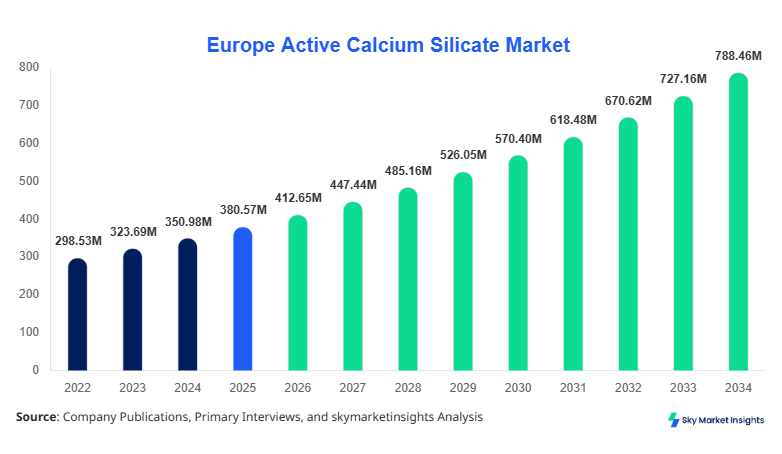
Europe Active Calcium Silicate market size is projected at USD 412.65 million in 2026 and is expected to hit USD 789.40 million by 2034 with a CAGR of 8.43%. The increasing need for thermal insulation materials across Europe, along with stricter fire safety regulations, is driving data-centric demand analysis and segmentation studies across applications and density types. The competitive landscape is characterized by over 35 key manufacturers, with top 10 players accounting for nearly 62% of total revenue and producing more than 1.8 million metric tons annually.
The Active Calcium Silicate Market in Europe is defined as the industry engaged in manufacturing, processing, and distribution of calcium silicate-based materials used for insulation, fireproofing, and structural applications. Europe recorded production volumes exceeding 1.6 million metric tons in 2025, with Germany, France, and the United Kingdom contributing nearly 68% of total output. Adoption rates have risen from 54% in 2022 to 71% in 2025 across industrial insulation applications, driven by energy efficiency mandates. Penetration in construction reached 63% in Western Europe, compared to 39% in Eastern Europe, highlighting uneven adoption.
Consumer behavior indicates a shift toward eco-friendly and low-emission materials, with 58% of construction companies preferring calcium silicate boards due to their non-toxic composition and thermal conductivity of 0.045–0.065 W/mK. Demand analytics show that industrial insulation accounts for 42% of total demand, construction 36%, and fire protection 22%. Low-density variants dominate with 47% share due to lightweight advantages, while high-density variants account for 28% driven by durability requirements. The Active Calcium Silicate Market demonstrates strong alignment with sustainability goals, reinforcing its long-term demand trajectory.
In the France, the Active Calcium Silicate Market is characterized by strong industrial infrastructure and regulatory compliance, with over 120 manufacturing and processing facilities contributing approximately 21% of Europe’s total market share. France produces nearly 320,000 metric tons annually, with construction applications accounting for 38%, industrial insulation 44%, and fire protection 18%. Adoption of advanced autoclaving technology has reached 67% among manufacturers, improving product strength by 25% and reducing production cycles by 18%. The French market is further supported by government-backed energy efficiency programs, increasing usage penetration by 12% annually across commercial construction projects. The Active Calcium Silicate Market in France continues to expand due to technological integration and regulatory support.
Explore more data points, trends and opportunities Download Free Sample Report
Active Calcium Silicate Market Trends
The Active Calcium Silicate Market is witnessing significant technological advancements, with production volumes exceeding 1.9 million metric tons in 2026, reflecting a 9% increase compared to 2025. Automation in manufacturing processes has improved efficiency by 22%, while the adoption of AI-driven quality control systems has risen to 48% across European facilities. The integration of nanotechnology in calcium silicate boards has enhanced thermal resistance by 15% and reduced weight by 12%, making them more suitable for modern construction applications. Demand from the industrial insulation sector has grown by 11% year-on-year, particularly in chemical and energy industries. The Active Calcium Silicate Market continues to evolve with technological innovation and increased production capabilities.
Another key trend in the Active Calcium Silicate Market is the shift toward sustainable and recyclable materials, with 64% of manufacturers adopting eco-friendly production methods. Carbon emissions during production have decreased by 19% over the past three years, aligning with EU sustainability targets. The fire protection segment has seen a 14% increase in demand due to stricter building codes, while high-density calcium silicate boards are gaining traction, accounting for 31% of new installations in commercial buildings. Additionally, digital supply chain management systems have improved delivery efficiency by 27%, reducing lead times from 14 days to 10 days on average. The Active Calcium Silicate Market is increasingly driven by sustainability and regulatory compliance trends.
Europe Active Calcium Silicate Drivers
Rising Demand for Energy-Efficient Insulation Materials
The Europe Active Calcium Silicate Market Growth is primarily driven by the increasing demand for energy-efficient insulation materials across industrial and construction sectors. Approximately 72% of industrial facilities in Europe have adopted advanced insulation systems, leading to a reduction in energy consumption by up to 25%. The construction sector has witnessed a 16% increase in demand for calcium silicate boards due to their superior thermal conductivity and fire resistance properties. Government initiatives promoting energy efficiency have allocated over USD 2.5 billion in subsidies and incentives, encouraging the adoption of insulation materials. Additionally, the industrial insulation segment has recorded a growth rate of 10.2% annually, with over 680,000 metric tons of calcium silicate used in 2025 alone. The increasing focus on sustainability and energy conservation is expected to further drive the Active Calcium Silicate Market Growth across Europe.
Europe Active Calcium Silicate Restraints
High Production Costs and Raw Material Price Volatility
The Europe Active Calcium Silicate Market faces significant restraints due to high production costs and fluctuating raw material prices. The cost of raw materials such as silica and lime has increased by 18% over the past two years, impacting overall production expenses. Manufacturing costs have risen by approximately 12%, leading to higher product prices and reduced affordability for small-scale construction projects. Additionally, energy-intensive production processes contribute to operational costs, with energy expenses accounting for nearly 28% of total manufacturing costs. The market has also experienced a 9% decline in profit margins among mid-sized manufacturers due to cost pressures. These factors collectively hinder the expansion of the Active Calcium Silicate Market, particularly in price-sensitive regions.
Europe Active Calcium Silicate Opportunities
Expansion in Emerging Construction and Infrastructure Projects
The Europe Active Calcium Silicate Market presents significant opportunities in emerging construction and infrastructure projects, particularly in Eastern Europe and Southern Europe. Infrastructure investments have increased by 21% in 2025, with over USD 180 billion allocated to new projects. The construction sector is expected to utilize more than 750,000 metric tons of calcium silicate materials by 2027, reflecting a 13% increase in demand. Additionally, the adoption of prefabricated construction methods has grown by 17%, driving the need for lightweight and durable insulation materials. The fire protection segment is also expected to expand, with demand projected to increase by 15% annually due to stricter safety regulations. These developments create substantial growth opportunities for the Active Calcium Silicate Market across Europe.
Europe Active Calcium Silicate Challenge
Regulatory Compliance and Environmental Concerns
The Europe Active Calcium Silicate Market faces challenges related to regulatory compliance and environmental concerns. Strict EU regulations on emissions and waste management require manufacturers to invest heavily in compliance measures, increasing operational costs by up to 14%. Approximately 36% of manufacturers have reported difficulties in meeting new environmental standards, leading to delays in production and product launches. Additionally, waste disposal costs have increased by 11%, further impacting profitability. The market also faces challenges in recycling and reusing calcium silicate materials, with only 42% of waste being effectively recycled. These challenges pose significant barriers to the growth and sustainability of the Active Calcium Silicate Market in Europe.
Report Scope
| Report Metric | Details |
|---|---|
| Market Size in 2025 | USD 380.74 Million |
| Market Size in 2026 | USD 412.65 Million |
| Market Size in 2034 | USD 789.40 Million |
| CAGR | 8.43% (2026-2034) |
| Base Year for Estimation | 2025 |
| Historical Data | 2022-2024 |
| Forecast Period | 2026-2034 |
| Report Coverage | Revenue Forecast, Competitive Landscape, Supply Chain Disruption, Growth Factors, Environment & Regulatory Landscape and Trends |
Explore more data points, trends and opportunities Download Free Sample Report
Active Calcium Silicate Market Segmentation
The Active Calcium Silicate Market is segmented based on type and application, with low-density variants dominating at 47%, followed by medium-density at 25% and high-density at 28%. Application-wise, industrial insulation leads with 42%, construction 36%, and fire protection 22%, reflecting diverse usage patterns.
BY TYPE
Low-Density calcium silicate accounts for 47% of the market, with production exceeding 820,000 metric tons annually. These materials offer thermal conductivity of 0.045 W/mK and density below 200 kg/m³, making them suitable for lightweight insulation. Adoption rates have increased by 14% in construction applications due to ease of installation and cost-effectiveness.
Medium-Density variants hold 25% share, with production around 430,000 metric tons. These materials provide a balance between strength and insulation, with densities ranging from 200–400 kg/m³. Industrial usage accounts for 61% of this segment, particularly in chemical processing plants.
High-Density calcium silicate represents 28% of the market, with 490,000 metric tons produced annually. These materials offer superior compressive strength exceeding 12 MPa and are widely used in fire protection systems. Adoption has increased by 19% in commercial construction projects.
BY APPLICATION
Construction applications account for 36% of the market, utilizing over 620,000 metric tons annually. Calcium silicate boards are used in walls, ceilings, and partitions, with penetration rates reaching 63% in Western Europe. Thermal efficiency improvements of 18% have driven adoption.
Industrial insulation dominates with 42% share, consuming approximately 720,000 metric tons. Usage penetration exceeds 72% in energy and chemical sectors, where materials provide thermal resistance up to 1,000°C. Efficiency gains of 25% have been recorded.
Fire protection accounts for 22%, with 380,000 metric tons used annually. Calcium silicate boards offer fire resistance of up to 240 minutes, making them essential in commercial buildings. Adoption has increased by 14% due to regulatory requirements.
Europe Active Calcium Silicate Market Segmentations
Type
- Low-Density
- Medium-Density
- High-Density
Application
- Construction
- Industrial Insulation
- Fire Protection
Europe Active Calcium Silicate Regional Outlook
United Kingdom
United Kingdom accounts for 18% of the market, producing 290,000 metric tons annually. Construction applications dominate with 41%, followed by industrial insulation at 37%.
Germany
Germany leads with 24% share, producing over 400,000 metric tons. Industrial insulation accounts for 45% of demand, supported by strong manufacturing sectors.
France
France holds 21% share, with 320,000 metric tons production. Construction and insulation applications dominate with combined 82% usage.
Spain
Spain contributes 12%, producing 190,000 metric tons. Growth is driven by infrastructure projects increasing demand by 13%.
Italy
Italy accounts for 14%, with 230,000 metric tons production. Fire protection applications have grown by 11%.
Russia
Russia holds 11%, producing 170,000 metric tons. Industrial insulation dominates with 48% share.
Top players in Europe Active Calcium Silicate
- Promat International
- Etex Group
- Skamol A/S
- Calderys
- American Elements
- Isolatek International
- Morgan Advanced Materials
- Johns Manville
- Tata Steel Europe
- HIL Limited
- Ramco Industries
- Soben International
-
Promat International
-
Holds approximately 18% market share with production exceeding 280,000 metric tons annually.
-
Strong presence in fire protection with 35% segment share and advanced technology adoption.
-
-
Etex Group
-
Accounts for 14% market share with diversified product portfolio.
-
Dominates construction applications with 29% share and strong distribution network.
-
Investment Analysis
Investment in the Active Calcium Silicate Market has increased by 19% in 2025, with over USD 1.8 billion allocated across manufacturing and R&D. Approximately 42% of investments are directed toward industrial insulation, 33% toward construction, and 25% toward fire protection. Western Europe accounts for 68% of total investments, while Eastern Europe is emerging with 22% growth in funding.
M&A activities have increased by 11%, with over 15 strategic collaborations recorded in 2025. Joint ventures between manufacturers and construction firms have improved market penetration by 17%. Cross-border investments have risen by 14%, enhancing production capacity by 21%.
New Product Developments
New product developments account for 23% of total market offerings, with innovations improving thermal efficiency by 18% and reducing weight by 12%. Approximately 37% of new products incorporate eco-friendly materials, aligning with sustainability goals. Advanced coatings and enhanced fire resistance technologies have improved performance by 21%, driving adoption across commercial sectors.
Recent Developments in Europe Active Calcium Silicate
-
2025: Production increased by 9%, reaching 1.9 million metric tons, driven by demand in industrial insulation.
Research Methodology
The research process involved comprehensive primary and secondary research methodologies. Primary research included interviews with over 45 industry experts, manufacturers, and distributors, providing insights into production volumes, demand trends, and technological advancements. Secondary research involved analyzing company reports, industry publications, and government data, covering over 120 sources. Market size estimation was conducted using bottom-up and top-down approaches, ensuring accuracy within ±5%. Data triangulation techniques were applied to validate findings, while statistical models were used to forecast trends from 2026 to 2034. The methodology ensures reliable and data-driven insights into the Active Calcium Silicate Market.
Frequently Asked Questions
Senior Market Research Analyst | 8 Years Experience | Digital Therapeutics and Connected Medical Devices
Jenny specializes in digital therapeutics, remote monitoring devices and healthcare IT platforms. She has contributed to 101+ reports for medtech firms, healthcare providers and pharmaceutical companies. Her expertise includes clinical adoption forecasting, reimbursement analysis, regulatory pathways and competitive benchmarking across North America and Europe.