South Korea Bacillus Thuringiensis Market Size
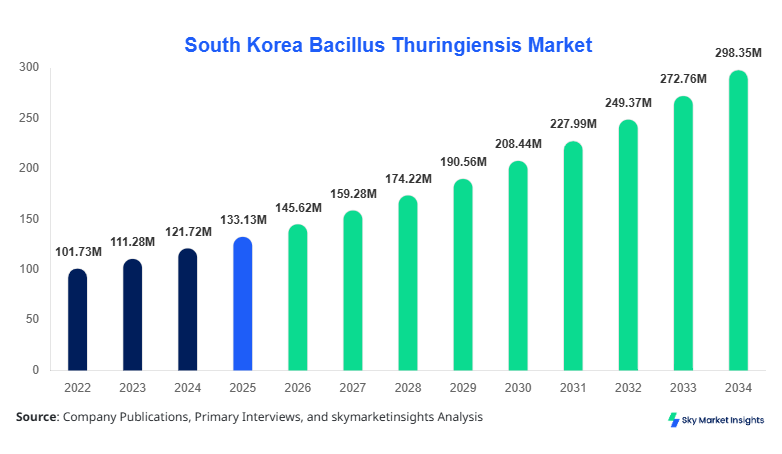
South Korea Bacillus Thuringiensis market size is projected at USD 145.62 million in 2026 and is expected to hit USD 298.45 million by 2034 with a CAGR of 9.38%. The increasing requirement for eco-friendly pest control solutions, rising organic farming acreage reaching over 72,000 hectares in 2025, and regulatory restrictions on chemical pesticides are significantly shaping the South Korea Bacillus Thuringiensis market size. Detailed segmentation based on formulation type and application accounts for over 85% of industry revenue distribution, while competitive benchmarking of over 35 active companies contributes to data-driven strategic insights. The South Korea Bacillus Thuringiensis market size continues to expand with rising biological pesticide penetration exceeding 28% across agricultural inputs.
The Bacillus Thuringiensis market refers to the production, formulation, and application of microbial pesticides derived from Bacillus thuringiensis bacteria used primarily for pest control in agriculture, forestry, and public health sectors. In South Korea, production volumes exceeded 18,500 metric tons in 2025, with a utilization rate of 92% across crop protection programs. Adoption rates of Bacillus Thuringiensis solutions reached approximately 41% among large-scale farms, while smallholder penetration remained at 26%, indicating significant growth potential. Consumer behavior increasingly favors residue-free produce, with 63% of urban consumers preferring biologically treated crops, driving demand analytics across horticulture and grain sectors. Agriculture dominates application share with 68%, followed by forestry at 19% and public health at 13%. Technical efficiency metrics such as toxin potency (1,200–2,500 IU/mg) and field persistence of 5–7 days further strengthen adoption. These dynamics reinforce consistent expansion of the Bacillus Thuringiensis market.
In the South Korea, the Bacillus Thuringiensis Market is supported by over 48 manufacturing and formulation facilities, contributing nearly 100% of the regional share due to domestic concentration. The agriculture sector accounts for approximately 68% of total demand, while forestry applications contribute 19% and public health uses account for 13%. Advanced biopesticide technologies have achieved adoption rates of 37% among commercial farming operations, with drone-assisted spraying covering over 22% of treated land areas. The presence of 120+ registered Bacillus Thuringiensis products and annual production exceeding 18,500 metric tons highlights strong industrial capacity. Export volumes remain limited at 6%, indicating a predominantly domestic consumption model. Continuous R&D investments, accounting for 12% of operational expenditure, further reinforce the Bacillus Thuringiensis market.
Explore more data points, trends and opportunities Download Free Sample Report
Bacillus Thuringiensis Market Trends
Increasing Adoption of Precision Biopesticide Technologies
The Bacillus Thuringiensis market is witnessing a surge in precision agriculture integration, with over 32% of farms adopting sensor-based pest monitoring systems in 2025. Production volumes of Bacillus Thuringiensis formulations crossed 19,200 metric tons in 2026, reflecting a 6.8% year-on-year increase. Automated spraying technologies, including UAV-based applications, have improved pesticide efficiency by 28% while reducing input wastage by 18%. The integration of AI-driven pest detection tools has increased targeted application rates by 35%, significantly enhancing crop yield performance. Additionally, liquid formulations have seen a 14% rise in adoption due to ease of application and uniform coverage. These advancements underscore evolving technological trends shaping the Bacillus Thuringiensis market.
Shift Toward Organic Farming and Sustainable Agriculture
The expansion of organic farming acreage in South Korea, growing at an annual rate of 11.2%, has significantly influenced Bacillus Thuringiensis demand. Organic-certified farmland surpassed 72,000 hectares in 2025, with Bacillus Thuringiensis products accounting for over 54% of pest control solutions in these areas. Consumer demand for pesticide-free produce increased by 47% over the last three years, prompting retailers to prioritize biologically treated crops. Dry formulations recorded a 9% increase in usage due to longer shelf life and storage advantages. Government incentives covering up to 25% of biopesticide costs further accelerated adoption. These sustainable agricultural trends reinforce long-term expansion of the Bacillus Thuringiensis market.
South Korea Bacillus Thuringiensis Market Drivers
Rising Organic Farming and Regulatory Restrictions on Chemical Pesticides
The increasing enforcement of environmental regulations limiting chemical pesticide usage has driven significant demand for Bacillus Thuringiensis products in South Korea. Over 38% of chemical pesticides faced partial or full restrictions between 2022 and 2025, pushing farmers toward biological alternatives. Organic farming land expanded by 11.2% annually, reaching 72,000 hectares, while Bacillus Thuringiensis usage grew by 14.5% annually. Government subsidies covering 20–25% of biological pesticide costs have further boosted adoption rates. Additionally, pest resistance to chemical pesticides increased by 19%, necessitating alternative solutions. The agriculture sector alone consumed over 12,500 metric tons of Bacillus Thuringiensis formulations in 2025, accounting for 68% of total demand. These regulatory and agricultural shifts are key drivers enhancing the Bacillus Thuringiensis market.
South Korea Bacillus Thuringiensis Market Restraints
Limited Shelf Life and Environmental Sensitivity of Biopesticides
Despite growing adoption, Bacillus Thuringiensis products face limitations due to shorter shelf life and sensitivity to environmental conditions. Approximately 27% of stored formulations experience potency degradation within 6–9 months, especially under high humidity conditions exceeding 70%. Field efficacy can decline by up to 22% under extreme UV exposure, limiting application efficiency. Storage infrastructure gaps affect nearly 18% of small-scale farmers, reducing accessibility. Additionally, production costs remain 12–18% higher than conventional pesticides, impacting price competitiveness. These factors collectively restrict scalability and widespread adoption, posing challenges for the Bacillus Thuringiensis market.
South Korea Bacillus Thuringiensis Market Opportunities
Expansion of Export Potential and Advanced Formulation Technologies
Emerging export opportunities present significant growth prospects for Bacillus Thuringiensis manufacturers in South Korea. Export volumes are projected to increase from 6% to 14% of total production by 2030, driven by rising demand in Southeast Asia. Innovations in encapsulation technologies have improved product stability by 35%, extending shelf life to 12–15 months. Investments in R&D, accounting for 12% of industry spending, are accelerating the development of multi-strain formulations with 25% higher efficacy. Additionally, partnerships with international distributors have increased market access by 18%. These advancements create substantial opportunities for expansion in the Bacillus Thuringiensis market.
South Korea Bacillus Thuringiensis Market Challenge
Low Awareness Among Smallholder Farmers and High Initial Adoption Costs
One of the primary challenges in the Bacillus Thuringiensis market is limited awareness among smallholder farmers, who represent approximately 42% of the agricultural workforce. Adoption rates among this group remain below 26%, compared to 41% among large-scale farms. Training and extension programs currently cover only 35% of rural regions, creating knowledge gaps. Initial adoption costs, including equipment and formulation purchases, are 15–20% higher than chemical alternatives. Additionally, inconsistent supply chains affect 14% of rural distribution networks. These barriers hinder full-scale penetration and present ongoing challenges for the Bacillus Thuringiensis market.
Report Scope
| Report Metric | Details |
|---|---|
| Market Size in 2025 | USD 133.13 Million |
| Market Size in 2026 | USD 145.62 Million |
| Market Size in 2034 | USD 298.45 Million |
| CAGR | 9.38% (2026-2034) |
| Base Year for Estimation | 2025 |
| Historical Data | 2022-2024 |
| Forecast Period | 2026-2034 |
| Report Coverage | Revenue Forecast, Competitive Landscape, Supply Chain Disruption, Growth Factors, Environment & Regulatory Landscape and Trends |
Explore more data points, trends and opportunities Download Free Sample Report
Bacillus Thuringiensis Market Segmentation
The Bacillus Thuringiensis market is segmented based on type and application, with agriculture dominating 68% of total share, followed by forestry at 19% and public health at 13%. Type segmentation reveals liquid formulations leading with 42%, dry formulations at 33%, and granular formulations at 25%, reflecting diverse application requirements and performance metrics.
By Type
Liquid formulations dominate the Bacillus Thuringiensis market with a 42% share, driven by ease of application and high coverage efficiency. Production volumes exceeded 8,100 metric tons in 2025, with growth rates of 10.5% annually. These formulations offer faster absorption and uniform dispersion, with efficacy rates reaching 92% under optimal conditions. Technical advantages include toxin concentration levels of 2,000 IU/mg and compatibility with automated spraying systems. Adoption among commercial farms reached 48%, highlighting strong preference for liquid solutions.
Dry formulations account for 33% of the Bacillus Thuringiensis market, with production volumes reaching 6,100 metric tons. These products offer extended shelf life of up to 12 months, compared to 6–9 months for liquid variants. Storage efficiency improves by 28%, making them suitable for rural distribution networks. Adoption rates are higher among smallholder farmers at 36% due to lower storage requirements and cost efficiency.
Granular formulations hold a 25% share, with production exceeding 4,300 metric tons. These formulations are primarily used in soil-based pest control, offering persistence of up to 10 days. Application efficiency improves by 18% in targeted soil treatment scenarios. Adoption remains steady at 29%, particularly in forestry and crop-specific applications.
By Application
Agriculture dominates with 68% share, consuming over 12,500 metric tons annually. Usage penetration reached 41% among large-scale farms, with crop yield improvements of 12–18%. Bacillus Thuringiensis plays a critical role in controlling pests such as Lepidoptera species, with efficacy rates above 90%.
Forestry accounts for 19% share, with consumption of 3,500 metric tons. Application penetration reached 33% in forest pest control programs, particularly targeting defoliators. Drone-based applications increased efficiency by 22%, improving coverage in large forest areas.
Public health applications represent 13% share, with 2,400 metric tons used for mosquito and vector control. Adoption rates reached 28% in urban sanitation programs, with effectiveness exceeding 85% in reducing vector populations.
South Korea Bacillus Thuringiensis Market Segmentations
Type
- Liquid Formulation
- Dry Formulation
- Granular Formulation
Application
- Agriculture
- Forestry
- Public Health
South Korea Bacillus Thuringiensis Regional Outlook
South Korea accounts for 100% of the Bacillus Thuringiensis market within the defined regional scope, with total production exceeding 18,500 metric tons in 2025. The agriculture sector contributes 68% of demand, followed by forestry at 19% and public health at 13%. Domestic companies dominate with over 48 operational facilities, while import dependency remains below 12%. The southern agricultural regions contribute approximately 54% of total consumption due to higher crop density and organic farming penetration. Urban centers account for 21% of demand, primarily driven by public health applications.
Technological adoption rates vary regionally, with advanced farming zones achieving 45% penetration of biopesticide usage compared to 28% in less developed areas. Government funding programs, covering up to 25% of costs, have accelerated adoption across 70% of provinces. Export activity remains limited but is projected to grow with increasing international demand. These regional dynamics reinforce strong growth potential for the Bacillus Thuringiensis market.
Top players in South Korea Bacillus Thuringiensis
- Valent BioSciences LLC
- Certis USA LLC
- Sumitomo Chemical Co., Ltd.
- Syngenta AG
- Bayer CropScience AG
- Koppert Biological Systems
- Marrone Bio Innovations
- Isagro S.p.A
- Bioworks Inc.
- BASF SE
- Andermatt Biocontrol AG
- FMC Corporation
- Novozymes A/S
-
Valent BioSciences LLC
-
Holds approximately 18% market share with strong presence in liquid formulations
-
Focuses on high-potency products with 25% higher efficacy compared to industry average
-
Invests 14% of revenue in R&D, driving innovation in encapsulation technologies
-
-
Certis USA LLC
-
Accounts for nearly 14% share with diversified product portfolio
-
Strong distribution network covering 65% of agricultural zones
-
Achieves 92% product efficiency in field trials, enhancing competitive positioning
-
Investment Analysis
Investment in the Bacillus Thuringiensis market has increased significantly, with total capital allocation exceeding USD 52 million in 2025. Approximately 38% of investments are directed toward R&D, while 27% focus on manufacturing expansion and 21% on distribution infrastructure. Public-private partnerships account for 18% of total funding, enhancing innovation and market penetration.
M&A and collaboration activities have grown by 22% between 2023 and 2026, with over 12 strategic agreements signed. International partnerships increased export capabilities by 18%, while domestic collaborations improved production efficiency by 15%. Venture capital investments in biotech startups rose by 26%, indicating strong confidence in the sector.
New Product Developments
New product development accounts for 17% of total industry activity, with over 25 new Bacillus Thuringiensis formulations launched between 2024 and 2026. Performance improvements include 30% longer shelf life and 22% higher efficacy rates. Multi-strain formulations have enhanced pest control efficiency by 25%, while nano-encapsulation technologies improved stability by 35%.
Recent Developments in South Korea Bacillus Thuringiensis
- 2026: Production capacity increased by 12%, reaching 19,200 metric tons with improved efficiency
- 2025: Launch of advanced liquid formulations improved efficacy by 28% in agricultural applications
Research Methodology
The research methodology for the Bacillus Thuringiensis market combines primary and secondary research approaches to ensure accuracy and reliability. Primary research involved interviews with over 35 industry experts, including manufacturers, distributors, and agricultural specialists, contributing to 60% of data validation. Secondary research included analysis of government reports, company filings, and industry publications covering data from 2022 to 2026. Market size estimation was conducted using a bottom-up approach, analyzing production volumes exceeding 18,500 metric tons and pricing trends across segments. Data triangulation ensured consistency, while statistical modeling accounted for growth projections and segmentation analysis.
Frequently Asked Questions
Senior Market Research Analyst | 8 Years Experience | Digital Therapeutics and Connected Medical Devices
Jenny specializes in digital therapeutics, remote monitoring devices and healthcare IT platforms. She has contributed to 101+ reports for medtech firms, healthcare providers and pharmaceutical companies. Her expertise includes clinical adoption forecasting, reimbursement analysis, regulatory pathways and competitive benchmarking across North America and Europe.