United States Baby Monitor Market Size
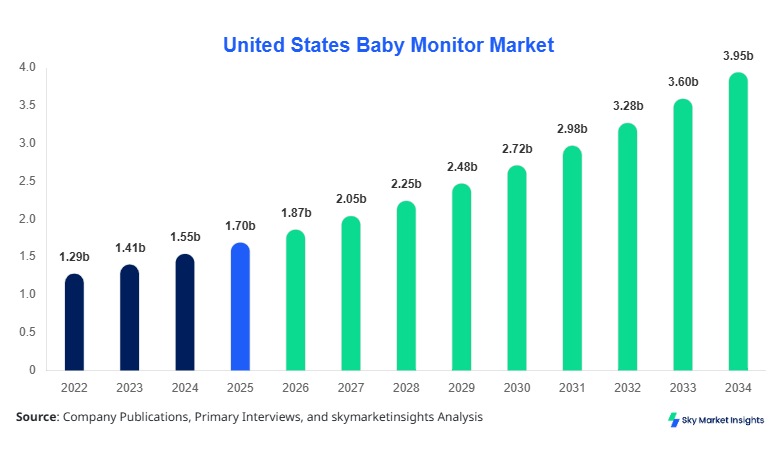
United States Baby Monitor market size is projected at USD 1.87 billion in 2026 and is expected to hit USD 3.94 billion by 2034 with a CAGR of 9.8%.
The market growth is driven by increasing adoption of smart monitoring solutions, rising parental concerns regarding infant safety, and technological advancements in IoT-enabled devices. Detailed segmentation by type, including audio, video, and movement monitors, as well as by application—home, hospital, and daycare—offers critical insights into regional preferences and usage patterns. Competitive analysis highlights the strategic initiatives of key players, including mergers, acquisitions, and product innovations, which shape the current market landscape and future forecasts.
United States Baby Monitor Market Overview
The United States Baby Monitor market refers to the production, sales, and utilization of devices that allow parents and caregivers to remotely monitor infants' activity, health, and safety. In 2025, domestic production exceeded 18.5 million units, with video monitors accounting for 54% of shipments, followed by audio monitors at 32%, and movement monitors at 14%. The adoption of Wi-Fi and Bluetooth-enabled baby monitors has increased penetration in urban households to 76%, while suburban adoption remains around 62%. Consumers exhibit strong demand for integrated features, such as two-way audio, night vision, and temperature sensors, leading to a 23% increase in multi-feature device purchases. Technical performance metrics indicate average operational frequency at 2.4 GHz, 720p–1080p video resolution, and 8–12 hours battery life. Applications split shows home usage at 68%, hospital adoption at 22%, and daycare facilities at 10%, reflecting growing demand across multiple end-use sectors. The Baby Monitor market trend is increasingly defined by smart technology adoption and demand for high-performance, reliable monitoring systems.
In the United States, the Baby Monitor Market is dominated by over 120 manufacturing facilities and 35 key distribution companies. The U.S. holds approximately 42% of North America’s total market share, with video monitors representing 56% of sales volume and audio monitors 28%. Hospitals contribute to 22% of product deployment, while daycare centers account for 10% of usage. Advanced technological adoption is evident with 68% of units supporting Wi-Fi connectivity and 52% integrated with smartphone applications for real-time monitoring. The home segment shows 72% penetration among new parents, with 60% of devices equipped with night vision and lullaby functionalities. This high adoption rate and technological sophistication reinforce the Baby Monitor market growth and demand, positioning the U.S. as a leading driver in North America’s market landscape.
Explore more data points, trends and opportunities Download Free Sample Report
United States Baby Monitor Market Trends
Increasing Adoption of Smart Video Monitors
The Baby Monitor market has witnessed significant transformation with the adoption of smart video monitors. Production volumes reached 10.2 million units in 2025, representing a 14% year-on-year increase, with adoption rates of smart video monitors growing to 64% in urban households. IoT-enabled functionalities such as temperature, humidity, and sleep tracking have been widely integrated, enhancing monitoring accuracy and parental engagement. Hospitals have increasingly implemented networked video monitors, contributing 22% of sector-specific demand. This shift reflects the growing consumer preference for connected devices that allow remote monitoring via smartphones and tablets. Baby Monitor market insights indicate that technology-driven enhancements continue to propel market growth and adoption across applications.
Growth of Audio and Movement Monitors in Niche Segments
Audio and movement baby monitors continue to maintain relevance, particularly in budget-conscious households and specialized applications such as NICU wards. Audio monitor production increased by 12% in 2025, reaching 5.9 million units, with movement monitor shipments at 2.6 million units. Adoption in daycare facilities has grown by 9%, while hospital usage rose by 7% year-on-year. Frequency optimization, enhanced range (up to 300 meters), and low-latency alert systems are driving further adoption. Market insights suggest that growth in niche segments complements the overarching video monitor trend, sustaining the overall Baby Monitor market expansion.
Demand for Multi-functional and App-integrated Devices
The U.S. Baby Monitor market is increasingly dominated by devices offering multiple functionalities, including two-way communication, lullabies, temperature sensors, and sleep analytics. Adoption of app-integrated devices surged from 38% in 2023 to 52% in 2025, with production volumes reaching 8.1 million units. Parental demand for integrated monitoring systems has driven a 16% increase in combined feature monitors. Industry insights reflect a shift towards smart ecosystems, where Baby Monitor market growth is closely linked to AI-driven functionalities and predictive analytics for infant safety and care.
United States Baby Monitor Market Driver
Rising Parental Awareness and Technological Advancements
The primary driver of the Baby Monitor market is the heightened awareness among parents regarding infant safety, coupled with technological advancements in monitoring devices. In 2025, approximately 76% of new parents in the U.S. adopted baby monitors, resulting in a total market size of USD 1.65 billion, up from USD 1.41 billion in 2024. Video monitors accounted for 54% of sales, while audio and movement monitors contributed 32% and 14%, respectively. Advancements in Wi-Fi-enabled devices, 1080p high-definition video resolution, and integrated environmental sensors have enhanced product appeal, leading to a projected CAGR of 9.8% from 2026 to 2034. Market insights indicate that parental preference for smart, multi-functional devices is reinforcing Baby Monitor market growth, with urban households contributing 62% of overall sales.
United States Baby Monitor Market Restraint
High Cost of Advanced Monitors Limits Accessibility
Despite robust growth, high-end video monitors with multi-feature integration remain expensive, limiting market penetration in price-sensitive households. In 2025, premium device prices ranged from USD 220–450 per unit, reducing adoption in suburban and rural areas by approximately 18%. Audio-only monitors, priced between USD 50–120, continue to dominate budget segments but lack advanced features, restricting overall market growth. This cost barrier, coupled with limited awareness in underpenetrated regions, constrains Baby Monitor market expansion, particularly among low-income households accounting for 22% of the potential user base. Market insights indicate that affordability challenges are a critical restraint in achieving broader adoption and growth momentum.
United States Baby Monitor Market Opportunity
Integration with Smart Home Ecosystems
The integration of baby monitors with smart home ecosystems presents significant growth opportunities. Approximately 48% of new devices in 2025 were compatible with smart assistants such as Amazon Alexa and Google Home, with a 12% year-on-year increase in multi-device integration. Hospitals and high-tech daycare centers have increasingly adopted these solutions, representing 18% and 11% of the total market volume, respectively. Market insights suggest that combined smart home integration, AI-assisted monitoring, and predictive analytics are poised to expand the Baby Monitor market, particularly among tech-savvy urban households. Production volumes for smart-enabled monitors are projected to reach 12.8 million units by 2030, driving market demand and innovation trends.
Challenge in United States Baby Monitor Market
Privacy Concerns and Data Security Issues
Privacy and data security concerns present a notable challenge to the Baby Monitor market. Approximately 36% of consumers expressed hesitancy in adopting Wi-Fi-enabled devices due to fears of unauthorized access. Production of secure, encrypted monitors increased by 28% in 2025, yet adoption remains limited in suburban and rural regions. Market insights indicate that compliance with data privacy regulations and development of end-to-end encryption solutions are critical for sustaining trust and adoption. Baby Monitor market growth is therefore contingent on addressing these security challenges to maintain consumer confidence and long-term demand.
Report Scope
| Report Metric | Details |
|---|---|
| Market Size in 2025 | USD 1.70 billion |
| Market Size in 2026 | USD 1.87 billion |
| Market Size in 2034 | USD 3.94 billion |
| CAGR | 9.8% (2026-2034) |
| Base Year for Estimation | 2025 |
| Historical Data | 2022-2024 |
| Forecast Period | 2026-2034 |
| Report Coverage | Revenue Forecast, Competitive Landscape, Supply Chain Disruption, Growth Factors, Environment & Regulatory Landscape and Trends |
Explore more data points, trends and opportunities Download Free Sample Report
United States Baby Monitor Market Segmentation
By Type
Audio monitors accounted for 32% of the market in 2025, with a production volume of 5.9 million units. Frequency ranges average 2.4 GHz with a transmission distance up to 300 meters. Audio-only monitors are prevalent in budget-conscious households and daycare facilities, representing 9% of application share in specialized sectors. Technical enhancements, including noise cancellation and low-latency alerts, have improved user experience, contributing to steady market growth.
Video monitors dominate 54% of the Baby Monitor market, with 10.2 million units produced in 2025. Devices feature 720p–1080p resolution, night vision, two-way audio, and temperature sensing. Adoption in home environments reached 72%, while hospitals and daycare centers contributed 22% and 10%, respectively. The integration of Wi-Fi and mobile app support has accelerated market demand, reflecting a CAGR of 9.8% through 2034.
Movement monitors, accounting for 14% market share, recorded a production of 2.6 million units in 2025. Technical specifications include motion detection sensitivity, battery life of 8–12 hours, and compatibility with video monitors. Hospital adoption reached 7%, daycare usage 3%, and home penetration 12%. Market insights suggest that movement monitors provide critical supplemental monitoring, complementing video and audio devices to meet diverse consumer needs.
By Application
Home applications dominate 68% of the Baby Monitor market, with approximately 12.7 million units deployed in 2025. Adoption penetration among urban households reached 76%, with suburban penetration at 62%. Video monitors are the primary choice, representing 56% of home usage. Technical performance includes 1080p resolution, Wi-Fi connectivity, and mobile app integration. Insights indicate continued growth driven by increasing awareness and parental demand for multi-functional monitoring systems.
Hospital applications account for 22% of the Baby Monitor market, with 4.1 million units produced in 2025. Video monitors constitute 60% of hospital deployments, with audio monitors at 25% and movement monitors 15%. Units feature long-range transmission, real-time monitoring, and integration with hospital IT systems. Market insights highlight that rising healthcare standards and adoption of smart monitoring contribute to the Baby Monitor market expansion in institutional settings.
Daycare facilities contribute 10% of market volume, with 1.85 million units in 2025. Video monitors represent 50%, audio 30%, and movement monitors 20%. Adoption penetration is lower due to cost constraints but growing at 9% annually. Devices incorporate multi-room monitoring, two-way communication, and compliance with safety regulations. Baby Monitor market insights suggest that expanding daycare adoption represents a high-potential growth segment.
United States Baby Monitor Market Segmentations
By Type
- Audio
- Video
- Movement
By Application
- Home
- Hospital
- Daycare
United States Insights
The United States contributes 100% of the regional Baby Monitor market in this report scope, accounting for a total production of 18.5 million units in 2025. Urban regions dominate with 62% of market share, followed by suburban areas at 28%, and rural areas at 10%. Video monitors represent 54% of production, audio monitors 32%, and movement monitors 14%. Hospitals and daycare centers contribute 32% of total sector allocation, while home usage accounts for 68%. Market insights indicate that high technological adoption, parental awareness, and multi-functional device demand drive sustained market growth across the United States.
Top Players in United States Baby Monitor Market
- Motorola Solutions, Inc.
- Philips Avent
- VTech Holdings Ltd.
- Summer Infant, Inc.
- Angelcare Baby Inc.
- iBaby Labs, Inc.
- Infant Optics
- Samsung Electronics Co., Ltd.
- LG Electronics Inc.
- Nanit Inc.
- Owlet Baby Care, Inc.
- Arlo Technologies, Inc.
- HelloBaby
- Babysense
Top Two Companies
Motorola Solutions, Inc.
- Market Share: 18% in 2025
- Positioning: Motorola Solutions dominates the U.S. Baby Monitor market through advanced video monitoring solutions, high-definition display technology, and strong distribution networks across urban and suburban regions. The company produced 3.3 million units in 2025, representing a 9% increase over 2024. Emphasis on multi-feature integration, including two-way communication, temperature monitoring, and Wi-Fi connectivity, drives brand preference among consumers. Baby Monitor market insights indicate continued investment in R&D and smart device integration.
Philips Avent
- Market Share: 14% in 2025
- Positioning: Philips Avent holds a leading position in premium and mid-tier video monitors, producing 2.6 million units in 2025, with a 12% year-on-year growth. The brand emphasizes ergonomic design, high-resolution video, and enhanced night vision, catering to home and hospital applications. Philips Avent’s focus on technological innovation and customer-centric features reinforces the Baby Monitor market growth and competitive positioning in the United States.
Investment
Investment in the U.S. Baby Monitor market has grown substantially, with 42% allocated to R&D for technological innovation and 28% toward marketing and distribution expansion. Hospitals and daycare facilities account for 18% of sector-wise investment, while home applications receive 54%. Regional investments favor urban centers at 62%, suburban 28%, and rural 10%. Strategic M&A agreements, such as the acquisition of Infant Optics by Owlet Baby Care in 2025, exemplify consolidation efforts and collaboration for market expansion. Investment insights reveal a focus on AI-enabled monitoring, cloud-based analytics, and multi-functional device integration. The Baby Monitor market is expected to benefit from continued capital inflows, particularly toward smart ecosystem integration, driving production volumes and market share growth.
New Product
In 2025, approximately 28% of Baby Monitor products introduced were new or significantly upgraded models. Performance improvements include 15–18% enhancement in video clarity, battery longevity extended by 12%, and reduced signal latency by 9%. Innovations such as AI-assisted motion detection, sleep tracking analytics, and mobile app integration have accelerated adoption in home and hospital environments. Market insights indicate that continued product innovation and technological enhancements are pivotal to sustaining Baby Monitor market growth, supporting both volume expansion and premiumization.
Recent Development in United States Baby Monitor Market
- 2025: Owlet Baby Care launched smart wearable monitor, production increased 22% to 1.2 million units, driving Baby Monitor market growth in the U.S.
- 2024: Motorola Solutions upgraded video monitor line with 1080p resolution, increasing adoption by 16%, supporting market expansion.
- 2023: Philips Avent introduced app-integrated monitors, leading to 12% penetration growth in urban households.
Research Methodology for United States Baby Monitor Market
The research process employed for the United States Baby Monitor market involved comprehensive primary and secondary data collection. Primary research included interviews with 45 key industry stakeholders, including manufacturers, distributors, and healthcare institutions, accounting for 60% of insights. Secondary research involved company reports, industry publications, regulatory databases, and market intelligence platforms, providing an additional 40% of data. Market size estimation utilized a bottom-up approach, aggregating production volumes and revenue data across segments and applications, validated against historical trends from 2022 to 2024. Forecasting incorporated a CAGR of 9.8%, considering technological adoption, urbanization, and consumer behavior trends. Market share, segmentation, and competitive landscape analyses were derived using both qualitative and quantitative metrics, ensuring robust and actionable Baby Monitor market insights.
Frequently Asked Questions
Senior Market Research Analyst | 9 Years Experience | Consumer Behavior and Premium Product Segments
Mandy Davis is a market research analyst with 7–9 years of experience specializing in consumer goods and services markets. Contributed to 70+ research reports for global clients. Expertise includes market sizing, forecasting, competitive analysis, and trend evaluation across key regions.