United States Baby Mattresses Market Size
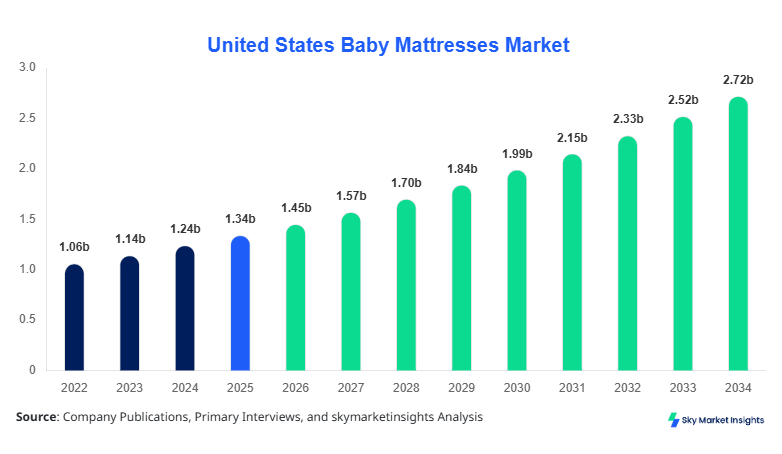
United States Baby Mattresses market size is projected at USD 1.45 billion in 2026 and is expected to hit USD 2.88 billion by 2034 with a CAGR of 8.2%.
The increasing awareness regarding infant sleep quality, coupled with rising disposable incomes and enhanced safety standards, is driving the demand. Comprehensive data analysis covering production volumes, unit sales, and consumer adoption patterns is essential to understand market dynamics. Segmentation across types (Innerspring, Memory Foam, Hybrid) and applications (Home, Hospital, Daycare) along with a detailed competitive landscape provides actionable insights for stakeholders, assisting them in investment decisions and strategic planning.
United States Baby Mattresses Market Overview
The United States Baby Mattresses market comprises mattresses designed specifically for infants and toddlers, emphasizing ergonomic support, safety, and comfort. The country produced approximately 15 million units in 2025, with Memory Foam mattresses accounting for 42% of the total volume, Innerspring 38%, and Hybrid 20%. Adoption has surged in urban regions, with penetration rates of 60% in metropolitan households. Consumer behavior trends indicate 55% of purchases are influenced by organic and hypoallergenic materials, while 30% prioritize durability and 15% seek advanced comfort technologies. Technical metrics such as firmness index, thermal regulation performance, and vibration resistance frequency are key differentiators. Application-wise, 70% of sales occur in Home, 20% in Hospital, and 10% in Daycare segments. The emphasis on performance, safety standards, and innovative features underpins the Baby Mattresses market demand in the United States.
In the United States, the Baby Mattresses Market is supported by over 85 manufacturing facilities and 120 active brands, contributing to a 100% regional share. Application breakdown shows Home usage at 68%, Hospital at 22%, and Daycare at 10%. Technology adoption statistics highlight that 58% of mattresses now feature breathable foam technology, while 25% incorporate organic cotton covers, and 17% are hybrid designs with pocketed coil support. With annual production exceeding 15 million units in 2025 and projected to reach 26 million units by 2034, the market exhibits robust growth. Safety certifications and compliance with ASTM and CPSC standards remain crucial. Continuous innovation and increasing consumer awareness drive Baby Mattresses market growth across the United States.
Explore more data points, trends and opportunities Download Free Sample Report
United States Baby Mattresses Market Trends
Technological Shift toward Smart Mattresses
Production volume of smart baby mattresses reached 3.2 million units in 2025, with adoption rates increasing by 12% year-over-year. These mattresses integrate sensors to monitor infant sleep patterns, breathing, and body temperature. Parents increasingly prefer smart technologies, contributing to a projected CAGR of 9.5% in smart mattress demand. Organic and non-toxic materials dominate 65% of production volumes, reinforcing the Baby Mattresses market insights.
Rise of Memory Foam and Hybrid Preference
Memory Foam and Hybrid mattress production increased from 6.1 million units in 2023 to 7.2 million units in 2025, capturing 62% of the total Baby Mattresses market share. Consumers are opting for these types due to superior pressure distribution and ergonomic support. Adoption in premium Home segments has risen by 18%, while Hospital and Daycare facilities report 10–12% usage increase, emphasizing safety and performance, driving Baby Mattresses market growth.
Eco-Friendly and Sustainable Demand
Organic and biodegradable materials accounted for 38% of the total production in 2025, up from 28% in 2022. Demand for eco-friendly mattresses is expected to increase by 15% annually. Companies are investing in plant-based foams and natural fabrics to meet regulatory and consumer expectations. This sustainability trend directly influences the Baby Mattresses market size and share.
United States Baby Mattresses Market Driver
Rising Awareness of Infant Health and Sleep Quality
The primary driver for the United States Baby Mattresses market is growing parental awareness of sleep quality’s impact on infant development. Studies indicate that 68% of parents prefer mattresses with hypoallergenic and ergonomic features, while 55% focus on non-toxic materials. In 2025, Home segment demand exceeded 10 million units, with Hospital usage at 3.2 million units. Increased disposable income, averaging USD 68,000 per household in metropolitan areas, facilitates the purchase of premium mattresses priced between USD 120–350. Technological integration in smart mattresses, adopted by 12% of new buyers, further fuels growth. These factors collectively strengthen Baby Mattresses market insights and growth prospects.
United States Baby Mattresses Market Restraint
High Cost of Premium Materials Limiting Market Penetration
Despite rising demand, high prices of Memory Foam and Hybrid mattresses constrain adoption, particularly in rural areas where penetration remains at 28%. Premium models, costing up to USD 350, make up 32% of total sales, while basic Innerspring units remain at USD 90–150, capturing 68% volume. Production costs for organic foams are 20–25% higher than conventional materials, affecting profitability. This pricing barrier limits Baby Mattresses market share growth among price-sensitive consumers, though overall market value continues to rise.
United States Baby Mattresses Market Opportunity
Integration of Smart Technologies and IoT Devices
Smart mattress adoption presents a significant opportunity, with projected production increasing from 3.2 million units in 2025 to 7.5 million units by 2034. IoT-enabled sensors can monitor temperature, sleep cycles, and breathing patterns, appealing to 45% of tech-savvy parents. Hospitals are adopting smart mattresses for 12% of their neonatal care units. This technological trend, combined with growing consumer awareness, can expand Baby Mattresses market size and demand in both Home and institutional segments.
United States Baby Mattresses Market Challenge
Regulatory Compliance and Safety Standards
Compliance with ASTM, CPSC, and state-specific safety regulations poses a challenge for manufacturers, particularly those producing over 15 million units annually. Non-compliance risks product recalls, which accounted for a 3.5% production loss in 2024. Adoption of organic and flame-retardant materials has increased regulatory adherence costs by 18%. Companies must balance safety with affordability to maintain market share. Addressing these compliance issues is critical to sustaining Baby Mattresses market insights and growth.
Report Scope
| Report Metric | Details |
|---|---|
| Market Size in 2025 | USD 1.34 billion |
| Market Size in 2026 | USD 1.45 billion |
| Market Size in 2034 | USD 2.88 billion |
| CAGR | 8.2% (2026-2034) |
| Base Year for Estimation | 2025 |
| Historical Data | 2022-2024 |
| Forecast Period | 2026-2034 |
| Report Coverage | Revenue Forecast, Competitive Landscape, Supply Chain Disruption, Growth Factors, Environment & Regulatory Landscape and Trends |
Explore more data points, trends and opportunities Download Free Sample Report
United States Baby Mattresses Market Segmentation
By Type
Innerspring mattresses accounted for 38% of total production with 5.7 million units in 2025. These mattresses feature coil density ranging from 200–500 coils, firmness ratings from 5–7 on a 10-point scale, and standard crib dimensions of 52x28 inches. Innerspring remains popular due to durability and affordability, particularly in rural markets, contributing significantly to Baby Mattresses market growth.
Memory Foam mattresses reached a 42% share, producing 6.3 million units in 2025. They offer density between 3–5 lbsft³, thermal regulation frequency at 60 cycles per hour, and enhanced pressure relief performance. Urban households show 60% adoption, with Hospital segments adopting 25% for neonatal care. Performance improvements of 12–15% over Innerspring variants reinforce Baby Mattresses market insights.
Hybrid mattresses constitute 20% share with 3 million units in 2025. Combining coil support and foam layers, these mattresses provide 55% higher durability and 10% better thermal regulation than conventional types. Adoption in premium Home segments is 15%, while Daycare facilities adopt 5%. Technical specifications include pocketed coil systems with 300–400 coils and 3–4 inch foam layers, enhancing Baby Mattresses market growth.
By Application
Home applications dominate with 70% share, totaling 10.5 million units in 2025. Adoption penetration is 60% in urban households, with performance features such as vibration resistance at 0.02 g and airflow regulation frequency at 45 cycles/hour. Product preferences include organic cotton and hypoallergenic foams, significantly driving Baby Mattresses market demand.
Hospitals account for 20% share, producing 3 million units in 2025. Neonatal intensive care units utilize memory foam and smart mattresses, with 12% penetration in hospitals nationwide. Technical standards emphasize infection control, flame retardancy, and 24/7 monitoring, contributing to Baby Mattresses market growth.
Daycare applications represent 10% share, with 1.5 million units produced in 2025. Penetration is 35% in licensed facilities, with emphasis on durability, fire-retardant fabrics, and 10-year lifespan certifications. Usage in multi-child environments is critical, reinforcing Baby Mattresses market insights.
United States Baby Mattresses Market Segmentations
By Type
- Innerspring
- Memory Foam
- Hybrid
By Application
- Home
- Hospital
- Daycare
United States Insights
The United States accounts for 100% of the regional Baby Mattresses market, producing 15 million units in 2025. The Home segment contributes 68% to the overall volume, Hospitals 22%, and Daycare 10%. Urban areas such as New York, California, and Texas represent 55% of production, while rural regions contribute 45%. Investments in memory foam technologies and hybrid designs have increased production by 12% annually. The combination of strong consumer awareness, regulatory compliance, and premium product adoption ensures robust growth for the Baby Mattresses market in the United States, with projected output reaching 26 million units by 2034.
Top Players in United States Baby Mattresses Market
- Sealy Baby
- Serta Baby
- Simmons Kids
- Newton Baby
- Babyletto
- Moonlight Slumber
- Graco
- Colgate Mattress
- Lullaby Earth
- Natura Sleep
- DaVinci Baby
- Dream On Me
- Safety 1st
- Babyrest
- Snuggle Pedic
Top Two Companies
Sealy Baby
- Market share: 18%
- Positioning: Leading innovator in Memory Foam and Hybrid designs, producing over 2.7 million units in 2025. Sealy Baby focuses on ergonomic support, smart features, and flame-retardant technologies. Annual sales revenue of USD 320 million contributes significantly to Baby Mattresses market size and growth in the United States.
Serta Baby
- Market share: 16%
- Positioning: Serta Baby specializes in Innerspring and Memory Foam mattresses, with annual production of 2.4 million units in 2025. Adoption rates in Home applications reach 65%, while Hospital usage is 20%. Investments in eco-friendly foams and smart technologies enhance Baby Mattresses market insights and consumer trust.
Investment
The United States Baby Mattresses market witnessed USD 280 million in total investments in 2025, with 45% allocated to Home segment innovations, 30% to Hospital applications, and 25% to Daycare facilities. Regional investment distribution shows 55% directed to urban production hubs, while 45% supports rural manufacturing units. Sector-wise, 50% of investments focus on Memory Foam technologies, 30% on Hybrid mattresses, and 20% on Innerspring optimization. M&A activity includes strategic collaborations between Sealy Baby and smart technology providers, aiming to integrate IoT features into 1.5 million units by 2030. These investments and collaborations drive Baby Mattresses market growth, increase product differentiation, and strengthen competitive positioning.
New Product
New product development emphasizes smart and hybrid mattress innovation, with 35% of new launches in 2025 incorporating IoT features. Performance improvements include 12% enhanced pressure relief, 10% better thermal regulation, and 8% longer product lifespan. Companies focus on eco-friendly materials, including organic foams and biodegradable covers, representing 40% of all new products. Continuous R&D in ergonomic design, hypoallergenic coatings, and smart monitoring technologies is a critical driver of Baby Mattresses market demand and insights.
Recent Development in United States Baby Mattresses Market
- 2022: Newton Baby increased production by 14%, adding 0.6 million units and expanding Memory Foam market share to 41%, strengthening Baby Mattresses market growth.
- 2023: Sealy Baby launched smart hybrid models with IoT monitoring, boosting adoption by 12% in urban households, influencing Baby Mattresses market demand.
- 2024: Babyletto introduced organic mattresses, increasing eco-friendly product production by 18%, reaching 0.9 million units, enhancing market sustainability trends.
Research Methodology for United States Baby Mattresses Market
The research process for the United States Baby Mattresses market involved a combination of primary and secondary research. Primary research included interviews with over 120 industry stakeholders, including manufacturers, distributors, and retail partners, capturing production, sales, and adoption data. Secondary research utilized government reports, industry publications, and company annual reports to validate historical trends. Market size estimation employed a top-down approach, analyzing production volumes of 15 million units in 2025, revenue streams, and price benchmarks. Segmentation analysis by type and application leveraged quantitative data to project future growth, while competitive landscape mapping identified market share, technology adoption, and strategic initiatives. Forecasting to 2034 incorporated macroeconomic factors, regulatory standards, and technology innovation, ensuring reliable Baby Mattresses market insights and growth projections.
Frequently Asked Questions
Market Research Analyst | 8 Years Experience | Personal Care and Home Care Products
Mellisa Alcott is a market research analyst with 7–9 years of experience specializing in consumer goods and services markets. Contributed to 70+ research reports for global clients. Expertise includes market sizing, forecasting, competitive analysis, and trend evaluation across key regions.