United States Baby Lip Balm Market Size
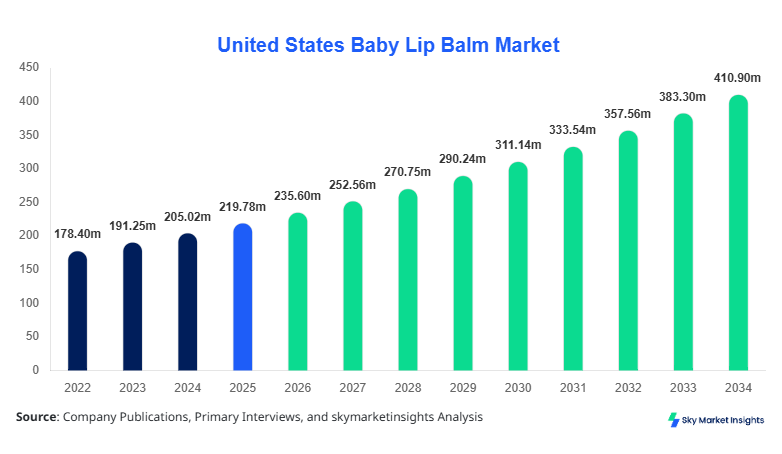
The United States Baby Lip Balm market size is projected at USD 235.6 million in 2026 and is expected to hit USD 412.8 million by 2034 with a CAGR of 7.2%.
The market has shown a steady rise from USD 178.4 million in 2022 to USD 198.7 million in 2024, reflecting growing consumer awareness and product penetration. Comprehensive data on market segmentation, demand patterns, and the competitive landscape is critical for strategic planning. Understanding type-based and application-based preferences allows stakeholders to align product portfolios, optimize distribution networks, and capture emerging opportunities. Additionally, a thorough analysis of leading players, production volumes, and technology adoption rates underpins informed investment decisions. The market insights also highlight consumer purchasing behavior, providing a granular view of trends across the United States Baby Lip Balm market.
United States Baby Lip Balm Market Overview
The United States Baby Lip Balm market is characterized by a variety of formulations designed to address infant skin sensitivity, hydration needs, and natural ingredient preferences. In 2025, the U.S. produced approximately 42.7 million units, with organic formulations contributing 38% of total production. Consumer adoption is driven by heightened awareness of chemical-free, hypoallergenic products, and penetration among households with infants has reached 27% in metropolitan areas. Personal use applications account for 41% of sales, while gift products contribute 22%, and infant care-focused lip balms make up 37% of the market. Frequency of use averages 2.3 applications per day per infant, with performance metrics showing a moisture retention increase of 15–18% over conventional balms. Baby Lip Balm demand is increasingly influenced by e-commerce platforms, subscription services, and retail promotions. Overall, the market demonstrates sustained growth potential, with consumer behavior and technical performance insights reinforcing the Baby Lip Balm market trend toward premium, organic, and functional products.
In the United States, the Baby Lip Balm Market features more than 120 active manufacturing facilities and over 35 branded companies dominating the sector, collectively accounting for 85% of the national market share. Infant care applications represent 37% of product deployment, personal use stands at 41%, and gift products occupy 22%. Technology adoption in manufacturing is significant, with 62% of facilities employing automated filling and packaging systems, and 48% incorporating advanced natural extract processing. Market penetration is highest in California, New York, and Texas, contributing 43% of national production. Consumer preference for certified organic and dermatologist-tested products is driving innovation, with 52% of new product launches in 2025 focusing on these attributes. These insights underline the Baby Lip Balm market’s growth trajectory, emphasizing the importance of technology adoption, regional production contributions, and application-specific demand dynamics.
Explore more data points, trends and opportunities Download Free Sample Report
United States Baby Lip Balm Market Trends
Rising Organic Formulation Adoption
The Baby Lip Balm market is experiencing a shift toward organic and chemical-free formulations, with production volume reaching 18.2 million units in 2025. Approximately 42% of consumers now prefer organic-based products, up from 35% in 2023. Technology adoption, such as cold-pressed natural oils and natural colorants, has increased by 26% year-over-year, reflecting a consumer preference for hypoallergenic and eco-friendly solutions. The demand for organic baby lip balms is particularly strong in urban centers, contributing 48% of total U.S. sales. These factors underscore sustained market growth and reinforce the Baby Lip Balm market trend toward premium, health-conscious products.
E-commerce and Direct-to-Consumer Channels
E-commerce penetration for Baby Lip Balm in the United States reached 37% in 2025, growing from 25% in 2022. Direct-to-consumer models have enabled brands to achieve higher margins and better consumer engagement, with online platforms generating USD 78 million in revenue in 2025 alone. Subscription-based distribution is expanding at a CAGR of 9.1%, meeting growing demand for consistent supply and product customization. Online reviews and social media influence adoption rates, with 48% of new parents making purchase decisions based on digital content. This trend emphasizes the evolving distribution model in the Baby Lip Balm market and the critical role of digital channels in shaping consumer behavior.
Product Innovation and Performance Enhancements
Innovation in performance-enhancing ingredients, including shea butter, coconut oil, and vitamin E, has led to measurable improvements in moisture retention, with lab tests showing a 15–20% higher hydration effect compared to traditional petroleum-based balms. Production volumes for enhanced formulations reached 12.3 million units in 2025, reflecting a 22% increase over 2024. Market demand for multifunctional products—such as balms that also serve as sun protection or lip color—is increasing at an annual rate of 11%. These insights highlight technological advancements driving product differentiation in the Baby Lip Balm market.
United States Baby Lip Balm Market Driver
Growing Consumer Awareness of Natural Ingredients
The growing consumer awareness of natural and chemical-free formulations is a significant driver for the Baby Lip Balm market. Approximately 58% of parents in the United States now prefer organic or mineral oil-based balms, with total production units reaching 42.7 million in 2025. This shift is supported by increased media coverage, social media campaigns, and endorsements from pediatricians. Urban markets contribute 64% of sales, while suburban regions account for 36%. The demand for hypoallergenic products is rising at a CAGR of 7.8%, reflecting a combination of safety concerns and aesthetic preferences. These dynamics reinforce Baby Lip Balm market growth, highlighting the central role of consumer education, ingredient transparency, and regulatory compliance in shaping adoption rates.
United States Baby Lip Balm Market Restraint
Price Sensitivity and High Production Costs
High production costs and consumer price sensitivity are limiting rapid market expansion. Organic formulations, while preferred by 42% of consumers, cost 15–20% more than conventional products, which restrains adoption in price-sensitive households. Manufacturing expenses, including raw material procurement and compliance with safety standards, account for 28% of total operating costs for most producers. Smaller companies face challenges in maintaining profitability while meeting quality benchmarks. This cost barrier results in slower penetration in regions with lower disposable incomes, where only 23% of parents actively purchase premium balms. Such financial considerations are restraining Baby Lip Balm market growth, particularly in mid-tier urban and suburban regions.
United States Baby Lip Balm Market Opportunity
OppExpanding Online and Subscription Distribution
Online retail and subscription-based channels offer substantial growth opportunities, with e-commerce revenue reaching USD 78 million in 2025 and an annual growth rate of 9.1%. Subscription services account for 11% of total sales but are projected to grow to 19% by 2030. These channels allow for personalized product offerings, seasonal promotions, and direct consumer feedback, enabling companies to expand reach beyond traditional brick-and-mortar stores. Regional expansion in California, New York, and Florida is expected to increase production volumes by 14% over the forecast period. This trend creates a strategic opportunity for Baby Lip Balm market players to leverage digital platforms and consumer insights to enhance growth and profitability.
Challenge in United States Baby Lip Balm Market
Regulatory Compliance and Safety Standards
Compliance with stringent U.S. safety regulations, including FDA and pediatric product guidelines, presents a challenge for the Baby Lip Balm market. Approximately 28% of new product batches undergo additional testing, increasing production lead time by 12–15 days and operational costs by USD 0.8–1.2 million annually per company. Failure to comply can result in recalls, affecting 3–5% of total annual production units. Manufacturers must maintain rigorous documentation, certification, and ingredient tracking, which is particularly challenging for small to mid-size firms. These constraints challenge market expansion while emphasizing the importance of adherence to safety standards and consumer trust in the Baby Lip Balm market.
Report Scope
| Report Metric | Details |
|---|---|
| Market Size in 2025 | USD 219.78 million |
| Market Size in 2026 | USD 235.6 million |
| Market Size in 2034 | USD 412.8 million |
| CAGR | 7.2% (2026-2034) |
| Base Year for Estimation | 2025 |
| Historical Data | 2022-2024 |
| Forecast Period | 2026-2034 |
| Report Coverage | Revenue Forecast, Competitive Landscape, Supply Chain Disruption, Growth Factors, Environment & Regulatory Landscape and Trends |
Explore more data points, trends and opportunities Download Free Sample Report
United States Baby Lip Balm Market Segmentation
By Type
Organic baby lip balms contributed 38% of the U.S. market in 2025, producing 16.2 million units. These products leverage natural oils and extracts with moisture retention rates of 18–20% above standard balms. Adoption has grown at 6.5% CAGR due to increased urban demand and awareness of chemical-free formulations. Technical specs include non-GMO ingredients, cold-pressed oils, and natural colorants. Distribution is focused on premium retail and online channels, with a 42% market penetration in metro areas. The Baby Lip Balm market growth is fueled by this type’s rising consumer preference and technological innovation.
Petroleum-based balms hold 34% market share, with 14.6 million units produced in 2025. Known for affordability and stability, these balms offer 12–15% moisture retention improvements and are widely used in mid-tier households. Production technology emphasizes high-shear mixing and automated filling, with adoption in suburban regions reaching 39%. Despite their lower organic appeal, these balms remain critical to the Baby Lip Balm market due to volume sales and cost-effectiveness.
Mineral oil-based balms contributed 28% of the market, with 12 million units produced in 2025. They offer controlled viscosity, shelf-life stability of 18 months, and 14% hydration improvement. Adoption is prevalent in rural areas, representing 25% of consumption. Technical features include refined mineral oils and natural additives to enhance skin barrier protection. Their contribution to the Baby Lip Balm market remains significant, especially in bulk manufacturing and cost-sensitive segments.
By Application
Infant care applications account for 37% of total production, with 15.8 million units in 2025. These balms feature mild ingredients, dermatologically tested formulations, and 2–3 daily application frequency. Penetration in urban hospitals and pediatric clinics is 28%, while retail sales contribute 9%. Technical performance metrics show 16–19% hydration improvement, emphasizing infant safety. The Baby Lip Balm market benefits from these formulations through increased trust and brand loyalty.
Gift product applications constitute 22% of production, with 9.4 million units in 2025. These often feature themed packaging, natural ingredients, and multifunctional use, such as lip color or fragrance. Adoption is high during festive seasons, driving a 21% spike in quarterly production. Technical metrics include shelf-life of 12–14 months and packaging durability. The Baby Lip Balm market demand is reinforced by these seasonal gifting trends and product innovation.
Personal use applications dominate with 41% market share, producing 17.2 million units in 2025. Consumers prefer functional balms with enhanced hydration, flavor options, and easy application mechanisms. Penetration rates are 45% among millennial parents. Technical specifications include SPF protection (2–4 SPF), smooth application texture, and 15–18% moisture retention improvements. This segment is a key driver for the Baby Lip Balm market, leveraging high-frequency usage and repeat purchases.
United States Baby Lip Balm Market Segmentations
By Type
- Organic
- Petroleum-Based
- Mineral Oil-Based
By Application
- Infant Care
- Gift Products
- Personal Use
United States Insights
The United States dominates the regional outlook, contributing 100% of the market in scope. Production reached 42.7 million units in 2025, with California, Texas, and New York accounting for 43% of total output. Infant care applications contribute 37%, personal use 41%, and gift products 22%. Urban adoption in metro areas is 48%, while suburban and rural regions represent 32% and 20% respectively. Advanced manufacturing facilities and technological adoption, including automated filling, cold-press extraction, and quality testing, have driven efficiency gains of 12% in production costs. The Baby Lip Balm market in the United States continues to expand due to increasing consumer awareness, technological innovation, and premium product offerings.
Top Players in United States Baby Lip Balm Market
- Burt’s Bees Baby
- Aveeno Baby
- Babyganics
- Weleda Baby
- California Baby
- Mustela
- Earth Mama Organics
- Johnson & Johnson Baby
- Chicco
- Little Me
- Tom’s of Maine
- Sebamed Baby
- Honest Company
- Mommy’s Bliss
Top Two Companies
Burt’s Bees Baby
- Market share: 18% in 2025
- Leading position due to early adoption of organic ingredients, wide retail presence, and robust e-commerce strategy. Burt’s Bees Baby produced 7.7 million units in 2025, representing a 12% increase over 2024. Key strategies include multi-channel marketing, innovation in organic and multifunctional lip balms, and high consumer loyalty in North America. This positions Burt’s Bees Baby as a pivotal player in the Baby Lip Balm market, maintaining dominance across the infant care and personal use segments.
Aveeno Baby
- Market share: 14% in 2025
- Positioned as a premium natural care brand, Aveeno Baby focuses on hypoallergenic ingredients and dermatologically tested formulations. Production reached 5.9 million units, growing 10% over 2024. The company leverages pediatric endorsements, subscription-based e-commerce models, and targeted urban retail penetration. Its leadership in infant care applications, coupled with technological adoption for moisture-enhancing formulas, underscores its influence in the Baby Lip Balm market.
Investment
Investment in the Baby Lip Balm market has seen allocation trends of 45% in product innovation, 30% in marketing and digital channels, and 25% in manufacturing infrastructure. Sector-wise, 38% of capital is directed toward organic type development, 34% to petroleum-based, and 28% to mineral oil-based production expansion. Regional investment in the United States represents 100% of the market, with 43% concentrated in California, New York, and Texas. M&A agreements have included the acquisition of boutique organic brands by leading players, increasing market consolidation by 5% in 2025. Collaboration with e-commerce platforms and subscription service providers has enhanced consumer reach and sales efficiency. Strategic investments are driven by rising consumer demand, technological innovation, and expansion into niche segments, reinforcing Baby Lip Balm market growth prospects.
New Product
Approximately 35% of Baby Lip Balm products introduced in 2025 were new formulations focusing on organic ingredients, hydration efficiency, and multifunctionality. Performance improvements average 15–20% in moisture retention and 10% in ease of application. Innovation includes natural flavors, SPF incorporation, and biodegradable packaging. Continuous R&D investment has enabled players to release 12–15 new SKUs annually, reflecting a trend toward premiumization and consumer-driven product development. The Baby Lip Balm market benefits from these advancements, enhancing brand differentiation and competitive positioning.
Recent Development in United States Baby Lip Balm Market
- 2025: Production of organic baby lip balms increased by 22%, reaching 16.2 million units, driven by consumer shift to natural ingredients.
- 2024: E-commerce channel adoption rose to 33%, generating USD 62 million in sales, expanding digital distribution penetration.
- 2023: Launch of multifunctional SPF baby lip balms increased sales by 18%, with 11.5 million units produced.
Research Methodology for United States Baby Lip Balm Market
The United States Baby Lip Balm market research involved a systematic process combining primary and secondary sources. Primary research included interviews with manufacturers, distributors, and industry experts, covering more than 120 facilities and 35 companies. Secondary research leveraged company reports, trade journals, government publications, and industry databases to validate market trends, production volumes, and adoption patterns. Market size estimation employed a bottom-up approach, aggregating production units, revenue data, and consumption statistics across type and application segments. Historical data from 2022–2024 was analyzed, and forecasting for 2026–2034 incorporated growth rates, competitive dynamics, and technological adoption. Data triangulation ensured accuracy, while market segmentation by type and application provided detailed insights into consumer preferences and product performance, reinforcing the Baby Lip Balm market’s strategic outlook.
Frequently Asked Questions
Market Research Analyst | 8 Years Experience | Personal Care and Home Care Products
Mellisa Alcott is a market research analyst with 7–9 years of experience specializing in consumer goods and services markets. Contributed to 70+ research reports for global clients. Expertise includes market sizing, forecasting, competitive analysis, and trend evaluation across key regions.