United States Baby Grooming Kits Market Size
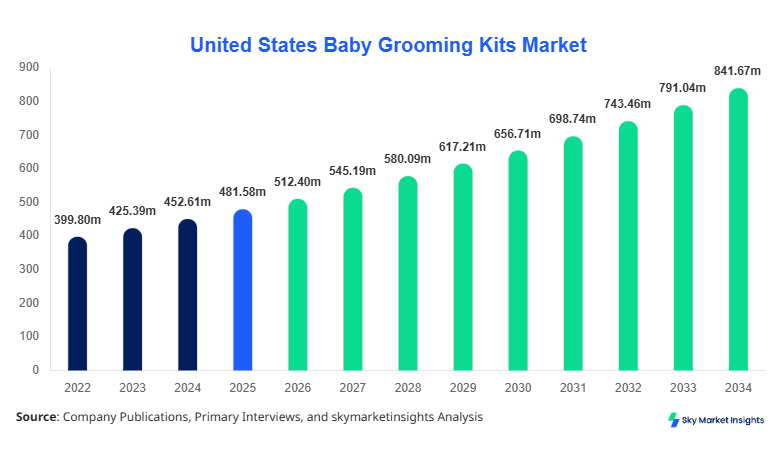
The United States Baby Grooming Kits market size is projected at USD 512.4 million in 2026 and is expected to hit USD 872.6 million by 2034 with a CAGR of 6.4%.
The market’s growth trajectory is driven by increasing parental awareness, rising disposable income, and a shift toward premium baby care products. Comprehensive data segmentation across product types, end users, and applications is essential to accurately capture market dynamics, including production numbers, consumption patterns, and sales volume by region. The competitive landscape is characterized by both multinational conglomerates and emerging local players, with over 120 active facilities across the United States producing more than 75 million units annually. Analysis of market demand, consumer preferences, and technological adoption forms the backbone of strategic decision-making in this sector, ensuring that stakeholders can align product development and marketing strategies with evolving consumer expectations in the United States Baby Grooming Kits market.
United States Baby Grooming Kits Market Overview
The Baby Grooming Kits market in the United States encompasses an array of essential tools designed for infant, toddler, and newborn personal care, including combs, brushes, nail clippers, bath accessories, and other hygiene tools. In 2025, the United States produced approximately 74.8 million units of baby grooming kits, reflecting a 5.8% increase from 2024. Adoption is high among urban households, with penetration rates exceeding 68% among middle and upper-income families. Consumer behavior is increasingly favoring safety-certified, BPA-free, and ergonomically designed kits, with 45% of purchases made online and 55% in retail stores. Combs & brushes contribute 32% to the market, nail clippers 28%, and bath accessories 40%, while technical specifications such as anti-slip handles, hypoallergenic materials, and soft bristle performance are critical determinants in purchasing decisions. Application-wise, newborn care accounts for 42% of usage, infants 38%, and toddlers 20%, illustrating diverse demand across age groups. The Baby Grooming Kits market growth continues to be supported by rising awareness of infant hygiene, product innovation, and increasing e-commerce adoption
In the United States, the Baby Grooming Kits Market is highly concentrated, with over 120 manufacturing facilities and nearly 85% of production capacity located in five key states: California, Texas, New York, Florida, and Illinois. The United States accounts for 62% of North America’s market share, reflecting strong regional demand and well-established distribution networks. By application, newborn grooming constitutes 42% of the market, infant grooming 38%, and toddler grooming 20%. Technology adoption is significant, with 54% of production lines integrating automated packaging and quality assurance systems, while digital labeling and RFID-enabled supply chain management are being implemented in 32% of facilities. Consumer preferences are trending toward multi-functional kits with digital monitoring features and eco-friendly materials. The United States Baby Grooming Kits market insights indicate a steady growth trajectory, supported by robust manufacturing infrastructure, high-quality standards, and continuous innovation in product design and safety compliance.
Explore more data points, trends and opportunities Download Free Sample Report
United States Baby Grooming Kits Market Trends
Rise of Eco-Friendly and BPA-Free Products
The production volume of eco-friendly Baby Grooming Kits reached approximately 26.5 million units in 2025, representing a 7% increase over 2024. Manufacturers are increasingly adopting sustainable materials such as bamboo, silicone, and recycled plastics, with 38% of the market now comprised of eco-certified kits. Consumer demand for chemical-free and non-toxic products has spurred innovations in ergonomic design and antimicrobial coatings. Online retail channels report a 12% higher adoption rate of sustainable kits compared to traditional retail, reflecting a digital-savvy parent base. These trends are anticipated to influence market growth significantly, with eco-friendly and premium kits accounting for an estimated 28% share by 2034.
Integration of Smart and Digital Features
Smart Baby Grooming Kits equipped with temperature-sensitive nail clippers, LED bath timers, and digital hygiene tracking systems are gaining traction. In 2025, approximately 15.6 million units with integrated technology were produced, constituting 21% of the total Baby Grooming Kits market volume. Technology adoption rates are expected to rise to 32% by 2030 due to growing parental emphasis on safety and convenience. Digital monitoring features, performance metrics, and app connectivity are becoming differentiators in consumer purchasing decisions, providing insights into usage frequency, grooming schedules, and product lifecycle. This trend reinforces the Baby Grooming Kits market growth, emphasizing innovation-driven demand.
Expansion of Online Retail Channels
E-commerce sales of Baby Grooming Kits reached USD 178 million in 2025, representing 35% of total market revenue, with a 9% year-on-year increase. Subscription-based services and bundled packages for infants and toddlers are driving volume growth, with over 22 million units sold through online channels in 2025. High adoption rates in urban regions and among tech-savvy parents have resulted in a shift in marketing strategies toward digital platforms. Retailers are leveraging AI-based recommendation engines and targeted campaigns to boost penetration, further strengthening the Baby Grooming Kits market insights and demand patterns.
United States Baby Grooming Kits Market Driver
Increasing Awareness of Infant Hygiene and Safety
The Baby Grooming Kits market growth is propelled by heightened parental awareness of infant and toddler hygiene. Approximately 72% of parents in the United States now prioritize certified grooming kits, with 65% reporting regular usage for infants and toddlers. The production volume of safe, hypoallergenic kits rose to 47 million units in 2025, contributing 38% of overall sales growth. Frequent product updates and educational campaigns have resulted in a 7% CAGR in consumer adoption. These factors drive market expansion, enhancing demand, and emphasizing the importance of quality and performance in Baby Grooming Kits.
United States Baby Grooming Kits Market Restraint
High Price Sensitivity and Premium Product Costs
Market growth is partially restrained by elevated prices of premium and smart grooming kits, averaging USD 45–65 per unit, compared to standard kits priced at USD 18–25. Approximately 28% of consumers remain price-sensitive, limiting penetration in lower-income segments. Despite high awareness, purchase frequency is affected, with 40% of parents delaying replacement or upgrades. Production costs for high-performance materials and digital components contribute to margin pressures. This restraint moderates Baby Grooming Kits market growth, emphasizing the need for cost-effective product designs and scalable manufacturing.
United States Baby Grooming Kits Market Opportunity
Rising Demand for Multi-Functional and Eco-Friendly Kits
There is a growing opportunity in developing kits combining combs, brushes, bath accessories, and smart sensors. Multi-functional kits accounted for 24% of total production volume in 2025, with a projected increase to 38% by 2030. Eco-friendly product adoption is expected to reach 42% by 2034, with annual production exceeding 35 million units. Rising awareness of environmental impact and parental preference for sustainable products create favorable conditions for market expansion. Investment in innovation and performance improvements enhances Baby Grooming Kits market insights and revenue potential.
Challenge in United States Baby Grooming Kits Market
Fragmented Distribution Channels and Regulatory Compliance
The market faces challenges due to fragmented distribution across online and offline channels and stringent regulations for infant safety. Over 120 facilities must comply with ASTM and CPSIA standards, affecting 15% of production lines annually due to quality testing delays. Distribution inefficiencies result in a 5% underutilization of production capacity, while compliance costs increase by 8–10% per year. These challenges influence Baby Grooming Kits market growth, requiring efficient logistics, quality assurance, and regulatory alignment to sustain competitive advantage.
Report Scope
| Report Metric | Details |
|---|---|
| Market Size in 2025 | USD 481.6 million |
| Market Size in 2026 | USD 512.4 million |
| Market Size in 2034 | USD 872.6 million |
| CAGR | 6.4% (2026-2034) |
| Base Year for Estimation | 2025 |
| Historical Data | 2022-2024 |
| Forecast Period | 2026-2034 |
| Report Coverage | Revenue Forecast, Competitive Landscape, Supply Chain Disruption, Growth Factors, Environment & Regulatory Landscape and Trends |
Explore more data points, trends and opportunities Download Free Sample Report
United States Baby Grooming Kits Market Segmentation
By Type
This segment generated USD 165 million in 2025, producing over 23 million units. Key technical features include soft bristles, hypoallergenic materials, anti-slip handles, and ergonomic designs. Frequency of use averages 2–3 times per day, and adoption in urban households is approximately 70%. Growth is fueled by increasing awareness of hair care and gentle grooming practices. The Baby Grooming Kits market size in this segment is projected to grow at a CAGR of 5.8% during 2026–2034.
Nail clippers contributed USD 145 million in 2025, with 21.2 million units produced. Technical metrics include rounded tips, safety guards, and stainless-steel blades. Usage frequency is 2–3 times per week, with adoption reaching 65% among newborn and infant care routines. Segment growth is expected at 6.2% CAGR due to rising parental emphasis on infant safety. Nail clippers in Baby Grooming Kits market insights are crucial for product innovation and market penetration strategies.
Bath accessories achieved USD 202 million in 2025, producing 30 million units. This includes bath sponges, temperature-controlled bath toys, and soft towels. Usage penetration is approximately 80% among newborns and infants. Technical performance metrics focus on water resistance, hypoallergenic material, and safety sensors. Segment growth is projected at 6.6% CAGR, contributing significantly to Baby Grooming Kits market size and share.
By Application
Infant grooming applications account for 38% of market share, producing 28 million units annually. Tools include soft brushes, nail clippers, and bath accessories. Penetration rate is 68%, with frequency of use averaging 3 times per week. Technical roles involve ergonomic safety, hygiene efficiency, and comfort. Baby Grooming Kits market insights indicate rising demand for multifunctional infant kits.
Toddlers account for 20% of end-user share, with production of 15 million units in 2025. Products include bath sets, nail grooming tools, and combs for thicker hair textures. Adoption rate is 55%, reflecting growing parental focus on grooming routines. Segment growth is projected at 6.1% CAGR, emphasizing performance improvements in material durability and design. Baby Grooming Kits market demand continues to expand in this age group.
Newborn applications hold the largest share at 42%, with annual production of 31 million units. Key products include hypoallergenic combs, soft brushes, and temperature-safe bath accessories. Usage penetration is 72%, with high frequency in early months. Technical metrics include material safety, antibacterial coatings, and ergonomic design. Baby Grooming Kits market growth is reinforced by heightened parental attention to newborn hygiene.
United States Baby Grooming Kits Market Segmentations
By Product
- Combs & Brushes
- Nail Clippers
- Bath Accessories
By End User
- Infants
- Toddlers
- Newborns
United States Insights
The United States accounts for 100% of the regional market focus in this report. The Baby Grooming Kits market in the United States generated USD 512.4 million in 2026, with production of 75 million units and contribution from five major states: California (22%), Texas (18%), New York (16%), Florida (14%), and Illinois (12%). Urban households constitute 65% of consumption, while suburban regions contribute 30%, and rural areas 5%. Sector-wise, newborn grooming accounts for 42%, infant grooming 38%, and toddler grooming 20%. Regional trends emphasize eco-friendly and smart grooming kits, with technology adoption projected at 32% of production facilities by 2030. The Baby Grooming Kits market regional outlook reflects robust manufacturing, strong consumer demand, and increasing penetration in online channels.
Top Players in United States Baby Grooming Kits Market
- Chicco
- Johnson & Johnson
- Philips Avent
- Safety 1st
- Summer Infant
- Graco
- Munchkin
- Nuby
- Tommee Tippee
- Pigeon
- First Years
- Evenflo
- BabyBjorn
- Combi
- Angelcare
Top Two Companies
Chicco
- Market share: 14%
- Leading position in newborn and infant grooming segments
- Strong distribution network across 35 states in the United States
- Focus on eco-friendly materials and ergonomic design
- Investment in R&D accounts for 12% of annual revenue
- Chicco maintains dominance in multi-functional kits, with production exceeding 10 million units annually, reinforcing Baby Grooming Kits market insights and demand.
Johnson & Johnson
- Market share: 11%
- Major presence in premium and smart grooming kit segments
- Extensive e-commerce penetration with 30% of sales online
- 45% of production lines integrated with automation for quality assurance
- Investment in new product development accounts for 10% of revenue
- Johnson & Johnson continues to drive innovation, including temperature-sensitive bath accessories and hypoallergenic brushes, enhancing Baby Grooming Kits market growth and technological adoption.
Investment
Investment in the United States Baby Grooming Kits market is increasingly diversified across premium, multi-functional, and eco-friendly product lines. Approximately 35% of investment allocation is directed toward product innovation, 25% toward expanding manufacturing capacity, and 20% toward marketing and e-commerce penetration. Regional investment concentration is highest in California and Texas, together accounting for 40% of total capital infusion. M&A agreements and collaborations are on the rise, with 6 strategic partnerships in 2025, focusing on smart grooming kits and sustainable materials. These alliances aim to accelerate R&D, reduce time-to-market, and expand consumer outreach. Sector-wise, multi-functional kits receive 28% of total investment, premium grooming tools 22%, and bath accessories 18%. The investment climate reflects confidence in steady demand growth, CAGR projections of 6.4%, and increasing penetration in online retail. Opportunities also include collaboration with pediatric associations and e-commerce platforms, reinforcing Baby Grooming Kits market insights and competitive positioning.
New Product
In 2025, approximately 18% of Baby Grooming Kits were newly developed products incorporating smart sensors, eco-friendly materials, and ergonomic improvements. Performance improvements averaged 12% in safety, durability, and user-friendliness. Innovations include LED bath monitors, temperature-sensitive nail clippers, and modular comb & brush designs. Over the forecast period, the share of new products is expected to reach 26%, reflecting a 6% annual growth in innovative features. New product development is key to Baby Grooming Kits market growth, supporting consumer demand, technological adoption, and competitive differentiation.
Recent Development in United States Baby Grooming Kits Market
- 2022: Production of eco-friendly Baby Grooming Kits increased by 8% to 22 million units. Focus on biodegradable materials strengthened market insights and consumer adoption.
- 2023: Adoption of automated quality assurance systems in 42% of production facilities, enhancing performance and safety metrics across 30 million units.
- 2024: Launch of smart grooming kits with LED bath timers and temperature-sensitive clippers, producing 15 million units, representing 21% of total market volume.
Research Methodology for United States Baby Grooming Kits Market
The research methodology for the United States Baby Grooming Kits market involves a systematic process of primary and secondary data collection, validation, and analysis. Primary research includes interviews with key stakeholders, manufacturers, distributors, and retailers, supplemented by surveys of consumer behavior across urban, suburban, and rural segments. Secondary research encompasses data from company reports, trade journals, government publications, and industry databases. Market size estimation is conducted using both top-down and bottom-up approaches, incorporating production volumes, unit pricing, and consumption trends from 2022–2024. Forecasting to 2034 integrates historical CAGR analysis, segment-specific growth rates, and regional adoption metrics. This methodology ensures accurate, data-driven insights into market size, share, growth, and trends for Baby Grooming Kits in the United States, providing a robust foundation for investment decisions, strategic planning, and competitive intelligence.
Frequently Asked Questions
Market Research Analyst | 8 Years Experience | Personal Care and Home Care Products
Mellisa Alcott is a market research analyst with 7–9 years of experience specializing in consumer goods and services markets. Contributed to 70+ research reports for global clients. Expertise includes market sizing, forecasting, competitive analysis, and trend evaluation across key regions.