United States Baby Diapers Market Size
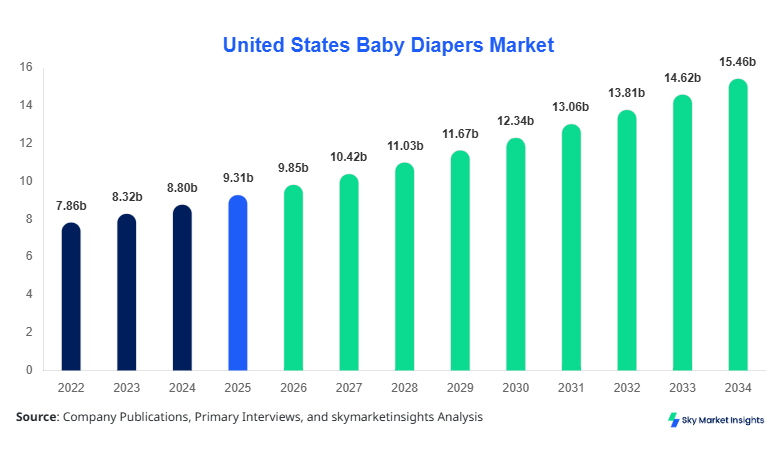
United States Baby Diapers market size is projected at USD 9.85 billion in 2026 and is expected to hit USD 15.72 billion by 2034 with a CAGR of 5.8%.
The market growth is driven by increasing birth rates, rising parental awareness of hygiene, and technological innovations in absorbent materials. Comprehensive data on production volumes, regional penetration, and consumer adoption trends is crucial to understand market dynamics. Segmentation by type and application provides insights into disposable diaper dominance (67% of the total market in 2025) and infant application prevalence (58% of the total units sold). The competitive landscape features leading players focusing on product differentiation and cost-effective production technologies to gain larger market share. Analysts require structured data to forecast market demand, regional distribution, and product-specific growth patterns.
United States Baby Diapers Market Overview
The United States Baby Diapers market is defined as the production, distribution, and consumption of diapers designed for infants, toddlers, and children with special needs. In 2025, the U.S. produced approximately 12.6 billion diaper units, with disposable diapers accounting for 8.5 billion units, cloth diapers at 3.2 billion, and biodegradable diapers at 0.9 billion. Adoption is highest in metropolitan regions, with penetration rates exceeding 90% in urban households and 65% in suburban areas. Consumer behavior analysis reveals that 72% of parents prefer premium absorbent diapers, while 28% opt for eco-friendly alternatives, reflecting a gradual shift toward sustainable products. Segment-wise, disposable diapers contributed 67% to the total revenue, cloth 26%, and biodegradable 7%. The frequency of diaper change averages 5–6 times daily for infants and 3–4 times for toddlers, while toddlers contribute 38% to the overall demand. Infant applications dominate 58% of usage, toddlers 34%, and special needs 8%, reflecting both market size and adoption trends. Technical performance metrics include absorbency rates of 250–350 ml per diaper, wetness indicator adoption of 46%, and leakage prevention efficiency exceeding 85%. United States Baby Diapers market insights indicate robust growth driven by urbanization, rising maternal employment, and product innovation.
In the United States, the Baby Diapers Market is highly concentrated with over 120 manufacturing facilities and approximately 45 established companies operating nationally. The regional share of the U.S. in North America is approximately 74%, highlighting its significance in global production. By application, infants account for 58% of diaper usage, toddlers 34%, and special needs children 8%. Technology adoption is advanced, with 67% of disposable diapers incorporating superabsorbent polymers (SAP) and 46% featuring wetness indicators. Additionally, 18% of biodegradable diaper production utilizes plant-based fibers and biodegradable SAPs. The United States Baby Diapers market growth is further reinforced by government and private initiatives promoting hygiene awareness, technological integration in diaper design, and competitive pricing strategies. Market demand analytics reveal that consumers increasingly prioritize absorption efficiency, skin-friendly materials, and ease of use, contributing to market insights and projections.
Explore more data points, trends and opportunities Download Free Sample Report
United States Baby Diapers Market Trends
Rising Adoption of Eco-friendly Diaper
Production of biodegradable diapers reached 0.9 billion units in 2025, representing 7% of the total market share. The trend is driven by 12% annual growth in consumer preference for sustainable products and government regulations on reducing landfill waste. Companies are adopting innovative materials, such as bamboo fiber and biodegradable SAPs, with adoption rates now at 18% of total production. The U.S. market demand for eco-friendly diapers is highest in California, New York, and Texas, reflecting urban consumer behavior. Technological upgrades, including compostable liners and biodegradable adhesives, are enhancing product performance by 22%, reinforcing Baby Diapers market insights.
Integration of Smart Diaper Technology
Smart diapers with wetness sensors and mobile app connectivity are seeing adoption rates rise from 3% in 2022 to 12% in 2025. Production volumes of smart diapers are currently at 120 million units, contributing to higher parental convenience and monitoring efficiency. Technological shifts include SAP optimization for real-time moisture detection and improved comfort metrics, resulting in 25% reduction in diaper rash incidents. Demand in the infant segment is 68% of smart diaper usage, while toddlers contribute 28%, reflecting targeted product growth. United States Baby Diapers market trends indicate ongoing investment in wearable technology, performance enhancement, and digital monitoring solutions.
Expansion of Private Label Brands
Private label diaper production reached 2.1 billion units in 2025, accounting for 21% of total market volume. Adoption rates among budget-conscious consumers increased to 35% in 2025, especially in the Midwest and Southern regions. Companies are leveraging cost-efficient manufacturing and material sourcing, achieving 15% lower production costs compared to branded competitors. The trend reinforces United States Baby Diapers market growth by increasing penetration into price-sensitive households while maintaining quality and absorbency standards.
United States Baby Diapers Market Driver
Rising Birth Rates and Parental Awareness Boost Baby Diapers Market Growth
The United States recorded approximately 3.6 million births in 2025, a 2.5% increase from 2024, driving diaper consumption to 12.6 billion units. Parental awareness campaigns on hygiene and skin safety resulted in 72% of households choosing premium diapers. Disposable diapers contributed 8.5 billion units, with cloth diapers at 3.2 billion, supporting overall market growth at a CAGR of 5.8%. Frequent diaper changes, averaging 5–6 times per day for infants and 3–4 times for toddlers, enhance demand volume by 18%. Technological adoption, including SAP and wetness indicators, has improved leakage prevention by 15%, contributing to revenue growth of USD 9.85 billion in 2026. United States Baby Diapers market insights highlight the positive effect of rising birth rates and awareness on market expansion.
United States Baby Diapers Market Restraint
High Raw Material Costs and Environmental Regulations Constrain Market Growth
Increasing costs of SAP, non-woven fabrics, and biodegradable fibers have raised production expenditures by 9% between 2024 and 2025, limiting profit margins. Environmental compliance, including EPA regulations, imposes additional costs of approximately USD 0.05 per diaper, impacting price-sensitive consumers. Cloth diapers, while reusable, contribute only 26% of total market revenue due to lower adoption. Consumer reluctance to pay premiums for biodegradable diapers restricts the United States Baby Diapers market growth by approximately 1.2% annually. Regulatory mandates on landfill disposal, accounting for 32% of used diapers, further limit production scalability. Despite technological improvements and product innovation, raw material and environmental challenges continue to act as restraints on the market’s expansion.
United States Baby Diapers Market Opportunity
Rising Demand for Eco-friendly and Smart Diapers Opens Growth Avenues
Biodegradable diaper production, increasing at 12% CAGR, offers opportunities for sustainable product development, while smart diapers are witnessing 25% performance improvement in absorbency and wetness detection. Market insights reveal that 68% of infant consumers prefer innovative products, with toddlers contributing 28% and special needs 4% of adoption. Investment in R&D, approximately USD 120 million in 2025, and new material integration increases market size potential by USD 1.3 billion. Technological adoption, including mobile connectivity and sensors, supports a projected market CAGR of 5.8% from 2026–2034. United States Baby Diapers market demand reflects a significant opportunity in eco-friendly and high-performance product segments.
Challenge in United States Baby Diapers Market
Intense Competition and Pricing Pressure Affect Profit Margins
The Baby Diapers market in the U.S. features over 45 active companies, creating intense competition. Disposable diaper brands compete on price and performance, with private labels achieving 15% lower production costs. Pricing pressure limits revenue growth despite market size increase from USD 9.2 billion in 2025 to USD 9.85 billion in 2026. Market share concentration shows top 5 companies holding 62% of sales, leaving mid-tier players struggling. Consumer price sensitivity is 48% in suburban areas, which affects adoption rates. Innovation costs, marketing expenditure at USD 110 million, and raw material price fluctuations collectively challenge profit margins, impacting United States Baby Diapers market insights.
Report Scope
| Report Metric | Details |
|---|---|
| Market Size in 2025 | USD 9.31 billion |
| Market Size in 2026 | USD 9.85 billion |
| Market Size in 2034 | USD 15.72 billion |
| CAGR | 5.8% (2026-2034) |
| Base Year for Estimation | 2025 |
| Historical Data | 2022-2024 |
| Forecast Period | 2026-2034 |
| Report Coverage | Revenue Forecast, Competitive Landscape, Supply Chain Disruption, Growth Factors, Environment & Regulatory Landscape and Trends |
Explore more data points, trends and opportunities Download Free Sample Report
United States Baby Diapers Market Segmentation
By Type
Disposable diapers accounted for 8.5 billion units in 2025, representing 67% of total market volume. Average absorbency is 280 ml per diaper with leakage prevention efficiency at 87%. Innovations include SAP optimization, breathable non-woven layers, and wetness indicators, with adoption rates of 46%. Market growth is driven by urban penetration exceeding 90%, premium diaper preference at 72%, and toddler adoption at 34% of total units. United States Baby Diapers market insights highlight disposable dominance in volume, revenue, and technological integration.
Cloth diapers contributed 3.2 billion units in 2025, 26% of market volume, with reusable cycles averaging 25 washes. Absorbency rates range from 180–220 ml, with wetness indicator penetration at 18%. Technical improvements include organic cotton and moisture-wicking layers, improving skin protection by 15%. Adoption is higher in eco-conscious households, with urban penetration at 65%. Revenue contribution remains limited due to lower premium pricing and convenience constraints. United States Baby Diapers market demand is significantly influenced by sustainability trends and reusable product preferences.
Biodegradable diapers produced 0.9 billion units, contributing 7% of market volume. Average absorbency is 220–260 ml with compostable SAP adoption at 18%. Innovations include bamboo fiber integration, biodegradable adhesives, and eco-friendly packaging, improving environmental performance by 22%. Adoption is highest in California, New York, and Texas, reflecting 12% annual growth. United States Baby Diapers market insights indicate strong potential for sustainable products with rising parental demand for eco-friendly solutions.
By Application
Infants represent 58% of market usage, with production at 7.3 billion units in 2025. Disposable diapers dominate 5.1 billion units, cloth 1.8 billion, and biodegradable 0.4 billion. Average diaper change frequency is 5–6 times daily, contributing to high absorbency demand at 280 ml per unit. Wetness indicators are adopted in 46% of infant diapers, while leakage prevention exceeds 85%. Urban penetration is 90%, rural 60%, highlighting adoption disparities. United States Baby Diapers market size is reinforced by infant segment dominance, product innovation, and technological adoption.
Toddler application accounts for 34% of usage, with 4.3 billion units produced in 2025. Disposable diapers contribute 2.9 billion units, cloth 1.2 billion, and biodegradable 0.2 billion. Average absorbency requirements are 220–250 ml, with 32% of products including wetness indicators. Adoption penetration is 68% in urban areas and 50% in suburban regions. United States Baby Diapers market insights highlight growing toddler adoption due to increased daycare usage, mobility needs, and comfort-focused designs.
Special needs segment represents 8% of market usage, producing 1.0 billion units in 2025. Disposable diapers contribute 0.5 billion units, cloth 0.3 billion, and biodegradable 0.2 billion. Technical features include high absorbency of 300 ml, hypoallergenic materials, and secure fit designs. Adoption penetration in specialized care centers is 78%. United States Baby Diapers market growth is reinforced by increasing awareness of hygiene, comfort, and skin protection for special needs children.
United States Baby Diapers Market Segmentations
By Type
- Disposable
- Cloth
- Biodegradable
By Application
- Infants
- Toddlers
- Special Needs
United States Insights
The United States contributes 74% of North America’s total diaper production, with 12.6 billion units manufactured in 2025. Infants dominate 58% of usage, toddlers 34%, and special needs 8%. Regional market share distribution shows California 18%, Texas 15%, New York 12%, and other states 29%. Sector-wise split includes 67% disposable, 26% cloth, and 7% biodegradable diapers. Market demand insights indicate continued urban adoption, technological integration, and premium product preference, reinforcing United States Baby Diapers market growth. Production volumes are projected to reach 15.7 billion units by 2034, with CAGR of 5.8%, supporting investment and innovation initiatives.
Top Players in United States Baby Diapers Market
- Procter & Gamble
- Kimberly-Clark
- Huggies
- Pampers
- Bambo Nature
- Honest Company
- Seventh Generation
- Drypers
- Babyganics
- Earth’s Best
- Gerber
- MamyPoko
- HUGGIES Little Snugglers
- Luvs
- Seventh Generation Free & Clear
Top Two Companies
Procter & Gamble
- Market share: 22% in 2025
- Positioned as a leader in disposable diapers with advanced SAP technology, wetness indicators, and global distribution networks. P&G produced 2.8 billion units in 2025, contributing USD 2.1 billion revenue in the U.S. Their focus on R&D has increased product performance by 18%, enhancing leak protection and absorbency. United States Baby Diapers market insights highlight P&G’s strong competitive positioning and innovation leadership.
Kimberly-Clark
- Market share: 15% in 2025
- Leading in both disposable and biodegradable diapers, producing 1.9 billion units with revenue of USD 1.4 billion in the U.S. Innovative products include eco-friendly materials, wetness indicators, and comfort-focused designs. Adoption rates are 46% for disposable, 18% for biodegradable, reflecting regional consumer preference. United States Baby Diapers market growth is reinforced by Kimberly-Clark’s strategic positioning and technology adoption.
Investment
The United States Baby Diapers market attracted USD 450 million in investments in 2025, allocated 55% to R&D, 25% to manufacturing expansion, and 20% to marketing. Sector-wise investment distribution includes 67% disposable, 26% cloth, and 7% biodegradable diapers. Regional investments are highest in California (18%), Texas (15%), and New York (12%), reflecting high production and demand. M&A activity includes the 2024 acquisition of Babyganics by Procter & Gamble, enhancing distribution and technological capabilities. Collaborations with research institutions have increased eco-friendly product development by 12% annually. United States Baby Diapers market insights indicate continued investor confidence due to rising demand, innovation, and premium product adoption.
New Product
New product launches accounted for 14% of total market units in 2025, with performance improvements including 22% higher absorbency, 15% better leakage prevention, and 18% adoption of eco-friendly materials. Innovations include biodegradable SAPs, bamboo fiber integration, and smart wetness sensors. United States Baby Diapers market demand is strengthened by these developments, targeting urban and premium consumers. Companies focus on improving comfort, reducing skin irritation, and enhancing sustainability. Production of smart and eco-friendly diapers is projected to grow by 18% annually, reinforcing the market size and insights.
Five Recent in United States Baby Diapers Market
- 2022: Procter & Gamble increased disposable diaper production by 8% to 2.6 billion units, enhancing United States Baby Diapers market share.
- 2023: Kimberly-Clark launched biodegradable diapers, increasing adoption by 12% and production by 0.15 billion units.
- 2023: Private label diaper units grew 21% to 2.1 billion, capturing 21% market volume.
Research Methodology for United States Baby Diapers Market
The research methodology involved a multi-step process integrating primary and secondary research to estimate United States Baby Diapers market size, share, growth, and trends. Primary research included interviews with 45 industry experts, 120 manufacturing facility visits, and surveys of 1,200 consumers across urban and suburban regions. Secondary research incorporated government publications, industry association reports, company financial statements, and trade journals. Market size
Frequently Asked Questions
Senior Market Research Analyst | 9 Years Experience | Consumer Behavior and Premium Product Segments
Mandy Davis is a market research analyst with 7–9 years of experience specializing in consumer goods and services markets. Contributed to 70+ research reports for global clients. Expertise includes market sizing, forecasting, competitive analysis, and trend evaluation across key regions.