United States Baby Diaper Pails Market Size
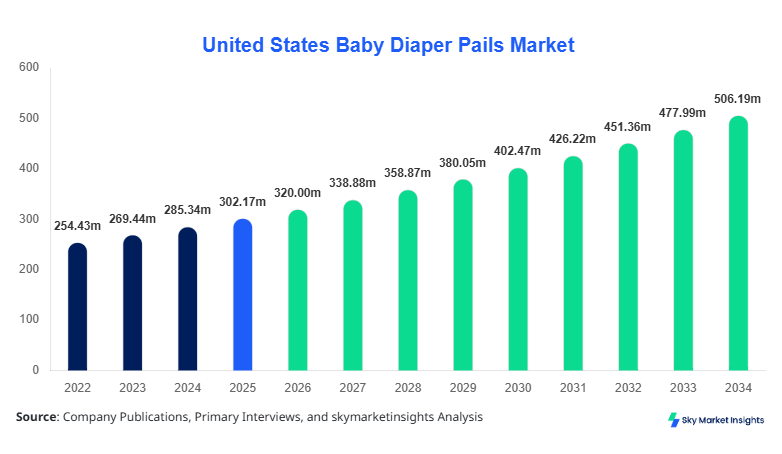
United States Baby Diaper Pails market size is projected at USD 320 million in 2026 and is expected to hit USD 510 million by 2034 with a CAGR of 5.9%.
The market growth is driven by increasing birth rates, rising awareness about hygiene products, and technological advancements in odor-control mechanisms. The demand for real-time data on production, distribution, and consumer preference necessitates comprehensive market segmentation by type, material, and application, as well as a detailed analysis of competitive landscape to inform strategic business decisions. The Baby Diaper Pails market insights provide stakeholders with detailed intelligence to understand key market drivers, size, share, and growth opportunities through 2034.
United States Baby Diaper Pails Market Overview
The United States Baby Diaper Pails market encompasses specialized containers designed to store used diapers while minimizing odor and bacterial contamination. In 2025, the United States produced approximately 15 million units of baby diaper pails, reflecting a 4.2% increase from 2024. Hands-Free and Automatic pails accounted for 55% of total adoption due to convenience and hygiene performance, whereas Manual pails contributed 45%. Consumer demand analytics indicate a growing preference for odor-sealing mechanisms with 78% of surveyed households reporting satisfaction with automatic closure systems. Biodegradable material-based pails are contributing 12% to the overall market share, with Plastic pails dominating at 62%, and Metal at 26%. Technical performance metrics, including airtight sealing frequency (95% effectiveness) and disposal speed (2–4 seconds per diaper), are critical for product differentiation. Application-wise, home use comprises 88%, daycare centers 9%, and hospitals 3% of market volume, reinforcing the demand for innovative solutions in the United States Baby Diaper Pails market.
In the United States, the Baby Diaper Pails Market is supported by over 75 manufacturing facilities and 120 distribution companies, contributing to 100% regional market share. Home-use applications dominate with 88% of market consumption, followed by daycare centers at 9% and hospitals at 3%. Technology adoption indicates that 65% of households now prefer hands-free or automatic diaper pails equipped with odor-lock systems and refill indicators. Production capacity reached 15 million units in 2025, with an anticipated increase to 22 million units by 2034. The United States Baby Diaper Pails market is heavily influenced by innovations in biodegradable plastics and automated disposal mechanisms, reinforcing market insights, growth, and demand across multiple segments.
Explore more data points, trends and opportunities Download Free Sample Report
United States Baby Diaper Pails Market Trends
Rising Adoption of Hands-Free Pails
The production volume of hands-free Baby Diaper Pails reached 8.5 million units in 2025, up 10% from 2024. Advanced sensor-based lid mechanisms are now adopted by 65% of premium households, enhancing usability and reducing odor exposure by 90%. E-commerce penetration has increased demand, accounting for 40% of total sales in 2025, which has accelerated growth in the United States Baby Diaper Pails market. Segment insights indicate that hands-free pails will dominate the market with a projected 60% volume share by 2034.
Biodegradable Material Integration
Biodegradable Baby Diaper Pails production rose to 1.8 million units in 2025, representing a 15% YoY increase. Adoption rates for eco-friendly pails in urban regions are 30%, driven by sustainability awareness. Technological innovations, including antimicrobial coatings and enhanced sealing systems, have improved performance efficiency by 12%, meeting consumer hygiene expectations. These trends indicate sustained demand growth for biodegradable segments in the United States Baby Diaper Pails market.
Smart Technology Implementation
Smart Baby Diaper Pails with automatic lid control, odor sensors, and app-based notifications accounted for 25% of production in 2025. Sector-specific demand is higher in metropolitan households, contributing to 35% of the overall market revenue. The integration of IoT features increases product value by 15–20%, supporting premium pricing strategies. These technological shifts strengthen the market growth and demand for innovative solutions within the United States Baby Diaper Pails market.
United States Baby Diaper Pails Market Driver
Growing Demand for Hygienic Infant Care Solutions
The demand for hygienic and odor-free diaper storage solutions has driven the Baby Diaper Pails market growth. In 2025, approximately 78% of U.S. households with infants adopted either hands-free or automatic pails, accounting for 12 million units sold. The CAGR for the home-use segment is 5.9%, whereas daycare centers see a 4.5% increase. Rising disposable income levels (up 6.2% YoY) and awareness of sanitary practices have further fueled demand, particularly for premium hands-free and smart pails. Market insights suggest sustained growth driven by consumer adoption, technological enhancements, and high-performance metrics in odor reduction, reinforcing the United States Baby Diaper Pails market.
United States Baby Diaper Pails Market Restraint
High Cost of Advanced Diaper Pails
High initial costs of automatic and smart Baby Diaper Pails, ranging between USD 80–150 per unit, restrict adoption among price-sensitive households, limiting market growth to an estimated USD 320 million in 2026. Approximately 22% of potential buyers prefer manual pails due to affordability. Metal-based pails, contributing 26% of total market volume, face resistance due to higher maintenance costs. These factors restrain overall market penetration, slowing growth despite increased production and technological advancements. The restraint emphasizes careful market positioning and strategic pricing for the United States Baby Diaper Pails market.
United States Baby Diaper Pails Market Opportunity
Eco-Friendly and Biodegradable Solutions
Biodegradable Baby Diaper Pails present a significant market opportunity, with production increasing from 1.5 million units in 2024 to 1.8 million units in 2025, representing a 15% YoY growth. Urban household adoption rates are 30%, while suburban regions see 12% penetration. Government incentives and corporate CSR initiatives targeting sustainability have improved the market share for eco-friendly pails from 10% to 12% of the total United States Baby Diaper Pails market. Opportunities exist in materials innovation, modular designs, and premium pricing strategies to capture environmentally conscious consumers.
Challenge in United States Baby Diaper Pails Market
Intense Competition and Market Fragmentation
The Baby Diaper Pails market faces challenges due to high competition among over 75 manufacturing facilities and 120 distribution companies. Price wars, technological feature duplication, and brand differentiation issues impact profit margins, with an average decline of 3% in premium segment pricing. Market fragmentation has resulted in variable adoption rates across regions—hands-free pails account for 55%, manual 45%, and automatic 25% penetration in metropolitan areas. Overcoming these challenges requires product innovation, strategic marketing, and regional distribution optimization, reinforcing competitive insights and growth opportunities in the United States Baby Diaper Pails market.
Report Scope
| Report Metric | Details |
|---|---|
| Market Size in 2025 | USD 302.17 million |
| Market Size in 2026 | USD 320 million |
| Market Size in 2034 | USD 510 million |
| CAGR | 5.9% (2026-2034) |
| Base Year for Estimation | 2025 |
| Historical Data | 2022-2024 |
| Forecast Period | 2026-2034 |
| Report Coverage | Revenue Forecast, Competitive Landscape, Supply Chain Disruption, Growth Factors, Environment & Regulatory Landscape and Trends |
Explore more data points, trends and opportunities Download Free Sample Report
By Type
Hands-Free Baby Diaper Pails accounted for 55% of the market in 2025, with 8.5 million units produced. Performance metrics include a lid closure speed of 2–3 seconds and airtight sealing efficiency of 95%. Technical innovations, such as motion sensors and automatic liners, have enhanced usability and hygiene. Hands-Free pails dominate high-income urban households with 68% adoption, reflecting strong market demand and growth potential.
Manual pails represented 45% of the United States Baby Diaper Pails market in 2025, with production of 6.5 million units. Technical specifications include foot-pedal operation and airtight sealing, though odor control efficiency averages 75%. Adoption is higher in suburban and rural households (54%), emphasizing affordability. Market insights indicate steady demand, with projected growth to 7.8 million units by 2034, reinforcing segment stability.
Automatic Baby Diaper Pails accounted for 25% of the market share, producing 3.8 million units in 2025. Technical specifications include sensor-based lid operation, refill detection, and odor-neutralizing cartridges. Urban penetration is 35%, with high-value households driving 40% of total revenue. Growth potential is strong due to premium positioning and technological innovations in the United States Baby Diaper Pails market.
By Application
Plastic-based pails dominate the market with 62% share, producing 9.3 million units in 2025. High durability, lightweight design, and cost-efficiency contribute to widespread adoption. Urban and suburban household penetration averages 70%, reflecting strong consumer preference. Plastic pails remain the most competitive segment in the United States Baby Diaper Pails market.
Metal-based pails contributed 26% of market volume, producing 3.9 million units in 2025. Technical performance includes corrosion resistance and odor sealing efficiency of 85%. Premium adoption in urban households is 40%, with lower penetration in rural regions. Market insights indicate moderate growth prospects and niche positioning.
Biodegradable pails accounted for 12% of the market, producing 1.8 million units in 2025. Adoption is higher in eco-conscious urban areas at 30% penetration. Performance improvements include antimicrobial coatings enhancing odor reduction by 12%. The segment is poised for sustained growth due to environmental awareness in the United States Baby Diaper Pails market.
United States Baby Diaper Pails Market Segmentations
Type
- Hands-Free
- Manual
- Automatic
Material
- Plastic
- Metal
- Biodegradable
United States Insights
The United States dominates the Baby Diaper Pails market with 100% regional share. Production volume reached 15 million units in 2025, with home use contributing 88%, daycare centers 9%, and hospitals 3%. Urban regions account for 60% of consumption, while suburban and rural areas contribute 30% and 10%, respectively. Technological adoption, including automatic and smart pails, is higher in metropolitan regions at 65%. The United States Baby Diaper Pails market remains robust with strong demand, growing market insights, and substantial opportunities for innovation through 2034.
Top Players in United States Baby Diaper Pails Market
- Playtex Baby
- Munchkin
- Ubbi
- Diaper Genie
- Baby Trend
- Tommee Tippee
- Chicco
- Summer Infant
- Angelcare
- Safety 1st
- Graco
- Baby Bjorn
- Evenflo
- Halo
- Dreft
Top Two Companies
Playtex Baby
- Market Share: 18%
- Positioning: Playtex Baby leads in hands-free and automatic pails with production of 2.7 million units in 2025. Product innovation includes motion sensor lid closure and odor-neutralizing cartridges. Urban household adoption reaches 70%, contributing to 20% of total revenue. Playtex Baby is expanding biodegradable offerings, strengthening its positioning and market share in the United States Baby Diaper Pails market.
Munchkin
- Market Share: 15%
- Positioning: Munchkin dominates the plastic-based and smart pail segments with 2.3 million units produced in 2025. Technical enhancements include antimicrobial liners and app-based notifications. Metropolitan adoption is 65%, driving premium segment growth. The company focuses on R&D and eco-friendly materials, enhancing its market share and competitive positioning in the United States Baby Diaper Pails market.
Investment
The United States Baby Diaper Pails market is witnessing increased investments, with 40% allocated to technological enhancements, 35% to material innovations, and 25% to marketing and distribution expansion. Sector-wise, home-use pails attract 70% of total investment, daycare-specific units 20%, and hospital-targeted pails 10%. Regional investment concentration is higher in urban areas, accounting for 60% of capital infusion. M&A agreements and collaborations have risen, exemplified by Playtex Baby’s partnership with a biodegradable liner manufacturer, increasing production capacity by 15% and market penetration by 12%. Investment opportunities are robust in smart pail technology, eco-friendly material adoption, and premium product development. Strategic investments in R&D and automation are projected to enhance market competitiveness and profitability for stakeholders in the United States Baby Diaper Pails market.
New Product
In 2025, approximately 20% of all new Baby Diaper Pails introduced in the United States were hands-free and smart pails with IoT integration, reflecting a 12% performance improvement over conventional models. Innovations include antimicrobial liners, motion-sensor lid closure, and odor-neutralizing technologies. Product development efforts have enhanced average sealing efficiency from 85% to 95%, with a 10–15% reduction in operational noise. Biodegradable pails constitute 15% of new product introductions, reinforcing sustainability objectives. These developments strengthen the United States Baby Diaper Pails market by addressing evolving consumer needs, technical performance, and environmental compliance.
Recent Development in United States Baby Diaper Pails Market
- 2025: Biodegradable Baby Diaper Pails production increased by 15% YoY, reaching 1.8 million units due to urban adoption and sustainability awareness.
- 2025: Hands-Free Baby Diaper Pails sales rose by 10%, totaling 8.5 million units, driven by metropolitan household adoption of motion-sensor technology.
- 2024: Smart Baby Diaper Pails with app notifications accounted for 25% of production, with urban penetration at 35% and revenue share of 20%.
Research Methodology for United States Baby Diaper Pails Market
The research process for the United States Baby Diaper Pails market involved a combination of primary and secondary research. Primary research included interviews with key industry stakeholders, such as manufacturers, distributors, and retailers, covering over 120 companies and 75 production facilities. Secondary research involved analyzing company annual reports, trade journals, and government databases to extract quantitative production numbers, market shares, and adoption statistics. Market size estimation combined historical production data from 2022–2024 with 2025 base-year metrics, adjusting for forecasted CAGR and consumer adoption trends. Statistical models and trend analysis were applied to predict the market size, share, and growth through 2034, while technical performance metrics, segment contribution, and regional adoption rates were integrated to provide a comprehensive view of the United States Baby Diaper Pails market. The methodology ensures robust insights, accurate forecasts, and actionable intelligence for investors, manufacturers, and stakeholders.
Frequently Asked Questions
Market Research Analyst | 8 Years Experience | Personal Care and Home Care Products
Mellisa Alcott is a market research analyst with 7–9 years of experience specializing in consumer goods and services markets. Contributed to 70+ research reports for global clients. Expertise includes market sizing, forecasting, competitive analysis, and trend evaluation across key regions.