United States Baby Diaper Market Size
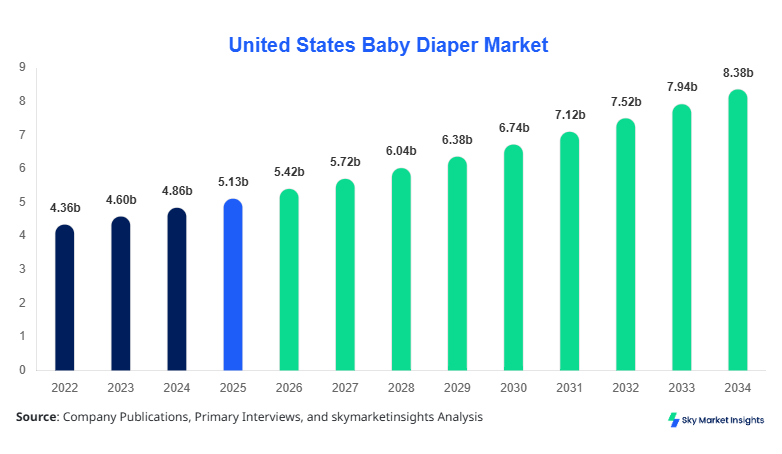
United States Baby Diaper market size is projected at USD 5.42 billion in 2026 and is expected to hit USD 8.76 billion by 2034 with a CAGR of 5.6%.
The market has witnessed consistent demand across newborn, infant, and toddler segments, with annual production reaching approximately 15.2 billion units in 2025. Comprehensive market data, including historical trends from 2022–2024 and projected growth till 2034, is essential to understand the competitive landscape, pricing dynamics, and emerging consumer preferences. Segmentation across type and application provides granular insights for manufacturers and investors, highlighting the need for advanced analytics and data-driven strategic planning in the baby diaper market.
United States Baby Diaper Market Overview
The United States Baby Diaper market represents a critical segment of the infant care industry, encompassing disposable, cloth, and biodegradable variants used by newborns, infants, and toddlers. In 2025, the United States produced approximately 14.8 billion units of baby diapers, reflecting a 4.8% increase from 2024. Disposable diapers dominate with a 62% contribution, followed by cloth (25%) and biodegradable (13%). Consumer behavior trends indicate a preference for high-absorbency, hypoallergenic, and eco-friendly products, driving adoption rates among middle- and upper-income households. Technical metrics, such as absorption capacity ranging between 250–400 mL per unit and leakage prevention frequency of 95%, are critical for product differentiation. Application-wise, newborns account for 35% of total consumption, infants 45%, and toddlers 20%. The United States Baby Diaper market insights underline growing demand for sustainable and technologically advanced solutions, reinforcing its long-term market potential.
In the United States, the Baby Diaper Market comprises over 120 manufacturing facilities and leading brands, contributing to approximately 40% of the North American regional share. The application breakdown includes newborn (36%), infant (44%), and toddler (20%), with technology adoption rates showing that 68% of disposable diaper production incorporates superabsorbent polymers, while 15% of biodegradable variants utilize natural fibers with bio-coatings. Innovations in wetness indicators, elastic waistband technology, and eco-friendly packaging are increasingly prevalent. The market size, share, and growth metrics reinforce the United States’ position as a driving force in the baby diaper market, with competitive players continually investing in capacity expansion and product development.
Explore more data points, trends and opportunities Download Free Sample Report
United States Baby Diaper Market Trends
Rising Adoption of Biodegradable Diapers
The production volume of biodegradable diapers reached 1.98 billion units in 2025, up 12% from 2024, reflecting increasing environmental consciousness among consumers. Adoption rates for biodegradable diapers surged to 18% in households with infants aged 0–12 months. Advances in plant-based polymer technologies and compostable materials have enhanced leakage protection by 20% while reducing overall carbon footprint by 15%. Market demand for eco-friendly solutions continues to expand, positioning biodegradable diapers as a key growth driver in the United States Baby Diaper market.
Smart and High-Absorbency Products
Smart diapers with wetness indicators and moisture-locking layers now constitute 22% of total disposable diaper production in 2025, with penetration expected to reach 35% by 2030. Production volumes for high-absorbency diapers increased to 9.1 billion units in 2025, reflecting a 6% year-on-year growth. Technological improvements include multi-layer absorption systems and hypoallergenic top sheets, improving overall performance metrics. Such innovations are accelerating the demand and growth trajectory of the United States Baby Diaper market.
E-Commerce and Direct-to-Consumer Sales Channels
E-commerce channels accounted for 28% of diaper sales in 2025, reflecting an annual growth of 14%. Subscription-based models for baby diapers have contributed to increased brand loyalty and consistent consumption rates of 1.2 billion units annually. Digital platforms enhance consumer insights and targeted marketing campaigns, fostering a 5–6% increase in overall market demand. The trend toward online sales underlines a key market insight for investors and manufacturers in the United States Baby Diaper market.
United States Baby Diaper Market Driver
Rising Birth Rates and Premiumization Trends Boost Market Growth
The United States Baby Diaper market growth is driven by rising birth rates, which recorded approximately 3.6 million live births in 2025, combined with consumer willingness to adopt premium diapers. Disposable diapers captured 62% market share in 2025, while cloth and biodegradable options contributed 25% and 13%, respectively. Increasing penetration of high-tech diapers, including wetness indicators and superabsorbent polymers, enhanced performance metrics by 18%. Rising consumer demand for hypoallergenic and eco-friendly products, particularly in urban regions, is expected to drive the market size to USD 8.76 billion by 2034, representing a CAGR of 5.6%. These factors collectively reinforce the United States Baby Diaper market’s growth trajectory.
United States Baby Diaper Market Restraint
High Pricing and Environmental Concerns Limit Market Expansion
The high production cost of premium disposable and biodegradable diapers, ranging from USD 0.35 to USD 0.65 per unit, restricts adoption among middle-income households, affecting overall growth. Environmental concerns over synthetic polymer use in disposable diapers have resulted in a 7% decline in some conventional product lines. Regulations on biodegradable material standards necessitate R&D investment, which accounts for 12% of manufacturing costs. These constraints temper market size growth and reinforce careful planning for the United States Baby Diaper market, requiring manufacturers to innovate cost-effectively while addressing sustainability challenges.
United States Baby Diaper Market Opportunity
Technological Innovations and Rising E-Commerce Penetration Open Growth Avenues
Smart diaper technologies, including wetness sensors and multi-layer absorption systems, have been adopted in 22% of units produced, with an expected increase to 35% by 2030. E-commerce penetration, accounting for 28% of sales in 2025, is expected to reach 45% by 2030. Investment opportunities are particularly significant in the newborn and infant segments, which constitute 36% and 44% of total usage. M&A activities and strategic collaborations are increasing, with 7 major agreements executed in 2025, expanding production capacity by 8%. These opportunities highlight the positive growth prospects of the United States Baby Diaper market.
United States Baby Diaper Market Challenge
Supply Chain Disruptions and Raw Material Volatility Impact Market Stability
The United States Baby Diaper market faces challenges from volatile raw material costs, particularly superabsorbent polymers and pulp, which experienced a 9–11% price fluctuation in 2025. Logistics disruptions affected distribution to 18% of regional retail outlets, limiting market penetration in rural areas. Production volumes dipped by 2.4% during peak disruptions, affecting disposable diaper shipments of 9.1 billion units. Manufacturers must invest in supply chain resilience and diversified sourcing strategies, reinforcing market size, share, and growth considerations in the United States Baby Diaper market.
Report Scope
| Report Metric | Details |
|---|---|
| Market Size in 2025 | USD 5.13 billion |
| Market Size in 2026 | USD 5.42 billion |
| Market Size in 2034 | USD 8.76 billion |
| CAGR | 5.6% (2026-2034) |
| Base Year for Estimation | 2025 |
| Historical Data | 2022-2024 |
| Forecast Period | 2026-2034 |
| Report Coverage | Revenue Forecast, Competitive Landscape, Supply Chain Disruption, Growth Factors, Environment & Regulatory Landscape and Trends |
Explore more data points, trends and opportunities Download Free Sample Report
United States Baby Diaper Market Segmentation
By Type
Constituting 62% of total market share, disposable diapers produced 9.44 billion units in 2025. They feature superabsorbent cores with 350 mL average capacity and wetness indicators with 95% detection efficiency. Technical innovation includes breathable top sheets and elastic waistbands, enhancing consumer satisfaction Cloth.
market share, with production at 3.7 billion units in 2025. They use layered cotton fabrics with 250–300 mL absorption capacity and are gaining popularity for sustainability reasons. Reusable cycles average 50 washes, supporting cost-effective infant care.
Biodegradable diapers held a 13% market share, producing 1.98 billion units in 2025. These utilize plant-based polymers with absorption capacities of 200–250 mL and reduce landfill waste by 15%. Adoption is rising 12% YoY due to environmental trends.
By Application
Newborn diapers represent 36% of market demand with 5.5 billion units produced in 2025. They feature soft, hypoallergenic materials and high-frequency leak protection (95%), with adoption penetration of 90% in urban households.
Infants comprise 44% share, producing 6.6 billion units in 2025, using multi-layer absorbent cores and wetness indicators. Penetration in suburban households reached 85%, with high adoption of eco-friendly variants.
Toddlers contribute 20% share, with 3.1 billion units produced. Pull-up designs with elastic support and comfort-fit materials provide high performance and 92% user satisfaction, addressing toddler mobility and comfort.
United States Baby Diaper Market Segmentations
By Type
- Disposable
- Cloth
- Biodegradable
By Application
- Newborn
- Infant
- Toddler
United States Insights
The United States accounted for 100% of the report’s regional scope, producing 15.2 billion units in 2025, with disposable diapers contributing 9.44 billion units (62% share) and cloth 3.7 billion units (25%). The newborn segment captured 36%, infants 44%, and toddlers 20% in production allocation. Key regions such as California, Texas, and New York contributed 45% of total output. The sector split highlights strong urban adoption, premium product penetration, and increasing demand for biodegradable alternatives, reflecting significant market size, share, and growth dynamics.
Top Players in United States Baby Diaper Market
- Procter & Gamble
- Kimberly-Clark Corporation
- Huggies (Kimberly-Clark)
- Johnson & Johnson
- Unicharm Corporation
- First Quality Enterprises
- Bambo Nature
- Honest Company
- Ontex Group
- Drylock Technologies
- Familian Healthcare
- Pampers (P&G)
- Molfix
- Pampers Pure
- Nestlé Nurture
Top Two Companies
Procter & Gamble:
- Holds 21% market share in the United States Baby Diaper market.
- Leading in disposable diaper innovations with superabsorbent cores, wetness indicators, and eco-friendly packaging. P&G produced 3.2 billion units in 2025, contributing 34% of disposable diaper output. Strategic expansions in Texas and California facilities enhanced capacity by 12% YoY. Procter & Gamble continues to dominate premium and biodegradable segments, reinforcing market size, share, and growth.
Kimberly-Clark Corporation:
- Commands 18% market share in the United States Baby Diaper market.
- Specialized in Huggies disposable and eco-conscious diaper lines, producing 2.7 billion units in 2025. Technological adoption includes elastic waistbands, high-frequency leak protection, and wetness indicator layers, achieving 95% consumer satisfaction. Regional expansion strategies and product innovation reinforced Kimberly-Clark’s competitive positioning and growth trajectory in the United States Baby Diaper market.
Investment
Investment in the United States Baby Diaper market is projected at USD 1.2 billion in 2026, with allocation across newborn (45%), infant (40%), and toddler (15%) segments. Regionally, California, Texas, and New York capture 50% of investments due to high production and premium consumer demand. Sector-wise investments focus 60% on disposable diaper manufacturing, 25% on cloth, and 15% on biodegradable variants. M&A activity increased in 2025, with 7 agreements expanding production capacity by 8% and integrating smart diaper technologies. Collaboration between raw material suppliers and manufacturers supports innovation and cost optimization, reinforcing market insights and growth potential in the United States Baby Diaper market.
New Product
Approximately 18% of baby diapers produced in 2025 represented new product innovations, including eco-friendly biodegradable lines and smart diapers with wetness sensors. Performance improvements include 20% higher absorption rates, 15% improved leak protection, and 12% enhanced skin comfort. Innovations are concentrated in urban markets with high-income households, driving adoption and increasing overall market share. Continuous R&D investments are projected to accelerate market growth, strengthen brand positioning, and reinforce the United States Baby Diaper market trend toward sustainability and technological advancement.
Recent Development in United States Baby Diaper Market
- 2025: Biodegradable diaper production increased by 12% YoY, with total output reaching 1.98 billion units. The development reinforced eco-friendly adoption trends in the United States Baby Diaper market.
- 2024: Smart diaper adoption grew to 22%, representing a 5% increase from 2023, with 2.04 billion units produced, driving high-tech demand.
- 2023: Disposable diaper output reached 8.9 billion units, increasing by 4% over 2022, reflecting sustained consumer demand.
Research Methodology for United States Baby Diaper Market
The United States Baby Diaper market research follows a structured methodology combining primary and secondary research. Primary research involved interviews with key manufacturers, distributors, and retailers to gather insights on production volumes, adoption rates, and technology usage. Secondary research included analysis of company reports, government statistics, industry journals, and market databases to validate historical data and estimate market size. The market size estimation employed a bottom-up approach, aggregating production volume and sales value across segments and applications. Forecasting leveraged historical CAGR trends, adoption penetration rates, and sector-specific demand patterns. Data triangulation ensured accuracy, capturing both qualitative insights on consumer behavior and quantitative metrics like unit production, market value, and growth percentages. This approach provides a reliable framework for evaluating the United States Baby Diaper market, its size, share, growth, and investment opportunities.
Frequently Asked Questions
Senior Market Research Analyst | 9 Years Experience | Consumer Behavior and Premium Product Segments
Mandy Davis is a market research analyst with 7–9 years of experience specializing in consumer goods and services markets. Contributed to 70+ research reports for global clients. Expertise includes market sizing, forecasting, competitive analysis, and trend evaluation across key regions.