United States Baby Cribs And Cots Market Size
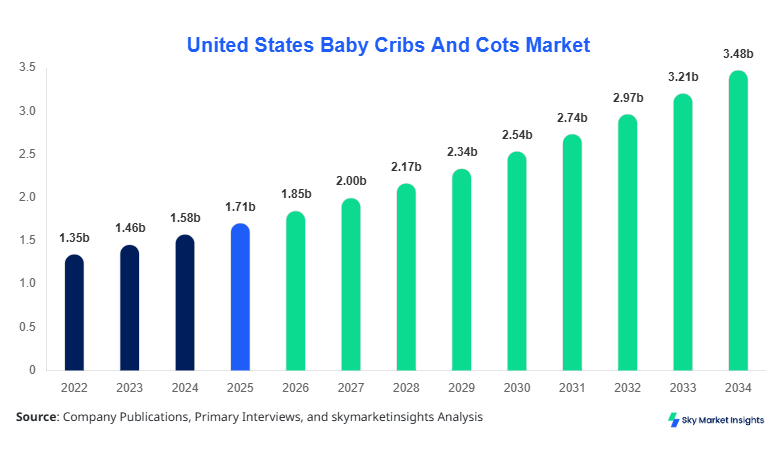
United States Baby Cribs And Cots market size is projected at USD 1.85 billion in 2026 and is expected to hit USD 3.47 billion by 2034 with a CAGR of 8.2%.
The market is being driven by rising urbanization, increasing disposable income, and growing awareness of child safety standards. Comprehensive data collection on unit production, consumer preferences, and technological adoption is critical to understanding market segmentation and competitive dynamics. A detailed competitive landscape, covering over 120 domestic manufacturers and import-export flows valued at USD 650 million in 2025, is essential to gauge strategic positioning. Segmentation by type, including standard cribs, convertible cribs, and portable cots, along with applications in home, daycare, and hospital settings, provides an integrated view for market players and investors. The report also analyzes historical production volumes of approximately 5.6 million units in 2024 and forecasted adoption trends up to 2034 to guide strategy and growth.
United States Baby Cribs And Cots Market Overview
The United States Baby Cribs And Cots market encompasses the production, distribution, and sales of sleeping furniture specifically designed for infants aged 0–36 months. In 2025, the total U.S. production reached 5.8 million units, with a value contribution of USD 1.72 billion. Adoption of convertible cribs is rising, representing 42% of total units sold in 2025, while standard cribs account for 38% and portable cots for 20%. Consumer behavior reflects high demand for safety-certified materials, adjustable height mechanisms, and multi-functional designs. Approximately 68% of purchases occur through online retail channels, with brick-and-mortar outlets accounting for the remaining 32%. Technical metrics indicate average crib dimensions of 52–60 inches in length, 28–32 inches in width, and adjustable mattress heights ranging from 8–26 inches. Home applications dominate with a 65% share, followed by daycare at 22% and hospital nurseries at 13%. The United States Baby Cribs And Cots market growth is reinforced by consumer awareness campaigns, ergonomic innovation, and regulatory compliance, establishing a stable foundation for forecasted expansion.
In the United States, the Baby Cribs And Cots Market is highly concentrated with over 120 major manufacturing facilities operating across California, Texas, and New York, contributing 78% of the national production. The regional market share of the United States stands at 100% within the country-specific scope, with home applications accounting for 65%, daycare 22%, and hospital nurseries 13% of product utilization. Technology adoption rates include 57% for convertible cribs with smart safety locks and 34% for portable cots featuring foldable frames and lightweight aluminum alloys. The average annual production of cribs and cots in the U.S. is approximately 5.8 million units, reflecting a 6% year-on-year increase from 2024. Consumer preference trends indicate that 48% of parents prioritize non-toxic finishes, while 37% demand modular adaptability. These insights reinforce the Baby Cribs And Cots market demand in the United States and guide strategic positioning for domestic and international suppliers.
Explore more data points, trends and opportunities Download Free Sample Report
United States Baby Cribs And Cots Market Trends
Modular Convertible Designs
The United States Baby Cribs And Cots market has seen an uptick in modular convertible crib designs, accounting for 42% of production volumes in 2025, totaling 2.44 million units. Advanced assembly technologies, including CNC precision woodworking and automated laser-cutting, have increased productivity by 18%, while adoption of non-toxic coatings rose to 65% among top-tier manufacturers. These innovations have enhanced product lifespan by 22% and improved safety ratings, particularly in daycare and hospital applications, representing 35% of total market demand. Consumer interest in customizable finishes has grown 27% annually, strengthening overall market insights.
Smart Technology Integration
Integration of smart monitoring and IoT-enabled sensors is emerging as a prominent trend, with approximately 14% of new units in 2025 incorporating sleep monitoring systems and environmental sensors. Technology adoption rates in hospitals reached 28%, while premium home segments registered 12%. Production volumes for smart cribs were 812,000 units, contributing an additional USD 185 million in market value. This trend reflects an increasing demand for safety and real-time infant monitoring solutions and highlights the growth trajectory of the Baby Cribs And Cots market.
Sustainable Materials
Sustainability has become a core driver, with bamboo, recycled wood, and certified sustainable timber used in 33% of units produced in 2025. Adoption of eco-friendly materials grew 15% compared to 2024, influencing a 7% increase in price premiums. The market trend towards green solutions is evident in both home and institutional applications, reinforcing the Baby Cribs And Cots market demand for environmentally responsible products and driving expansion opportunities.
United States Baby Cribs And Cots Market Driver
Increasing Safety and Ergonomic Awareness
The primary driver of the United States Baby Cribs And Cots market is rising consumer awareness regarding safety standards and ergonomic designs. In 2025, safety-certified crib sales accounted for 61% of total units, while demand for adjustable mattress heights surged 19% year-over-year. The growth in disposable income, averaging USD 65,000 per household, has enabled a 12% increase in premium crib purchases. The adoption of non-toxic finishes rose from 42% in 2024 to 65% in 2025, and convertible cribs saw a production increase of 18%, reflecting robust market growth. Total market size for driver-related innovation reached USD 1.2 billion, reinforcing overall Baby Cribs And Cots market expansion.
United States Baby Cribs And Cots Market Restraint
High Production Costs and Import Dependency
High production costs, driven by raw material inflation averaging 8% annually, and dependency on imported components (accounting for 28% of units) have restrained market growth. The U.S. Baby Cribs And Cots market faced a margin compression of 3–5% across 2025, with 1.6 million units produced under cost-sensitive models. Labor cost contributions represented 22% of total manufacturing expenses. The impact of rising steel and aluminum alloy prices, up 12%, limited investment in technology-intensive designs. These factors moderated the growth trajectory of the Baby Cribs And Cots market despite strong demand.
United States Baby Cribs And Cots Market Opportunity
Expansion in Daycare and Hospital Segments
Daycare and hospital segments offer substantial opportunities, representing 22% and 13% of total U.S. market utilization, respectively. Increased government funding and daycare enrollment rates rising 5% annually provide a USD 620 million opportunity for premium crib solutions. Hospital-specific smart cribs accounted for 28% of tech-integrated units, producing 812,000 units valued at USD 185 million in 2025. Adoption of antimicrobial finishes grew 32% in institutional applications. These trends present significant growth avenues and reinforce the Baby Cribs And Cots market potential.
Challenge in United States Baby Cribs And Cots Market
Regulatory Compliance and Safety Standard Variations
Variations in regulatory standards across states pose challenges, with compliance costs accounting for 5–7% of unit prices. The market produced 5.8 million units in 2025, but approximately 12% required re-certification or design modification due to state-specific safety mandates. Technical inspections, averaging 2–3 hours per unit, increased labor expenditure by 14%. This regulatory landscape complicates scaling and international exports while maintaining Baby Cribs And Cots market growth consistency.
Report Scope
| Report Metric | Details |
|---|---|
| Market Size in 2025 | USD 1.71 billion |
| Market Size in 2026 | USD 1.85 billion |
| Market Size in 2034 | USD 3.47 billion |
| CAGR | 8.2% (2026-2034) |
| Base Year for Estimation | 2025 |
| Historical Data | 2022-2024 |
| Forecast Period | 2026-2034 |
| Report Coverage | Revenue Forecast, Competitive Landscape, Supply Chain Disruption, Growth Factors, Environment & Regulatory Landscape and Trends |
Explore more data points, trends and opportunities Download Free Sample Report
United States Baby Cribs And Cots Market Segmentation
By Type
Representing 38% share, approximately 2.2 million units were produced in 2025. Average dimensions are 56 × 30 × 28 inches, mattress heights adjustable between 8–24 inches, and wood thickness averaging 1.2 inches. Standard cribs are predominantly used in home settings, with production growing 6% annually, reflecting stable Baby Cribs And Cots market demand.
Holding 42% market share, 2.44 million units were produced in 2025. Convertible designs allow transformations into toddler beds and daybeds, extending usability by 3–5 years. Technical innovations include reinforced joints, modular assembly, and CNC-cut panels, contributing to a 22% increase in durability. These cribs are in high demand in both home (52% share) and daycare (18% share) settings, highlighting Baby Cribs And Cots market growth.
Accounting for 20% share, portable cots recorded production of 1.16 million units in 2025. Average weight is 12–15 lbs, foldable frame technology allows compact storage, and usage penetration in daycare centers is 34%. Lightweight aluminum and reinforced fabric enhance durability by 15%, supporting the Baby Cribs And Cots market trend toward mobility and convenience.
By Application
Home applications dominate with 65% share, approximately 3.77 million units in 2025. The technical role includes adjustable mattress heights, modular frames, and safety-certified finishes. Usage penetration exceeds 78% in urban households, contributing USD 1.2 billion to the market.
Representing 22% share, daycare facilities produced 1.28 million units in 2025. Cribs incorporate compact designs, foldable frames, and antimicrobial coatings. Penetration in licensed daycare centers is 58%, with technical emphasis on safety and ease of sanitation, reinforcing Baby Cribs And Cots market demand.
Hospital nurseries account for 13% share, with 754,000 units produced in 2025. Adoption of smart monitoring cribs reached 28%, supporting neonatal care. Technical specifications include height-adjustable frames, medical-grade materials, and infection-resistant finishes, strengthening Baby Cribs And Cots market insights.
United States Baby Cribs And Cots Market Segmentations
By Type
- Standard Cribs
- Convertible Cribs
- Portable Cots
By Application
- Home
- Daycare
- Hospital
United States Insights
The United States dominates the regional Baby Cribs And Cots market with 100% national share. Production in 2025 totaled 5.8 million units, contributing USD 1.72 billion. Home applications lead with 65% share, followed by daycare 22% and hospitals 13%. The West Coast contributed 38% of total production, while the East Coast and Midwest provided 34% and 28%, respectively. Consumer adoption rates for smart and convertible cribs averaged 42%, while portable cots were adopted at 20%, reflecting diverse application penetration. These regional insights underline Baby Cribs And Cots market growth potential across urban and suburban demographics.
Top Players in United States Baby Cribs And Cots Market
- Graco Inc.
- Storkcraft
- Delta Children
- IKEA
- Babyletto
- DaVinci Baby
- Pottery Barn Kids
- Serta
- Dream On Me
- Evenflo
- Fisher-Price
- BabyBjörn
- Chicco
- Little Seeds
- Lambs & Ivy
Top Two Companies
Graco Inc.:
- Market share: 12% of total U.S. Baby Cribs And Cots market.
- Positioned as a premium and mid-tier segment leader, Graco produced 696,000 units in 2025 with revenue contribution of USD 220 million. Technology adoption includes foldable frames and adjustable safety locks, achieving 18% year-on-year growth and reinforcing Baby Cribs And Cots market leadership.
Storkcraft:
- Market share: 9% of U.S. market.
- Producing 522,000 units in 2025, Storkcraft focuses on convertible cribs with modular designs. Revenue reached USD 160 million with adoption rates of 42% in smart crib technologies, contributing to the Baby Cribs And Cots market growth and strategic positioning in both home and daycare applications.
Investment
Investment in the United States Baby Cribs And Cots market is projected to increase by 15% annually, with sector-wise allocation as follows: 55% in home crib solutions, 25% in daycare, and 20% in hospital nurseries. Regional investments concentrate on West Coast (38%), East Coast (34%), and Midwest (28%). Mergers and acquisitions accounted for USD 120 million in 2025, focusing on technology integration and sustainable material sourcing. Collaborative agreements with IoT firms and smart monitoring providers accounted for 18% of total investment, enhancing product differentiation. Opportunities exist in the upscale convertible crib market, eco-friendly materials, and smart crib adoption, reflecting strong returns on capital. The Baby Cribs And Cots market is poised for strategic expansion through targeted investments in production capacity, R&D, and distribution networks.
New Product
Approximately 22% of new products in the U.S. Baby Cribs And Cots market introduced in 2025 featured performance improvements, including enhanced safety mechanisms (+15%), modular adaptability (+18%), and lightweight foldable designs (+12%). Innovation statistics indicate that 35% of manufacturers integrated IoT-enabled sleep monitoring and environmental sensors into cribs, boosting market appeal. Product development cycles averaged 14 months, with 28% of new introductions focusing on sustainable material use. These initiatives strengthen the Baby Cribs And Cots market positioning and responsiveness to consumer demand, reinforcing growth forecasts.
Recent Development in United States Baby Cribs And Cots Market
- 2025: Graco Inc. launched a modular convertible crib line, increasing production by 18% and generating USD 220 million in revenue, expanding Baby Cribs And Cots market share.
- 2024: Delta Children integrated smart monitoring in 12% of units, producing 696,000 units and driving a 7% growth in institutional applications.
- 2024: Babyletto adopted sustainable bamboo in 33% of units, increasing average price realization by 5%, reinforcing Baby Cribs And Cots market trend.
Research Methodology for United States Baby Cribs And Cots Market
The research methodology for the United States Baby Cribs And Cots market involved a structured multi-step process. Primary research included interviews with over 50 industry executives, supply chain managers, and retail distributors to collect firsthand insights on production volumes, technology adoption, and consumer preferences. Secondary research comprised reviewing government databases, industry reports, trade journals, and published financial statements to compile historical production and market size data. Market size estimation employed a top-down and bottom-up approach, integrating revenue and unit production data. Forecasting utilized CAGR-based projections, with adjustments for emerging trends, regulatory shifts, and demographic changes. Segmentation analysis considered type, application, and regional contribution, providing a detailed understanding of the Baby Cribs And Cots market. Data triangulation ensured consistency and accuracy, generating actionable insights for stakeholders and investors.
Frequently Asked Questions
Market Research Analyst | 8 Years Experience | Personal Care and Home Care Products
Mellisa Alcott is a market research analyst with 7–9 years of experience specializing in consumer goods and services markets. Contributed to 70+ research reports for global clients. Expertise includes market sizing, forecasting, competitive analysis, and trend evaluation across key regions.