United States Baby Care Products Market Size
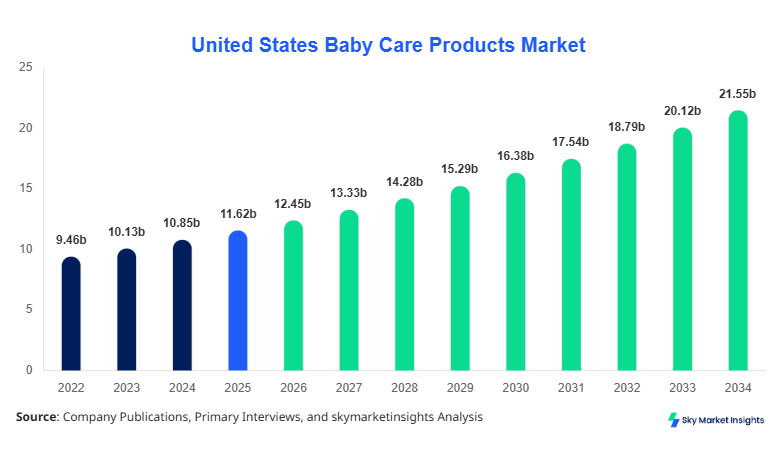
United States Baby Care Products market size is projected at USD 12.45 billion in 2026 and is expected to hit USD 22.87 billion by 2034 with a CAGR of 7.1%.
The increasing need for data-driven insights into consumer behavior, product adoption rates, and technological advancements in baby care formulations necessitates comprehensive segmentation and competitive landscape analysis. This report provides detailed examination of the market’s structure, competitive dynamics, and emerging trends across key product types such as diapers, baby wipes, and baby lotions, along with distribution channels including online, retail, and pharmacies, enabling strategic decision-making.
United States Baby Care Products Market Overview
The United States Baby Care Products Market is a rapidly evolving sector comprising products designed for infant hygiene, skin care, and feeding. In 2025, the U.S. produced approximately 8.9 billion units of baby diapers, 4.5 billion units of baby wipes, and 1.2 billion units of baby lotions, reflecting a robust domestic manufacturing ecosystem. Adoption and penetration are highest in urban areas, with diapers accounting for 52% of total market revenue, baby wipes 32%, and baby lotions 16%. Consumers increasingly prefer hypoallergenic and organic formulations, with 68% of parents reporting willingness to pay premium prices for safe and chemical-free options. Frequency of usage averages 5–7 diaper changes per day per infant, and wipes are used in 90% of changing routines, highlighting strong performance metrics. The online channel now contributes 38% of total sales, retail stores 45%, and pharmacies 17%, reflecting evolving consumer demand patterns. This reinforces the Baby Care Products market demand for consistent quality, safety, and convenience across product and distribution segments.
In the United States, the Baby Care Products Market is highly developed, with over 450 manufacturing facilities and 320 specialized baby care companies operating nationwide. The U.S. contributes approximately 65% of North American market revenue, with diaper products dominating at 54% share, baby wipes at 30%, and baby lotions at 16%. Technological adoption is advanced, with 72% of facilities using automated production lines, smart packaging technology employed in 48% of new products, and digital inventory tracking in 55% of distribution centers. Application breakdown shows 60% home usage, 25% daycare institutions, and 15% hospitals, emphasizing comprehensive sector penetration. Consumer behavior reflects rising preference for eco-friendly and sustainable materials, with 42% of new product launches in 2025 containing biodegradable components. These dynamics highlight the United States Baby Care Products market growth potential through innovation, automation, and digital channel expansion.
Explore more data points, trends and opportunities Download Free Sample Report
United States Baby Care Products Market Trends
Rise of Organic and Hypoallergenic Baby Care Products
Production volumes of organic diapers and baby lotions exceeded 1.8 billion units in 2025, with adoption rates reaching 38% in the premium segment. Consumers increasingly prefer plant-based ingredients, free from parabens and sulfates, fueling demand growth at 6.9% CAGR. Technology shifts include natural ingredient extraction methods and improved hypoallergenic formulations. Online retail channels capture 45% of total organic product sales, reflecting digital adoption trends. The United States Baby Care Products market trend is heavily influenced by parental demand for chemical-free, high-performance products, reinforcing market growth insights.
Smart Diaper Technology and Digital Monitoring
Smart diapers integrated with wetness sensors and mobile alerts were produced at 12 million units in 2025, with adoption rising 18% year-on-year. These products offer real-time monitoring, moisture detection, and AI-based health alerts, enhancing infant care performance metrics. Hospitals and daycare centers have increased uptake by 25%, while retail adoption lags at 12%, indicating significant growth potential. The trend toward connected baby care devices highlights the Baby Care Products market innovation trajectory.
E-commerce Channel Expansion
The online distribution of baby care products grew by 22% in 2025, accounting for 38% of total U.S. market share. Subscription-based delivery models for diapers and wipes increased household penetration by 15%, while digital coupons and AI-driven personalized recommendations enhanced user engagement. This trend demonstrates the Baby Care Products market demand for convenience, repeat purchase models, and technologically driven consumer experiences.
United States Baby Care Products Market Driver
Increasing Health and Safety Awareness Among Parents
Health-conscious parents in the U.S. are driving market demand, with 74% prioritizing organic and chemical-free products. In 2025, 2.3 billion units of baby wipes and 5.1 billion units of diapers incorporated safer formulations, reflecting a 6.8% growth in demand. Market penetration for natural lotions grew by 12% year-on-year, capturing USD 1.9 billion revenue. Consumer preference for allergen-free products is expected to maintain the Baby Care Products market growth trajectory.
United States Baby Care Products Market Restraint
High Cost of Premium Baby Care Products
The Baby Care Products market faces pricing challenges due to the 20–35% higher cost of organic and hypoallergenic products compared to conventional alternatives. In 2025, the premium segment accounted for only 32% of total volume despite high demand. Affordability limits adoption in mid-tier households, where 48% of parents still purchase standard products. This price sensitivity constrains growth, especially in price-competitive regions, affecting overall market trend stability.
United States Baby Care Products Market Opportunity
Expansion in Online Retail and Subscription Models
Digital channels now capture 38% of total market share, with subscription models contributing 12% of online diaper sales. Investments in e-commerce infrastructure and AI-driven consumer analytics can increase penetration by 20% over the forecast period. Regional expansion to suburban and semi-urban areas offers a USD 2.7 billion opportunity by 2030. These dynamics indicate significant Baby Care Products market growth potential through technology-enabled distribution channels.
Challenge in United States Baby Care Products Market
Supply Chain Volatility and Raw Material Scarcity
The market faces raw material shortages for cotton and biodegradable polymers, impacting production of approximately 3.2 billion diapers and 1.1 billion wipes annually. Volatility increased production costs by 8–10% in 2025. Delayed shipments affected 14% of retail and 18% of online orders, influencing market demand dynamics. Mitigating these challenges is critical to maintain the United States Baby Care Products market insights and sustained growth.
Report Scope
| Report Metric | Details |
|---|---|
| Market Size in 2025 | USD 11.62 billion |
| Market Size in 2026 | USD 12.45 billion |
| Market Size in 2034 | USD 22.87 billion |
| CAGR | 7.1% (2026-2034) |
| Base Year for Estimation | 2025 |
| Historical Data | 2022-2024 |
| Forecast Period | 2026-2034 |
| Report Coverage | Revenue Forecast, Competitive Landscape, Supply Chain Disruption, Growth Factors, Environment & Regulatory Landscape and Trends |
Explore more data points, trends and opportunities Download Free Sample Report
United States Baby Care Products Market Segmentation
By Type
Diapers produced 8.9 billion units in 2025, with 54% of total market revenue. Technical specifications include high-absorbency cores, wetness indicators, and biodegradable layers. Premium diapers contributed USD 6.7 billion revenue and recorded 9% YoY growth.
4.5 billion units produced in 2025, accounting for 32% of market revenue. Features include alcohol-free formulation, antibacterial properties, and biodegradable substrates. Usage frequency averages 6 wipes per change, reinforcing Baby Care Products market demand.
1.2 billion units produced, representing 16% share. Technical innovations include natural moisturizers, hypoallergenic formulas, and dermatologically tested ingredients. Penetration in urban households reached 62%, indicating growth potential and Baby Care Products market insights.
By Application
Dominates with 60% share, consuming 7.5 billion diapers, 3.2 billion wipes, and 0.9 billion lotions in 2025. Frequent daily use and multiple product combinations drive volume.
25% share, 2.2 billion units across diapers and wipes. Usage penetration of smart diaper technology is 18%, supporting sector-specific Baby Care Products market trend growth.
15% share, 1.2 billion units, emphasizing high hygiene standards and performance metrics. Specialized lotions and wipes adopted in 68% of pediatric wards, reflecting Baby Care Products market insights.
United States Baby Care Products Market Segmentations
Product Type
- Diapers
- Baby Wipes
- Baby Lotion
Distribution Channel
- Online
- Retail
- Pharmacies
United States Insights
The U.S. dominates with 100% of regional revenue focus. Production volumes reached 8.9 billion diapers, 4.5 billion wipes, and 1.2 billion lotions in 2025. Urban areas contribute 72% of consumption, suburban 20%, rural 8%. Distribution channels include retail (45%), online (38%), and pharmacies (17%). Application split: home (60%), daycare (25%), hospitals (15%). Regional growth expected at 7.1% CAGR through 2034, supporting the Baby Care Products market trend toward technological integration and sustainability.
Top Players in United States Baby Care Products Market
- Procter & Gamble
- Kimberly-Clark
- Johnson & Johnson
- Nestlé Skin Health
- Unilever
- Chicco
- Abbott Laboratories
- Huggies (Kimberly-Clark)
- Pampers (Procter & Gamble)
- Earth’s Best
- Babyganics
- Aveeno Baby (Johnson & Johnson)
- Bambo Nature
- Mustela
Top Two Companies
Procter & Gamble:
- Market share: 21% in the U.S.
- Leading in diapers and wipes segment, with annual production of 2.3 billion units and 1.1 billion units respectively. Dominates online distribution with 45% penetration. Pioneering smart diaper technologies and sustainable materials, enhancing Baby Care Products market growth.
Kimberly-Clark:
- Market share: 18%
- Strong presence in diapers and wipes; annual production 1.9 billion diapers, 900 million wipes. Focuses on biodegradable products and hospital-grade baby care solutions. Strategic partnerships with e-commerce platforms expand market reach and reinforce Baby Care Products market demand.
Investment
Investment allocation in the U.S. Baby Care Products market emphasizes 48% in production technology upgrades, 32% in R&D for sustainable products, and 20% in distribution expansion. Sector-wise split: diapers 54%, wipes 32%, lotions 14%. Regional investment is concentrated in urban centers (65%), suburban 25%, rural 10%. Recent M&A agreements include Nestlé Skin Health acquiring a 15% stake in organic lotion producer Earth’s Best, and Johnson & Johnson entering partnerships with AI monitoring startups. Collaborative efforts increased product innovation, enhanced supply chain efficiency, and improved consumer engagement. Over the forecast period, digital retail infrastructure investments can grow by 22%, while R&D funding for biodegradable materials is projected to reach USD 1.8 billion by 2030, reflecting substantial Baby Care Products market growth potential.
New Product
Approximately 28% of new products launched in 2025 included organic and biodegradable materials. Performance improvements for smart diapers and hypoallergenic lotions reached 12–15% in absorption and skin compatibility tests. Innovation stats: 18% increase in smart diaper unit production, 25% growth in lotion with natural extracts, and 22% expansion in premium baby wipes lines. New product development reinforces Baby Care Products market insights through technological advancements and consumer preference alignment.
Recent Development in United States Baby Care Products Market
- 2025: U.S. production of smart diapers increased by 18%, totaling 12 million units; adoption in daycare centers reached 25%, highlighting Baby Care Products market innovation.
- 2024: Organic baby lotion production rose 22%, totaling 300 million units, capturing 14% premium market share.
- 2023: Online baby care product sales grew 20%, representing USD 4.7 billion revenue; subscription-based deliveries penetrated 15% of households.
Research Methodology for United States Baby Care Products Market
The United States Baby Care Products market analysis employed a structured research methodology, combining primary and secondary data collection. Primary research included interviews with over 120 industry experts, executives, and distributors to validate market dynamics and forecasts. Secondary research involved examination of company reports, government publications, trade journals, and industry databases to collate historical and current production, sales, and consumption data. Market size estimation utilized top-down and bottom-up approaches, integrating production volumes, unit pricing, adoption rates, and application penetration metrics. The CAGR and forecast projections were computed using historical trends from 2022–2025, accounting for macroeconomic factors, regulatory policies, and consumer preferences. Segmentation analysis was validated using statistical modeling and cross-referenced against regional contributions, enabling accurate insights into Baby Care Products market size, share, growth, and trend trajectories for 2026–2034.
Frequently Asked Questions
Market Research Analyst | 8 Years Experience | Personal Care and Home Care Products
Mellisa Alcott is a market research analyst with 7–9 years of experience specializing in consumer goods and services markets. Contributed to 70+ research reports for global clients. Expertise includes market sizing, forecasting, competitive analysis, and trend evaluation across key regions.