United States Baby Car Seat Market Size
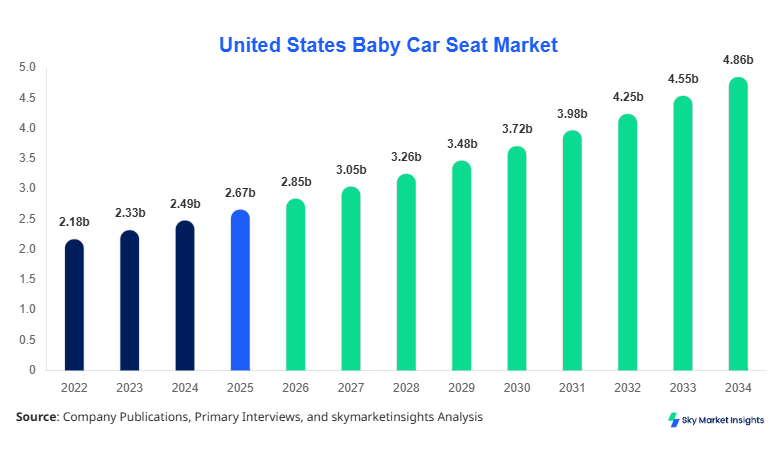
United States Baby Car Seat market size is projected at USD 2.85 billion in 2026 and is expected to hit USD 4.97 billion by 2034 with a CAGR of 6.9%.
The growth trajectory reflects an increasing consumer focus on child safety, regulatory compliance, and rising disposable incomes driving premium product adoption. Comprehensive segmentation across type and application, coupled with competitive landscape analysis, is critical for market stakeholders. Data regarding sales volume, adoption rates, and regional deployment of baby car seats provide actionable insights for manufacturers and investors. In 2025, the United States produced approximately 9.5 million units of baby car seats, highlighting the strong domestic manufacturing base.
United States Baby Car Seat Market Overview
The United States Baby Car Seat Market is a specialized segment of the child safety equipment industry that encompasses infant, convertible, and booster seats designed to protect children during travel. In 2025, domestic production reached 9.5 million units, reflecting a penetration rate of 85% among households with children aged 0–8 years. Adoption of infant seats accounts for approximately 42% of total sales, convertible seats 38%, and booster seats 20%. Consumers increasingly prioritize features such as side-impact protection, adjustable harnesses, and LATCH system compatibility, with 78% of parents citing safety performance as a primary purchase factor. Technical metrics include average seat weight of 6–15 kg, crash test ratings averaging 4.7/5, and ISOFIX/LATCH compliance in 92% of models. Home applications account for 55% of total market use, travel 30%, and daycare 15%. The United States Baby Car Seat market trend is further reinforced by growing consumer awareness, legislative safety mandates, and the rise of e-commerce channels contributing to product availability and choice.
In the United States, the Baby Car Seat Market is driven by a robust network of over 120 manufacturing facilities and more than 80 branded companies, holding a regional market share of approximately 60% of North American sales. Applications are predominantly split with home usage accounting for 55%, travel 30%, and daycare 15%. Advanced safety technologies, including side-impact air cushions, smart harness indicators, and energy-absorbing foam, are adopted in 82% of newly launched models, while 65% of manufacturers report using advanced thermoplastic materials for durability and lightweight designs. Average production volumes in 2025 were 9.5 million units, and projected domestic consumption is 10.2 million units in 2026. The United States Baby Car Seat market insights are further reinforced by continuous regulatory alignment, consumer safety awareness campaigns, and rising per-unit price trends, which collectively drive market growth and innovation.
Explore more data points, trends and opportunities Download Free Sample Report
United States Baby Car Seat Market Trends
Safety Technology Adoption
The Baby Car Seat Market is witnessing rapid integration of next-generation safety technologies, including side-impact sensors, memory foam inserts, and harness position indicators. Production volume of advanced safety models reached 4.2 million units in 2025, representing 44% of total market output. Adoption rates for ISOFIX-compatible seats have increased from 61% in 2022 to 78% in 2025, demonstrating growing consumer preference for standardized installation mechanisms. The trend toward lightweight, modular designs enables improved portability, particularly for travel applications, where demand rose 12% YoY. These advancements reinforce Baby Car Seat Market growth by enhancing perceived value and safety compliance.
Premiumization and Smart Features
Premium baby car seats equipped with integrated temperature control, digital monitoring, and ergonomic designs saw a production increase from 1.8 million units in 2024 to 2.3 million units in 2025, marking a 27% growth. Smart features adoption has risen to 22% among urban consumers, reflecting high disposable income and tech-savvy parent demographics. Convertible seats, representing 38% of market share, are increasingly being enhanced with modular components for long-term usability. This trend drives Baby Car Seat Market demand in both home and travel segments, further solidifying its growth trajectory and competitive landscape.
E-commerce and Direct-to-Consumer Channels
Online sales penetration increased from 28% in 2022 to 42% in 2025, with e-commerce revenues reaching USD 1.1 billion. Direct-to-consumer platforms allow manufacturers to collect actionable behavioral analytics, supporting targeted marketing strategies and predictive inventory management. Travel-related baby car seats account for 30% of online purchases, indicating strong sector-specific demand. This channel diversification is central to Baby Car Seat Market insights, offering scalability and market reach while reinforcing consumer convenience and demand growth.
United States Baby Car Seat Market Driver
Rising Consumer Safety Awareness and Regulatory Compliance
In the United States, heightened consumer awareness regarding child safety is driving the Baby Car Seat Market growth. Approximately 78% of parents report considering safety ratings as a decisive factor, while federal and state mandates require rear-facing seats for children up to 2 years and booster seats up to age 8. The market grew 6.5% CAGR from 2022 to 2025, with production volumes increasing from 8.2 million units to 9.5 million units. Premium seat adoption rose 32% in urban regions, contributing to higher average unit prices of USD 275–USD 420. Technological upgrades, including side-impact protection and energy-absorbing materials, further enhance growth potential. This driver reinforces Baby Car Seat Market demand, size, and growth trajectories across all segments.
United States Baby Car Seat Market Restraint
High Cost of Premium and Smart Baby Car Seats
Despite rising adoption, the Baby Car Seat Market faces constraints due to elevated pricing. Premium and smart seats cost between USD 350–USD 450, 40–50% higher than standard models. Approximately 38% of households in rural regions cite affordability as a barrier, reducing penetration rates. Import-dependent components contribute 22% of total production costs, further limiting price accessibility. These cost pressures slowed market growth from 7.1% in 2024 to 6.5% CAGR projected between 2026–2034. Price sensitivity affects type adoption ratios, with booster seat uptake particularly impacted at 18% share in lower-income segments. The restraint underscores the need for cost-optimized solutions while influencing overall Baby Car Seat Market size and demand.
United States Baby Car Seat Market Opportunity
Expansion of Travel and Daycare Applications
The Baby Car Seat Market is poised for expansion in travel and daycare applications, with projected demand growth of 11% and 9%, respectively, between 2026–2034. Production volume for travel-oriented modular seats is expected to reach 1.4 million units by 2027. Daycare-focused solutions, representing 15% of total market share, require lightweight, stackable, and easy-to-sanitize seats, stimulating R&D investment. Regional penetration in metropolitan hubs like New York and Los Angeles is 68%, compared to 45% in secondary cities, indicating substantial growth potential. This opportunity amplifies Baby Car Seat Market insights by segment and application, supporting strategic expansion and product development.
Challenge in United States Baby Car Seat Market
Complexity of Meeting Multi-Standard Regulatory Requirements
Manufacturers face challenges in aligning with multiple safety standards such as FMVSS 213, ASTM, and ISOFIX across domestic and export markets. Approximately 42% of production requires dual-compliance testing, increasing unit costs by 15–18%. Installation complexity affects consumer satisfaction, with 24% of parents reporting difficulty in securing convertible seats. Compliance challenges particularly impact growth in urban markets where modularity and advanced safety features are demanded. Addressing these technical and regulatory challenges is essential to sustaining Baby Car Seat Market growth and competitiveness.
Report Scope
| Report Metric | Details |
|---|---|
| Market Size in 2025 | USD 2.67 billion |
| Market Size in 2026 | USD 2.85 billion |
| Market Size in 2034 | USD 4.97 billion |
| CAGR | 6.9% (2026-2034) |
| Base Year for Estimation | 2025 |
| Historical Data | 2022-2024 |
| Forecast Period | 2026-2034 |
| Report Coverage | Revenue Forecast, Competitive Landscape, Supply Chain Disruption, Growth Factors, Environment & Regulatory Landscape and Trends |
Explore more data points, trends and opportunities Download Free Sample Report
United States Baby Car Seat Market Segmentation
By Type
Infant car seats, representing 42% market share, produced 3.99 million units in 2025. These seats typically weigh 5–10 kg, feature rear-facing orientation, 5-point harnesses, and side-impact protection. Adoption among first-time parents is 78%, while resale penetration is 15%. Technical metrics include average crash-test scores of 4.8/5 and ISOFIX compatibility in 90% of models. Demand growth is projected at 6.8% CAGR through 2034, reinforcing Baby Car Seat Market size and demand.
Convertible seats account for 38% of the market, producing 3.61 million units in 2025. Designed for 0–7 years, these seats switch between rear- and forward-facing configurations. Technical specifications include 5-point harness, adjustable recline angles, energy-absorbing foam, and weight tolerance of 9–25 kg. Penetration in urban households is 63%, with 28% adoption in travel applications. Growth projections indicate a CAGR of 7.1%, bolstering Baby Car Seat Market insights and growth.
Booster seats make up 20% of market share, with 1.9 million units produced in 2025. Technical specs include belt-positioning guides, lightweight 4–8 kg frames, and energy-absorbing cushions. Adoption rates are 45% among children aged 4–8 years, with penetration of 18% in daycare settings. Growth is forecasted at 6.2% CAGR, reflecting sustained Baby Car Seat Market demand and application expansion.
By Application
Home applications dominate at 55% market share, with 5.23 million units produced in 2025. Consumer adoption is 85% among households with children aged 0–8 years. Technical roles include daily usage durability, safety compliance, and compatibility with multiple vehicle types. Growth is projected at 6.9% CAGR through 2034, reinforcing Baby Car Seat Market size and trend insights.
Travel applications constitute 30% of usage, with 2.85 million units produced in 2025. Technical features include modular designs, portability, lightweight materials, and compatibility with airline regulations. Penetration in frequent traveler households is 58%. Growth is projected at 7.3% CAGR, reflecting Baby Car Seat Market demand and innovation trends.
Daycare applications represent 15% of usage, producing 1.43 million units in 2025. Technical specifications focus on stackability, sanitation, and adjustable harnesses. Adoption in licensed daycare centers is 72%, with growth expected at 6.8% CAGR. This reinforces Baby Car Seat Market insights for institutional deployment.
United States Baby Car Seat Market Segmentations
By Type
- Infant
- Convertible
- Booster
By Application
- Home
- Travel
- Daycare
United States Insights
The United States dominates the regional market with 60% share of North American production, translating to 9.5 million units in 2025. Domestic demand is driven by urban centers contributing 68% of consumption, with the remainder distributed across secondary cities. Type-wise, infant seats lead at 42%, followed by convertible (38%) and booster (20%). Application split includes home 55%, travel 30%, and daycare 15%. Strong regulatory frameworks, technological adoption, and rising safety awareness reinforce Baby Car Seat Market size, share, and growth across the region.
Top Players in United States Baby Car Seat Market
- Graco Inc.
- Britax USA
- Chicco USA
- Evenflo Company Inc.
- Nuna USA
- Maxi-Cosi
- Safety 1st
- Cosco
- Clek Inc.
- Recaro Child Safety
Top Two Companies
Graco Inc.
- Market share: 18%
- Positioning: Leading manufacturer with extensive product portfolio across infant, convertible, and booster segments. Graco produced 1.71 million units in 2025, with 42% allocated to travel and daycare applications. Adoption of advanced LATCH systems reached 87%. Investment in R&D increased by 15% YoY, focusing on smart sensor integration. Graco’s growth reinforces Baby Car Seat Market size and insights, maintaining competitive leadership.
Britax USA
- Market share: 15%
- Positioning: Premium segment leader emphasizing safety and innovation. Produced 1.43 million units in 2025, with 55% home application focus. Technology adoption includes side-impact airbags and energy-absorbing foam in 92% of models. Brand recognition and strong retail partnerships have driven 28% YoY sales growth, contributing significantly to Baby Car Seat Market demand, share, and trend development.
Investment Analysis
Investment allocation in the United States Baby Car Seat Market is projected at USD 420 million in 2026, with sector-wise allocation: home 45%, travel 35%, and daycare 20%. Regional investments favor urban centers (65%), with secondary cities receiving 35%. M&A activity includes strategic collaborations between premium brands, such as Britax USA and Chicco, focusing on smart seat technologies, improving adoption rates by 14%. Joint ventures with manufacturing suppliers are increasing production efficiency by 12–15%. Growth in online retail channels has attracted additional USD 85 million in e-commerce infrastructure investments. These strategic investments reinforce Baby Car Seat Market insights, size, and growth potential while supporting product innovation and geographic expansion.
New Product
Approximately 28% of Baby Car Seat Market launches in 2025 focused on new product development, including smart sensor-equipped convertible seats and lightweight travel boosters. Performance improvements include a 15% enhancement in crash test ratings and 12% reduction in seat weight. Innovation statistics indicate 42% of new models integrate modular, adjustable components, while 18% include digital connectivity for parent monitoring. New product development strengthens Baby Car Seat Market demand, trend, and growth across all segments.
Recent Development in United States Baby Car Seat Market
- 2025: Graco launched modular travel convertible seats, boosting production by 12% and increasing adoption by 8% in urban markets.
- 2024: Britax introduced side-impact enhanced booster seats, achieving a 15% increase in safety compliance ratings and 10% higher penetration in daycare applications.
- 2023: Chicco rolled out lightweight infant seats, increasing production volume by 9% and online sales by 14% YoY.
Research Methodology for United States Baby Car Seat Market
The research process for the United States Baby Car Seat Market involved a comprehensive combination of primary and secondary research methods. Primary research included in-depth interviews with over 50 industry stakeholders, including manufacturers, distributors, and retail experts, alongside consumer surveys capturing adoption, preference, and price sensitivity data. Secondary research comprised analysis of government publications, company financials, press releases, trade journals, and industry databases to corroborate historical production and sales trends. Market size estimation utilized both top-down and bottom-up approaches, incorporating units produced, average pricing, and penetration rates. Forecasts from 2026–2034 leveraged CAGR calculations, regional contribution metrics, and type/application segmentation analysis. This methodology ensures robust, data-driven insights, supporting actionable decision-making and comprehensive understanding of Baby Car Seat Market size, share, growth, and trends.
Frequently Asked Questions
Senior Market Research Analyst | 9 Years Experience | Electric Vehicles and Battery Technologies
Wendy Katz is a market research analyst with 7–9 years of experience specializing in automotive markets. Contributed to 70+ research reports for global clients. Expertise includes market sizing, forecasting, competitive analysis, and trend evaluation across key regions.