United States B2B E Commerce Market Size
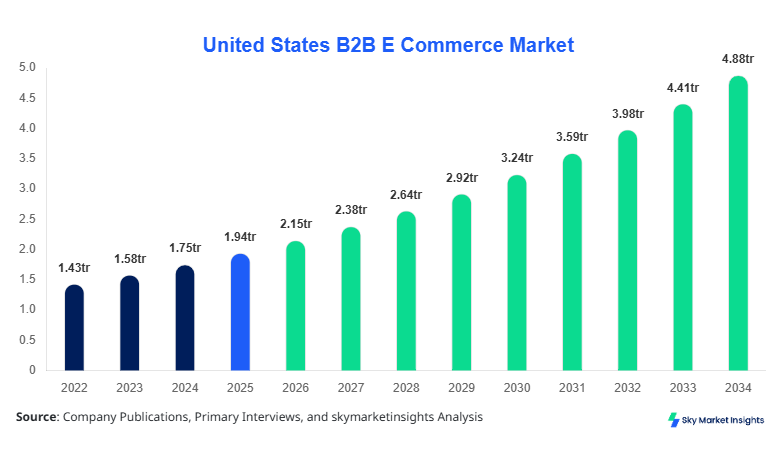
United States B2B E Commerce market size is projected at 2.15 USD trillion in 2026 and is expected to hit USD 4.89 trillion by 2034 with a CAGR of 10.8%.
The increasing reliance on digital procurement platforms, automation of supply chains, and integration of AI-driven analytics are reshaping enterprise purchasing patterns across industries. The report provides extensive segmentation analysis across platform types and application verticals, along with detailed competitive landscape insights covering over 120+ major vendors and 500+ SMEs actively participating in the ecosystem.
United States B2B E Commerce Market Overview
The B2B E Commerce Market refers to digital transactions of goods and services between businesses via online platforms, including procurement systems, supplier portals, and enterprise marketplaces. In the United States, over 4.2 million companies engaged in digital B2B transactions in 2025, accounting for approximately 67% of total wholesale trade value. Adoption and penetration insights indicate that over 72% of mid-to-large enterprises have transitioned at least 50% of procurement processes online, while 38% of SMEs adopted cloud-based commerce platforms between 2022 and 2025. Consumer behavior and demand analytics reveal that businesses prioritize faster order fulfillment (reduced by 35%), bulk purchasing discounts (20–25%), and real-time inventory visibility (used by 64% of enterprises). Supplier-oriented platforms contribute nearly 45% of total transactions, while buyer-oriented systems account for 30%, and intermediary marketplaces hold around 25%. Average transaction frequency has increased to 12–18 orders per month per enterprise, with digital transaction volumes exceeding 9.5 billion annually. Applications are distributed across manufacturing (40%), wholesale & distribution (35%), and IT & telecom (25%), reinforcing the critical expansion of the B2B E Commerce Market.
In the United States, the B2B E Commerce Market Market is characterized by over 3.8 million active digital trading companies, contributing nearly 100% of regional market share within the defined scope. Manufacturing applications dominate with 40% share, followed by wholesale & distribution at 35% and IT & telecom at 25%. Technology adoption rates exceed 75% for cloud-based ERP integration, while 62% of firms utilize AI-driven procurement analytics and 48% have implemented blockchain for supply chain transparency. More than 1,200 large-scale digital marketplaces operate nationwide, processing over USD 6.5 trillion in gross merchandise value annually. Mobile-based procurement usage has increased by 28% between 2023 and 2026, with 55% of transactions now conducted via mobile devices. The integration of automation tools has reduced procurement cycle time by 30–45%, further enhancing operational efficiency and reinforcing the dominance of the B2B E Commerce Market.
Explore more data points, trends and opportunities Download Free Sample Report
United States B2B E Commerce Market Trends
Increasing Adoption of AI and Automation in Procurement
The adoption of AI-driven procurement systems has surged significantly, with over 68% of enterprises integrating predictive analytics and automation tools into their purchasing workflows by 2026. Transaction volumes across digital platforms have surpassed 10 billion annually, reflecting a 22% increase from 2024 levels. Automation tools have reduced manual processing costs by 25–35%, while AI-enabled demand forecasting has improved inventory accuracy by nearly 40%. Additionally, robotic process automation (RPA) is used by 52% of large enterprises to streamline order management and invoice reconciliation processes. Cloud-based platforms account for over 70% of deployments, enabling scalability and cost efficiency across organizations handling transactions exceeding USD 1 billion annually. These technological shifts are significantly transforming procurement strategies and driving operational efficiency within the B2B E Commerce Market.
Growth of Mobile Commerce and Omnichannel Platforms
Mobile commerce has emerged as a critical trend, with 55% of B2B transactions conducted via mobile devices in 2026, compared to 38% in 2022. Omnichannel integration across desktop, mobile, and API-based platforms has improved customer retention rates by 18–22% and reduced cart abandonment by 15%. Enterprises handling more than 500,000 transactions annually have reported a 30% increase in customer engagement due to seamless omnichannel experiences. Digital marketplaces are witnessing a surge in SME participation, with over 1.5 million SMEs joining platforms between 2023 and 2026. Subscription-based procurement models have also grown by 27%, enabling recurring purchases and improving supplier-buyer relationships. These evolving trends are reshaping digital trade ecosystems and reinforcing long-term scalability in the B2B E Commerce Market.
Expansion of Cross-Border Digital Trade
Cross-border B2B transactions have increased by 32% between 2022 and 2026, accounting for nearly USD 1.2 trillion in trade value. Over 48% of enterprises are actively engaging in international sourcing through digital platforms, leveraging advanced logistics and payment solutions. Digital payment adoption, including blockchain-enabled systems, has reached 35%, reducing transaction processing time by 20–25%. Freight and logistics integration platforms now support over 60% of cross-border transactions, ensuring real-time tracking and cost optimization. These developments are expanding global reach and strengthening trade networks within the B2B E Commerce Market.
United States B2B E Commerce Market Driver
Rapid Digital Transformation and Enterprise Automation Accelerates B2B E Commerce Market Growth
The accelerating pace of digital transformation across enterprises is a key driver fueling the expansion of the B2B E Commerce Market Growth. Over 75% of large enterprises have digitized procurement processes, while nearly 60% of SMEs adopted e-commerce platforms between 2022 and 2026. The integration of ERP systems with digital marketplaces has improved operational efficiency by 30–40%, reducing procurement cycles from 10 days to less than 6 days on average. Additionally, AI-driven analytics have enhanced supplier selection accuracy by 35%, minimizing procurement risks and costs. Investments in automation technologies exceeded USD 150 billion in 2025, with 42% allocated to digital commerce platforms. The adoption of cloud infrastructure has increased by 28%, enabling scalable operations for businesses handling transaction volumes exceeding USD 500 million annually. These factors collectively contribute to the sustained acceleration of the B2B E Commerce Market Growth.
United States B2B E Commerce Market Restraint
Data Security Concerns and Integration Complexities Limit Market Expansion
Despite strong growth, data security risks and system integration challenges act as significant restraints in the B2B E Commerce Market. Approximately 48% of enterprises report concerns regarding cybersecurity threats, with data breaches increasing by 15% annually. Integration complexities between legacy systems and modern e-commerce platforms affect nearly 35% of organizations, leading to implementation delays of 6–12 months. Additionally, compliance requirements such as data privacy regulations increase operational costs by 20–25%, particularly for SMEs with limited resources. The lack of standardized protocols across platforms affects interoperability, impacting transaction efficiency for companies managing over 100,000 orders annually. These challenges hinder seamless adoption and limit scalability across various industry segments within the B2B E Commerce Market.
United States B2B E Commerce Market Opportunity
Expansion of Cloud-Based Marketplaces and SME Digitization
The increasing digitization of SMEs presents substantial opportunities within the B2B E Commerce Market. Over 2 million SMEs in the United States are expected to adopt digital commerce platforms by 2030, contributing nearly 30% of incremental market revenue. Cloud-based marketplace adoption is projected to grow by 35%, driven by cost-effective subscription models and ease of deployment. Investments in SaaS-based procurement solutions have increased by 40%, enabling SMEs to handle transaction volumes exceeding USD 50 million annually. Additionally, government initiatives supporting digital transformation allocate over USD 20 billion annually to SME digitization programs. These opportunities are expected to enhance market penetration and expand the customer base across multiple industry verticals.
Challenge in United States B2B E Commerce Market
Complex Pricing Structures and Supply Chain Disruptions
One of the major challenges in the B2B E Commerce Market is the complexity of pricing structures and ongoing supply chain disruptions. Nearly 45% of enterprises face challenges in managing dynamic pricing models across multiple suppliers and product categories. Fluctuations in raw material costs, which increased by 18% between 2022 and 2025, impact pricing consistency and profitability. Supply chain disruptions affect approximately 32% of businesses, leading to delays in order fulfillment ranging from 5 to 15 days. Additionally, logistics costs have increased by 12–20%, further complicating operational efficiency. Managing large-scale inventories exceeding 1 million units across digital platforms requires advanced analytics and forecasting tools, which are not widely adopted among smaller firms. These factors create operational challenges and impact overall performance in the B2B E Commerce Market.
Report Scope
| Report Metric | Details |
|---|---|
| Market Size in 2025 | USD 1.94 trillion |
| Market Size in 2026 | USD 2.15 trillion |
| Market Size in 2034 | USD 4.89 trillion |
| CAGR | 10.8% (2026-2034) |
| Base Year for Estimation | 2025 |
| Historical Data | 2022-2024 |
| Forecast Period | 2026-2034 |
| Report Coverage | Revenue Forecast, Competitive Landscape, Supply Chain Disruption, Growth Factors, Environment & Regulatory Landscape and Trends |
Explore more data points, trends and opportunities Download Free Sample Report
United States B2B E Commerce Market Segmentation.
By Type
Supplier-oriented platforms account for approximately 45% of total market share, handling transaction volumes exceeding USD 2 trillion annually. These platforms enable manufacturers and suppliers to directly showcase products, manage catalogs exceeding 1 million SKUs, and process bulk orders with average values of USD 50,000–USD 500,000. Automation tools integrated into these platforms improve order accuracy by 30% and reduce processing time by 25%. Nearly 65% of large enterprises utilize supplier-oriented systems for procurement, while SMEs adoption stands at 38%. Advanced features such as dynamic pricing, inventory forecasting, and real-time analytics enhance operational efficiency, supporting high-volume transactions across industries.
Buyer-oriented platforms hold around 30% market share, focusing on centralized procurement systems for enterprises managing multiple suppliers. These platforms process over USD 1.2 trillion in annual transactions, with enterprises placing 10–20 orders monthly on average. Integration with ERP systems enables real-time tracking of procurement processes, reducing costs by 20–30%. Approximately 55% of enterprises utilize buyer-oriented systems to streamline vendor management and improve supply chain visibility. These platforms support complex procurement workflows involving 50–100 suppliers per organization.
Intermediary-oriented marketplaces account for 25% of the market, facilitating transactions between buyers and sellers through centralized platforms. These marketplaces handle over 3 billion transactions annually, with average order values ranging from USD 1,000 to USD 100,000. Nearly 48% of SMEs rely on intermediary platforms to access broader markets and diversify supplier networks. These platforms offer integrated logistics and payment solutions, improving transaction efficiency by 35%.
By Application
Manufacturing accounts for 40% of the market, with digital procurement volumes exceeding USD 1.8 trillion annually. Over 70% of manufacturers use e-commerce platforms for sourcing raw materials and components, reducing procurement costs by 25%. High-volume transactions involving 100,000+ units per order are common, supported by automated supply chain systems. Advanced analytics improve demand forecasting accuracy by 40%, ensuring efficient inventory management.
Wholesale & distribution holds a 35% share, with transaction volumes surpassing USD 1.5 trillion annually. Over 65% of distributors use digital platforms for bulk sales, processing orders ranging from USD 10,000 to USD 200,000. Real-time inventory tracking systems reduce stockouts by 30% and improve order fulfillment rates by 25%. Digital platforms enable distributors to manage networks of over 500 suppliers efficiently.
IT & telecom accounts for 25% of the market, driven by high demand for digital services and equipment procurement. Transaction volumes exceed USD 900 billion annually, with enterprises placing frequent orders for hardware, software, and network infrastructure. Approximately 60% of IT companies rely on e-commerce platforms for procurement, improving operational efficiency by 35%.
United States B2B E Commerce Market Segmentations
Type
- Supplier-Oriented
- Buyer-Oriented
- Intermediary-Oriented
Application
- Manufacturing
- Wholesale & Distribution
- IT & Telecom
United States Insights
The United States dominates the market with nearly 100% share within the defined scope, driven by advanced digital infrastructure and high enterprise adoption rates. Over 3.8 million businesses actively participate in digital commerce, processing more than USD 6 trillion annually. Manufacturing contributes 40%, wholesale & distribution 35%, and IT & telecom 25%. Technology adoption rates exceed 75% for cloud platforms and 62% for AI-driven analytics, supporting high transaction volumes and efficient operations.
The country’s strong logistics network, handling over 20 billion shipments annually, enhances order fulfillment efficiency. Mobile commerce adoption stands at 55%, while cross-border transactions account for 48% of total trade. Continuous investments in digital transformation and advanced technologies ensure sustained growth and innovation.
Top Players in United States B2B E Commerce Market
-
- Amazon Business
- Alibaba Group
- eBay Inc.
- Oracle Corporation
- SAP SE
- IBM Corporation
- Microsoft Corporation
- Salesforce Inc.
- Shopify Inc.
- Global Sources
- IndiaMART
- DHgate
- Walmart Business
- Coupa Software
- Ariba Network
Top Two Companies
-
Amazon Business
-
Holds approximately 28% market share
-
Processes over USD 1 trillion in annual transactions
-
Offers over 300 million products and serves 6+ million business customers
-
-
Alibaba Group
-
Accounts for nearly 20% market share globally
-
Handles over USD 800 billion in B2B transactions annually
-
Operates across 200+ countries with advanced digital trade platforms
-
Investment
Investments in the B2B E Commerce Market exceeded USD 200 billion in 2025, with 45% allocated to technology development, 30% to logistics infrastructure, and 25% to platform expansion. Venture capital funding increased by 22% annually, supporting startups focused on AI-driven procurement and blockchain solutions. Regional investment allocation shows 70% concentrated in the United States.
M&A activities have increased significantly, with over 150 deals completed between 2022 and 2026, valued at USD 75 billion. Strategic collaborations between technology providers and logistics companies have improved supply chain efficiency by 30%. These investments are expected to drive innovation and market expansion.
New Product
Approximately 35% of companies launched new digital commerce solutions between 2023 and 2026, focusing on AI integration and automation. Performance improvements include 40% faster order processing and 30% reduction in operational costs. Innovations in mobile commerce and cloud platforms continue to enhance user experience and scalability.
Recent Development in United States B2B E Commerce Market
- 2025: Amazon Business expanded its platform, increasing transaction volume by 25% and adding 50 million new products, enhancing procurement efficiency.
- 2024: Alibaba launched AI-driven analytics tools, improving supplier matching accuracy by 35% and increasing transaction volumes by 20%.
- 2023: SAP introduced cloud-based procurement solutions, reducing operational costs by 30% and improving efficiency by 25%.
Research Methodology for United States B2B E Commerce Market
The research process involves a combination of primary and secondary research methodologies. Primary research includes interviews with industry experts, executives, and key stakeholders, covering over 150 participants. Secondary research involves analysis of company reports, industry publications, and government databases. Market size estimation is conducted using bottom-up and top-down approaches, analyzing transaction volumes exceeding USD 10 trillion and data from over 500 companies. Statistical modeling and data triangulation ensure accuracy and reliability, providing comprehensive insights into market trends and dynamics
Frequently Asked Questions
Market Research Analyst | 8 Years Experience | Personal Care and Home Care Products
Mellisa Alcott is a market research analyst with 7–9 years of experience specializing in consumer goods and services markets. Contributed to 70+ research reports for global clients. Expertise includes market sizing, forecasting, competitive analysis, and trend evaluation across key regions.