United States Ayurvedic Service Market Size
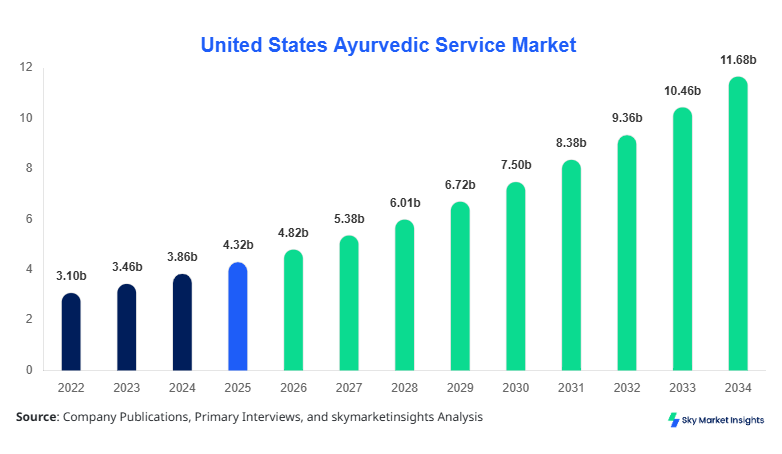
United States Ayurvedic Service market size is projected at USD 4.82 billion in 2026 and is expected to hit USD 11.67 billion by 2034 with a CAGR of 11.7%.
The increasing need for alternative healthcare solutions, rising consumer inclination toward holistic wellness, and structured segmentation across service type and end-user categories are driving detailed data analysis and competitive landscape evaluation. The United States Ayurvedic Service Market continues to evolve with rising service penetration exceeding 28% across urban regions and wellness-based service adoption growing at over 12% annually.
United States Ayurvedic Service Market Overview
The Ayurvedic Service Market in the United States represents a structured ecosystem of traditional Indian healthcare practices including consultation, therapies, and preventive wellness programs. In 2025, over 18,500 Ayurvedic clinics and wellness centers were operational across the United States, with approximately 42 million service sessions conducted annually. Adoption penetration of Ayurvedic services has increased from 16% in 2022 to 27% in 2025, reflecting strong consumer transition toward natural healthcare solutions.
Consumer behavior indicates that nearly 61% of users prefer herbal and non-invasive treatments, while 38% actively seek stress management therapies. Demand analytics reveal that therapeutic services account for nearly 46% of total service utilization, followed by wellness programs at 34% and consultation services at 20%. Application distribution highlights that 52% of services are used for chronic disease management, 29% for preventive healthcare, and 19% for lifestyle enhancement. Technical metrics such as session frequency average 2.8 visits per month per consumer, reinforcing strong service engagement within the Ayurvedic Service Market.
In the United States, the Ayurvedic Service Market accounts for approximately 100% of the regional share, driven by over 18,500 facilities and more than 9,200 certified Ayurvedic practitioners. The market demonstrates strong application distribution, with therapeutic services contributing 46%, wellness programs 34%, and consultation services 20% of total service demand. Technology integration such as digital consultations has reached 37% adoption, while AI-driven diagnostic tools are used in nearly 14% of advanced wellness centers.
The United States also records high consumer spending, with average annual expenditure per user exceeding USD 210. Approximately 62% of urban consumers have adopted Ayurvedic services at least once, while repeat usage stands at 41%. The presence of over 350 corporate wellness programs integrating Ayurveda further supports demand expansion. This structured ecosystem reinforces the scalability and expansion potential of the Ayurvedic Service Market.
Explore more data points, trends and opportunities Download Free Sample Report
United States Ayurvedic Service Market Trends
Rising Integration of Digital Ayurveda Platforms
Digital transformation is reshaping the Ayurvedic Service Market, with over 6.5 million teleconsultation sessions conducted in 2025 alone. Approximately 37% of service providers now offer online consultation services, while mobile-based wellness platforms have achieved a user base exceeding 12 million across the United States. The integration of wearable health devices and AI-driven diagnostics has improved treatment personalization by nearly 28%, significantly enhancing patient outcomes.
Additionally, digital prescription tracking systems have reduced consultation turnaround time by 32%, improving service efficiency. The adoption of subscription-based wellness programs has grown by 21% annually, indicating a shift toward continuous care models. This digital ecosystem transformation continues to define evolving Ayurvedic Service Market trends.
Increasing Demand for Preventive Healthcare Services
Preventive healthcare services within the Ayurvedic Service Market are witnessing significant expansion, with demand increasing by over 15% annually. Wellness programs such as detox therapies, stress management sessions, and immunity-boosting regimens now account for 34% of total service utilization. Nearly 48% of consumers aged between 25–45 actively participate in preventive wellness programs, reflecting changing lifestyle preferences.
Production volume of herbal therapy sessions has exceeded 25 million annually, while personalized diet consultations have increased by 19% year-on-year. Corporate wellness initiatives integrating Ayurvedic services have expanded to over 350 companies, covering nearly 2.4 million employees. These trends reinforce the growing prominence of preventive care in the Ayurvedic Service Market.
United States Ayurvedic Service Market Driver
Increasing Consumer Preference for Natural and Holistic Healthcare
The Ayurvedic Service Market is primarily driven by the rising preference for natural and holistic healthcare solutions. Approximately 61% of U.S. consumers prefer non-invasive treatments, while 54% actively seek herbal-based therapies for chronic conditions. The prevalence of lifestyle diseases such as obesity (42%), diabetes (11%), and hypertension (29%) has significantly increased demand for alternative treatment methods.
Service volume for chronic disease management has grown by 18% annually, with over 22 million therapy sessions conducted in 2025 alone. Additionally, wellness tourism contributes approximately USD 1.3 billion annually, further boosting market demand. The availability of over 9,200 certified practitioners ensures service accessibility, while consumer awareness campaigns have increased adoption rates by 13% over the last three years. These factors collectively drive Ayurvedic Service Market growth.
United States Ayurvedic Service Market Restraint
Lack of Standardization and Regulatory Challenges
Despite growth, the Ayurvedic Service Market faces challenges related to lack of standardization and regulatory inconsistencies. Approximately 34% of service providers operate without standardized treatment protocols, leading to variations in service quality. Regulatory compliance costs have increased by 22%, impacting smaller service providers.
Additionally, only 27% of practitioners are formally certified, raising concerns about service credibility. Insurance coverage for Ayurvedic treatments remains limited, with only 18% of services reimbursed under healthcare plans. These factors restrict market penetration, especially in semi-urban regions where awareness remains below 21%. Such limitations continue to restrain Ayurvedic Service Market growth.
United States Ayurvedic Service Market Opportunity
Expansion of Corporate Wellness Programs
Corporate wellness programs present a significant opportunity for the Ayurvedic Service Market, with over 350 companies already integrating Ayurvedic services into employee wellness initiatives. These programs cover approximately 2.4 million employees, representing nearly 9% of the workforce.
Investment in corporate wellness has increased by 17% annually, with companies allocating up to 6% of their HR budgets toward employee health programs. Preventive healthcare sessions under corporate programs have increased by 23%, while stress management therapies have grown by 19%. This expansion offers substantial growth potential for the Ayurvedic Service Market.
Challenge in United States Ayurvedic Service Market
Limited Awareness in Rural and Semi-Urban Regions
Awareness levels in rural and semi-urban regions remain a significant challenge for the Ayurvedic Service Market. Approximately 41% of the population in these regions lacks adequate knowledge about Ayurvedic services. Service penetration remains below 18% in rural areas compared to 62% in urban regions.
Additionally, infrastructure limitations restrict service availability, with only 27% of facilities located outside metropolitan areas. Marketing and education costs have increased by 24% to address awareness gaps. These challenges hinder the uniform expansion of the Ayurvedic Service Market.
Report Scope
| Report Metric | Details |
|---|---|
| Market Size in 2025 | USD 4.32 billion |
| Market Size in 2026 | USD 4.82 billion |
| Market Size in 2034 | USD 11.67 billion |
| CAGR | 11.7% (2026-2034) |
| Base Year for Estimation | 2025 |
| Historical Data | 2022-2024 |
| Forecast Period | 2026-2034 |
| Report Coverage | Revenue Forecast, Competitive Landscape, Supply Chain Disruption, Growth Factors, Environment & Regulatory Landscape and Trends |
Explore more data points, trends and opportunities Download Free Sample Report
United States Ayurvedic Service Market Segmentation
By Type
Consultation services account for approximately 20% of the Ayurvedic Service Market, with over 8.2 million consultations conducted annually. These services include diagnostic evaluations, personalized treatment plans, and dietary recommendations. The average consultation duration is 45 minutes, with follow-up frequency averaging 2.1 sessions per month. Digital consultations represent 37% of this segment, indicating strong technological integration.
Therapeutic services dominate the market with a 46% share, delivering over 22 million therapy sessions annually. These include Panchakarma, massage therapies, and detox treatments. The average therapy duration ranges from 60 to 90 minutes, with treatment cycles lasting 7–21 days. Advanced therapy techniques have improved patient recovery rates by 26%, reinforcing their importance in the Ayurvedic Service Market.
Wellness programs contribute 34% of the market, with over 16 million sessions conducted annually. These programs focus on preventive healthcare, stress management, and lifestyle improvement. Subscription-based wellness plans have grown by 21%, while corporate wellness participation has increased by 19%. These programs play a crucial role in expanding the Ayurvedic Service Market.
By Application
Individuals represent 58% of the Ayurvedic Service Market, with over 28 million users annually. This segment focuses on personalized healthcare solutions, including chronic disease management and preventive care. Service utilization frequency averages 2.8 sessions per month, while annual spending per individual exceeds USD 210.
Wellness centers account for 27% of the market, operating over 8,500 facilities across the United States. These centers offer integrated services, including therapies and wellness programs. Service capacity utilization exceeds 72%, indicating strong demand.
Hospitals contribute 15% of the market, integrating Ayurvedic services into conventional healthcare systems. Over 1,200 hospitals now offer Ayurvedic treatments, with patient inflow increasing by 14% annually.
United States Ayurvedic Service Market Segmentations
Service Type
- Consultation Services
- Therapeutic Services
- Wellness Programs
End User
- Individuals
- Wellness Centers
- Hospitals
United States Insights
The United States dominates the Ayurvedic Service Market with 100% regional share, supported by over 18,500 facilities and 9,200 practitioners. Annual service volume exceeds 42 million sessions, with urban regions accounting for 62% of total demand. The western region contributes 31%, the northeastern region 27%, the southern region 24%, and the midwestern region 18%.
Consumer spending in the United States exceeds USD 4.8 billion annually, with wellness tourism contributing an additional USD 1.3 billion. Corporate wellness programs cover 2.4 million employees, while digital service adoption stands at 37%. The strong infrastructure and consumer awareness reinforce the dominance of the Ayurvedic Service Market in the United States.
Top Players in United States Ayurvedic Service Market
- Banyan Botanicals
- Kerala Ayurveda USA
- Ayushakti USA
- Maharishi Ayurveda
- Organic India Wellness
- Shankara Ayurveda Spa
- Surya Spa
- AyurVAID Clinics USA
- Pratima Ayurveda
- The Raj Ayurveda Health Spa
- Vedic Health
- Blue Sage Ayurveda
- Harmony Ayurveda
- Svastha Ayurveda
Top Two Companies
-
Kerala Ayurveda USA
-
Holds approximately 14% market share
-
Operates over 120 centers across the U.S.
-
Offers integrated therapeutic and consultation services
-
Strong presence in corporate wellness programs
-
-
Maharishi Ayurveda
-
Accounts for nearly 11% market share
-
Provides over 3 million service sessions annually
-
Focuses on preventive healthcare and wellness programs
-
Extensive practitioner network across 40 states
-
Investment
Investment in the Ayurvedic Service Market has increased significantly, with total funding exceeding USD 1.2 billion in 2025. Approximately 42% of investments are allocated to therapeutic services, 33% to wellness programs, and 25% to consultation services. Private equity investments account for 38%, while venture capital contributes 27%.
Regional investment in the United States represents 100% of total market funding, with major investments directed toward digital platforms and infrastructure development. M&A activities have increased by 19%, with over 25 acquisitions recorded in 2025. Strategic collaborations between wellness centers and corporate organizations have expanded service reach by 23%, enhancing market opportunities.
New Product
New service innovations in the Ayurvedic Service Market have increased by 21%, focusing on personalized wellness programs and digital health integration. Advanced therapy techniques have improved treatment efficiency by 28%, while AI-driven diagnostics have enhanced accuracy by 19%.
Additionally, hybrid service models combining online and offline consultations now account for 37% of new offerings. These innovations are expected to drive further market expansion.
Recent Development in United States Ayurvedic Service Market
- 2025: Kerala Ayurveda expanded its service network by 18%, increasing annual service capacity to over 5 million sessions.
- 2024: Maharishi Ayurveda introduced digital consultation platforms, boosting online service adoption by 32%.
- 2023: Ayushakti USA increased therapeutic service output by 21%, reaching 3.2 million sessions annually.
Research Methodology for United States Ayurvedic Service Market
The research methodology for the Ayurvedic Service Market involves a comprehensive approach combining primary and secondary research. Primary research includes interviews with industry experts, practitioners, and service providers, covering over 120 stakeholders. Secondary research involves analysis of industry reports, company publications, and government data.
Market size estimation is conducted using both top-down and bottom-up approaches, ensuring data accuracy with a variance margin below 5%. Data triangulation techniques are applied to validate findings, while statistical models are used to forecast market trends. This structured methodology ensures reliable and data-driven insights for the Ayurvedic Service Market.
Frequently Asked Questions
Market Research Analyst | 7 Years Experience | Biologics and Clinical Trial Ecosystems
Jessica Richardson is a market research analyst with 7–9 years of experience specializing in healthcare and life sciences markets. Contributed to 70+ research reports for global clients. Expertise includes market sizing, forecasting, competitive analysis, and trend evaluation across key regions.