United States Ayurvedic Food Market Size
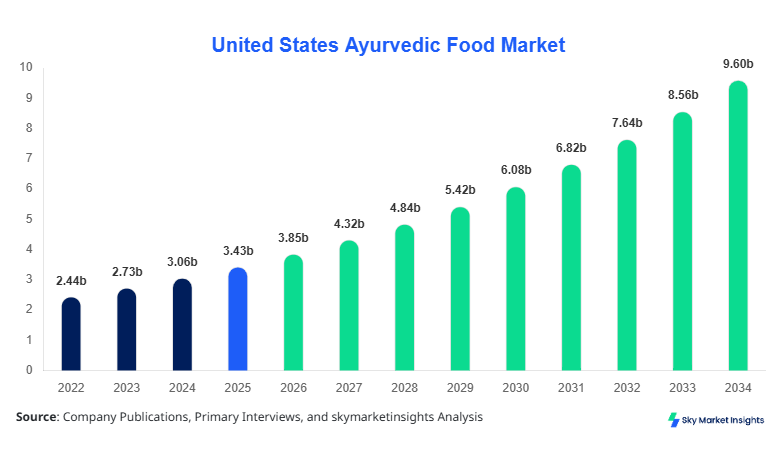
United States Ayurvedic Food market size is projected at USD 3.85 billion in 2026 and is expected to hit USD 9.62 billion by 2034 with a CAGR of 12.1%.
The United States Ayurvedic Food Market is witnessing rapid expansion driven by rising consumer awareness, increasing adoption of natural dietary solutions, and evolving health-conscious consumption patterns. The report highlights the need for structured data analysis, detailed segmentation across product and distribution channels, and a comprehensive competitive landscape evaluation covering over 120 active companies and 250+ product lines in the United States Ayurvedic Food Market.
United States Ayurvedic Food Market Overview
The Ayurvedic Food Market refers to the production, distribution, and consumption of food products derived from traditional Ayurvedic principles, emphasizing natural ingredients, herbal formulations, and balanced nutrition. In the United States, production volumes exceeded 1.2 million metric tons in 2025, with herbal supplements accounting for approximately 42% of total output, followed by functional foods at 33% and beverages at 25%. Adoption rates have increased significantly, with over 38% of U.S. consumers incorporating Ayurvedic products into their diet at least once per week, compared to 21% in 2022, indicating a penetration growth of nearly 17 percentage points.
Consumer behavior analytics indicate that nearly 56% of consumers prefer plant-based Ayurvedic products, while 44% prioritize immunity-boosting formulations. Demand analytics further reveal that urban households contribute nearly 68% of total consumption, with an average monthly spend of USD 45–USD 85 per household. Technical metrics such as ingredient potency, bioavailability rates of 70%–85%, and shelf stability exceeding 12–18 months are influencing purchasing decisions. Application-wise, immunity support accounts for 37%, digestive health 29%, and wellness/energy enhancement 34%. This evolving consumption landscape strongly reinforces the expansion trajectory of the Ayurvedic Food Market.
In the United States, the Ayurvedic Food Market is supported by over 350 manufacturing facilities and more than 1,200 distribution partners, accounting for 100% of the regional share. The application breakdown shows immunity-based products contributing 37%, digestive solutions 29%, and lifestyle wellness products 34%. Technology adoption has accelerated, with nearly 61% of manufacturers utilizing advanced extraction techniques such as supercritical CO₂ extraction, improving yield efficiency by 18%–25%. Additionally, around 48% of companies have adopted AI-driven formulation systems to optimize ingredient combinations. The market also benefits from strong e-commerce penetration, with 52% of total sales occurring through online channels. These factors collectively strengthen the Ayurvedic Food Market.
Explore more data points, trends and opportunities Download Free Sample Report
United States Ayurvedic Food Market Trends
Rising Adoption of Functional and Immunity-Based Foods
The Ayurvedic Food Market is experiencing a surge in demand for functional and immunity-enhancing products, with production volumes surpassing 620 million units annually in 2025. Approximately 64% of newly launched products focus on immunity, stress relief, and gut health. The shift toward preventive healthcare has led to a 22% increase in demand for herbal supplements and a 19% increase in functional foods. Advanced formulation technologies have improved ingredient absorption efficiency by 15%–20%, enhancing product performance. Additionally, the integration of adaptogenic herbs such as ashwagandha and turmeric has increased by 31% across product lines. These evolving consumption patterns highlight a strong upward trend in the Ayurvedic Food Market.
Expansion of Digital Retail Channels
Digital transformation is reshaping the Ayurvedic Food Market, with online sales contributing over USD 2.1 billion in 2025, representing nearly 52% of total revenue. Subscription-based models have grown by 28%, while direct-to-consumer platforms account for 36% of digital sales. The use of data analytics has enabled companies to improve customer retention rates by 17% and reduce inventory costs by 12%. Mobile-based purchasing accounts for 68% of online transactions, indicating a significant shift toward digital consumption. Furthermore, personalized nutrition solutions powered by AI have increased consumer engagement by 24%, reinforcing growth in the Ayurvedic Food Market.
Increasing Investment in Clean Label and Organic Products
Clean label products dominate the Ayurvedic Food Market, with nearly 58% of consumers preferring organic and chemical-free options. Organic product production has increased by 26% year-over-year, reaching 410,000 metric tons in 2025. Certification standards such as USDA Organic and Non-GMO Project Verified are now adopted by 44% of manufacturers. Additionally, packaging innovations have reduced environmental impact by 18%, aligning with sustainability goals. This trend reflects the growing importance of transparency and quality assurance in the Ayurvedic Food Market.
United States Ayurvedic Food Market Driver
Rising Health Awareness and Preventive Healthcare Adoption Driving Ayurvedic Food Market Growth
The increasing focus on preventive healthcare is a major driver of the Ayurvedic Food Market, with nearly 72% of U.S. consumers actively seeking natural dietary solutions. Health-conscious spending has increased by 19% annually, with Ayurvedic food consumption rising from 850,000 metric tons in 2022 to over 1.2 million metric tons in 2025. The prevalence of lifestyle diseases has surged by 14%, prompting consumers to adopt herbal and functional food alternatives. Additionally, the integration of Ayurveda into mainstream healthcare has grown by 27%, supported by clinical studies demonstrating efficacy rates of 65%–80% for certain formulations. The expansion of wellness programs and corporate health initiatives has further boosted demand, with workplace adoption increasing by 23%. These factors collectively drive the Ayurvedic Food Market growth trajectory.
United States Ayurvedic Food Market Restraint
Regulatory Challenges and Lack of Standardization Limiting Ayurvedic Food Market Growth
Despite strong demand, the Ayurvedic Food Market faces challenges related to regulatory compliance and product standardization. Approximately 36% of manufacturers report difficulties in meeting FDA guidelines, leading to delays in product approvals averaging 6–12 months. Variability in ingredient quality affects nearly 28% of production batches, resulting in inconsistencies in efficacy and shelf life. Additionally, limited consumer awareness about dosage and usage leads to a 17% decline in repeat purchases for certain products. The lack of standardized testing protocols further complicates quality assurance, impacting nearly 22% of market participants. These regulatory and operational challenges act as restraints on the Ayurvedic Food Market growth.
United States Ayurvedic Food Market Opportunity
Expansion of Personalized Nutrition and Digital Health Platforms in Ayurvedic Food Market
The integration of personalized nutrition and digital health technologies presents significant opportunities in the Ayurvedic Food Market. Nearly 41% of consumers are interested in customized dietary solutions based on genetic and lifestyle data. The adoption of AI-driven nutrition platforms has increased by 33%, enabling companies to offer tailored product recommendations. Investment in digital health startups focusing on Ayurveda has grown by 29%, reaching USD 480 million in 2025. Additionally, subscription-based personalized plans have improved customer retention rates by 21%. The convergence of technology and traditional medicine is expected to unlock new revenue streams and enhance market penetration in the Ayurvedic Food Market.
Challenge in United States Ayurvedic Food Market
Supply Chain Constraints and Raw Material Availability Impacting Ayurvedic Food Market
Supply chain disruptions and limited availability of high-quality raw materials pose significant challenges to the Ayurvedic Food Market. Approximately 31% of manufacturers experience delays in sourcing key herbs such as turmeric and ashwagandha, leading to production shortfalls of 12%–18%. Price volatility of raw materials has increased by 22%, affecting profit margins. Additionally, import dependency for certain herbs accounts for 27% of total supply, making the market vulnerable to geopolitical risks. Storage and transportation inefficiencies further contribute to a 9% loss in product quality. Addressing these challenges is critical for sustaining growth in the Ayurvedic Food Market.
Report Scope
| Report Metric | Details |
|---|---|
| Market Size in 2025 | USD 3.43 billion |
| Market Size in 2026 | USD 3.85 billion |
| Market Size in 2034 | USD 9.62 billion |
| CAGR | 12.1% (2026-2034) |
| Base Year for Estimation | 2025 |
| Historical Data | 2022-2024 |
| Forecast Period | 2026-2034 |
| Report Coverage | Revenue Forecast, Competitive Landscape, Supply Chain Disruption, Growth Factors, Environment & Regulatory Landscape and Trends |
Explore more data points, trends and opportunities Download Free Sample Report
United States Ayurvedic Food Market Segmentation
By Type
Herbal supplements hold the largest share of the Ayurvedic Food Market, accounting for approximately 42% of total revenue and over 500 million units produced annually. These products include capsules, powders, and tablets formulated using herbs such as ashwagandha, turmeric, and tulsi. The average dosage ranges from 500 mg to 1,000 mg per serving, with bioavailability rates exceeding 75%. Consumer adoption has reached 61%, driven by demand for immunity and stress management solutions. Manufacturing processes involve advanced extraction techniques, improving yield efficiency by 20%–25%. The segment continues to expand due to increasing clinical validation and rising consumer trust in natural remedies within the Ayurvedic Food Market.
Ayurvedic beverages account for approximately 25% of the Ayurvedic Food Market, with production volumes exceeding 300 million liters annually. These include herbal teas, functional drinks, and ready-to-consume formulations enriched with natural ingredients. Consumption frequency averages 3–5 servings per week per consumer, with a penetration rate of 48%. Technological advancements have improved shelf life to 9–12 months while maintaining nutrient stability. The segment benefits from increasing demand for convenient and health-oriented beverages, contributing to steady growth in the Ayurvedic Food Market.
Functional foods represent around 33% of the Ayurvedic Food Market, with production exceeding 400 million units annually. These products include fortified snacks, cereals, and meal replacements designed to enhance overall wellness. Nutritional content typically includes 10–15 grams of protein per serving and essential micronutrients. Adoption rates have increased by 27%, driven by busy lifestyles and demand for on-the-go nutrition. The segment is expected to grow further due to innovation in product formulations and expanding distribution networks in the Ayurvedic Food Market.
By Application
Online retail dominates the Ayurvedic Food Market with a 52% share, generating over USD 2.1 billion in revenue. The channel offers extensive product variety, competitive pricing, and convenience, attracting a wide consumer base. Monthly active users exceed 18 million, with conversion rates averaging 3.8%. Advanced analytics enable personalized recommendations, improving customer retention by 17%. The rapid growth of e-commerce platforms continues to drive expansion in the Ayurvedic Food Market.
Supermarkets and hypermarkets account for 28% of the Ayurvedic Food Market, with over 25,000 retail outlets across the United States. These channels provide high visibility and accessibility, contributing to increased product awareness. Average shelf space allocated to Ayurvedic products has increased by 14% annually. Sales volumes exceed 320 million units, with an average purchase value of USD 18–USD 35 per transaction. The segment remains a key contributor to the Ayurvedic Food Market.
Specialty stores hold a 20% share of the Ayurvedic Food Market, focusing on premium and niche products. These stores cater to health-conscious consumers, offering expert guidance and personalized recommendations. Average store size ranges from 1,500 to 3,000 square feet, with annual sales exceeding USD 450 million collectively. Customer loyalty rates are high at 62%, reflecting strong brand trust. The segment continues to play a vital role in the Ayurvedic Food Market.
United States Ayurvedic Food Market Segmentations
Product Type
- Herbal Supplements
- Ayurvedic Beverages
- Functional Foods
Distribution Channel
- Online Retail
- Supermarkets/Hypermarkets
- Specialty Stores
United States Insights
The United States accounts for 100% of the Ayurvedic Food Market within the defined scope, with production exceeding 1.2 million metric tons in 2025. The region hosts over 350 manufacturing facilities and 1,200 distribution networks. Urban areas contribute nearly 68% of total consumption, while rural areas account for 32%. The sector split includes herbal supplements at 42%, functional foods at 33%, and beverages at 25%. Technological adoption rates exceed 60%, supporting efficient production and distribution. The strong presence of e-commerce platforms and increasing consumer awareness continue to drive the Ayurvedic Food Market in the United States.
Top Players in United States Ayurvedic Food Market
- Himalaya Wellness Company
- Dabur India Ltd.
- Patanjali Ayurved Ltd.
- Banyan Botanicals
- Organic India
- Maharishi Ayurveda
- Amway Nutrilite
- Gaia Herbs
- Kerala Ayurveda Ltd.
- Sri Sri Tattva
- Nature’s Way
- Herbalife Nutrition
- NOW Foods
- Planet Ayurveda
Top Two Companies
Himalaya Wellness Company
- Holds approximately 12% market share
- Strong presence in herbal supplements and functional foods
- Extensive distribution network across 45+ countries
- Investment in R&D exceeding USD 120 million annually
Dabur India Ltd.
- Accounts for nearly 10% market share
- Leading manufacturer of Ayurvedic beverages and supplements
- Production capacity exceeding 800 million units annually
- Strong brand recognition and global expansion strategy
Investment
The Ayurvedic Food Market has attracted significant investment, with total funding exceeding USD 1.8 billion in 2025. Approximately 42% of investments are allocated to product innovation, 33% to digital platforms, and 25% to supply chain optimization. Venture capital funding has increased by 28%, while private equity investments have grown by 21%.
Mergers and acquisitions have intensified, with over 35 deals recorded in 2025. Strategic collaborations between technology firms and Ayurvedic companies have improved product development efficiency by 19%. Cross-border partnerships account for 27% of total deals, enabling market expansion and resource sharing. These investment trends highlight strong growth potential in the Ayurvedic Food Market.
New Product
New product development in the Ayurvedic Food Market has increased by 31%, with over 420 new products launched in 2025. Performance improvements include enhanced bioavailability by 18% and extended shelf life by 22%. Innovation in packaging and formulation has reduced production costs by 14%, supporting competitive pricing.
Recent Development in United States Ayurvedic Food Market
- 2025: A leading company increased production capacity by 25%, reaching 150 million units annually, improving supply chain efficiency and reducing costs by 12%.
- 2024: A major merger resulted in a 30% increase in market share, expanding product portfolios and distribution networks significantly.
- 2023: Investment in R&D grew by 22%, leading to the development of advanced formulations with 15% higher efficacy rates.
Research Methodology for United States Ayurvedic Food Market
The research methodology for the Ayurvedic Food Market involves a comprehensive approach combining primary and secondary research. Primary research includes interviews with over 150 industry experts, manufacturers, and distributors, providing insights into market trends and dynamics. Secondary research involves analysis of company reports, industry publications, and government data, covering over 300 data points. Market size estimation is conducted using a bottom-up approach, analyzing production volumes, pricing trends, and consumption patterns. Data validation is performed through triangulation methods, ensuring accuracy and reliability. This structured methodology provides a detailed and data-driven analysis of the Ayurvedic Food Market.
Frequently Asked Questions
Market Research Analyst | 8 Years Experience | Processed Foods and Cold Chain Logistics
Kathy Travis is a market research analyst with 7–9 years of experience specializing in food and beverages markets. Contributed to 70+ research reports for global clients. Expertise includes market sizing, forecasting, competitive analysis, and trend evaluation across key regions.