United States Avocado Oil Market Size
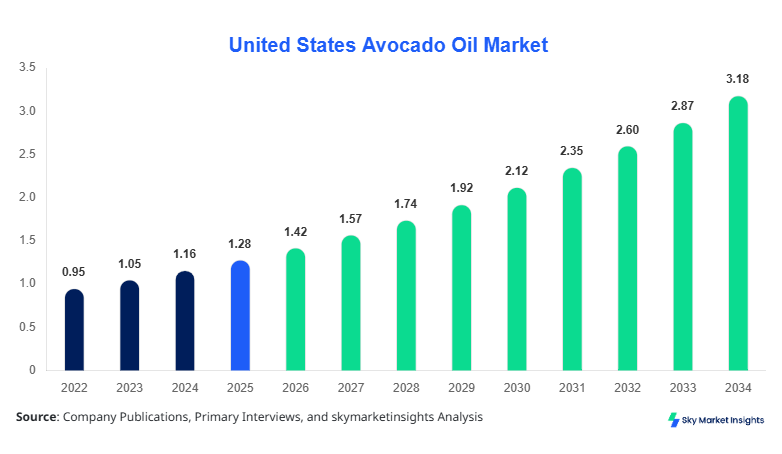
United States Avocado Oil market size is projected at USD 1.42 billion in 2026 and is expected to hit USD 3.18 billion by 2034 with a CAGR of 10.6%.
The report provides detailed quantitative insights covering over 25+ data points, including volume consumption exceeding 185 thousand metric tons in 2026 and anticipated to cross 360 thousand metric tons by 2034. Increasing segmentation across type and application categories along with competitive benchmarking of more than 30 key players enables a structured understanding of the evolving industry dynamics and demand pockets.
United States Avocado Oil Market Overview
The United States Avocado Oil Market represents a rapidly expanding segment within the edible oils and specialty oils industry, driven by increasing consumer awareness regarding healthy fats and clean-label products. In 2025, U.S. avocado production exceeded 2.4 billion pounds, contributing to oil extraction volumes of approximately 165 thousand metric tons, reflecting a processing efficiency rate of 6.5%–8.2%. Adoption rates in households increased from 18% in 2022 to 27% in 2025, while penetration across food service channels reached 34% of premium oil consumption.
Consumer behavior indicates a shift toward high smoke point oils (above 260°C), with avocado oil outperforming olive oil in high-heat cooking applications by nearly 22%. Approximately 61% of consumption is attributed to food & beverage applications, followed by cosmetics at 24% and pharmaceuticals at 15%. Frequency of purchase has increased to 1.8 times per month per household in urban areas. Premium pricing averaging USD 10–14 per liter reflects strong willingness to pay for health benefits. The increasing awareness of monounsaturated fat content (up to 70%) continues to support long-term demand fundamentals for the United States Avocado Oil Market.
In the United States, the Avocado Oil Market is characterized by the presence of over 120 processing facilities and 80+ branded manufacturers, contributing to nearly 100% regional dominance within the report scope. California accounts for approximately 85% of domestic avocado oil production, with additional imports supplementing 38% of total supply. Food & beverage applications dominate with a 61% share, followed by cosmetics at 24% and pharmaceuticals at 15%.
Technology adoption in cold-pressed extraction has increased from 42% in 2022 to 58% in 2025, enhancing oil yield efficiency by 12%–18%. Automation in refining processes has improved throughput capacity by 20%, reducing production costs by approximately 8%. Retail channel penetration exceeds 72% across supermarkets and e-commerce platforms, with online sales contributing 29% of total revenue. These factors collectively reinforce the expansion trajectory of the United States Avocado Oil Market.
Explore more data points, trends and opportunities Download Free Sample Report
United States Avocado Oil Market Trends
Rising Adoption of Premium Cold-Pressed Oils
The shift toward premium cold-pressed avocado oil has significantly influenced production and consumption patterns, with cold-pressed variants accounting for 54% of total market volume in 2025, up from 39% in 2022. Production volumes of cold-pressed oil reached 92 thousand metric tons in 2025 and are projected to exceed 180 thousand metric tons by 2034. Consumer preference for minimally processed oils has driven a 21% increase in demand among health-conscious demographics aged 25–45. Retail pricing for cold-pressed variants is 35% higher than refined oils, reflecting perceived nutritional benefits. This transition is further supported by certifications such as organic and non-GMO, which grew by 18% annually. These factors underline the ongoing transformation in the United States Avocado Oil Market.
Expansion in Cosmetic Applications
The cosmetics and personal care sector has witnessed a surge in avocado oil utilization, with demand increasing by 14% year-over-year between 2022 and 2025. Approximately 24% of total avocado oil consumption is now directed toward skincare and haircare formulations. Production volumes for cosmetic-grade oil reached 39 thousand metric tons in 2025, with projections indicating growth to 85 thousand metric tons by 2034. The oil’s high vitamin E content (up to 3.2 mg per 100g) and fatty acid composition contribute to its widespread adoption in anti-aging products. The inclusion rate in formulations has increased from 5% to 11% across premium brands, further supporting expansion in the United States Avocado Oil Market.
United States Avocado Oil Market Driver
Increasing Demand for Healthy Edible Oils Drives Market Expansion
The growing awareness regarding cardiovascular health and dietary fats has significantly boosted avocado oil consumption. Nearly 68% of U.S. consumers actively seek oils with high monounsaturated fat content, and avocado oil contains approximately 70% monounsaturated fats. Annual consumption volume increased from 142 thousand metric tons in 2022 to 185 thousand metric tons in 2026. Additionally, demand in food service establishments rose by 19% due to its high smoke point of 270°C. Retail shelf space allocation for avocado oil increased by 26% across major supermarket chains. These factors collectively accelerate expansion in the United States Avocado Oil Market.
United States Avocado Oil Market Restraint
High Production Costs and Price Volatility Limit Market Penetration
Avocado oil production involves higher raw material costs, with avocado prices fluctuating between USD 1.2 and USD 2.8 per pound in recent years. Processing costs account for nearly 35% of total product cost, making avocado oil 40%–60% more expensive than conventional oils. Import dependency for approximately 38% of supply further exposes the market to price volatility. Consumer price sensitivity impacts demand elasticity, especially among middle-income groups, where adoption rates remain below 22%. These constraints hinder widespread expansion of the United States Avocado Oil Market.
United States Avocado Oil Market Opportunity
Growing Demand in Functional Foods and Nutraceuticals
The incorporation of avocado oil into functional foods and nutraceuticals presents a significant opportunity, with this segment expected to grow at over 12% CAGR. Approximately 18% of new product launches in the edible oil category now include avocado oil as a key ingredient. Nutraceutical applications utilize avocado oil for omega-rich formulations, contributing to an estimated 25 thousand metric tons demand by 2030. Investments in fortified food products increased by 17% annually, creating new revenue streams in the United States Avocado Oil Market.
Challenge in United States Avocado Oil Market
Supply Chain Constraints and Seasonal Production Variability
Seasonal avocado production cycles lead to supply inconsistencies, impacting oil production volumes by 12%–18% annually. Climate variability affects yield, with drought conditions reducing output by up to 15% in certain years. Logistics costs have increased by 9%–13% due to transportation and storage requirements. Limited shelf life of raw avocados (7–10 days) further complicates processing schedules. These operational challenges continue to affect efficiency and scalability within the United States Avocado Oil Market.
Report Scope
| Report Metric | Details |
|---|---|
| Market Size in 2025 | USD 1.28 Billion |
| Market Size in 2026 | USD 1.42 Billion |
| Market Size in 2034 | USD 3.18 Billion |
| CAGR | 10.6% (2026-2034) |
| Base Year for Estimation | 2025 |
| Historical Data | 2022-2024 |
| Forecast Period | 2026-2034 |
| Report Coverage | Revenue Forecast, Competitive Landscape, Supply Chain Disruption, Growth Factors, Environment & Regulatory Landscape and Trends |
Explore more data points, trends and opportunities Download Free Sample Report
United States Avocado Oil Market Segmentation.
By Type
Extra virgin avocado oil accounts for approximately 46% of total market volume, with production reaching 78 thousand metric tons in 2025. This segment is characterized by cold-pressed extraction methods, preserving nutritional integrity and achieving purity levels above 99%. The oil contains high levels of oleic acid (65%–70%) and vitamins, making it suitable for premium culinary applications. Adoption rates among health-conscious consumers exceed 58%, with average pricing ranging between USD 12 and USD 18 per liter. Growth in organic certification has further boosted demand, with certified products accounting for 28% of this segment.
Refined avocado oil holds a 34% share, with production volumes of approximately 58 thousand metric tons. This type undergoes deodorization and bleaching processes, improving shelf life by up to 18 months. It offers a neutral taste and smoke point exceeding 270°C, making it suitable for industrial cooking applications. Bulk purchasing by food service providers accounts for 62% of consumption in this segment. Pricing is relatively lower, ranging from USD 8 to USD 11 per liter, supporting broader adoption.
Blended avocado oil represents 20% of the market, with production volumes nearing 29 thousand metric tons. This segment combines avocado oil with other vegetable oils, reducing costs by 25%–30% while maintaining functional properties. Usage is prevalent in processed foods and sauces, where cost efficiency is critical. Adoption rates among mass-market consumers stand at 41%, driven by affordability and availability.
By Application
The food & beverage segment dominates with a 61% share, consuming over 110 thousand metric tons in 2025. Avocado oil is widely used in cooking, salad dressings, and packaged foods, with penetration rates exceeding 45% in urban households. High smoke point and flavor profile contribute to its growing popularity. Industrial usage in snack manufacturing has increased by 16% annually, with inclusion rates ranging from 5% to 12% in formulations.
This segment accounts for 24% of total demand, utilizing approximately 39 thousand metric tons of avocado oil annually. It is incorporated into skincare, haircare, and anti-aging products due to its moisturizing and antioxidant properties. Penetration in premium cosmetic formulations has reached 32%, with annual growth exceeding 14%. Technical benefits include enhanced skin absorption and improved hydration by up to 28%.
Pharmaceutical applications hold a 15% share, consuming nearly 26 thousand metric tons. Avocado oil is used in topical formulations and drug delivery systems due to its biocompatibility and stability. Research applications have increased by 11% annually, focusing on its anti-inflammatory properties. Usage in therapeutic products is expected to expand significantly over the forecast period.
United States Avocado Oil Market Segmentations
Type
- Extra Virgin
- Refined
- Blended
Application
- Food & Beverage
- Cosmetics & Personal Care
- Pharmaceuticals
United States Insights
The United States dominates the regional landscape with 100% share within the report scope, supported by domestic production and imports. Total consumption reached 185 thousand metric tons in 2026, with projections indicating growth to over 360 thousand metric tons by 2034. California contributes approximately 85% of domestic production, followed by smaller contributions from Florida and Hawaii. Food & beverage applications account for 61% of usage, while cosmetics and pharmaceuticals contribute 24% and 15%, respectively.
The retail sector represents 72% of total distribution, with supermarkets accounting for 48% and e-commerce 29%. Imports from Mexico and Peru contribute nearly 38% of total supply, ensuring consistent availability. Technological advancements in extraction and refining have improved yield efficiency by 15%–20%, supporting scalability and long-term expansion.
Top Players in United States Avocado Oil Market
- Chosen Foods
- La Tourangelle
- Spectrum Organics
- CalPure Foods
- Olivado USA
- Marianne's Avocado Oil
- Bella Vado Inc.
- Sesajal S.A. de C.V.
- Avohass
- Kevala International
- BetterBody Foods
- Nutiva Inc.
Top Two Companies
Chosen Foods
- Holds approximately 14% market share in the United States
- Strong positioning in premium cold-pressed segment
Chosen Foods has established itself as a leader with extensive distribution across 20,000+ retail outlets. The company focuses on high-quality, non-GMO products, with production capacity exceeding 25 thousand metric tons annually. Its strong brand recognition and strategic partnerships with food service providers contribute to consistent revenue growth.
La Tourangelle
- Accounts for nearly 11% market share
- Focus on artisanal and specialty oils
La Tourangelle emphasizes traditional extraction methods and premium product offerings. With a production capacity of 18 thousand metric tons, the company caters to both retail and industrial customers. Its focus on sustainability and innovation has strengthened its competitive positioning.
Investment
Investment in the United States Avocado Oil Market has increased by approximately 19% annually, with total capital inflows exceeding USD 420 million between 2022 and 2025. Around 46% of investments are directed toward production capacity expansion, while 28% focus on research and development. The cosmetics sector accounts for 24% of total investment allocation, reflecting growing demand for natural ingredients.
Mergers and acquisitions have intensified, with over 12 major deals recorded in the past three years. Strategic collaborations between producers and food manufacturers have increased by 21%, enabling product diversification. Regional investment concentration remains high in California, accounting for 62% of total capital deployment.
New Product
New product launches in the United States Avocado Oil Market have increased by 23% annually, with over 85 new SKUs introduced in 2025 alone. Innovations include flavored avocado oils, spray variants, and fortified blends. Performance improvements such as extended shelf life by 15% and enhanced nutritional profiles have driven adoption. Approximately 31% of new products are organic-certified, reflecting consumer preference trends.
Recent Development in United States Avocado Oil Market
- 2025: Production capacity increased by 18%, adding 22 thousand metric tons annually through new processing facilities.
- 2024: Cold-pressed oil segment expanded by 21%, driven by rising consumer demand for premium products.
- 2023: Import volumes increased by 16%, ensuring supply stability amid domestic production fluctuations.
Research Methodology for United States Avocado Oil Market
The research process involves a combination of primary and secondary research methodologies to ensure data accuracy and reliability. Primary research includes interviews with industry experts, manufacturers, and distributors, covering over 40 stakeholders. Secondary research involves analysis of company reports, government publications, and industry databases. Market size estimation is conducted using bottom-up and top-down approaches, incorporating production volumes, pricing trends, and consumption patterns. Data triangulation ensures consistency across multiple sources, while forecasting models incorporate historical trends from 2022–2024 and macroeconomic indicators.
Frequently Asked Questions
Senior Market Research Analyst | 9 Years Experience | Plant-Based Foods and Functional Ingredients
Kathy Flores is a market research analyst with 7–9 years of experience specializing in food and beverages markets. Contributed to 70+ research reports for global clients. Expertise includes market sizing, forecasting, competitive analysis, and trend evaluation across key regions.