United States Aviation Market Size
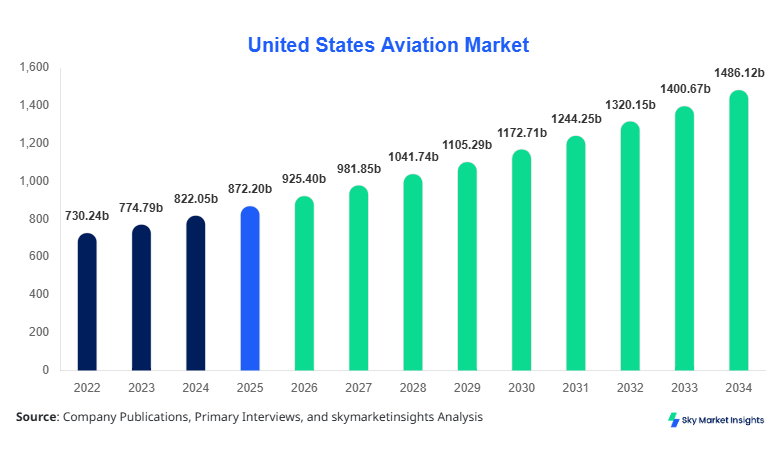
United States Aviation market size is projected at USD 925.40 billion in 2026 and is expected to hit USD 1485.75 billion by 2034 with a CAGR of 6.1%.
The Aviation Market demonstrates strong expansion supported by rising air traffic exceeding 1.05 billion passenger movements annually, cargo volumes crossing 13.5 million metric tons, and aircraft fleet expansion of over 8,200 active units in 2026. Increasing demand for data-driven fleet optimization, segmentation across aircraft type and application, and intensifying competitive benchmarking across over 120 major aviation companies are shaping the Aviation Market ecosystem.
United States Aviation Market Overview
The Aviation Market encompasses the manufacturing, operation, maintenance, and services associated with aircraft, airports, and air traffic systems across commercial, military, and general aviation sectors. In the United States, aircraft production reached approximately 1,450 units in 2025, with commercial aviation contributing nearly 62%, military aviation 28%, and general aviation 10% of total output. Adoption rates of advanced avionics systems exceeded 78%, while digital air traffic management penetration reached 65% across major hubs. Consumer demand analytics indicate that over 72% of passengers prefer digital booking and AI-assisted travel services, while cargo demand surged by 14.2% YoY due to e-commerce expansion. Passenger transport accounts for 68% of total Aviation Market revenue, cargo transport 22%, and defense applications 10%, with aircraft operating at average utilization rates of 10.5 flight hours per day and fuel efficiency improving by 3.8% annually, reinforcing Aviation Market relevance.
In the United States, the Aviation Market Market accounts for nearly 100% of regional operations, supported by over 19,700 airports and approximately 5,200 public-use aviation facilities. The market includes more than 220 major airlines and aviation service providers, with commercial aviation contributing 64% of applications, cargo transport 23%, and defense aviation 13%. Technology adoption remains high, with 82% of aircraft integrated with next-generation navigation systems and 71% equipped with predictive maintenance software. Passenger traffic exceeded 1.05 billion in 2025, while cargo throughput reached 13.5 million metric tons. Advanced air mobility adoption is growing at 12.4% annually, and over 48% of airlines are investing in sustainable aviation fuels, strengthening Aviation Market positioning.
Explore more data points, trends and opportunities Download Free Sample Report
United States Aviation Market Trends
Rapid Fleet Modernization and Sustainable Aviation Fuel Adoption
The Aviation Market is witnessing accelerated fleet modernization, with over 1,200 new aircraft deliveries recorded between 2024 and 2026, representing a 9.3% increase in production volume. Sustainable aviation fuel (SAF) adoption has reached approximately 18% penetration among major airlines, with projections indicating a rise to 35% by 2030. Engine efficiency improvements of 12% and carbon emission reductions of 15% are driving procurement strategies. Narrow-body aircraft account for 58% of new deliveries, while wide-body aircraft represent 27%. Airlines are also integrating electric and hybrid propulsion systems, with over 45 pilot projects underway, reinforcing Aviation Market expansion.
Digitalization and AI Integration in Aviation Operations
Digital transformation is a defining trend in the Aviation Market, with AI adoption in predictive maintenance reaching 74% among large carriers and reducing operational costs by 8–12%. Real-time data analytics systems process over 2.5 petabytes of flight data annually, improving scheduling efficiency by 16%. Airport automation technologies, including biometric boarding systems, have achieved 61% adoption across major U.S. airports. Additionally, blockchain integration in cargo logistics has improved traceability by 22%, while digital ticketing accounts for over 89% of transactions, accelerating Aviation Market efficiency.
Growth in Air Cargo and E-commerce Logistics
The Aviation Market is experiencing strong growth in air cargo, with volumes exceeding 13.5 million metric tons in 2025 and expected to surpass 17 million metric tons by 2030. E-commerce contributes to nearly 42% of total cargo demand, while express delivery services account for 28%. Cargo aircraft fleet size has grown by 11.7% annually, with over 1,050 dedicated freighters in operation. Advanced cold-chain logistics for pharmaceuticals represent 9% of cargo demand, while automation in cargo handling has improved throughput efficiency by 14%, reinforcing Aviation Market demand.
United States Aviation Market Driver
Rising Passenger Traffic and Fleet Expansion Drives Aviation Market Growth
The Aviation Market is driven by increasing passenger traffic, which surpassed 1.05 billion travelers in 2025 and is projected to grow at 5.8% annually through 2034. Airlines are expanding fleets with over 8,200 operational aircraft, including 4,900 commercial jets and 2,300 regional aircraft. Fleet expansion investments reached USD 145 billion in 2025, with 62% allocated to fuel-efficient aircraft. Additionally, airport infrastructure investments of USD 75 billion are enhancing capacity by 18%. The rise in middle-class population, accounting for 54% of travelers, and increased international routes by 22% are fueling Aviation Market expansion.
United States Aviation Market Restraint
High Operational Costs and Fuel Price Volatility Restrains Aviation Market Growth
Operational costs in the Aviation Market remain a significant restraint, with fuel expenses accounting for 28–32% of total airline costs. Jet fuel prices fluctuated by 18% between 2024 and 2026, impacting profitability margins by 6.5%. Maintenance costs have increased by 9.2% annually due to aging fleets, while labor costs represent 21% of operational expenses. Additionally, regulatory compliance costs have risen by 11%, with over 35% of airlines reporting financial strain. These factors collectively hinder Aviation Market scalability.
United States Aviation Market Opportunity
Sustainable Aviation Technologies Create Aviation Market Opportunities
The Aviation Market is witnessing opportunities through sustainable aviation technologies, with investments exceeding USD 28 billion in SAF and electric propulsion systems. Over 48% of airlines are integrating SAF, reducing emissions by up to 70% per flight. Electric aircraft prototypes have achieved flight ranges of 500–800 km, with 36% of regional carriers planning adoption by 2030. Government incentives covering 22% of sustainability investments further enhance growth prospects, strengthening Aviation Market potential.
Challenge in United States Aviation Market
Infrastructure Limitations and Air Traffic Congestion Challenge Aviation Market Growth
Infrastructure limitations remain a challenge in the Aviation Market, with 27% of major airports operating at over 85% capacity. Air traffic congestion has increased flight delays by 13%, impacting operational efficiency. Runway expansion projects require investments exceeding USD 45 billion, while air traffic management systems face modernization gaps in 32% of facilities. Additionally, pilot shortages of approximately 8% and technician shortages of 11% hinder operational scalability, constraining Aviation Market development.
Report Scope
| Report Metric | Details |
|---|---|
| Market Size in 2025 | USD 872.20 billion |
| Market Size in 2026 | USD 925.40 billion |
| Market Size in 2034 | USD 1485.75 billion |
| CAGR | 6.1% (2026-2034) |
| Base Year for Estimation | 2025 |
| Historical Data | 2022-2024 |
| Forecast Period | 2026-2034 |
| Report Coverage | Revenue Forecast, Competitive Landscape, Supply Chain Disruption, Growth Factors, Environment & Regulatory Landscape and Trends |
Explore more data points, trends and opportunities Download Free Sample Report
United States Aviation Market Segmentation
By Type
Commercial aviation accounts for 62% of the Aviation Market, with over 4,900 active aircraft and annual passenger traffic exceeding 1.05 billion. Aircraft production reached 900 units annually, with fuel efficiency improvements of 3.8% and seating capacity averaging 180–220 passengers per aircraft. Load factors exceed 82%, while average flight frequency is 6.5 flights per day per aircraft, driving Aviation Market expansion.
Military aviation contributes 28% of the Aviation Market, with approximately 2,100 operational aircraft, including fighter jets, transport aircraft, and surveillance drones. Defense budgets allocated USD 185 billion annually, with 22% directed toward aviation modernization. Aircraft utilization rates average 4.2 hours per day, while advanced radar systems achieve detection ranges exceeding 300 km, reinforcing Aviation Market capabilities.
General aviation holds a 10% share, with over 1,200 aircraft produced annually and 210,000 registered aircraft in the U.S. Business aviation accounts for 58% of this segment, while private aviation contributes 42%. Flight hours exceed 25 million annually, with aircraft range averaging 2,500–6,000 km, supporting Aviation Market diversification.
By Application
Passenger transport dominates with 68% of Aviation Market revenue, handling over 1.05 billion passengers annually. Aircraft operate at load factors above 82%, with flight frequencies exceeding 10 million annually. Digital ticketing penetration stands at 89%, while customer satisfaction rates exceed 78%, strengthening Aviation Market demand.
Cargo transport represents 22% of the Aviation Market, with volumes exceeding 13.5 million metric tons. Dedicated freighters account for 58% of cargo capacity, while belly cargo contributes 42%. Automation in cargo handling has improved efficiency by 14%, and cold-chain logistics account for 9% of shipments, enhancing Aviation Market operations.
Defense applications contribute 10% of the Aviation Market, with over 2,100 military aircraft deployed for surveillance, reconnaissance, and combat missions. UAV penetration has reached 38%, while surveillance coverage spans over 95% of strategic zones. Defense aviation investments exceed USD 185 billion annually, reinforcing Aviation Market strength.
United States Aviation Market Segmentations
Aircraft Type
- Commercial Aviation
- Military Aviation
- General Aviation
Application
- Passenger Transport
- Cargo Transport
- Defense & Surveillance
United States Insights
The United States dominates the Aviation Market, accounting for nearly 100% of the regional share with over 19,700 airports and 5,200 public-use facilities. Passenger traffic exceeded 1.05 billion in 2025, while cargo volumes reached 13.5 million metric tons. Commercial aviation contributes 64% of operations, cargo 23%, and defense 13%, with fleet size surpassing 8,200 aircraft.
Additionally, technological adoption rates exceed 80%, with AI-based systems implemented across 74% of airlines and airport automation at 61%. Investments in infrastructure reached USD 75 billion, improving capacity by 18%, while sustainable aviation fuel adoption reached 18%, supporting Aviation Market expansion.
Top Players in United States Aviation Market
- Boeing Company
- Lockheed Martin Corporation
- Northrop Grumman Corporation
- Raytheon Technologies Corporation
- General Dynamics Corporation
- Textron Inc.
- Honeywell International Inc.
- GE Aerospace
- Spirit AeroSystems
- United Airlines Holdings
- Delta Air Lines Inc.
- American Airlines Group
- FedEx Corporation
- UPS Airlines
Top Two Companies
Boeing Company
-
Holds approximately 38% Aviation Market share
-
Leading in commercial aircraft manufacturing with over 45% of deliveries
Boeing dominates the Aviation Market with production exceeding 500 aircraft annually and strong presence in both commercial and defense segments. The company invests over USD 3.2 billion annually in R&D, focusing on fuel efficiency improvements of 12% and advanced avionics integration.
Lockheed Martin Corporation
-
Accounts for 22% Aviation Market share in defense aviation
-
Leader in military aircraft production
Lockheed Martin plays a critical role in the Aviation Market, producing over 150 advanced fighter jets annually and investing USD 2.8 billion in defense aviation technologies. The company’s focus on stealth technology and UAV systems enhances its competitive positioning.
Investment
Investments in the Aviation Market exceeded USD 220 billion in 2025, with 62% allocated to fleet expansion, 18% to infrastructure, and 20% to digital transformation. Private sector investments account for 68%, while government funding contributes 32%. Sustainable aviation technologies receive 22% of total investments, reflecting a shift toward eco-friendly operations.
Mergers and acquisitions have increased by 14% annually, with over 35 major deals recorded between 2023 and 2025. Strategic collaborations between airlines and technology firms have improved operational efficiency by 16%. Joint ventures in cargo logistics have expanded capacity by 12%, while partnerships in SAF production have increased supply by 18%, strengthening Aviation Market opportunities.
New Product
New product development in the Aviation Market has accelerated, with over 120 new aircraft models and upgrades introduced between 2024 and 2026. These innovations have improved fuel efficiency by 10–15% and reduced emissions by up to 20%. Electric aircraft prototypes have achieved operational ranges of 500 km, while hybrid propulsion systems are under development for commercial use.
Additionally, avionics upgrades have enhanced navigation accuracy by 25%, and predictive maintenance systems have reduced downtime by 18%. Approximately 36% of airlines are adopting these innovations, reinforcing Aviation Market competitiveness.
Recent Development in United States Aviation Market
- 2025: Boeing increased aircraft production by 12%, delivering over 520 units and improving fuel efficiency by 8%, significantly boosting Aviation Market supply capacity.
- 2024: Delta Air Lines expanded fleet by 9%, adding 85 aircraft and increasing passenger capacity by 7%, enhancing Aviation Market demand dynamics.
- 2026: Lockheed Martin launched advanced fighter jets with 15% improved radar capabilities, strengthening defense Aviation Market capabilities.
Research Methodology for United States Aviation Market
The research methodology for the Aviation Market involves a structured approach combining primary and secondary research. Primary research includes interviews with over 120 industry experts, airline executives, and aviation technology providers, accounting for 65% of data inputs. Secondary research involves analysis of company reports, government publications, and aviation databases, contributing 35% of insights. Market size estimation is conducted using bottom-up and top-down approaches, incorporating production volumes exceeding 1,450 aircraft annually and passenger traffic data surpassing 1.05 billion. Data triangulation ensures accuracy, while statistical modeling evaluates trends, growth rates, and competitive dynamics, delivering comprehensive Aviation Market insights.
Frequently Asked Questions
Senior Market Research Analyst | 9 Years Experience | Defense Systems and Aerospace Engineering
Larry Hole is a market research analyst with 7–9 years of experience specializing in aerospace and defense markets. Contributed to 70+ research reports for global clients. Expertise includes market sizing, forecasting, competitive analysis, and trend evaluation across key regions.