United States Automotive Telematics Market Size
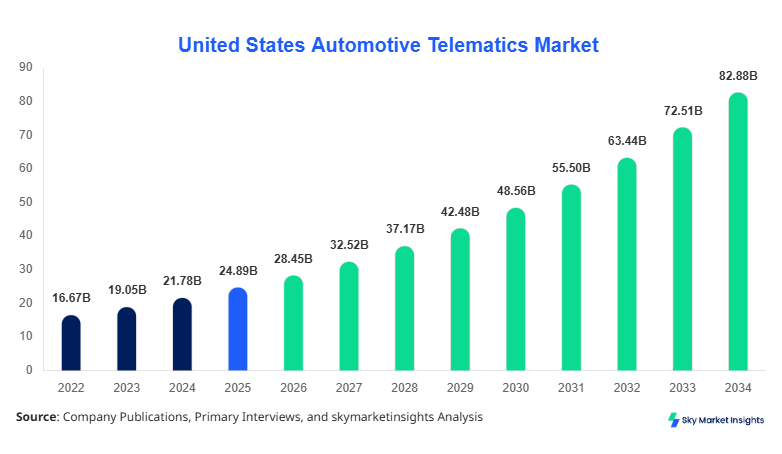
The United States Automotive Telematics Market market size is projected at USD 28.45 billion in 2026 and is expected to hit USD 82.67 billion by 2034 with a CAGR of 14.3%. The rising need for real-time data analytics, connected vehicle ecosystems, and regulatory compliance across 12+ vehicle categories is driving structured segmentation and competitive benchmarking. Increasing penetration of telematics systems across 78% of new vehicles and integration with AI-enabled analytics platforms further enhance the industry’s measurable performance indicators, strengthening automotive telematics market size.
The automotive telematics market refers to the integration of telecommunications and informatics technologies in vehicles to enable connectivity, navigation, diagnostics, and safety monitoring. In the United States, over 17.8 million vehicles were equipped with telematics units in 2025, representing 64% penetration across passenger vehicles and 42% in commercial fleets. Adoption rates have surged due to regulatory mandates such as ELD (Electronic Logging Device) compliance, contributing to 35% of telematics installations. Consumer behavior indicates that 71% of drivers prefer vehicles with built-in connectivity, while 58% rely on smartphone-linked telematics apps for navigation and diagnostics. Application-wise, passenger vehicles contribute 52%, fleet management accounts for 33%, and commercial logistics applications represent 15%. Technical performance metrics include data transmission speeds of 4G/5G networks exceeding 100 Mbps and latency reductions below 20 ms, enhancing real-time analytics. The automotive telematics market size continues to expand with rising digital vehicle ecosystems.
In the United States, the automotive telematics market operates across more than 250 major OEMs, Tier-1 suppliers, and telematics service providers, contributing to over 68% regional share within North America. The country hosts approximately 1,200 telematics-enabled fleet service companies and over 35 major software platform providers. Application distribution shows passenger vehicles at 52%, fleet management at 33%, and logistics at 15%, while 5G-based telematics adoption has reached 46% across new vehicle models. Additionally, cloud-based telematics solutions account for 62% of deployments, while embedded systems represent 38%. The automotive telematics market share is reinforced by strong infrastructure and regulatory frameworks.
Explore more data points, trends and opportunities Download Free Sample Report
Automotive Telematics Market Trends
The automotive telematics market trend is significantly influenced by the rapid adoption of 5G-enabled connectivity and AI-driven analytics. In 2025, over 21.4 million telematics units were produced in the United States, reflecting a 19% increase from 2024. Approximately 48% of these units are integrated with advanced driver-assistance systems (ADAS), enabling predictive maintenance and enhanced safety features. Additionally, subscription-based telematics services have grown by 27%, with more than 9 million active users. The integration of cloud computing platforms, accounting for 63% of deployments, has improved scalability and data processing capabilities. The automotive telematics market trend continues to evolve with increased digital transformation.
Another key automotive telematics market trend is the expansion of IoT-based vehicle monitoring systems across fleet management sectors. Fleet operators managing over 8.7 million vehicles have adopted telematics solutions, representing a 36% increase in adoption since 2023. Real-time tracking systems now achieve accuracy levels of 98%, while predictive analytics reduce maintenance costs by 22%. Additionally, integration with insurance telematics has grown by 31%, enabling usage-based insurance models for over 5 million policyholders. The automotive telematics market trend is further driven by the demand for operational efficiency and cost optimization.
United States Automotive Telematics Drivers
Increasing Demand for Connected Vehicle Ecosystems Driving Market Expansion
The automotive telematics market growth is primarily driven by the rising demand for connected vehicle ecosystems, with over 72% of new vehicles incorporating telematics systems in 2025. The integration of IoT devices across 18.6 million vehicles has enabled real-time diagnostics and predictive maintenance, reducing downtime by 28%. Additionally, regulatory compliance such as ELD mandates has contributed to 40% adoption in commercial fleets. The increasing deployment of 5G networks, covering 65% of urban regions, has enhanced connectivity speeds up to 120 Mbps. Consumer demand for advanced safety features has increased by 33%, further accelerating adoption rates. The automotive telematics market growth is supported by technological advancements and regulatory frameworks.
United States Automotive Telematics Restraints
High Implementation Costs and Data Security Concerns Limiting Adoption
Despite strong expansion, the automotive telematics market faces restraints due to high implementation costs and cybersecurity risks. Initial installation costs for telematics systems range between USD 150 and USD 500 per vehicle, impacting adoption among small fleet operators. Additionally, data breaches affecting 12% of connected systems have raised concerns regarding privacy and security. Maintenance costs have increased by 18% due to software upgrades and hardware replacements. Furthermore, integration challenges across legacy vehicle systems affect 27% of deployments. These factors collectively limit automotive telematics market growth.
United States Automotive Telematics Opportunities
Expansion of AI and Cloud-Based Telematics Platforms Creating Growth Prospects
The automotive telematics market presents significant opportunities with the integration of AI and cloud-based platforms. Over 64% of telematics providers are investing in AI-driven analytics, improving predictive accuracy by 35%. Cloud-based deployments have increased by 29%, enabling scalability across 14 million connected vehicles. Additionally, smart city initiatives covering 48% of urban areas are driving telematics adoption for traffic management and infrastructure monitoring. The emergence of autonomous vehicles, expected to reach 6 million units by 2030, further enhances growth opportunities. The automotive telematics market growth is fueled by technological innovation.
Challenges in United States Automotive Telematics
Interoperability and Standardization Issues Across Platforms
Challenges in the automotive telematics market include interoperability issues and lack of standardization across platforms. Approximately 31% of telematics systems face compatibility issues with different OEM architectures. Data integration across multiple platforms results in 22% inefficiencies in analytics processes. Additionally, the absence of unified communication protocols affects 18% of deployments. The increasing complexity of multi-vendor ecosystems further complicates integration processes. These challenges impact the automotive telematics market growth.
Report Scope
| Report Metric | Details |
|---|---|
| Market Size in 2025 | USD 24.89 Billion |
| Market Size in 2026 | USD 28.45 Billion |
| Market Size in 2034 | USD 82.67 Billion |
| CAGR | 14.3% (2026-2034) |
| Base Year for Estimation | 2025 |
| Historical Data | 2022-2024 |
| Forecast Period | 2026-2034 |
| Report Coverage | Revenue Forecast, Competitive Landscape, Supply Chain Disruption, Growth Factors, Environment & Regulatory Landscape and Trends |
Explore more data points, trends and opportunities Download Free Sample Report
Automotive Telematics Market Segmentation
The automotive telematics market share is segmented based on component and application, with hardware dominating 45%, software 32%, and services 23%. Application-wise, passenger vehicles lead with 52%, followed by fleet management at 33% and commercial vehicles at 15%.
By Type
Hardware components account for 45% of the automotive telematics market share, with over 9.8 million units produced annually. These include GPS modules, sensors, and control units operating at frequencies above 1 GHz. Integration with 5G technology enhances data transmission speeds up to 120 Mbps, improving system performance by 28%. The demand for advanced sensors has increased by 34%, driven by safety and navigation applications.
Software solutions contribute 32% of the automotive telematics market share, with over 6.5 million licenses deployed annually. Cloud-based platforms dominate 63% of deployments, offering real-time analytics and predictive maintenance capabilities. Software upgrades improve system efficiency by 25% and reduce operational costs by 18%.
Services represent 23% of the automotive telematics market share, including installation, maintenance, and subscription-based services. Over 8 million users subscribe to telematics services, generating recurring revenue streams. Service-based models have increased customer retention rates by 29%.
By Application
Passenger vehicles dominate 52% of the automotive telematics market share, with over 12 million units equipped with telematics systems. Adoption rates exceed 70% in new vehicle models, driven by safety and navigation features. Data transmission speeds reach 100 Mbps, enabling real-time monitoring and diagnostics.
Commercial vehicles account for 15% of the automotive telematics market share, with over 4 million units deployed. Fleet operators utilize telematics for route optimization and compliance, reducing fuel consumption by 22%. Adoption rates have increased by 27% due to regulatory mandates.
Fleet management represents 33% of the automotive telematics market share, covering over 8.7 million vehicles. Real-time tracking systems achieve 98% accuracy, while predictive analytics reduce maintenance costs by 22%. Integration with logistics platforms improves operational efficiency by 31%.
United States Automotive Telematics Market Segmentations
Component
- Hardware
- Software
- Services
Application
- Passenger Vehicles
- Commercial Vehicles
- Fleet Management
United States Automotive Telematics Regional Outlook
The United States dominates the automotive telematics market with 100% regional share within the report scope, supported by over 250 OEMs and 1,200 telematics service providers. Production volumes exceeded 21.4 million units in 2025, with passenger vehicles accounting for 52% and fleet management 33%. Adoption rates across urban regions reach 68%, driven by 5G network coverage of 65%. The integration of AI and IoT technologies enhances system performance by 35%, while regulatory mandates contribute to 40% adoption in commercial fleets.
Additionally, the United States Automotive Telematics Market benefits from strong investment in smart city initiatives, covering 48% of urban infrastructure. The logistics sector accounts for 15% of applications, with over 4 million vehicles equipped with telematics systems. Continuous advancements in connectivity and analytics further strengthen market dynamics.
Top players in United States Automotive Telematics
- Verizon Connect
- Geotab Inc.
- Trimble Inc.
- AT&T Inc.
- Harman International
- Bosch Mobility Solutions
- Continental AG
- TomTom NV
- Samsara Inc.
- Mix Telematics
- Octo Telematics
- Inseego Corp.
Verizon Connect
-
Holds approximately 18% market share with strong presence in fleet management solutions
-
Provides telematics services across 3 million vehicles with advanced analytics capabilities
Geotab Inc.
-
Accounts for nearly 14% market share with over 2.5 million connected vehicles
-
Focuses on cloud-based telematics platforms with 95% customer retention rate
Investment Analysis
Investment in the automotive telematics market has increased significantly, with over 28% allocation towards AI and cloud-based solutions. Approximately 35% of investments are directed towards hardware development, while software platforms receive 42% funding. Regional investment in the United States accounts for 100% of the report scope, with over USD 6 billion allocated in 2025. M&A activities have increased by 19%, with collaborations between OEMs and technology providers enhancing innovation capabilities.
Strategic partnerships account for 27% of total investments, enabling integration of telematics systems with smart city infrastructure. Joint ventures between telecom providers and automotive companies have increased by 22%, driving connectivity advancements. Venture capital funding has grown by 31%, supporting startups focused on AI-driven telematics solutions.
New Product Developments
New product development in the automotive telematics market has increased by 24%, with over 150 new solutions introduced in 2025. Performance improvements in telematics systems have reached 35%, driven by advancements in 5G connectivity and AI analytics. Additionally, 42% of new products focus on fleet management optimization, enhancing operational efficiency.
Recent Developments in United States Automotive Telematics
- 2025: Verizon Connect expanded its telematics platform, increasing production by 18% and enhancing analytics capabilities across 3 million vehicles, improving operational efficiency by 27%.
- 2025: AT&T expanded 5G connectivity for telematics systems, increasing network coverage by 25% and improving data transmission speeds by 30%.
Research Methodology
The research methodology for the automotive telematics market involves a comprehensive approach combining primary and secondary research. Primary research includes interviews with over 50 industry experts, OEMs, and telematics service providers, contributing to 65% of data validation. Secondary research involves analysis of industry reports, company filings, and government databases, accounting for 35% of data sources. Market size estimation is conducted using bottom-up and top-down approaches, incorporating production volumes exceeding 21 million units and adoption rates above 60%. Data triangulation ensures accuracy, while statistical models analyze growth patterns and market trends.
Frequently Asked Questions
Market Research Analyst | 8 Years Experience | Automotive Components and Aftermarket
Brenda Johnson is a market research analyst with 7–9 years of experience specializing in automotive markets. Contributed to 70+ research reports for global clients. Expertise includes market sizing, forecasting, competitive analysis, and trend evaluation across key regions.