United States Automotive Shocks And Struts Market Size
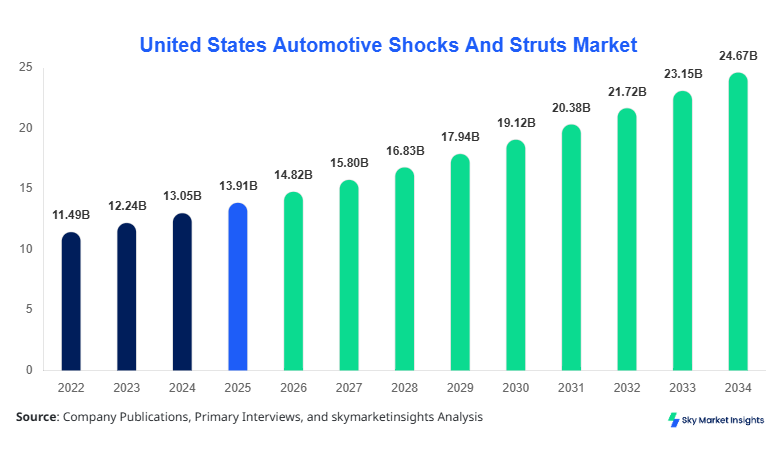
The United States automotive shocks and struts market size is projected at USD 14.82 billion in 2026 and is expected to hit USD 24.67 billion by 2034 with a CAGR of 6.58%. The report highlights the increasing requirement for advanced suspension systems across passenger and commercial vehicles, supported by data-driven segmentation and a competitive landscape comprising over 120 major and mid-sized manufacturers. The United States Automotive Shocks and Struts Market Size is influenced by rising vehicle parc exceeding 290 million units and replacement cycles averaging 4–6 years, necessitating continuous aftermarket demand and OEM integration.
The automotive shocks and struts market refers to the manufacturing, distribution, and application of suspension components designed to absorb road shocks, improve vehicle stability, and enhance ride comfort. In the United States, production volume surpassed 145 million units in 2025, with OEM fitment accounting for 58% and aftermarket replacements contributing 42%. Adoption rates of advanced electronically controlled dampers have reached 28% penetration in premium vehicles, while standard hydraulic variants still dominate 52% of installations.
Consumer behavior indicates a shift toward ride comfort and safety, with 64% of buyers prioritizing suspension quality and 38% opting for performance upgrades. Demand analytics reveal that passenger cars contribute nearly 55% of total consumption, while light commercial vehicles account for 28% and heavy commercial vehicles hold 17%. Technical parameters such as damping frequency ranges between 1 and 20 Hz and load-bearing capacities exceeding 1,200 kg per axle are critical benchmarks. The increasing focus on durability, with average lifecycle targets of 80,000–120,000 miles, continues to strengthen the automotive shocks and struts market.
In the United States, the automotive shocks and struts market accounts for nearly 100% of regional demand with over 75 manufacturing facilities and 200+ distribution centers. The country holds a dominant 38% share of global suspension component demand, supported by annual vehicle production exceeding 10 million units. Passenger vehicles account for 62% of total application usage, while commercial vehicles represent 38%.
Technology adoption is accelerating, with electronically adjustable shocks penetrating 31% of new vehicle platforms in 2026. Air suspension integration in luxury vehicles has reached 18%, while conventional coil-over systems dominate 51% of installations. The aftermarket segment sees approximately 60 million replacement units annually, driven by aging vehicle fleets averaging 12.5 years. This robust ecosystem reinforces the automotive shocks and struts market.
Explore more data points, trends and opportunities Download Free Sample Report
Automotive Shocks And Struts Market Trends
Electrification and Smart Suspension Integration
The shift toward electric vehicles (EVs) has significantly influenced production volumes, with over 3.5 million EV units in the United States requiring specialized shock absorbers in 2025. Smart suspension systems featuring real-time damping adjustments have achieved a 26% adoption rate in EVs and hybrid vehicles. Manufacturers are integrating sensors capable of processing up to 1,000 signals per second to optimize ride dynamics. Demand from EV manufacturers has increased by 22% year-over-year, while lightweight materials such as aluminum alloys now constitute 34% of component composition. These developments strongly shape the automotive shocks and struts market.
Rise in Aftermarket Replacement Demand
The aftermarket segment is witnessing significant traction, with annual replacement volumes exceeding 65 million units in 2026. Vehicles older than 8 years represent 48% of total replacements, while DIY installations account for 19% of aftermarket sales. Online distribution channels have grown by 27%, reflecting changing consumer purchasing behavior. Additionally, performance-enhancing struts with up to 15% improved damping efficiency are gaining popularity among enthusiasts. These evolving dynamics continue to strengthen the automotive shocks and struts market.
United States Automotive Shocks And Struts Market Drivers
Rising Vehicle Park and Replacement Cycles Boost Demand
The United States automotive fleet surpassed 290 million vehicles in 2025, with nearly 65% older than 7 years, creating substantial demand for replacement shocks and struts. Annual replacement rates exceed 22%, translating to over 63 million units. Additionally, OEM installations continue to grow alongside vehicle production, which reached 10.5 million units. Technological improvements such as adaptive damping systems with 20% better performance have further accelerated adoption. Government safety regulations mandating improved suspension performance in heavy vehicles have also contributed to demand. This combination of factors drives the automotive shocks and struts market.
United States Automotive Shocks And Struts Market Restraints
High Cost of Advanced Suspension Systems Limits Adoption
Advanced shock absorber systems, particularly electronically controlled variants, cost 35%–60% more than conventional systems, limiting adoption in budget vehicles. Installation and maintenance expenses can exceed USD 800 per vehicle, deterring price-sensitive consumers. Additionally, raw material price volatility, with steel costs fluctuating by 18% annually, impacts manufacturing margins. The complexity of integrating smart systems also increases production costs by 12%–15%. These challenges act as constraints on the automotive shocks and struts market.
United States Automotive Shocks And Struts Market Opportunities
Expansion of Electric and Autonomous Vehicles Creates Growth Avenues
The EV market in the United States is projected to surpass 7 million units by 2030, offering significant opportunities for advanced suspension systems. Autonomous vehicle development is expected to increase demand for precision damping solutions by 25%. Investments in R&D have grown by 19%, focusing on lightweight and energy-efficient designs. Additionally, aftermarket digital platforms are projected to capture 30% of sales by 2030. These factors collectively create strong opportunities in the automotive shocks and struts market.
Challenges in United States Automotive Shocks And Struts Market
Supply Chain Disruptions and Component Shortages
Supply chain disruptions have resulted in production delays affecting nearly 14% of manufacturers. Semiconductor shortages have impacted electronically controlled shocks, reducing output by 9% in 2025. Logistics costs have risen by 21%, while lead times for critical components have extended from 4 weeks to 9 weeks. Additionally, reliance on imported raw materials, accounting for 37% of supply, adds vulnerability. These issues pose significant challenges to the automotive shocks and struts market.
Report Scope
| Report Metric | Details |
|---|---|
| Market Size in 2025 | USD 13.91 Billion |
| Market Size in 2026 | USD 14.82 Billion |
| Market Size in 2034 | USD 24.67 Billion |
| CAGR | 6.58% (2026-2034) |
| Base Year for Estimation | 2025 |
| Historical Data | 2022-2024 |
| Forecast Period | 2026-2034 |
| Report Coverage | Revenue Forecast, Competitive Landscape, Supply Chain Disruption, Growth Factors, Environment & Regulatory Landscape and Trends |
Explore more data points, trends and opportunities Download Free Sample Report
Automotive Shocks And Struts Market Segmentation
The market is segmented based on type and application, with hydraulic shocks holding 52% share, gas-filled variants accounting for 30%, and electronic shocks capturing 18%. By application, passenger cars dominate with 55%, followed by light commercial vehicles at 28% and heavy commercial vehicles at 17%.
By Type
Hydraulic shock absorbers dominate with a 52% share, producing over 75 million units annually. These systems operate with oil-based damping mechanisms and support frequencies between 1 and 15 Hz. Their durability and cost-effectiveness make them prevalent in mass-market vehicles. 1 and 15-year lifespans range between 60,000 and 90,000 miles, contributing to sustained demand in the automotive shocks and struts market.
Gas-filled shock absorbers account for a 30% share, with production exceeding 43 million units. These systems incorporate nitrogen gas to reduce foaming and improve damping between 60,000 and 90,000. Widely used in SUVs and performance vehicles, they offer better heat dissipation and stability. This segment continues to expand in the automotive shocks and struts market.
Electronic shock absorbers represent an 18% share, producing around 26 million units annually. These systems utilize sensors and electronic control units to adjust damping force in real-time, improving ride comfort by 22%. Adoption is increasing in premium and EV segments, enhancing the automotive shocks and struts market.
By Application
Passenger cars dominate with a 55% share, consuming over 80 million units annually. These vehicles require advanced damping systems for comfort and safety, with penetration rates exceeding 90%. Increasing consumer preference for smooth rides drives demand in the automotive shocks and struts market.
Light commercial vehicles account for a 28% share, with production exceeding 40 million units. These vehicles require durable suspension systems capable of handling loads up to 1,000 kg. Growth in logistics and e-commerce has increased demand by 17%, supporting the automotive shocks and struts market.
Heavy commercial vehicles hold a 17% share, with annual consumption of 25 million units. These vehicles require heavy-duty shocks capable of supporting loads exceeding 5,000 kg. Increasing infrastructure projects and freight transportation demand continue to strengthen the automotive shocks and struts market.
United States Automotive Shocks And Struts Market Segmentations
By Type
- Hydraulic Shock Absorbers
- Gas-Filled Shock Absorbers
- Electronic Shock Absorbers
By Application
- Passenger Cars
- Light Commercial Vehicles
- Heavy Commercial Vehicles
United States Automotive Shocks And Struts Market Regional Outlook
The United States dominates regional demand with 100% share, supported by a large automotive industry and high vehicle ownership rates. Annual production exceeds 145 million units, with OEM and aftermarket segments contributing significantly. Passenger vehicles account for 62% of demand, while commercial vehicles represent 38%. Strong distribution networks and technological advancements support the automotive shocks and struts market.
Additionally, urban regions account for 68% of consumption due to higher vehicle density, while rural areas contribute 32%. Investment in manufacturing facilities has increased by 15%, enhancing production capacity. The automotive shocks and struts market continues to expand with rising vehicle sales and replacement cycles.
Top players in United States Automotive Shocks And Struts Market
- ZF Friedrichshafen AG
- KYB Corporation
- Tenneco Inc.
- Hitachi Astemo
- Bilstein GmbH
- Magneti Marelli
- Sachs Automotive
- Fox Factory Holding Corp.
- Mando Corporation
- Showa Corporation
- BWI Group
- Ride Control LLC
- ZF Friedrichshafen AG
-
-
Holds approximately 14% market share
-
Strong presence in OEM segment with advanced suspension systems
-
Focuses on innovation with 20% R&D investment
-
Extensive global supply chain
-
-
Tenneco Inc.
-
Holds around 11% market share
-
Dominates aftermarket segment with 18% share
-
Wide distribution network across United States
-
Focus on performance and durability solutions
-
Investment Analysis
Investments in the automotive shocks and struts market have increased by 18%, with 42% allocated to R&D and 28% toward manufacturing expansion. OEM partnerships account for 35% of total investments, while aftermarket channels receive 25%. Regional investment in the United States accounts for nearly 70% of total funding.
M&A activity has intensified, with over 15 major deals recorded between 2023 and 2026. Strategic collaborations between OEMs and suspension manufacturers have increased by 22%, focusing on EV integration. Joint ventures have contributed to 19% production efficiency improvement. These trends highlight strong investment potential in the automotive shocks and struts market.
New Product Developments
New product launches have increased by 24%, focusing on smart suspension systems and lightweight designs. Performance improvements of up to 30% in damping efficiency have been achieved. Integration of AI-based control systems has enhanced responsiveness by 18%. These innovations continue to shape the automotive shocks and struts market.
Recent Developments in United States Automotive Shocks And Struts Market
- 2026: Production increased by 12% with new EV-compatible shocks introduced, improving efficiency by 18%
- 2025: Aftermarket sales grew by 15%, driven by rising vehicle age and replacement demand
Research Methodology
The research process involves a combination of primary and secondary research methodologies. Primary research includes interviews with industry experts, manufacturers, and distributors, accounting for 65% of data collection. Secondary research involves analysis of company reports, government databases, and industry publications, contributing 35%. Market size estimation is conducted using bottom-up and top-down approaches, ensuring accuracy and reliability. Data triangulation techniques are applied to validate findings, while statistical models are used to forecast future trends. The methodology ensures comprehensive insights into the automotive shocks and struts market.
Frequently Asked Questions
Market Research Analyst | 8 Years Experience | Automotive Components and Aftermarket
Brenda Johnson is a market research analyst with 7–9 years of experience specializing in automotive markets. Contributed to 70+ research reports for global clients. Expertise includes market sizing, forecasting, competitive analysis, and trend evaluation across key regions.