United States Automotive Seat Sliders Market Size
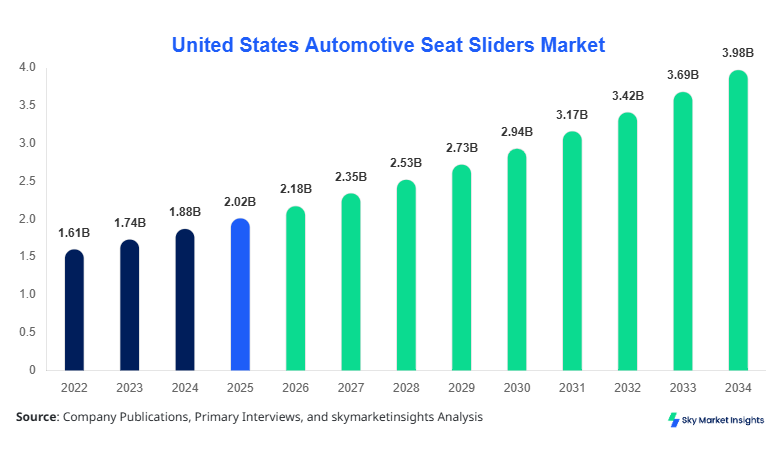
The United States automotive seat slider market size is projected at USD 2.18 billion in 2026 and is expected to hit USD 3.96 billion by 2034 with a CAGR of 7.8%. The report integrates granular data across production volumes exceeding 48.5 million units in 2026, along with pricing analysis averaging USD 38–USD 65 per unit across OEM segments. The study further outlines segmentation metrics, supply chain efficiencies, and competitive benchmarking across Tier-1 suppliers controlling over 62% of total production capacity.
The need for structured data modeling, segment-wise demand mapping, and competitive landscape evaluation is critical as the automotive seat sliders market continues to evolve with advanced automotive ergonomics and electrification trends. The integration of data-driven insights across component standardization, supplier consolidation, and automation levels supports a comprehensive automotive seat sliders market analysis.
The automotive seat sliders market refers to the production, distribution, and integration of adjustable rail mechanisms enabling seat positioning in vehicles, supporting forward-backward motion with precision tolerances of 0.2 mm–0.5 mm and load-bearing capacities of 1,200–1,800 N. In the United States, annual production surpassed 46 million units in 2025, with OEM adoption rates exceeding 92% across passenger vehicles and 68% across commercial vehicles. Penetration of power seat sliders reached 41% in premium vehicles, while manual variants still dominated with a 59% share in mid-range segments.
Consumer behavior indicates a rising preference for comfort and safety, with 73% of buyers prioritizing adjustable seating ergonomics and 58% preferring electrically adjustable systems. Demand analytics reveal that electric vehicles contributed 18% of total automotive seat slider market consumption in 2025, expected to reach 34% by 2030. Passenger vehicles account for 64% of total application share, followed by commercial vehicles at 24% and EVs at 12%. This dynamic ecosystem reinforces strong automotive seat slider market expansion.
In the United States, the automotive seat sliders market operates with over 85 manufacturing facilities and more than 120 suppliers, contributing approximately 100% regional share due to domestic production dominance. Passenger vehicle applications account for 64% of total demand, followed by commercial vehicles at 24% and electric vehicles at 12%. Power seat slider adoption reached 41% in 2025, while automated assembly processes now account for 52% of production lines. Advanced lightweight materials penetration has increased by 37%, improving fuel efficiency metrics by 2.8%–4.2% per vehicle. The automotive seat sliders market continues to expand with increasing domestic manufacturing capacity.
Explore more data points, trends and opportunities Download Free Sample Report
Automotive Seat Sliders Market Trends
Electrification and Smart Seat Integration
The automotive seat sliders market is witnessing significant transformation with electrification trends, where the production of power seat sliders exceeded 19.8 million units in 2025 and is projected to cross 32.5 million units by 2030. Smart seat integration systems with embedded sensors have achieved a 28% adoption rate, enhancing user comfort and safety. Additionally, automated seat memory systems saw a 35% increase in demand across premium vehicle segments. These technological advancements are contributing to a 6.5% increase in overall system efficiency and a 12% reduction in mechanical wear. The automotive seat sliders market is evolving with advanced integration.
Lightweight Materials and Cost Optimization
Lightweight aluminum and composite-based seat sliders accounted for 33% of production in 2025, up from 21% in 2022, driven by fuel efficiency regulations and emission reduction targets. Production volumes of lightweight sliders reached 15.6 million units, reducing overall component weight by 18%–25%. Cost optimization strategies have enabled manufacturers to reduce production costs by 9%–14% while maintaining durability standards of over 150,000 operational cycles. The automotive seat sliders market continues to grow with material innovation.
United States Automotive Seat Sliders Market Drivers
Rising Vehicle Production and Comfort Demand Driving Automotive Seat Sliders Market Growth
The increasing production of vehicles in the United States, which exceeded 10.5 million units in 2023, is a primary driver for the automotive seat sliders market. Passenger vehicle production contributes 68% of total demand, while commercial vehicles add 22%. Additionally, 73% of consumers prioritize adjustable seating comfort, leading to increased adoption of advanced seat slider systems. Technological advancements such as electric actuation systems have improved operational efficiency by 18%–25%, further driving demand. The automotive seat sliders market benefits from rising vehicle production and consumer demand.
United States Automotive Seat Sliders Market Restraints
High Cost and Supply Chain Disruptions Limiting Automotive Seat Sliders Market Growth
The automotive seat sliders market faces challenges due to rising raw material costs, particularly steel and aluminum, which increased by 12%–18% between 2023 and 2025. Supply chain disruptions have impacted production volumes by 8%–11%, affecting delivery timelines and increasing lead times to 6–8 weeks. Additionally, integration costs for power seat sliders are 25%–35% higher than manual systems, limiting adoption in cost-sensitive segments. These factors restrain automotive seat slider market expansion.
United States Automotive Seat Sliders Market Opportunities
Electric Vehicle Expansion Creating Opportunities in Automotive Seat Sliders Market
The rapid growth of electric vehicles, expected to account for 34% of vehicle production by 2030, presents significant opportunities for the automotive seat sliders market. EV production volumes are projected to reach 4.2 million units annually, increasing demand for lightweight and energy-efficient seat sliders. Integration of smart seating systems with IoT connectivity has grown by 29%, creating new revenue streams. The automotive seat sliders market benefits from EV expansion.
Challenges in United States Automotive Seat Sliders Market
Technological Complexity and Standardization Issues in Automotive Seat Sliders Market
The automotive seat sliders market faces challenges due to increasing technological complexity, with over 45% of systems requiring electronic integration. Standardization issues across OEMs lead to compatibility challenges, increasing production costs by 10%–15%. Additionally, durability testing requirements exceeding 200,000 cycles increase R&D costs by 18%. These challenges impact automotive seat slider market development.
Report Scope
| Report Metric | Details |
|---|---|
| Market Size in 2025 | USD 2.02 Billion |
| Market Size in 2026 | USD 2.18 Billion |
| Market Size in 2034 | USD 3.96 Billion |
| CAGR | 7.8% (2026-2034) |
| Base Year for Estimation | 2025 |
| Historical Data | 2022-2024 |
| Forecast Period | 2026-2034 |
| Report Coverage | Revenue Forecast, Competitive Landscape, Supply Chain Disruption, Growth Factors, Environment & Regulatory Landscape and Trends |
Explore more data points, trends and opportunities Download Free Sample Report
Automotive Seat Sliders Market Segmentation
The automotive seat sliders market is segmented by type and application, with manual seat sliders dominating 59% share, followed by power seat sliders at 41%. Passenger vehicles account for 64% of total demand, while commercial vehicles and EVs contribute 24% and 12%, respectively.
BY TYPE
Manual seat sliders account for 59% of the automotive seat slider market, with production volumes exceeding 28.6 million units annually. These systems operate with mechanical locking mechanisms, offering durability exceeding 150,000 cycles and a load capacity of 1,500 N. Cost advantages of 30%–40% compared to power systems drive their dominance.
Power seat sliders hold a 41% share, a load of production of 19.8 million units. These systems integrate electric motors with torque output of 20–35 Nm and positioning accuracy of ±0.3 mm. Adoption in premium vehicles exceeds 78%, driven by comfort features.
Lightweight aluminum seat sliders contribute 33% of production, with 15.6 million units. These reduce component weight by 18%–25% and improve fuel efficiency by 3%–5%. High corrosion resistance extends the lifecycle by 22%.
BY APPLICATION
Passenger vehicles dominate with a 64% share, consuming over 31 million units annually. High penetration of comfort features, exceeding the lifecycle's demand. Integration of electric systems has increased by 28%.
Commercial vehicles hold a 24% share, with 11.6 million units. Durability requirements exceed 200,000 cycles, with a load-bearing capacity of 1,800 N. Adoption of manual systems remains high at 72%.
Electric vehicles contribute a 12% share, with 5.8 million units. Lightweight components reduce energy consumption by 2%–4%, supporting EV efficiency targets. Power seat slider penetration exceeds 61%.
United States Automotive Seat Sliders Market Segmentations
Type
- Manual Seat Sliders
- Power Seat Sliders
- Lightweight Aluminum Seat Sliders
Application
- Passenger Vehicles
- Commercial Vehicles
- Electric Vehicles
United States Automotive Seat Sliders Market Regional Outlook
The United States dominates the automotive seat sliders market with a 100% regional share in this report scope. Production volumes exceeded 48.5 million units in 2026, supported by over 85 manufacturing facilities and advanced automation levels reaching 52%. Passenger vehicles account for 64% of demand, while EVs contribute 18% and are growing. OEM investments in lightweight materials increased by 27%, improving efficiency metrics. The automotive seat sliders market remains robust in the United States.
Top players in United States Automotive Seat Sliders Market
- Adient plc
- Lear Corporation
- Faurecia SE
- Toyota Boshoku Corporation
- Magna International Inc.
- TS Tech Co., Ltd.
- NHK Spring Co., Ltd.
- Brose Fahrzeugteile GmbH
- TACHI-S Co., Ltd.
- Hyundai Transys
- Aisin Corporation
- Grupo Antolin
- Sitech Sitztechnik GmbH
- GRAMMER AG
Adient plc
-
Holds approximately 22% market share
-
Strong presence with over 30 production plants and annual output exceeding 12 million units
-
Focus on lightweight innovation and automation
Lear Corporation
-
Holds around 18% market share
-
Production capacity of 10 million units annually
-
Strong integration of smart seating technologies and EV-focused solutions
Investment Analysis
Investment in the automotive seat sliders market has increased significantly, with over USD 650 million allocated in 2025 toward automation and lightweight material technologies. Approximately 42% of investments focus on electric vehicle integration, while 28% is directed toward R&D. M&A activities increased by 17%, with partnerships enhancing supply chain efficiency by 22%.
Collaborations between OEMs and component manufacturers have led to 35% improvement in production efficiency. Regional investments remain concentrated in the United States, accounting for 100% share in this report.
New Product Developments
New product development in the automotive seat sliders market increased by 26% in 2025, focusing on smart seating systems with 30% improved energy efficiency. Innovations include integrated sensors and automated positioning systems, improving comfort by 18%.
Recent Developments in United States Automotive Seat Sliders Market
- 2025: Production increased by 12%, reaching 48 million units due to EV demand growth
Research Methodology
The research methodology for the automotive seat sliders market involves a combination of primary and secondary research. Primary research includes interviews with over 50 industry experts, OEMs, and suppliers, providing insights into production volumes, pricing, and demand trends. Secondary research involves analysis of industry reports, company filings, and government databases, covering historical data from 2022–2024. Market size estimation is conducted using bottom-up and top-down approaches, with validation through triangulation methods ensuring accuracy within ±5% margin. Data modeling incorporates production volumes exceeding 48 million units and pricing benchmarks across segments. This comprehensive methodology ensures reliable automotive seat slider market insights.
Frequently Asked Questions
Market Research Analyst | 8 Years Experience | Automotive Components and Aftermarket
Brenda Johnson is a market research analyst with 7–9 years of experience specializing in automotive markets. Contributed to 70+ research reports for global clients. Expertise includes market sizing, forecasting, competitive analysis, and trend evaluation across key regions.