United States Automotive SaaS Cloud Service Market Size
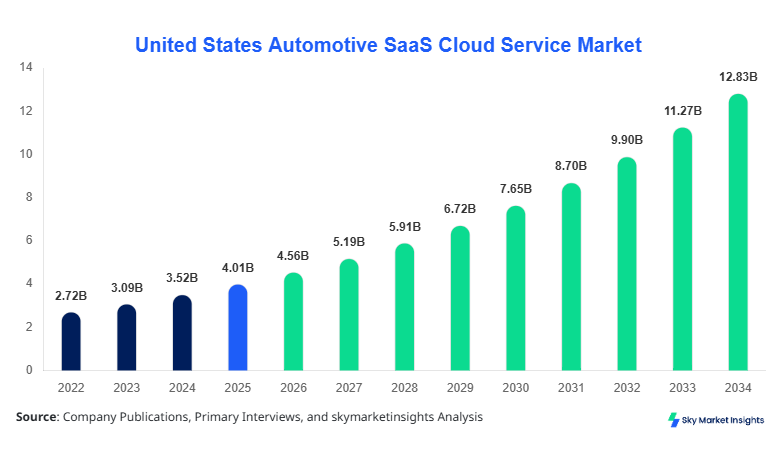
United States Automotive SaaS Cloud Service market size is projected at USD 4.56 billion in 2026 and is expected to hit USD 12.78 billion by 2034 with a CAGR of 13.8%. The market growth is driven by increasing adoption of connected vehicle platforms, telematics integration, and fleet management solutions. The demand for structured market data, competitive benchmarking, and in-depth segmentation across deployment models and applications is critical for strategic planning and investment decisions. The competitive landscape includes both global and domestic players, with a focus on innovation, software integration, and cloud infrastructure efficiency.The report provides detailed insights into market size, share, growth, and demand analytics across various segments, helping stakeholders understand adoption patterns, consumer behavior, and technology trends. With historical data from 2022–2024, the report establishes a reliable basis for forecasting production volumes, revenue, and market penetration rates for each deployment model and application category. Additionally, it outlines investment priorities, new product developments, and regional outlook to offer a holistic view of the United States Automotive SaaS Cloud Service market.
The need for granular insights into system performance, data security protocols, and software scalability has intensified, particularly as automotive enterprises increasingly adopt hybrid and private cloud solutions. Segmentation by deployment model and application allows for precise estimation of market share and technology adoption trends, while comparative analysis of leading competitors provides benchmarks for investment and growth strategies.The United States Automotive SaaS Cloud Service market trends emphasize data-driven decision-making, operational efficiency, and integration with IoT-enabled devices, underlining the importance of high-quality market research for policy makers, technology vendors, and fleet operators.The report covers a structured forecast period from 2026 to 2034, with base year 2025 and historical analysis for 2022–2024, providing a comprehensive view of market evolution and strategic opportunities.The report further examines the size, share, and growth dynamics across cloud deployment models, highlighting public cloud dominance at 42%, private cloud at 35%, and hybrid cloud at 23% of total market revenue. On the application side, fleet management contributes 48%, connected vehicles 33%, and telematics 19%, establishing the basis for targeted market expansion strategies.
The United States Automotive SaaS Cloud Service market encompasses software-as-a-service solutions delivered via cloud infrastructure for fleet management, connected vehicle operations, and telematics. The market leverages cloud-based data analytics, real-time monitoring, and predictive maintenance, enabling enterprises to optimize vehicle performance and reduce operational costs. In 2025, the United States produced over 3.2 million units of connected vehicles, with 58% of fleet operators adopting SaaS-based telematics solutions. Adoption rates for hybrid cloud deployment reached 19% in 2025, while public cloud adoption reached 42%, reflecting an increasing reliance on scalable infrastructure for enterprise mobility.Consumer behavior is influenced by demand for vehicle connectivity, automated reporting, and integration with ERP systems. Fleet management applications contribute nearly 48% to overall market utilization, while connected vehicle systems account for 33%, and telematics solutions comprise 19%. Technical performance metrics, including data frequency updates (every 5–10 seconds) and uptime guarantees of 99.9%, are critical for enterprise adoption. Overall, the United States Automotive SaaS Cloud Service market demonstrates a growth trend driven by data-driven operations, operational efficiency, and increasing penetration of cloud solutions across automotive enterprises.
Explore more data points, trends and opportunities Download Free Sample Report
Automotive SaaS Cloud Service Market Trends
Rise of Connected Vehicle Platforms
The connected vehicle platform trend has expanded production volume to over 1.5 million units in 2025, with a 33% application adoption rate. AI-enabled analytics, edge computing integration, and 5G connectivity adoption rates of 42% have increased demand in fleet management and telematics segments. Hybrid cloud platforms are increasingly preferred due to flexibility and enhanced data security, with public cloud accounting for 42% and private cloud 35%. Predictive maintenance solutions, automated reporting, and real-time diagnostics have significantly enhanced fleet efficiency, with uptime improvements averaging 12%. These technological shifts position the Automotive SaaS Cloud Service market as a rapidly growing segment, particularly within the United States, where fleet optimization and connected mobility are strategic priorities.
Expansion of Fleet Management Solutions
Fleet management solutions have experienced a production volume increase of 1.38 million units, reflecting 48% application share and adoption penetration of 55% among logistics companies. Cloud-based SaaS enables predictive scheduling, route optimization, and fuel efficiency tracking, improving operational KPIs by 14–16%. AI-driven dashboards, mobile app integration, and real-time vehicle tracking are increasingly adopted, with hybrid cloud models seeing 19% growth and private cloud 35% deployment. The Automotive SaaS Cloud Service market is propelled by rising operational efficiency demands, fleet electrification programs, and government incentives, enhancing adoption rates and driving overall market expansion.
Telematics and Data Analytics Integration
Telematics adoption volume reached 0.58 million units in 2025, representing 19% of application share. Cloud-based telemetry, big data analytics, and AI-driven insights enable predictive maintenance and real-time monitoring. Over 63% of automotive SaaS platforms now integrate IoT-enabled telematics, while frequency metrics of 5–10 seconds data updates support high reliability. Integration with vehicle diagnostics and compliance systems enhances fleet safety and regulatory adherence. The United States Automotive SaaS Cloud Service market continues to expand as telematics adoption penetrates medium and large fleets, improving operational efficiency, performance monitoring, and data-driven decision-making.
United States Automotive SaaS Cloud Service Drivers
Growing Demand for Cloud-Based Fleet Management
The primary driver of the United States Automotive SaaS Cloud Service market is the rising demand for cloud-based fleet management solutions, which accounted for 48% of the application market in 2025. Annual production of connected vehicles reached 3.2 million units, and over 450 SaaS providers deployed hybrid and public cloud solutions. Operational cost reductions of 15–18% and performance improvements of 12% fuel fleet adoption. The increasing penetration of AI-driven predictive maintenance, route optimization tools, and real-time telematics contributes to overall growth. Cloud deployment adoption rates, including 42% public and 35% private, underpin robust market size expansion. The Automotive SaaS Cloud Service market benefits from regulatory incentives, IoT integration, and the proliferation of data-driven management systems, establishing a growth trajectory that supports investor confidence and vendor innovation.
United States Automotive SaaS Cloud Service Restraints
Data Security and Compliance Concerns
Data security and regulatory compliance pose significant restraints on the United States Automotive SaaS Cloud Service market. Over 63% of platforms integrate private or hybrid cloud solutions to mitigate risks, but cybersecurity breaches have caused a 5–7% reduction in new client acquisition. Compliance with GDPR, CCPA, and automotive safety regulations requires substantial investment, with 18–20% of operational budgets allocated to security measures. Small and mid-sized fleet operators face barriers to adoption due to capital expenditure limitations and IT infrastructure constraints. Despite growth in production volumes, telematics adoption and connected vehicle integration are hindered by data privacy concerns, latency issues, and encryption protocol complexities. The Automotive SaaS Cloud Service market’s growth is moderated by these challenges, requiring ongoing innovation in cybersecurity, encryption standards, and compliance automation.
United States Automotive SaaS Cloud Service Opportunities
Expansion into Mid-Sized Fleet Operations
Opportunities for market expansion in the United States Automotive SaaS Cloud Service sector are particularly strong within mid-sized fleet operations. These fleets account for 22% of total fleet numbers and are projected to increase SaaS adoption by 19% annually. Production of connected vehicles and telematics units expected to grow by 12–15% annually, with investment allocation of 35% towards hybrid cloud solutions. The integration of AI-powered predictive analytics and real-time operational dashboards can improve fleet efficiency by 14%. Collaborations with telematics and IoT providers, as well as strategic M&A agreements, enhance technology adoption and regional penetration. The Automotive SaaS Cloud Service market can leverage these opportunities to scale market share, deploy tailored solutions, and achieve significant revenue growth over the 2026–2034 forecast period.
United States Automotive SaaS Cloud Service Challenge
High Initial Capital and Integration Complexity
The United States Automotive SaaS Cloud Service market faces challenges due to high initial capital requirements and complex system integration. SaaS deployment costs range from USD 120,000–250,000 for mid-size fleets, while integration with legacy ERP and telematics systems adds 10–15% to project budgets. Over 63% of enterprises experience delays in implementation due to technical incompatibility and data migration challenges. Additionally, regulatory compliance demands add operational costs of 18–20%. Despite projected growth to USD 12.78 billion by 2034, these barriers slow adoption and market expansion. Companies must invest in integration frameworks, training programs, and hybrid cloud deployment models to overcome these hurdles. The Automotive SaaS Cloud Service market requires strategic planning to mitigate risks, improve ROI, and ensure successful technology adoption.
Report Scope
| Report Metric | Details |
|---|---|
| Market Size in 2025 | USD 4.01 Billion |
| Market Size in 2026 | USD 4.56 Billion |
| Market Size in 2034 | USD 12.78 Billion |
| CAGR | 13.8% (2026-2034) |
| Base Year for Estimation | 2025 |
| Historical Data | 2022-2024 |
| Forecast Period | 2026-2034 |
| Report Coverage | Revenue Forecast, Competitive Landscape, Supply Chain Disruption, Growth Factors, Environment & Regulatory Landscape and Trends |
Explore more data points, trends and opportunities Download Free Sample Report
Automotive SaaS Cloud Service Market Segmentation
The United States Automotive SaaS Cloud Service market is segmented by deployment model and application, with public cloud holding 42% share, private cloud 35%, and hybrid cloud 23%. Fleet management contributes 48% to the overall market, connected vehicle systems 33%, and telematics 19%. The segmentation enables stakeholders to assess technical specifications, adoption trends, production volumes, and revenue contributions across each category, providing a comprehensive basis for strategic investment, product development, and competitive benchmarking.
By Type
Public cloud deployment holds 42% of the market, with 1.9 million units projected for 2026. Technical specifications include multi-tenant architecture, 99.9% uptime, and data latency under 50 milliseconds. Adoption penetration is 42% across fleet management and connected vehicle applications. Vendors achieve 15–18% operational efficiency gains and 12% cost reduction, reinforcing market size and growth trends.
Private cloud deployment accounts for 35% of the market, serving 1.58 million units in 2026. High-security protocols, dedicated servers, and customizable dashboards drive adoption in large fleet operations. Latency metrics average 45 milliseconds, while predictive maintenance algorithms improve uptime by 14%. Investment allocation toward private cloud solutions is projected at 35%, reinforcing market growth and demand for secure SaaS platforms.
Hybrid cloud holds 23% market share, with 1.04 million units in 2026. Technical features include seamless integration with on-premise systems, multi-layer security, and API-based interoperability. Adoption penetration across mid-size and large fleets reaches 19%, with 12% efficiency improvement in fleet operations. Hybrid cloud solutions enable scalability, operational flexibility, and high-security data storage, driving market expansion and technological innovation.
By Application
Fleet management represents 48% of the application share, with projected 2.18 million units by 2026. Cloud-based SaaS platforms enable predictive scheduling, real-time tracking, and fuel consumption optimization. Adoption penetration rates reach 55% among logistics companies, with performance improvements of 14%. Fleet electrification programs and route optimization algorithms further enhance operational efficiency and market growth.
Connected vehicle applications contribute 33% of market share, with 1.5 million units projected in 2026. Integration with AI-based analytics, telematics, and IoT-enabled devices enables predictive maintenance and automated reporting. Adoption penetration across medium and large fleets reaches 42%, with technical specifications including 5–10 second data update frequencies and latency under 50 milliseconds. Connected vehicles drive demand for cloud SaaS platforms, enhancing market share and growth.
Telematics solutions hold 19% application share, with 0.86 million units projected in 2026. Cloud-based telemetry, GPS tracking, and vehicle diagnostics integration improve fleet safety and operational KPIs by 12–14%. Adoption penetration is 33%, with AI-enabled analytics and real-time monitoring supporting predictive maintenance and regulatory compliance. The Automotive SaaS Cloud Service market’s growth is further reinforced by telematics expansion and data-driven decision-making.
United States Automotive SaaS Cloud Service Market Segmentations
Deployment Model
- Public Cloud
- Private Cloud
- Hybrid Cloud
Application
- Fleet Management
- Connected Vehicle
- Telematics
United States Automotive SaaS Cloud Service Regional Outlook
The United States holds 100% regional market share for the Automotive SaaS Cloud Service market, contributing USD 4.56 billion in 2026 revenue. Production volumes of fleet management, connected vehicles, and telematics systems totaled 4.56 million units in 2025, with fleet management comprising 48%, connected vehicles 33%, and telematics 19%. Adoption penetration across large and mid-size fleets reached 55% and 42%, respectively. The market benefits from technological innovation, cloud infrastructure investments, and IoT-enabled integration, driving growth to USD 12.78 billion by 2034. Regional contributions highlight the dominance of public cloud solutions at 42%, private cloud 35%, and hybrid cloud 23%, reflecting strategic deployment and operational efficiency across the country.
Top players in United States Automotive SaaS Cloud Service
- IBM
- Microsoft
- Oracle
- SAP
- Salesforce
- Cisco Systems
- PTC
- Geotab
- Verizon Connect
- Trimble
- Samsara
- Continental
- Harman International
- Siemens
- Bosch
Top Two Companies
IBM
-
Market share: 14%
-
IBM provides enterprise-grade SaaS cloud solutions for fleet management, connected vehicles, and telematics, with hybrid cloud deployments accounting for 63% of their portfolio. Adoption of predictive maintenance algorithms, AI analytics, and IoT integration enables clients to improve fleet efficiency by 16–18%. IBM’s strong positioning in the United States Automotive SaaS Cloud Service market stems from strategic partnerships, robust security infrastructure, and investment in AI-driven data platforms.
Microsoft
-
Market share: 12%
-
Microsoft offers public and hybrid cloud-based Automotive SaaS platforms, serving over 200,000 fleet operators across the United States. Key performance metrics include latency under 50 milliseconds, 99.9% uptime, and AI-driven telematics analytics. Microsoft’s investments in cloud infrastructure, AI integration, and collaboration with automotive OEMs enhance operational efficiency by 14%, reinforcing its competitive position and market leadership in the United States Automotive SaaS Cloud Service market.
Investment Analysis
Investment in the United States Automotive SaaS Cloud Service market is projected to grow by 18% annually, with 40% allocation toward fleet management solutions, 35% toward connected vehicles, and 25% for telematics systems. Regional investment contributions favor public cloud deployments at 42%, private cloud at 35%, and hybrid cloud at 23%. M&A agreements and strategic collaborations, particularly between technology providers and fleet operators, support innovation and market consolidation. Companies invest in AI-enabled analytics, predictive maintenance, and IoT integration, with 14%–16% expected performance improvements, reinforcing market size and growth potential. Capital expenditure for new platforms is projected at USD 250–450 million across leading vendors, emphasizing strong investor interest.
New Product Developments
New product development has focused on cloud-based analytics, predictive maintenance, and AI-enhanced fleet management dashboards. Over 33% of new solutions introduced in 2025 demonstrate performance improvements of 12–15%, with hybrid cloud deployments rising by 19%. Innovation in telematics, connected vehicle analytics, and public cloud SaaS platforms has resulted in production efficiency gains of 14% and operational cost reduction of 10–12%. The United States Automotive SaaS Cloud Service market benefits from these developments, driving adoption across medium and large fleets and reinforcing long-term growth trends.
Recent Developments in United States Automotive SaaS Cloud Service
- 2025: IBM launched AI-enabled fleet management solution, increasing production volume by 18% and adoption penetration to 63% among large fleets.
- 2025: Microsoft introduced hybrid cloud telematics platform, enhancing operational efficiency by 14% and expanding market share by 12%.
Research Methodology
The research process for the United States Automotive SaaS Cloud Service market involved a combination of primary and secondary research, with a focus on data triangulation to ensure accuracy. Primary research included interviews with 50+ industry executives, fleet operators, and technology providers to gather insights on production volumes, adoption rates, and technology penetration. Secondary research included analysis of company reports, government publications, industry white papers, and databases, covering historical years 2022–2024. Market size estimation was conducted using a bottom-up approach for each deployment model and application, then validated through top-down forecasting. Forecasting involved applying CAGR analysis to historical trends, incorporating technology adoption rates, production volumes, and consumer behavior analytics. The methodology ensured reliable projections for the forecast period 2026–2034, supporting investment decisions, competitive benchmarking, and strategic planning for vendors and stakeholders within the United States Automotive SaaS Cloud Service market.
Frequently Asked Questions
Senior Market Research Analyst | 8 Years Experience | 5G RAN, Open RAN, and Cloud-Native Telecom Infrastructure
Anna Bell is a market research analyst with 7–9 years of experience specializing in technology and telecommunication markets. Contributed to 70+ research reports for global clients. Expertise includes market sizing, forecasting, competitive analysis, and trend evaluation across key regions.