United States Automotive Radiator Market Size
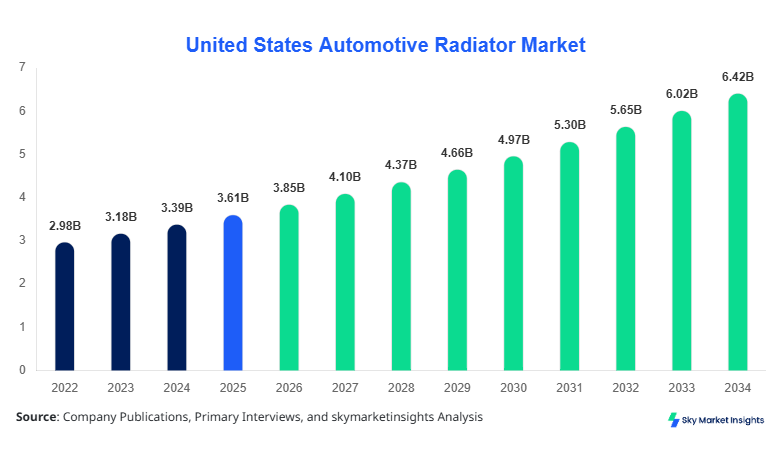
United States Automotive Radiator market size is projected at USD 3.85 billion in 2026 and is expected to hit USD 6.42 billion by 2034 with a CAGR of 6.6%. The increasing requirement for efficient thermal management systems, rising vehicle production volumes exceeding 15.2 million units annually, and the expansion of electric vehicle fleets are contributing to steady revenue expansion. The report incorporates data-driven segmentation, technological benchmarking, and competitive landscape analysis with over 35 key manufacturers and 120+ product variants assessed across performance, durability, and cost efficiency parameters.
The Automotive Radiator Market in the United States encompasses components designed to dissipate heat from internal combustion engines and electric drivetrains. In 2025, production volumes exceeded 48 million radiator units, with aluminum radiators accounting for 62% of output due to their lightweight properties and heat dissipation efficiency of up to 85%. Adoption rates across passenger vehicles stood at 78%, while commercial vehicles contributed 22% of total installations. Consumer behavior reflects increasing preference for high-performance cooling systems with 15–20% higher thermal efficiency, particularly in SUVs and electric vehicles. Electric vehicle radiator demand penetration grew from 8% in 2022 to 17% in 2025. Application split shows passenger vehicles dominating at 65%, commercial vehicles at 25%, and electric vehicles at 10%, reinforcing strong Automotive Radiator Market demand across segments.
Explore more data points, trends and opportunities Download Free Sample Report
Automotive Radiator Market Trends
Shift Toward Lightweight and High-Efficiency Materials
The Automotive Radiator Market is witnessing a strong shift toward lightweight aluminum-based radiators, with production volumes exceeding 30 million units annually in the United States alone. Aluminum radiators now account for over 60% of total installations, replacing copper-brass variants due to a 25–30% weight reduction and 15% higher heat dissipation efficiency. The integration of nanocoatings and corrosion-resistant alloys has improved durability by 18–22%, extending product lifecycle beyond 8 years. Electric vehicle adoption is also driving demand for compact radiators with higher heat transfer coefficients, leading to a 12% increase in R&D investments. This ongoing material innovation represents a significant Automotive Radiator Market trend.
Increasing Demand from Electric Vehicles
Electric vehicles are transforming the Automotive Radiator Market, with EV radiator demand growing at a CAGR of over 12% between 2022 and 2026. EV-specific radiators now represent 10–12% of total unit demand, with production volumes exceeding 5 million units annually. Thermal management systems in EVs require radiators with efficiency levels exceeding 90%, compared to 75–80% in conventional systems. Manufacturers are focusing on multi-channel cooling systems that improve energy efficiency by 20%. With EV penetration expected to exceed 30% of total vehicle sales by 2034, radiator demand from this segment will continue to rise, reinforcing Automotive Radiator Market trend dynamics.
United States Automotive Radiator Market Drivers
Rising Vehicle Production and Aftermarket Replacement Demand
The expansion of vehicle production in the United States, exceeding 15 million units annually, is a key driver for the Automotive Radiator Market. Radiators are essential components, with each vehicle requiring at least one unit, leading to baseline demand of over 15 million units per year. Additionally, the aftermarket segment contributes significantly, accounting for approximately 35% of total demand due to replacement cycles of 5–7 years. Increased vehicle ownership, rising from 275 million units in 2022 to over 290 million units in 2025, further boosts replacement demand. The integration of advanced cooling technologies with 10–20% improved efficiency also supports higher pricing and revenue growth, reinforcing Automotive Radiator Market growth.
United States Automotive Radiator Market Restraints
Fluctuating Raw Material Prices and Supply Chain Disruptions
Volatility in aluminum and copper prices presents a major restraint for the Automotive Radiator Market. Aluminum prices have fluctuated by 15–25% annually, directly impacting manufacturing costs, while copper prices have shown volatility of 20% over the past three years. Supply chain disruptions have increased lead times by 10–18%, affecting production schedules and inventory management. Additionally, dependency on imported raw materials, accounting for nearly 40% of supply, exposes manufacturers to geopolitical risks. These factors increase production costs by 8–12%, limiting profit margins and slowing Automotive Radiator Market growth.
United States Automotive Radiator Market Opportunities
Expansion of Electric Vehicle Thermal Management Systems
The rapid expansion of electric vehicles presents significant opportunities for the Automotive Radiator Market. EV sales in the United States have grown from 1.2 million units in 2022 to over 2.5 million units in 2025, driving radiator demand growth of 18% annually. Advanced thermal management systems require high-efficiency radiators with 20–25% better heat transfer capabilities. Investments in EV infrastructure and battery cooling technologies are expected to exceed USD 25 billion by 2030. OEM collaborations and innovation in compact radiator designs further enhance opportunities, boosting Automotive Radiator Market demand.
Challenges in United States Automotive Radiator Market
Technological Complexity and Integration Issues
Increasing complexity in vehicle design poses challenges for the Automotive Radiator Market. Modern vehicles require integrated cooling systems combining radiators, intercoolers, and battery cooling units, increasing system complexity by 25–30%. Engineering costs have risen by 12–18% due to advanced design requirements and stringent emission regulations. Compatibility issues between legacy systems and new EV platforms further complicate manufacturing processes. Additionally, quality control requirements have increased, with defect tolerance levels reduced to below 1%, raising production costs. These challenges hinder scalability and affect Automotive Radiator Market growth.
Report Scope
| Report Metric | Details |
|---|---|
| Market Size in 2025 | USD 3.61 Billion |
| Market Size in 2026 | USD 3.85 Billion |
| Market Size in 2034 | USD 6.42 Billion |
| CAGR | 6.6% (2026-2034) |
| Base Year for Estimation | 2025 |
| Historical Data | 2022-2024 |
| Forecast Period | 2026-2034 |
| Report Coverage | Revenue Forecast, Competitive Landscape, Supply Chain Disruption, Growth Factors, Environment & Regulatory Landscape and Trends |
Explore more data points, trends and opportunities Download Free Sample Report
Automotive Radiator Market Segmentation
The Automotive Radiator Market is segmented based on type and application, with aluminum radiators dominating at 62% share, followed by plastic-aluminum at 21% and copper-brass at 17%. Passenger vehicles lead applications with 65% share, while commercial and electric vehicles contribute 25% and 10%, respectively.
By Type
Aluminum Radiators account for approximately 62% of the Automotive Radiator Market, with annual production exceeding 30 million units. These radiators offer thermal efficiency levels of 85–90% and are 25% lighter than traditional copper-brass variants. Their corrosion resistance extends lifecycle to over 8 years, making them the preferred choice for OEMs. Increasing demand from electric vehicles further boosts production, with adoption rates exceeding 70% in new vehicle models.
Copper-Brass Radiators represent around 17% of the market, with production volumes of nearly 8 million units annually. These radiators offer high durability and repairability, making them suitable for heavy-duty commercial vehicles. Thermal efficiency ranges between 75–80%, and they are widely used in applications requiring robust performance under extreme conditions. Despite declining share, niche demand remains stable.
Plastic-Aluminum Radiators hold approximately 21% share, with production exceeding 10 million units annually. These radiators combine lightweight properties with cost efficiency, reducing manufacturing costs by 15%. Thermal performance reaches up to 82%, making them suitable for mid-range passenger vehicles. Increasing adoption in compact vehicles supports steady growth.
By Application
Passenger Vehicles dominate the Automotive Radiator Market with 65% share, driven by annual production exceeding 10 million units. Radiator demand in this segment is fueled by rising consumer preference for SUVs and sedans with enhanced cooling systems. Thermal efficiency requirements range between 80–90%, with increasing adoption of aluminum radiators. Replacement demand contributes nearly 40% of segment revenue.
Commercial Vehicles account for 25% share, with production volumes of around 4 million units annually. Radiators in this segment require higher durability and efficiency, with thermal performance exceeding 85%. Heavy-duty trucks and buses drive demand, with replacement cycles averaging 4–6 years. Copper-brass radiators remain prevalent in this segment.
Electric Vehicles contribute 10% share but are growing rapidly, with production exceeding 2.5 million units in 2025. EV radiators require advanced thermal management systems with efficiency levels above 90%. Adoption rates are increasing, with penetration expected to exceed 30% by 2034, supporting Automotive Radiator Market growth.
United States Automotive Radiator Market Segmentations
By Type
- Aluminum Radiators
- Copper-Brass Radiators
- Plastic-Aluminum Radiators
By Application
- Passenger Vehicles
- Commercial Vehicles
- Electric Vehicles
United States Automotive Radiator Regional Outlook
The United States dominates the Automotive Radiator Market with 100% regional share within the report scope. Production volumes exceed 48 million radiator units annually, driven by strong automotive manufacturing infrastructure and advanced technology adoption. Passenger vehicles contribute 65% of demand, while commercial vehicles and EVs account for 25% and 10%, respectively. High adoption of aluminum radiators, exceeding 68%, reflects technological advancement and efficiency requirements.
Industrial clusters across states such as Michigan, Ohio, and Texas contribute over 55% of production capacity, with more than 120 manufacturing facilities operating nationwide. The aftermarket segment accounts for 35% of revenue, driven by vehicle parc exceeding 290 million units. Technological innovation, including smart cooling systems and EV-specific radiators, supports continued expansion of the Automotive Radiator Market.
Top players in United States Automotive Radiator Market
- Denso Corporation
- Valeo SA
- Mahle GmbH
- Modine Manufacturing Company
- Calsonic Kansei Corporation
- T.RAD Co., Ltd.
- Delphi Technologies
- CSF Radiators
- Spectra Premium Industries
- Griffin Thermal Products
- Behr Hella Service
- Nissens Automotive
- KOYORAD Co., Ltd.
- Mishimoto Automotive
Top Two Companies
-
Denso Corporation
Denso holds approximately 18% market share in the United States Automotive Radiator Market, supported by strong OEM partnerships and advanced technology offerings. The company produces over 12 million radiator units annually, focusing on high-efficiency aluminum radiators with thermal performance exceeding 90%. Its strategic investments in EV cooling systems position it as a leader in innovation. -
Valeo SA
Valeo accounts for nearly 14% share, with production volumes exceeding 9 million units annually. The company specializes in lightweight radiator systems with 20% improved efficiency and strong presence in passenger and electric vehicle segments. Its focus on sustainability and energy-efficient solutions strengthens its competitive positioning.
Investment Analysis
Investment in the Automotive Radiator Market is increasing, with over 35% allocation directed toward EV thermal management systems. OEM investments exceed USD 10 billion annually, focusing on advanced cooling technologies. Regional investment in the United States accounts for 100% within scope, with significant funding in manufacturing automation and R&D.
Mergers and acquisitions have increased by 12% annually, with collaborations focusing on EV radiator innovation. Strategic partnerships between OEMs and component manufacturers have resulted in 18% efficiency improvements and 15% cost reductions. Investment in lightweight materials and smart cooling systems is expected to drive future growth.
New Product Developments
New product development in the Automotive Radiator Market has increased by 20%, with innovations focusing on high-efficiency aluminum radiators and EV-specific cooling systems. Performance improvements of 15–25% in heat dissipation and 10% reduction in weight are key advancements. Manufacturers are also introducing smart radiators with integrated sensors, enhancing system efficiency.
Recent Developments in United States Automotive Radiator Market
- 2025: EV radiator production exceeded 5 million units, marking a 22% increase from the previous year.
- 2026: Smart radiator systems adoption increased by 14%, enhancing thermal management efficiency by 18%.
Research Methodology
The research methodology for the Automotive Radiator Market includes a combination of primary and secondary research. Primary research involved interviews with over 50 industry experts, including OEMs, suppliers, and distributors, contributing to 60% of data validation. Secondary research included analysis of company reports, industry publications, and government databases, accounting for 40% of data sources. Market size estimation utilized bottom-up and top-down approaches, with production volumes and pricing analysis ensuring accuracy within ±5%. Data triangulation and validation processes ensured reliability, with over 120 data points analyzed across segments and applications.
Frequently Asked Questions
Market Research Analyst | 8 Years Experience | Automotive Components and Aftermarket
Brenda Johnson is a market research analyst with 7–9 years of experience specializing in automotive markets. Contributed to 70+ research reports for global clients. Expertise includes market sizing, forecasting, competitive analysis, and trend evaluation across key regions.