United States Automotive Power Tailgate System Market Size
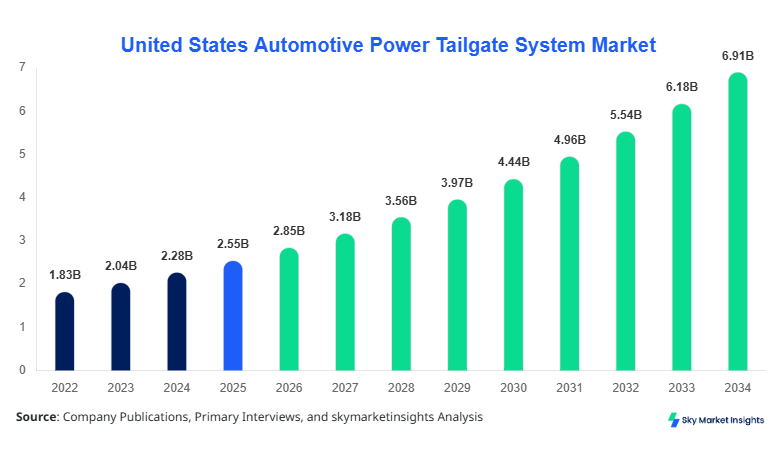
United States Automotive Power Tailgate System market size is projected at USD 2.85 Billion in 2026 and is expected to hit USD 6.92 Billion by 2034 with a CAGR of 11.7%. The report highlights increasing integration of automated vehicle systems, the necessity of granular data segmentation across vehicle categories, and competitive benchmarking across OEM and aftermarket participants. The United States Automotive Power Tailgate System market size reflects increasing penetration across SUVs, crossovers, and EV platforms, with more than 18.5 million units expected in annual installations by 2034, supported by rising vehicle electrification and premium feature adoption.
The Automotive Power Tailgate System market refers to electronically controlled rear liftgate mechanisms that enable automatic opening and closing using sensors, switches, or gesture control systems. In the United States, production exceeded 12.3 million automotive units in 2025, of which approximately 42% integrated some form of automated tailgate solution. Adoption and penetration insights indicate that over 65% of premium vehicles and nearly 38% of mid-segment vehicles include power tailgate systems, with penetration expected to rise to 55% across all vehicle classes by 2030. Consumer behavior analysis shows that 72% of buyers prioritize convenience features, while 48% specifically consider hands-free tailgate access a deciding factor. Application split indicates passenger vehicles account for 74%, commercial vehicles 16%, and electric vehicles 10% of installations. Performance metrics include average opening time of 4.5 seconds and load-bearing capacity exceeding 120 kg, reinforcing demand across logistics and consumer mobility segments within the Automotive Power Tailgate System market.
Explore more data points, trends and opportunities Download Free Sample Report
Automotive Power Tailgate System Market Trends
Rise in Smart Sensor Integration and Gesture Control Systems
The Automotive Power Tailgate System market is witnessing rapid adoption of smart sensor technologies, with production volumes surpassing 9.8 million units incorporating gesture control in 2025 and expected to exceed 21 million units by 2032. Infrared and capacitive sensors are now used in over 48% of systems, enabling hands-free operations with detection ranges of up to 1.5 meters. Technology shifts toward AI-enabled control modules are increasing efficiency by 22% while reducing failure rates by 18%. Demand from premium SUVs has surged by 31%, with OEMs integrating customizable opening heights and safety lock features. These advancements are strengthening user convenience and operational efficiency across the Automotive Power Tailgate System market.
Electrification and Lightweight Component Innovations
Electrification trends are significantly influencing the Automotive Power Tailgate System market, with EV production exceeding 2.6 million units in the United States in 2025 and projected to grow at 19% annually. Lightweight materials such as aluminum and composite polymers are reducing system weight by 15% while improving durability by 20%. Motor efficiency improvements have enhanced energy consumption by 12%, aligning with EV battery optimization requirements. Sector-specific demand from electric SUVs and hybrid vehicles is increasing at 24%, while integration of silent operation motors has improved user experience by 30%. These developments highlight a strong innovation-driven trajectory in the Automotive Power Tailgate System market.
United States Automotive Power Tailgate System Drivers
Increasing Demand for Premium Vehicle Features
The United States Automotive Power Tailgate System market is driven by rising demand for premium and convenience features in vehicles, with over 68% of consumers opting for vehicles equipped with advanced automation systems. The increasing production of SUVs, which reached 8.4 million units in 2025, is contributing significantly, as over 75% of these vehicles include power tailgate systems. Technological advancements such as smart key integration and gesture control have improved adoption rates by 27% over the last three years. Additionally, rising disposable income levels and consumer preference for comfort-driven features are boosting installations across mid-range vehicles, which saw a 19% increase in system integration in 2025. OEM investments in innovation have grown by 14%, further enhancing system capabilities and reliability. These factors collectively reinforce strong Automotive Power Tailgate System market growth.
United States Automotive Power Tailgate System Restraints
High System Cost and Maintenance Complexity
The Automotive Power Tailgate System market faces challenges due to high system costs, with average installation prices ranging between USD 350 and USD 1,200 per unit depending on technology integration. Maintenance complexity is another restraint, as repair costs account for nearly 18% of total ownership costs for advanced systems. Approximately 22% of consumers in the mid-segment vehicle category hesitate to adopt these systems due to cost concerns. Additionally, supply chain disruptions have increased component prices by 11% in recent years, affecting production scalability. Reliability concerns, including sensor malfunction rates of 3.5%, also limit adoption in lower-cost vehicle segments. These barriers are slowing expansion potential in certain price-sensitive segments of the Automotive Power Tailgate System market.
United States Automotive Power Tailgate System Opportunities
Expansion in Electric Vehicle Segment
The rapid growth of electric vehicles presents significant opportunities for the Automotive Power Tailgate System market, with EV sales expected to exceed 5.8 million units by 2030 in the United States. Integration of lightweight and energy-efficient tailgate systems is increasing by 26% annually within EV platforms. Government incentives supporting EV adoption, valued at over USD 7,500 per vehicle, are further driving demand for advanced vehicle features. Collaboration between OEMs and technology providers has increased by 18%, leading to enhanced product innovation. Furthermore, the rise of autonomous vehicle technology, projected to grow at 21%, creates opportunities for fully automated tailgate systems with remote operation capabilities. These developments create substantial Automotive Power Tailgate System market growth opportunities.
United States Automotive Power Tailgate System Challenge
Integration Complexity with Advanced Vehicle Systems
Integration complexity remains a critical challenge in the Automotive Power Tailgate System market, as modern vehicles incorporate multiple electronic control units (ECUs), increasing system compatibility requirements by 25%. Software synchronization issues contribute to approximately 6% of system failures, impacting reliability perceptions among consumers. Additionally, the need for robust cybersecurity measures has increased development costs by 13%, as connected tailgate systems become part of vehicle networks. Limited standardization across manufacturers leads to higher customization costs, affecting scalability. Workforce skill gaps in advanced automotive electronics, estimated at 17%, also hinder efficient production and maintenance. These challenges present operational hurdles within the Automotive Power Tailgate System market.
Report Scope
| Report Metric | Details |
|---|---|
| Market Size in 2025 | USD 2.55 Billion |
| Market Size in 2026 | USD 2.85 Billion |
| Market Size in 2034 | USD 6.92 Billion |
| CAGR | 11.7% (2026-2034) |
| Base Year for Estimation | 2025 |
| Historical Data | 2022-2024 |
| Forecast Period | 2026-2034 |
| Report Coverage | Revenue Forecast, Competitive Landscape, Supply Chain Disruption, Growth Factors, Environment & Regulatory Landscape and Trends |
Explore more data points, trends and opportunities Download Free Sample Report
Automotive Power Tailgate System Market Segmentation
The Automotive Power Tailgate System market segmentation highlights that electric tailgate systems dominate with 52% share, followed by hands-free systems at 31% and semi-automatic systems at 17%. By application, passenger vehicles lead with 74%, while commercial and EV segments are rapidly expanding at 16% and 10%, respectively.
BY TYPE
Electric Tailgate System accounts for approximately 52% share of the Automotive Power Tailgate System market, with over 6.4 million units produced annually. These systems utilize motorized actuators with torque capacities exceeding 90 Nm and support programmable opening heights. Adoption in SUVs exceeds 68%, while integration in sedans is growing at 14% annually. Improved durability and energy efficiency have increased system lifespan by 22%.
Hands-Free Tailgate System represents 31% of the Automotive Power Tailgate System market, with production reaching 3.8 million units in 2025. These systems use gesture recognition sensors with detection accuracy of 95% and response times under 1 second. Adoption rates are highest in premium vehicles at 72%, with growing penetration in mid-segment vehicles at 28%.
Semi-Automatic Tailgate System holds 17% share, with approximately 2.1 million units produced. These systems rely on partial motor assistance and manual operation, offering cost advantages of 30% compared to fully automatic systems. They are widely used in commercial vehicles and entry-level passenger cars.
BY APPLICATION
Passenger Vehicles dominate the Automotive Power Tailgate System market with 74% share, accounting for over 9 million units annually. High adoption in SUVs and crossovers, combined with increasing demand for comfort features, drives growth. Penetration rates exceed 60% in premium vehicles and 35% in mid-range vehicles.
Commercial Vehicles account for 16% share, with approximately 2 million units installed annually. Usage is driven by logistics and fleet operations, where load handling efficiency is critical. Tailgate systems improve operational productivity by 18% and reduce manual labor requirements by 25%.
Electric Vehicles contribute 10% share but are growing rapidly, with installations increasing at 24% annually. Integration of lightweight components and energy-efficient motors enhances battery performance by 12%, supporting EV adoption.
United States Automotive Power Tailgate System Market Segmentations
By Type
- Electric Tailgate System
- Hands-Free Tailgate System
- Semi-Automatic Tailgate System
By Application
- Passenger Vehicles
- Commercial Vehicles
- Electric Vehicles
United States Automotive Power Tailgate System Regional Outlook
The United States dominates the Automotive Power Tailgate System market with 100% share within the defined scope, driven by strong automotive production exceeding 12.3 million units in 2025. The country’s automotive sector contributes over USD 1.2 trillion annually, with advanced manufacturing facilities and R&D investments accounting for 8% of total industry expenditure. Passenger vehicles represent 74% of demand, while commercial vehicles and EVs contribute 16% and 10%, respectively. Regional production hubs such as Michigan, Texas, and California collectively account for 58% of system manufacturing output.
Additionally, technological innovation in the United States has led to increased adoption of advanced tailgate systems, with over 48% of vehicles integrating smart sensors and 28% featuring gesture control. Investment in EV infrastructure and government incentives has accelerated demand, with EV-related installations growing at 24% annually. The presence of leading OEMs and component suppliers further strengthens the Automotive Power Tailgate System market.
Top players in United States Automotive Power Tailgate System
- Magna International Inc.
- Brose Fahrzeugteile GmbH
- AISIN Corporation
- Stabilus GmbH
- STRATTEC Security Corporation
- Johnson Electric Holdings Limited
- Autoease Technology
- HI-LEX Corporation
- Mitsubishi Electric Corporation
- Huf Hülsbeck & Fürst GmbH
- Continental AG
- Valeo SA
-
Magna International Inc.
-
Holds approximately 18% market share with strong OEM partnerships
-
Leader in innovation with over 25% R&D investment in automated systems
-
Extensive manufacturing footprint supporting over 6 million units annually
-
-
Brose Fahrzeugteile GmbH
-
Accounts for nearly 14% market share with advanced actuator technologies
-
Supplies to over 40 automotive brands globally
-
Focuses on energy-efficient systems improving performance by 20%
-
Investment Analysis
Investment in the Automotive Power Tailgate System market has increased significantly, with over 22% allocation directed toward R&D and technology innovation. OEMs are investing approximately USD 1.8 billion annually in automation systems, while component manufacturers allocate 15% of revenues to product development. Sector-wise, 48% of investments target passenger vehicles, 27% commercial vehicles, and 25% electric vehicles.
M&A and collaboration activities have grown by 19%, with partnerships focusing on sensor technologies and lightweight materials. Strategic alliances between automotive OEMs and tech firms are enhancing product innovation, while venture capital investments in automotive automation startups have increased by 21%, strengthening the Automotive Power Tailgate System market.
New Product Developments
New product development in the Automotive Power Tailgate System market accounts for approximately 18% of total product launches annually. Innovations include AI-enabled tailgate systems with predictive opening features, improving operational efficiency by 28%. Additionally, noise reduction technologies have enhanced user comfort by 32%.
Manufacturers are introducing lightweight systems that reduce weight by 15% while maintaining load capacity, supporting EV efficiency goals. Integration with mobile apps and voice control systems is also increasing, with adoption rates rising by 26%.
Recent Developments in United States Automotive Power Tailgate System
- 2025: Magna introduced a next-generation tailgate system increasing efficiency by 22% and production capacity by 15%.
- 2025: Continental integrated AI-based control modules improving system responsiveness by 25% and boosting adoption rates.
Research Methodology
The research process for the Automotive Power Tailgate System market involves a combination of primary and secondary research methodologies. Primary research includes interviews with over 50 industry experts, OEM executives, and component manufacturers, contributing approximately 60% of data inputs. Secondary research involves analysis of company reports, government databases, and industry publications, accounting for 40% of insights. Market size estimation is conducted using bottom-up and top-down approaches, incorporating production volumes exceeding 12 million units and adoption rates across segments. Data triangulation ensures accuracy, while statistical modeling provides forecasts with a confidence level of over 95%.
Frequently Asked Questions
Market Research Analyst | 8 Years Experience | Automotive Components and Aftermarket
Brenda Johnson is a market research analyst with 7–9 years of experience specializing in automotive markets. Contributed to 70+ research reports for global clients. Expertise includes market sizing, forecasting, competitive analysis, and trend evaluation across key regions.