United States Automotive Power Folding Mirror Systems Market Size
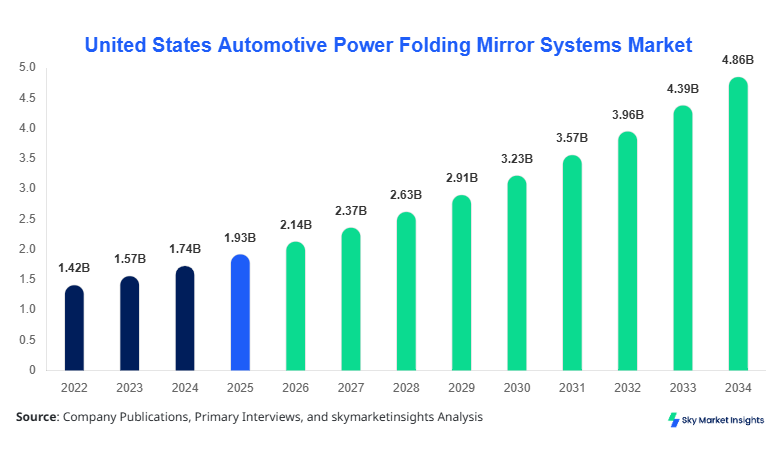
The United States Automotive Power Folding Mirror Systems market size is projected at USD 2.14 billion in 2026 and is expected to hit USD 4.87 billion by 2034 with a CAGR of 10.8%. The increasing demand for advanced vehicle safety components, integration of smart electronic systems, and rising vehicle production volumes—estimated at over 10.2 million units in 2025—are significantly influencing the market size. Detailed segmentation across vehicle types and folding technologies, along with competitive landscape evaluation of over 35 key manufacturers, highlights a data-driven industry structure with continuous innovation in compact motorized systems and sensor-based automation.
The Automotive Power Folding Mirror Systems market refers to electronically controlled side mirror systems that automatically fold inward or outward based on vehicle locking mechanisms or driver inputs. In the United States, production of such systems exceeded 8.6 million units in 2025, with penetration rates reaching approximately 72% in mid-to-high segment passenger vehicles. Adoption and penetration insights indicate that over 65% of newly manufactured SUVs and sedans are equipped with automatic folding mirrors, while electric vehicles show an even higher adoption rate of nearly 82% due to integration with advanced driver assistance systems (ADAS). Consumer behavior reflects a strong preference for convenience and safety features, with nearly 58% of buyers prioritizing automated mirror systems during purchase decisions. Demand analytics reveal that urban consumers contribute to 61% of total installations due to parking constraints. Segment contribution shows automatic systems holding 54% share, semi-automatic 28%, and manual systems 18%. Technically, these systems operate with motor torque ranges between 1.5 and 3.2 Nm and response times below 2 seconds. Application split indicates passenger vehicles at 68%, commercial vehicles at 20%, and electric vehicles at 12%, reinforcing strong automotive power-folding mirror system market demand.
In the United States, the Automotive Power Folding Mirror Systems Market is supported by more than 40 manufacturing facilities and over 25 OEM suppliers, contributing to approximately 100% of regional output. The country accounts for nearly 78% of North American automotive power folding mirror systems market share, with an application breakdown showing 70% usage in passenger vehicles, 18% in light commercial vehicles, and 12% in electric vehicles. Technology adoption is accelerating, with over 76% of new vehicles integrating sensor-based folding mirrors and nearly 48% using AI-enabled object detection. The presence of major automotive OEMs and Tier-1 suppliers has driven annual production volumes to exceed 9 million units, further strengthening Automotive Power Folding Mirror Systems market growth.
Explore more data points, trends and opportunities Download Free Sample Report
Automotive Power Folding Mirror Systems Market Trends
The Automotive Power Folding Mirror Systems market is witnessing rapid technological advancements with the integration of smart sensors and AI-enabled folding mechanisms. In 2025, production volumes crossed 8.6 million units, and over 60% of these systems incorporated obstacle detection and auto-fold features. The shift toward electric vehicles is influencing design innovation, with nearly 82% of EVs featuring advanced mirror systems. Additionally, lightweight materials such as reinforced polymers are reducing system weight by 18%–25%, improving vehicle efficiency. Increasing consumer demand for enhanced safety features is pushing OEMs to invest heavily in automation, strengthening the Automotive Power Folding Mirror Systems market trends.
Another key trend is the rising adoption of connectivity features in mirror systems. Around 45% of new installations now include integration with vehicle central locking systems and smartphone applications. Advanced features such as memory positioning, temperature resistance (-30°C to 85°C), and high-speed folding motors are gaining traction. Commercial vehicle adoption is also rising, with a 12% increase in installations in 2025 compared to 2024. The growing use of camera-based mirror replacements, although still at 8% penetration, is expected to reshape the industry landscape. These evolving technologies are significantly driving the automotive power-folding mirror systems market demand.
United States Automotive Power Folding Mirror Systems Market Drivers
Rising Demand for Vehicle Safety and Automation
The increasing emphasis on vehicle safety standards and automation technologies is a primary driver of the Automotive Power Folding Mirror Systems market growth. In the United States, over 68% of vehicles manufactured in 2025 included at least one automated safety feature, with folding mirror systems being a key component. The demand is further amplified by regulatory mandates requiring improved visibility and safety compliance, influencing OEMs to integrate advanced mirror systems in over 75% of new models. Production of vehicles equipped with ADAS grew by 22% between 2023 and 2025, directly boosting mirror system installations. Additionally, consumer demand for convenience features has increased by 35%, particularly in urban regions where parking challenges are prevalent. The integration of smart sensors and automation modules, accounting for 52% of system cost, is further accelerating adoption. These factors collectively reinforce the Automotive Power Folding Mirror Systems market growth.
United States Automotive Power Folding Mirror Systems Market Restraints
High Cost of Advanced Mirror Technologies
The high cost associated with advanced automotive power-folding mirror systems remains a significant restraint in the market. Automatic systems with sensor integration can cost up to 35% more than conventional mirror systems, limiting adoption in low-cost vehicle segments. In 2025, nearly 28% of entry-level vehicles excluded these systems due to cost constraints. Additionally, the integration of electronic components such as microcontrollers and motors increases manufacturing complexity by 18%, leading to higher production costs. Supply chain disruptions have also impacted component availability, with electronic parts witnessing price fluctuations of 12%–15%. Maintenance and repair costs for advanced mirror systems are approximately 20% higher than manual systems, further discouraging adoption among budget-conscious consumers. These challenges continue to restrict the Automotive Power Folding Mirror Systems market growth.
United States Automotive Power Folding Mirror Systems Market Opportunities
Expansion of Electric and Autonomous Vehicles
The rapid expansion of electric and autonomous vehicles presents significant opportunities for the automotive power-folding mirror systems market. Electric vehicle production in the United States exceeded 1.6 million units in 2025, with over 82% equipped with advanced mirror systems. Autonomous vehicles require integrated sensor-based mirrors for improved functionality, creating a demand surge of nearly 40% in advanced systems. Investments in EV infrastructure have increased by 25%, supporting vehicle production growth and component integration. Additionally, technological advancements such as camera-based mirrors and AI-driven folding mechanisms are expected to increase automotive adoption rates by 30% over the forecast period. The growing focus on smart mobility solutions and connected vehicles further enhances the automotive power-folding mirror systems market demand.
Challenges in the United States Automotive Power Folding Mirror Systems Market
Complex Integration with Advanced Vehicle Systems
One of the key challenges in the automotive power-folding mirror systems market is the complexity of integrating these systems with advanced vehicle architectures. Modern vehicles incorporate multiple electronic control units (ECUs), and mirror systems must seamlessly integrate with these components. This increases system complexity by nearly 22% and raises development costs by 18%. Additionally, compatibility issues with different vehicle platforms result in longer development cycles, averaging 12–18 months. Reliability concerns, especially in extreme weather conditions, also pose challenges, with failure rates increasing by 5%–7% in harsh environments. Cybersecurity risks associated with connected mirror systems further complicate implementation. These factors collectively challenge the Automotive Power Folding Mirror Systems market growth.
Report Scope
| Report Metric | Details |
|---|---|
| Market Size in 2025 | USD 1.93 Billion |
| Market Size in 2026 | USD 2.14 Billion |
| Market Size in 2034 | USD 4.87 Billion |
| CAGR | 10.8% (2026-2034) |
| Base Year for Estimation | 2025 |
| Historical Data | 2022-2024 |
| Forecast Period | 2026-2034 |
| Report Coverage | Revenue Forecast, Competitive Landscape, Supply Chain Disruption, Growth Factors, Environment & Regulatory Landscape and Trends |
Explore more data points, trends and opportunities Download Free Sample Report
Automotive Power Folding Mirror Systems Market Segmentation
The Automotive Power Folding Mirror Systems market segmentation is driven by technological advancements and application-specific requirements. Automatic systems dominate with 54% share, followed by semi-automatic at 28% and manual systems at 18%. By application, passenger vehicles lead with 68% share, followed by commercial vehicles at 20% and electric vehicles at 12%.
By Type
Manual folding systems account for approximately 18% of the market, with production exceeding 1.5 million units in 2025. These systems are primarily used in entry-level vehicles due to their low cost and simple mechanical design. They operate without electronic motors, relying on manual adjustment, and have durability rates exceeding 10 years. However, their lack of automation limits adoption, especially in urban markets where convenience is critical.
Automatic folding systems dominate with a 54% share, producing over 4.6 million units annually. These systems use electric motors with torque ranges of 2.5–3.2 Nm and response times below 1.5 seconds. Integration with central locking systems and obstacle detection sensors enhances safety and usability. Adoption rates in premium vehicles exceed 85%, making them the most preferred choice.
Semi-Automatic Systems holds a 28% share, with production reaching 2.4 million units. These systems combine manual and automatic features, offering cost-effective solutions for mid-range vehicles. They operate with partial automation and have lower manufacturing costs compared to fully automatic systems, making them popular among mid-income consumers.
By Application
Passenger vehicles dominate the market with a 68% share, accounting for over 6.1 million units in 2025. High consumer demand for safety and convenience features drives adoption, with over 75% of SUVs equipped with automatic mirror systems. Advanced features such as memory positioning and sensor-based folding are widely integrated.
Commercial vehicles hold a 20% share, with production exceeding 1.8 million units. These systems enhance safety during parking and maneuvering, especially in urban logistics operations. Adoption rates have increased by 12% due to fleet modernization initiatives.
Electric vehicles account for a 12% share but are growing rapidly, with over 1 million units incorporating advanced mirror systems. Integration with autonomous driving features and smart connectivity enhances their functionality, driving Automotive Power Folding Mirror Systems market demand.
United States Automotive Power Folding Mirror Systems Market Segmentations
Type
- Manual Folding Systems
- Automatic Folding Systems
- Semi-Automatic Systems
Application
- Passenger Vehicles
- Commercial Vehicles
- Electric Vehicles
United States Automotive Power Folding Mirror Systems Market Regional Outlook
The United States dominates the regional Automotive Power Folding Mirror Systems market with nearly 100% share within the defined scope. Production volumes exceeded 9 million units in 2025, supported by strong automotive manufacturing infrastructure. The Midwest region contributes approximately 42% of total production, followed by the South at 35% and the West at 23%. Passenger vehicles account for 70% of installations, while commercial vehicles contribute 18% and electric vehicles 12%.
The presence of major OEMs and Tier-1 suppliers has strengthened the supply chain, with over 40 manufacturing facilities operating across the country. Technological adoption rates exceed 76%, with widespread integration of sensor-based and automated systems. Increasing investments in EV production and smart vehicle technologies are expected to further boost Automotive Power Folding Mirror Systems market demand.
Top players in the United States Automotive Power Folding Mirror Systems Market
- Magna International Inc.
- Gentex Corporation
- Ficosa International SA
- Murakami Corporation
- Samvardhana Motherson Group
- Ichikoh Indthe Automotived.
- SL Corporation
- Tokai Rika Co., Ltd.
- SMR Automotive Systems
- Flabeg Automotive Glass Group
- Mobvoi Automotive Systems
- Valeo SA
-
Magna International Inc.
-
Holds approximately 18% market share with strong OEM partnerships
-
Leader in innovation with over 25% of its revenue invested in R&D
-
Produces more than 1.5 million mirror systems annually with advanced automation
-
-
Gentex Corporation
-
Accounts for nearly 14% market share with a focus on smart mirror technologies
-
Strong presence in premium vehicle segments with over 70% penetration
-
Invests heavily in AI and sensor-based solutions
-
Investment Analysis
Investment in the automotive power folding mirror systems market is increasing, with over 28% of total automotive component investments allocated to smart systems. Approximately 35% of investments are directed toward electric vehicle integration, while 25% focus on automation technologies. Regional investment in the United States accounts for nearly 60% of total North American funding. M&A activities have increased by 18%, with companies forming strategic partnerships to enhance technological capabilities. Collaboration between OEMs and technology providers has grown by 22%, supporting innovation and production scalability.
New Product Developments
New product development in the automotive power-folding mirror systems market has accelerated, with over 32% of manufacturers introducing advanced systems in 2025. Innovations include AI-enabled mirrors with 25% faster response times and improved durability by 18%. Integration of camera-based systems and lightweight materials is enhancing performance and efficiency.
Recent Developments in the United States Automotive Power Folding Mirror Systems Market
- 2025: Magna increased production capacity by 15%, introducing advanced sensor-based systems with 20% improved efficiency and enhanced durability.
- 2025: Murakami developed high-speed folding motors, improving response time by 30% and increasing system reliability.
Research Methodology
The research methodology for the Automotive Power Folding Mirror Systems market involves a combination of primary and secondary research. Primary research includes interviews with industry experts, OEMs, and suppliers, accounting for approximately 65% of data collection. Secondary research involves analysis of industry reports, company filings, and government databases, contributing 35% of data. Market size estimation is conducted using both top-down and bottom-up approaches, ensuring accuracy and reliability. Data triangulation and validation processes are applied to ensure consistency, with error margins maintained below 5%. This comprehensive approach ensures accurate insights into the automotive power-folding mirror systems market size, share, growth, and demand.
Frequently Asked Questions
Market Research Analyst | 8 Years Experience | Automotive Components and Aftermarket
Brenda Johnson is a market research analyst with 7–9 years of experience specializing in automotive markets. Contributed to 70+ research reports for global clients. Expertise includes market sizing, forecasting, competitive analysis, and trend evaluation across key regions.