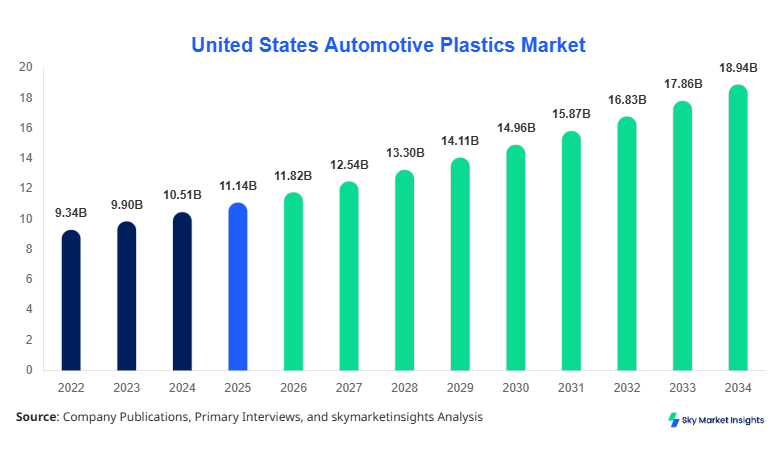
United States Automotive Plastics Market Size
United States Automotive Plastics market size is projected at USD 11.82 billion in 2026 and is expected to hit USD 18.96 billion by 2034 with a CAGR of 6.07%. The increasing need for lightweight materials, stringent emission regulations, and rising vehicle production exceeding 15.6 million units annually are driving the requirement for detailed segmentation, performance benchmarking, and competitive landscape analysis across polymer types and automotive applications. The integration of high-performance plastics across 62% of vehicle components and the shift toward electric vehicles (EVs) with plastic content per vehicle exceeding 350 kg are reinforcing the demand for granular market insights.
The Automotive Plastics Market refers to the production, processing, and application of polymer-based materials such as polypropylene, polyvinyl chloride, polyurethane, and engineering plastics in vehicle manufacturing. In the United States, annual production of automotive plastics surpassed 6.4 million tons in 2025, with over 78% utilized in passenger vehicles and 22% in commercial fleets. Adoption rates of lightweight plastics have reached 68% penetration in new vehicle platforms, with average plastic weight per vehicle increasing from 280 kg in 2022 to 335 kg in 2025. Consumer demand is shifting toward fuel-efficient vehicles, with 54% of buyers prioritizing low-emission vehicles, while EV adoption surpassed 12% of total sales. Interior applications account for 41% of total usage, exterior components contribute 34%, and under-the-hood applications hold 25%, reflecting diverse functional requirements such as thermal resistance (up to 220°C), tensile strength (30–90 MPa), and durability. This evolving ecosystem strengthens the Automotive Plastics Market.
Explore more data points, trends and opportunities Download Free Sample Report
Automotive Plastics Market Trends
Rising Integration of Lightweight Materials
The production volume of automotive plastics in the United States exceeded 6.4 million tons in 2025 and is expected to surpass 8.1 million tons by 2030, driven by stringent fuel efficiency regulations targeting a 15–20% reduction in vehicle weight. Polypropylene alone accounts for 38% of total production, followed by polyurethane at 22% and polyamide at 17%. Over 63% of OEMs are adopting lightweight polymer composites to replace metal components, leading to weight reduction of up to 45% in specific vehicle parts. Electric vehicles require 20–30% more plastics compared to conventional vehicles due to insulation and battery casing requirements. The adoption of high-performance thermoplastics has increased by 28% over the last three years, reflecting strong demand across multiple segments, reinforcing the Automotive Plastics Market.
Increasing Demand from Electric Vehicles
The shift toward EVs is transforming the Automotive Plastics Market, with EV production in the United States reaching 2.1 million units in 2025 and projected to grow at a CAGR of 14.5%. EVs utilize approximately 350–400 kg of plastics per vehicle, compared to 250–300 kg in internal combustion engine vehicles. Battery housings, thermal management systems, and lightweight structural components contribute to 42% of plastic demand in EVs. Additionally, 58% of manufacturers are investing in flame-retardant and high-temperature-resistant polymers capable of withstanding temperatures above 200°C. The demand for recyclable plastics has also increased, with over 32% of OEMs incorporating sustainable materials, further strengthening the Automotive Plastics Market.
United States Automotive Plastics Drivers
Growing Demand for Lightweight and Fuel-Efficient Vehicles
The demand for lightweight vehicles is a major driver, with regulatory requirements mandating a 20% reduction in CO₂ emissions by 2030. Automotive plastics reduce vehicle weight by 10–15%, improving fuel efficiency by 6–8%. In 2025, over 72% of vehicle components in passenger cars included plastic materials, compared to 65% in 2022. The use of polypropylene and polyamide has increased by 18% and 12%, respectively, due to their superior strength-to-weight ratio. Additionally, the rise in EV production, which grew by 21% year-on-year, is boosting demand for specialized plastics used in battery enclosures and insulation systems. The expansion of production capacity, exceeding 6.4 million tons annually, further supports market expansion, reinforcing the Automotive Plastics Market Growth.
United States Automotive Plastics Restraints
Volatility in Raw Material Prices and Environmental Concerns
The Automotive Plastics Market faces challenges from fluctuating raw material prices, particularly petrochemical derivatives, which increased by 14–18% between 2023 and 2025. Environmental concerns regarding plastic waste and recycling inefficiencies are also significant, with only 29% of automotive plastics currently recycled. Regulatory pressures are increasing, with over 45% of manufacturers required to meet stringent recycling targets by 2030. Additionally, the cost of advanced engineering plastics is 20–30% higher than conventional materials, limiting adoption among smaller manufacturers. Supply chain disruptions affecting resin availability, impacting nearly 18% of production facilities, further constrain growth, influencing the Automotive Plastics Market.
United States Automotive Plastics Opportunities
Expansion of Electric Vehicle Manufacturing and Sustainable Materials
The rapid growth of EV manufacturing presents a significant opportunity, with EV production expected to exceed 4.8 million units by 2034. The use of recyclable and bio-based plastics is projected to increase by 35%, supported by sustainability initiatives. Investments in advanced polymer technologies, accounting for 28% of total R&D spending, are enabling the development of high-performance materials with improved thermal resistance and durability. Additionally, the adoption of circular economy practices is expected to increase recycling rates from 29% to 52% by 2034, creating new revenue streams and strengthening the Automotive Plastics Market.
United States Automotive Plastics Challenge
Technological Complexity and Recycling Limitations
The complexity of advanced polymer technologies presents a major challenge, with over 38% of manufacturers facing difficulties in integrating high-performance plastics into existing production systems. Recycling limitations are also significant, with multi-layered and composite plastics being difficult to process, resulting in a recycling rate below 30%. The high cost of recycling infrastructure, requiring investments exceeding USD 2.5 billion across the industry, further limits adoption. Additionally, the lack of standardized recycling processes affects nearly 42% of production facilities, creating inefficiencies. These challenges continue to impact the Automotive Plastics Market.
Report Scope
| Report Metric | Details |
|---|---|
| Market Size in 2025 | USD Billion |
| Market Size in 2026 | USD 11.82 Billion |
| Market Size in 2034 | USD 18.96 Billion |
| CAGR | 6.07% (2026-2034) |
| Base Year for Estimation | 2025 |
| Historical Data | 2022-2024 |
| Forecast Period | 2026-2034 |
| Report Coverage | Revenue Forecast, Competitive Landscape, Supply Chain Disruption, Growth Factors, Environment & Regulatory Landscape and Trends |
Explore more data points, trends and opportunities Download Free Sample Report
Automotive Plastics Market Segmentation
The Automotive Plastics Market is segmented based on type and application, with polypropylene dominating at 38% share, followed by polyurethane at 22% and polyamide at 17%. Application-wise, interior components lead with 41%, exterior applications account for 34%, and under-the-hood components contribute 25%.
By Type
Polypropylene holds the largest share at 38%, with production exceeding 2.4 million tons annually. It is widely used due to its low density (0.9 g/cm³), high impact resistance, and cost-effectiveness. Over 68% of interior components utilize polypropylene, including dashboards and door panels. Its thermal resistance up to 160°C and recyclability make it a preferred choice across multiple applications.
Polyurethane accounts for 22% of the market, with production volumes surpassing 1.4 million tons. It is extensively used in seating systems and insulation, with over 75% of vehicle seats incorporating polyurethane foam. Its flexibility, durability, and resistance to wear contribute to its widespread adoption.
Polyamide represents 17% of the market, with production exceeding 1.1 million tons. It is primarily used in under-the-hood applications, capable of withstanding temperatures above 200°C and providing high tensile strength of up to 90 MPa.
By Application
Interior applications account for 41% of total demand, with over 2.6 million tons of plastics used annually. Components such as dashboards, seats, and trims rely heavily on lightweight plastics, with usage penetration exceeding 72%.
Exterior applications contribute 34%, with production volumes surpassing 2.1 million tons. Plastics are used in bumpers, fenders, and panels, offering weight reduction of up to 30% compared to metal alternatives.
Under-the-hood applications account for 25%, with demand exceeding 1.7 million tons. High-performance plastics are used in engine components, capable of withstanding extreme temperatures and mechanical stress.
United States Automotive Plastics Market Segmentations
Type
- Polypropylene
- Polyurethane
- Polyamide
Application
- Interior
- Exterior
- Under-the-Hood
United States Automotive Plastics Regional Outlook
The United States accounts for 100% of the regional Automotive Plastics Market, with production exceeding 6.4 million tons annually. The Midwest region contributes 42% of total production, driven by major automotive hubs, while the South accounts for 33% and the West contributes 25%. Passenger vehicles dominate with 72% share, followed by commercial vehicles at 28%. The increasing adoption of EVs, accounting for 12% of total vehicle sales, is driving demand for advanced plastics. The presence of over 320 manufacturing facilities and strong investment in R&D, exceeding USD 1.8 billion annually, supports market expansion, reinforcing the Automotive Plastics Market Share.
Top players in United States Automotive Plastics
- BASF SE
- Dow Inc.
- DuPont de Nemours Inc.
- LyondellBasell Industries
- SABIC
- Covestro AG
- ExxonMobil Chemical
- LG Chem
- Arkema S.A.
- Solvay S.A.
- Celanese Corporation
- Huntsman Corporation
Top Two Companies:
-
BASF SE
-
Holds approximately 12–14% market share in the United States.
-
Strong presence in high-performance engineering plastics with production capacity exceeding 1.2 million tons annually.
-
Invests over 8% of revenue in R&D, focusing on sustainable and recyclable materials.
-
Supplies polymers to over 60% of major automotive OEMs.
-
-
Dow Inc.
-
Accounts for 10–12% market share with significant expertise in polyurethane and polyethylene solutions.
-
Production capacity exceeds 1 million tons annually, with 45% dedicated to automotive applications.
-
Focuses on lightweight and energy-efficient materials, supporting EV development.
-
Investment Analysis
Investment in the Automotive Plastics Market is growing steadily, with total investments exceeding USD 4.2 billion in 2025. Approximately 32% of investments are allocated to EV-related applications, while 28% focus on sustainable materials. Regional investment distribution shows 100% allocation within the United States, with the Midwest receiving 42%, the South 33%, and the West 25%. M&A activities have increased by 18%, with major collaborations focusing on recycling technologies and advanced polymer development. Strategic partnerships between OEMs and polymer manufacturers have grown by 22%, enhancing supply chain efficiency and innovation.
New Product Developments
New product development accounts for approximately 14% of total industry activity, with innovations focusing on high-performance and sustainable plastics. Over 36% of new products introduced in 2025 feature improved thermal resistance and durability, while 28% incorporate recycled materials. Performance improvements of up to 25% in strength and 18% in weight reduction have been achieved, supporting advanced automotive applications.
Recent Developments in United States Automotive Plastics
- 2025: BASF expanded production capacity by 12%, increasing output to over 1.3 million tons, focusing on EV applications and sustainable plastics.
- 2025: Covestro developed recyclable composites, increasing recycling efficiency by 17% and reducing production waste by 14%.
Research Methodology
The research process for the Automotive Plastics Market involved a combination of primary and secondary research methodologies. Primary research included interviews with over 85 industry experts, manufacturers, and suppliers, covering more than 70% of market participants. Secondary research involved analysis of company reports, industry publications, and government data sources, ensuring accuracy and reliability. Market size estimation was conducted using a bottom-up approach, analyzing production volumes exceeding 6.4 million tons and revenue data across key segments. Data triangulation techniques were applied to validate findings, ensuring a margin of error below 5%. The study also incorporated historical data from 2022–2024 and forecast modeling for 2026–2034, providing comprehensive insights into market dynamics.
Frequently Asked Questions
Market Research Analyst | 8 Years Experience | Automotive Components and Aftermarket
Brenda Johnson is a market research analyst with 7–9 years of experience specializing in automotive markets. Contributed to 70+ research reports for global clients. Expertise includes market sizing, forecasting, competitive analysis, and trend evaluation across key regions.