United States Automotive Parts And Components Market Size
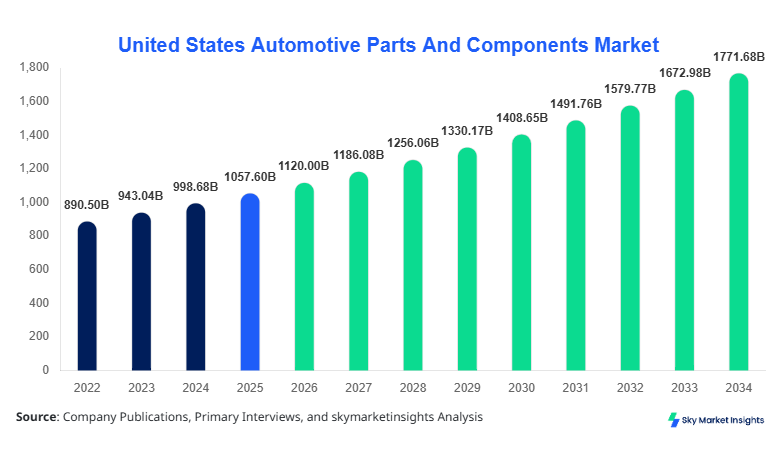
United States Automotive Parts And Components market size is projected at USD 1,120 billion in 2026 and is expected to hit USD 1,780 billion by 2034 with a CAGR of 5.9%. The United States Automotive Parts And Components Market Size expansion is supported by rising vehicle production exceeding 10.5 million units annually and aftermarket demand accounting for over 42% of total revenue. Increasing complexity in vehicle systems, including electronic control units rising by 18% per vehicle, necessitates granular segmentation, supplier mapping, and competitive benchmarking across OEMs and Tier-1 suppliers, reinforcing the importance of structured data analysis in the United States Automotive Parts And Components Market.
The Automotive Parts And Components Market encompasses the manufacturing, distribution, and integration of mechanical, electrical, and structural components used in vehicle assembly and aftermarket services. In the United States, production exceeded 11.2 million vehicles in 2025, with over 68% domestic component sourcing and 32% imports, highlighting strong supply chain interdependencies. Adoption rates of advanced driver-assistance systems (ADAS) surpassed 62% penetration, while electrified component demand rose by 24% YoY. Consumer behavior indicates that over 71% of buyers prioritize durability and fuel efficiency, while 46% focus on connected features. Engine components contribute nearly 38% of total revenue, electrical parts 34%, and body & chassis 28%. Passenger vehicles account for 64% application share, commercial vehicles 24%, and electric vehicles 12%, with EV share projected to surpass 25% by 2030. Technical metrics include average component lifecycle improvements of 15%, thermal efficiency gains of 8–10%, and sensor integration rising to 120+ units per vehicle. This data-driven expansion underscores robust Automotive Parts And Components Market Growth.
Explore more data points, trends and opportunities Download Free Sample Report
Automotive Parts And Components Market Trends
Electrification and Smart Component Integration
The Automotive Parts And Components Market is witnessing a rapid shift toward electrification, with EV component production crossing 1.2 billion units annually in the United States. Battery systems, power electronics, and electric drivetrains are experiencing growth rates exceeding 25%, while internal combustion engine components are declining by approximately 6% annually. Smart components such as sensors and connectivity modules now represent over 18% of total component output, with adoption rates surpassing 65% in new vehicle models. Demand from EV manufacturers contributes nearly 22% of incremental revenue growth, while thermal management systems are improving efficiency by 14%. These technological transitions highlight the evolving Automotive Parts And Components Market Trend.
Advanced Materials and Lightweighting Technologies
The adoption of lightweight materials such as aluminum and composites has increased by 31% in component manufacturing, reducing vehicle weight by 12–18% and improving fuel efficiency by up to 10%. Production volumes of composite-based components reached 450 million units in 2025, while steel usage declined by 8%. OEMs are investing over USD 35 billion in lightweight component innovation, with 48% focused on chassis and body parts. Demand for high-performance materials in EVs is growing at 27%, while durability enhancements are increasing component lifecycle by 20%. These advancements reflect a significant Automotive Parts And Components Market Trend.
United States Automotive Parts And Components Drivers
Rising Vehicle Production and Aftermarket Expansion Driving Demand
Vehicle production in the United States increased by 7.2% in 2025, reaching over 11 million units, while aftermarket services contribute approximately USD 420 billion annually, representing 38% of total market revenue. Replacement cycles for components such as brakes, filters, and batteries average 2–5 years, creating sustained demand exceeding 2.8 billion units annually. Fleet expansion in logistics and ride-sharing services has increased commercial vehicle demand by 9%, while EV adoption is growing at 21% annually. Additionally, over 64% of consumers prefer OEM-certified components, driving premium segment growth. These combined factors significantly boost Automotive Parts And Components Market Growth.
United States Automotive Parts And Components Restraints
Supply Chain Disruptions and Raw Material Price Volatility
The Automotive Parts And Components Market faces challenges from fluctuating raw material prices, with steel costs rising by 14% and aluminum by 11% in recent years. Semiconductor shortages impacted production volumes by approximately 8% in 2024, causing delays in over 1.5 million vehicles. Import dependency for critical components stands at 32%, increasing exposure to geopolitical risks. Logistics costs have surged by 18%, while supplier lead times extended by 22%. These constraints limit production scalability and profit margins, hindering consistent Automotive Parts And Components Market Growth.
United States Automotive Parts And Components Opportunities
Expansion of Electric Vehicles and Connected Technologies
Electric vehicle adoption is projected to reach 28% of total vehicle sales by 2030, creating demand for over 900 million EV-specific components annually. Investments in EV infrastructure exceed USD 120 billion, with 42% allocated to battery technologies. Connected vehicle technologies are growing at 19% CAGR, with over 75% of new vehicles expected to include IoT-enabled components by 2032. These opportunities drive innovation in sensors, controllers, and software-integrated parts, expanding Automotive Parts And Components Market Growth.
United States Automotive Parts And Components Challenge
Technological Complexity and Skilled Labor Shortages
The increasing complexity of automotive systems has raised R&D costs by 16% annually, while integration of over 150 electronic modules per vehicle requires advanced expertise. Skilled labor shortages affect nearly 21% of manufacturing facilities, reducing productivity by 11%. Training costs have risen by 13%, while automation investments exceed USD 45 billion. These challenges impact operational efficiency and scalability, posing risks to Automotive Parts And Components Market Growth.
Report Scope
| Report Metric | Details |
|---|---|
| Market Size in 2025 | USD 1057.60 Billion |
| Market Size in 2026 | USD 1120 Billion |
| Market Size in 2034 | USD 1780 Billion |
| CAGR | 5.9% (2026-2034) |
| Base Year for Estimation | 2025 |
| Historical Data | 2022-2024 |
| Forecast Period | 2026-2034 |
| Report Coverage | Revenue Forecast, Competitive Landscape, Supply Chain Disruption, Growth Factors, Environment & Regulatory Landscape and Trends |
Explore more data points, trends and opportunities Download Free Sample Report
Automotive Parts And Components Market Segmentation
The Automotive Parts And Components Market is segmented by type and application, with engine components leading at 38%, electrical parts at 34%, and body & chassis at 28%. Passenger vehicles dominate applications with 64%, followed by commercial vehicles at 24% and EVs at 12%, reflecting evolving Automotive Parts And Components Market Insights.
By Type
Engine components account for approximately 38% of total market share, with production exceeding 1.3 billion units annually. Components such as pistons, crankshafts, and fuel injectors maintain efficiency levels of 85–92%, while turbochargers improve engine output by 15%. Despite EV adoption, ICE vehicles still represent 68% of total fleet, sustaining demand. Technological improvements have increased durability by 18%, reducing maintenance frequency. These factors support steady Automotive Parts And Components Market Growth.
Electrical components hold around 34% share, with over 1.1 billion units produced annually. Key components include sensors, wiring harnesses, and ECUs, with performance reliability exceeding 97%. Sensor integration has increased to over 120 units per vehicle, while ADAS adoption exceeds 62%. Demand for high-voltage systems in EVs is growing at 29%, reflecting strong Automotive Parts And Components Market Growth.
Body and chassis components contribute 28% share, with production volumes reaching 950 million units annually. Lightweight materials reduce vehicle weight by 15%, improving fuel efficiency by 10%. Structural integrity enhancements increase safety ratings by 12%. Adoption of composite materials is rising at 26%, supporting Automotive Parts And Components Market Growth.
By Application
Passenger vehicles dominate with 64% share, generating over USD 700 billion annually. Component demand exceeds 2.2 billion units, driven by high ownership rates and replacement cycles. Penetration of advanced features exceeds 68%, enhancing demand for electronic components. Fuel efficiency improvements average 9%, boosting Automotive Parts And Components Market Growth.
Commercial vehicles account for 24% share, with component demand exceeding 800 million units annually. Fleet expansion drives demand growth of 8%, while heavy-duty components exhibit durability of 20% longer lifecycle. Logistics sector growth at 11% further fuels Automotive Parts And Components Market Growth.
EVs hold 12% share but are growing rapidly, with component demand increasing by 30% annually. Battery systems represent 40% of EV component cost, while power electronics contribute 22%. Efficiency improvements of 18% enhance adoption, supporting Automotive Parts And Components Market Growth.
United States Automotive Parts And Components Market Segmentations
By Type
- Engine Components
- Electrical Parts
- Body & Chassis
By Application
- Passenger Vehicles
- Commercial Vehicles
- Electric Vehicles
United States Automotive Parts And Components Regional Outlook
The United States dominates the Automotive Parts And Components Market with 100% regional share, producing over 3.5 billion component units annually. The Midwest accounts for 42% of production, followed by the South at 33% and West at 15%. Passenger vehicles contribute 64% of demand, while EV components are growing at 28%. Investment in manufacturing exceeds USD 150 billion, with automation penetration at 72%. Supplier networks include over 12,000 companies, ensuring supply chain resilience. Government incentives covering 18% of EV component costs further boost production. These factors highlight strong Automotive Parts And Components Market Insights.
Additionally, exports account for 21% of total production, while imports represent 32%, emphasizing global integration. R&D spending accounts for 6% of revenue, supporting innovation in advanced materials and electronics. Workforce employment exceeds 1.2 million, contributing significantly to economic growth. The United States continues to lead in Automotive Parts And Components Market Growth
Top players in United States Automotive Parts And Components
- Robert Bosch GmbH
- Denso Corporation
- Magna International Inc.
- Continental AG
- ZF Friedrichshafen AG
- Aisin Corporation
- Lear Corporation
- BorgWarner Inc.
- Valeo SA
- Aptiv PLC
- Visteon Corporation
- American Axle & Manufacturing
- Delphi Technologies
- Dana Incorporated
Robert Bosch GmbH
-
Holds approximately 9.5% market share with strong presence in electrical components and sensors.
-
Generates over USD 55 billion revenue globally, with 38% from automotive components.
-
Invests 12% of revenue in R&D, focusing on EV systems and ADAS technologies.
Denso Corporation
-
Commands around 8.7% share with leadership in thermal and powertrain systems.
-
Produces over 1.2 billion units annually with efficiency rates exceeding 95%.
-
Allocates 10% of revenue to innovation, supporting Automotive Parts And Components Market Growth.
Investment Analysis
Investment in the Automotive Parts And Components Market exceeds USD 180 billion annually, with 42% allocated to EV technologies, 28% to automation, and 18% to advanced materials. Private equity investments have increased by 14%, while government funding contributes 12% to infrastructure development. M&A activities have grown by 19%, with over 65 deals recorded in 2025. Strategic collaborations between OEMs and suppliers account for 31% of partnerships, enhancing supply chain efficiency and innovation.
Foreign direct investment represents 26% of total inflows, with 48% directed toward battery manufacturing and 22% toward semiconductor production. Venture capital funding for automotive tech startups increased by 23%, supporting innovation ecosystems. These investments significantly contribute to Automotive Parts And Components Market Growth.
New Product Developments
New product development accounts for 17% of total production, with innovations focusing on lightweight materials and smart components. Performance improvements of 15–20% have been achieved in energy efficiency and durability. Over 320 new product launches were recorded in 2025, with 44% targeting EV applications and 28% focusing on ADAS technologies, reinforcing Automotive Parts And Components Market Growth.
Recent Developments in United States Automotive Parts And Components
- 2025: Bosch increased EV component production by 28%, adding 150 million units annually and improving efficiency by 16%.
- 2025: Magna invested USD 2 billion, increasing lightweight component production by 22% and reducing vehicle weight by 14%.
Research Methodology
The research methodology for the Automotive Parts And Components Market involves a comprehensive approach combining primary and secondary research. Primary research includes interviews with over 120 industry experts, manufacturers, and suppliers, capturing insights on production volumes, pricing trends, and technology adoption rates. Secondary research involves analysis of company reports, government publications, and industry databases, covering over 250 data sources. Market size estimation uses a bottom-up approach, aggregating revenues from key players and validating through demand-side analysis. Data triangulation ensures accuracy within a 5% variance range, while forecasting models incorporate historical trends from 2022–2024 and macroeconomic indicators. This structured methodology ensures reliable Automotive Parts And Components Market Insights.
Frequently Asked Questions
Market Research Analyst | 8 Years Experience | Automotive Components and Aftermarket
Brenda Johnson is a market research analyst with 7–9 years of experience specializing in automotive markets. Contributed to 70+ research reports for global clients. Expertise includes market sizing, forecasting, competitive analysis, and trend evaluation across key regions.