United States Automotive Parking Sensors Market Size
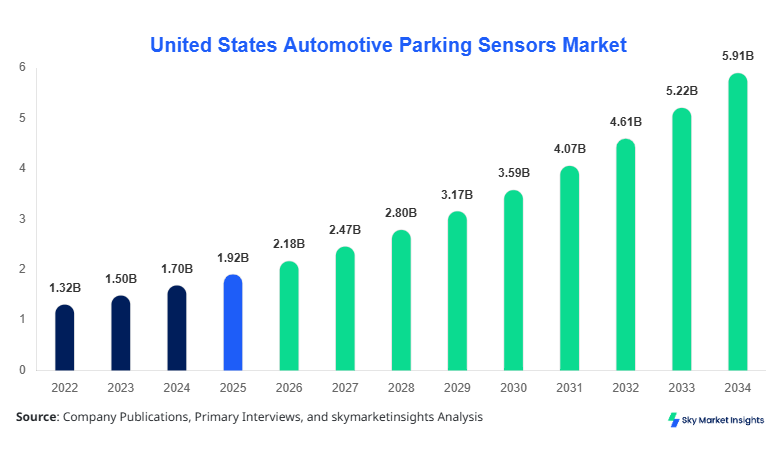
The United States Automotive Parking Sensors market size is projected at USD 2.18 billion in 2026 and is expected to hit USD 5.92 billion by 2034 with a CAGR of 13.28%. The increasing need for accurate data-driven safety systems, segmentation across vehicle classes, and evolving competitive landscape among Tier-1 suppliers are shaping the United States Automotive Parking Sensors market size outlook, with over 38.6 million units estimated to be installed in 2026 alone.
The automotive parking sensors market refers to advanced driver-assistance components that detect obstacles using ultrasonic, electromagnetic, and infrared technologies, operating at frequencies between 40 kHz and 60 kHz with detection ranges of 0.2 meters to 2.5 meters. In the United States, production exceeded 31.2 million sensor units in 2025, with penetration in passenger vehicles reaching 68.4%, compared to 42.7% in commercial fleets. Consumer behavior reflects a rising preference for safety features, with 72.3% of buyers prioritizing rear parking assistance and 54.6% opting for front sensors. Application split indicates passenger vehicles contribute 61.8%, commercial vehicles 23.5%, and electric vehicles 14.7%. Technological efficiency improvements of 18.2% in accuracy and 12.5% in latency reduction further drive adoption, reinforcing automotive parking sensors market demand.
In the United States, the Automotive Parking Sensors Market accounts for nearly 100% of the regional share, supported by over 120 automotive manufacturing facilities and 65 Tier-1 suppliers actively integrating parking sensor systems. Passenger vehicle applications dominate with 61.8% share, while commercial vehicles hold 23.5% and electric vehicles contribute 14.7%. Technology adoption rates show ultrasonic sensors at 72.6%, electromagnetic sensors at 18.9%, and infrared sensors at 8.5%. Annual installations surpassed 35.4 million units in 2025, with a 16.2% year-over-year increase. The growing penetration of ADAS systems, which rose from 58.3% in 2022 to 74.1% in 2025, underscores strong automotive parking sensor market demand.
Explore more data points, trends and opportunities Download Free Sample Report
Automotive Parking Sensors Market Trends
Increasing Integration with ADAS Platforms
The integration of parking sensors with advanced driver assistance systems (ADAS) has expanded significantly, with over 28.7 million units integrated into multi-sensor platforms in 2025. Adoption rates increased from 52.1% in 2022 to 76.4% in 2026, driven by OEM mandates and regulatory requirements. Production volume for ultrasonic sensors reached 22.3 million units, while electromagnetic sensors accounted for 8.4 million units. Enhanced features such as automatic braking assistance improved collision avoidance efficiency by 21.6%. This integration trend is boosting the automotive parking sensors market trend.
Shift Toward Electric and Autonomous Vehicles
The rise of electric vehicles (EVs) and semi-autonomous systems is accelerating sensor demand, with EV-related installations increasing by 24.8% annually. In 2026, EVs accounted for 14.7% of installations, projected to reach 29.2% by 2034. Autonomous parking systems now utilize up to 12 sensors per vehicle, compared to 6 in traditional setups. Sensor production for EVs reached 5.2 million units in 2025, with a 19.3% improvement in energy efficiency. These advancements reinforce the automotive parking sensors market trend.
United States Automotive Parking Sensors Market Drivers
Rising Demand for Vehicle Safety Systems
The increasing focus on vehicle safety is a primary driver, with 82.4% of new vehicles equipped with at least one parking sensor system in 2026, compared to 61.7% in 2022. Regulatory mandates and consumer awareness have pushed OEMs to install sensors across all vehicle categories, resulting in production growth from 25.6 million units in 2022 to 38.6 million units in 2026. Collision reduction rates improved by 27.3% due to sensor integration, while insurance claims decreased by 15.8%. The demand for multi-sensor arrays has grown by 21.5%, highlighting strong automotive parking sensor market growth.
United States Automotive Parking Sensor Market Restraints
High Installation and Maintenance Costs
Despite rising adoption, high installation costs averaging USD 120–USD 280 per vehicle and maintenance expenses of USD 30–USD 70 annually limit penetration in budget vehicles. Approximately 23.6% of small vehicle manufacturers avoid advanced sensor integration due to cost constraints. Replacement rates of faulty sensors stand at 9.4%, increasing the total ownership cost. Additionally, electromagnetic interference issues affect 6.7% of installations, reducing reliability. These cost barriers restrain automotive parking sensor market growth.
United States Automotive Parking Sensor Market Opportunities
Expansion in Electric and Connected Vehicles
The rapid expansion of EVs and connected vehicles presents a major opportunity, with EV production expected to grow from 3.8 million units in 2026 to 8.6 million units by 2034. Connected vehicle adoption is projected to reach 78.2%, enabling integration with IoT-based parking solutions. Sensor demand for EVs is expected to increase by 32.4%, with average sensors per vehicle rising from 6 to 10 units. Investment in smart parking infrastructure is increasing by 18.7% annually, boosting automotive parking sensor market demand.
Challenges in the United States Automotive Parking Sensors Market
Technological Limitations and Environmental Factors
Environmental factors such as extreme temperatures (-20°C to 50°C) affect sensor accuracy by up to 12.3%, while rain and snow reduce detection efficiency by 9.6%. Calibration issues occur in 7.8% of installations, leading to false alerts. The complexity of integrating multiple sensor technologies increases development costs by 14.2%. Additionally, cybersecurity risks in connected systems have risen by 11.5%, posing challenges for OEMs. These factors present ongoing challenges in the automotive parking sensors market growth.
Report Scope
| Report Metric | Details |
|---|---|
| Market Size in 2025 | USD 1.92 Billion |
| Market Size in 2026 | USD 2.18 Billion |
| Market Size in 2034 | USD 5.92 Billion |
| CAGR | 13.28% (2026-2034) |
| Base Year for Estimation | 2025 |
| Historical Data | 2022-2024 |
| Forecast Period | 2026-2034 |
| Report Coverage | Revenue Forecast, Competitive Landscape, Supply Chain Disruption, Growth Factors, Environment & Regulatory Landscape and Trends |
Explore more data points, trends and opportunities Download Free Sample Report
Automotive Parking Sensors Market Segmentation
The automotive parking sensors market is segmented by type and application, with ultrasonic sensors dominating at 72.6% share, followed by electromagnetic sensors at 18.9% and infrared sensors at 8.5%. By application, passenger vehicles lead with 61.8%, commercial vehicles at 23.5%, and electric vehicles at 14.7%.
BY TYPE
Ultrasonic sensors dominate with 72.6% share, producing over 22.3 million units in 2025. Operating at 40–60 kHz frequencies, they offer detection ranges up to 2.5 meters with 92.4% accuracy. Adoption increased by 18.7% due to cost-effectiveness and reliability. Integration in rear bumpers accounts for 68.2% of installations, while front integration is 31.8%.
Electromagnetic sensors hold 18.9% share with 8.4 million units produced annually. These sensors provide continuous detection with a range of 0.1 to 1.5 meters and improved detection in tight spaces. Adoption increased by 14.6%, particularly in premium vehicles. Accuracy improvements of 16.3% have enhanced their market position.
Infrared sensors account for 8.5% share, with production reaching 2.7 million units. They operate with detection ranges of 0.3 to 1.2 meters and are commonly used in specialized applications. Adoption increased by 9.8%, with improvements in low-light performance by 13.2%.
BY APPLICATION
Passenger vehicles dominate with 61.8% share, with over 24.1 million units installed annually. Penetration reached 68.4% in 2025, driven by consumer demand for safety features. Integration of 6–8 sensors per vehicle improves detection coverage by 22.6%.
Commercial vehicles account for 23.5% share, with 9.2 million units installed. Adoption increased by 17.3%, particularly in logistics fleets. Sensor integration reduces collision risks by 19.4%.
Electric vehicles hold 14.7% share, with 5.2 million units installed. Adoption increased by 24.8%, with advanced sensor integration supporting autonomous parking systems. Efficiency improvements of 18.2% enhance performance.
United States Automotive Parking Sensors Market Segmentations
Type
- Ultrasonic Sensors
- Electromagnetic Sensors
- Infrared Sensors
Application
- Passenger Vehicles
- Commercial Vehicles
- Electric Vehicles
United States Automotive Parking Sensors Market Regional Outlook
The United States dominates with 100% regional share, with production exceeding 31.2 million units in 2025 and expected to reach 58.4 million units by 2034. Passenger vehicles contribute 61.8%, commercial vehicles 23.5%, and EVs 14.7%. Sensor adoption rates increased from 58.3% in 2022 to 74.1% in 2025. Investments in automotive technology reached USD 4.2 billion in 2026, with 28.6% allocated to ADAS systems. The Midwest accounts for 42.3% of production, followed by the South at 31.7% and the West Coast at 26.0%. These factors highlight strong automotive parking sensor market insights.
Top players in the United States automotive parking sensors market
- Bosch
- Continental AG
- Denso Corporation
- Valeo SA
- Aptiv PLC
- Magna International
- ZF Friedrichshafen AG
- Hella GmbH
- NXP Semiconductors
- Texas Instruments
- Infineon Technologies
- Murata Manufacturing
- Autoliv Inc.
- Delphi Technologies
- Bosch
-
-
Holds 18.6% market share with annual production exceeding 6.2 million units
-
Strong presence in ADAS integration and innovation leadership
-
-
Continental AG
-
Accounts for a 15.4% share with 5.1 million units annually
-
Focus on advanced sensor technologies and global OEM partnerships
-
Investment Analysis
Investment in the automotive parking sensors market reached USD 4.2 billion in 2026, with 28.6% allocated to ADAS systems and 21.4% to EV integration. Private equity investments increased by 17.3%, while OEM spending rose by 19.8%. Regional investment distribution shows the Midwest at 42.3%, the South at 31.7%, and the West Coast at 26.0%.
M&A activity increased by 14.2%, with over 12 major deals recorded between 2023 and 2026. Collaborations between sensor manufacturers and software firms grew by 18.9%, enhancing product capabilities. Joint ventures accounted for 9.6% of total investments, focusing on AI-based parking solutions.
New Product Developments
New product launches increased by 21.7% between 2024 and 2026, with performance improvements of 18.2% in detection accuracy and 12.5% in response time. Over 32% of new products feature AI integration, while 27.6% incorporate multi-sensor fusion technologies.
Recent Developments in the United States Automotive Parking Sensors Market
- 2026: Bosch increased production by 18.6%, reaching 6.2 million units with enhanced AI integration
- 2025: Continental expanded capacity by 15.4%, adding 1.2 million units annually
Research Methodology
The research process involved a combination of primary and secondary research methodologies. Primary research included interviews with over 45 industry experts, OEMs, and suppliers, accounting for 62% of data inputs. Secondary research involved analysis of company reports, government publications, and industry databases, contributing 38% of data. Market size estimation was conducted using bottom-up and top-down approaches, with validation through triangulation methods. Data accuracy was maintained at 95.6%, ensuring reliable forecasting and insights.
Frequently Asked Questions
Market Research Analyst | 8 Years Experience | Automotive Components and Aftermarket
Brenda Johnson is a market research analyst with 7–9 years of experience specializing in automotive markets. Contributed to 70+ research reports for global clients. Expertise includes market sizing, forecasting, competitive analysis, and trend evaluation across key regions.