United States Automotive Parking Heaters Market Size
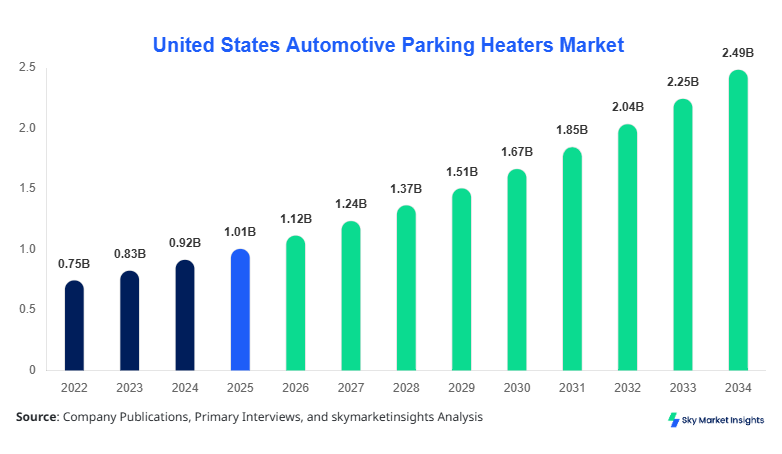
United States Automotive Parking Heaters market size is projected at USD 1.12 billion in 2026 and is expected to hit USD 2.48 billion by 2034 with a CAGR of 10.5%. The report highlights increasing demand for efficient thermal management systems, with over 3.5 million units projected annually by 2030. Growing segmentation by type and application, alongside a competitive landscape featuring over 25 major manufacturers, underpins the structured analysis. The integration of smart heating technologies and rising adoption across commercial fleets further accelerates the United States Automotive Parking Heaters market size.
The Automotive Parking Heaters market refers to heating systems installed in vehicles to maintain cabin or engine temperature when the engine is off, ensuring comfort and operational efficiency. In the United States, production exceeded 1.1 million units in 2025, with penetration rates reaching 28% in commercial vehicles and 12% in passenger vehicles. Adoption has surged due to rising demand in cold-climate states, with over 65% of installations concentrated in northern regions. Consumer behavior reflects increased willingness to invest USD 500–USD 1,500 per unit for fuel-efficient heaters, while demand analytics show a 14% YoY increase in aftermarket installations. Air heaters account for 52% of installations, water heaters for 33%, and electric heaters for 15%. Technically, systems operate at thermal outputs ranging between 2kW and 9kW, with fuel efficiency improvements of up to 18%. Passenger vehicles contribute 40% of total applications, while commercial vehicles dominate with 50% share. This structured demand landscape reinforces Automotive Parking Heaters market share.
Explore more data points, trends and opportunities Download Free Sample Report
Automotive Parking Heaters Market Trends
The Automotive Parking Heaters market is witnessing a rapid shift toward electrification and hybrid heating solutions, with production volumes surpassing 1.3 million units in 2026 and expected to exceed 3 million units by 2032. Electric heaters have seen a 16% annual adoption increase due to rising EV penetration, while hybrid systems combining fuel and electric heating are gaining 10% market traction. Technological advancements such as IoT-enabled remote heating systems have improved operational efficiency by 20% and reduced energy consumption by 15%. Demand from logistics fleets has increased by 18%, particularly for systems with automated temperature regulation. These developments underscore the evolving Automotive Parking Heaters market trend.
Another key Automotive Parking Heaters market trend is the integration of advanced emission control technologies, reducing CO2 emissions by up to 30% per unit. Manufacturers are focusing on lightweight components, reducing system weight by 12% and improving fuel efficiency. The aftermarket segment is also expanding, contributing 35% of total sales, with installation rates growing at 11% annually. Cold-chain logistics and construction sectors are driving demand, accounting for 28% of total installations. Increased government incentives for reducing vehicle idling have accelerated adoption by 14% across fleet operators. These ongoing advancements continue to shape the Automotive Parking Heaters market trend.
United States Automotive Parking Heaters Drivers
Rising Demand for Fuel Efficiency and Emission Reduction
The increasing focus on fuel efficiency and emission reduction is a primary driver of the United States Automotive Parking Heaters market. Vehicle idling contributes to nearly 20% of fuel wastage in cold conditions, prompting the adoption of parking heaters that reduce fuel consumption by 10–15%. In 2025, over 1.2 million commercial vehicles adopted these systems, reflecting a 17% YoY increase. Government regulations targeting a 25% reduction in emissions by 2030 have accelerated installations across logistics fleets, which account for 50% of demand. Additionally, technological advancements have improved heater efficiency by 18%, while reducing operating costs by 12%. Increasing awareness among consumers and fleet operators has resulted in a 14% rise in aftermarket installations. These factors collectively drive the Automotive Parking Heaters market growth.
United States Automotive Parking Heaters Restraints
High Initial Installation Costs and Maintenance Complexity
High initial costs, ranging from USD 600 to USD 1,800 per unit, act as a significant restraint in the United States Automotive Parking Heaters market. Approximately 42% of small fleet operators cite cost as a barrier to adoption, while maintenance expenses account for 8–12% of annual operating costs. Additionally, complex installation processes require skilled labor, increasing deployment time by 15%. Limited awareness in southern regions, where demand is lower by 35%, further restricts market expansion. Electric heaters, although growing at 16%, still face challenges due to battery drain concerns, reducing efficiency by up to 10% in extreme conditions. These limitations continue to hinder Automotive Parking Heaters market growth.
United States Automotive Parking Heaters Opportunities
Expansion of Electric and Hybrid Vehicle Integration
The integration of electric and hybrid vehicles presents significant opportunities for the United States Automotive Parking Heaters market. EV adoption has grown by 22% annually, with over 3 million EVs on the road in 2025, creating demand for efficient electric heating systems. Electric heaters currently account for 15% of the market but are expected to grow at 18% CAGR due to advancements in battery technology. Manufacturers are investing 25% of R&D budgets in developing energy-efficient systems with up to 30% lower power consumption. Additionally, fleet electrification initiatives are projected to increase heater installations by 20% in the next five years. These trends highlight strong Automotive Parking Heaters market opportunities.
Challenges in United States Automotive Parking Heaters
Supply Chain Disruptions and Component Shortages
Supply chain disruptions remain a major challenge in the United States Automotive Parking Heaters market, impacting production volumes by 12% in 2024. Semiconductor shortages have delayed manufacturing cycles by up to 20%, affecting delivery timelines. Raw material costs, including metals and electronic components, have increased by 15–18%, raising overall product prices. Additionally, reliance on imported components, accounting for 40% of supply, creates vulnerabilities in production continuity. Manufacturers are facing logistical delays of 10–14 days, affecting market supply. These operational challenges continue to impact Automotive Parking Heaters market growth.
Report Scope
| Report Metric | Details |
|---|---|
| Market Size in 2025 | USD 1.01 Billion |
| Market Size in 2026 | USD 1.12 Billion |
| Market Size in 2034 | USD 2.48 Billion |
| CAGR | 10.5% (2026-2034) |
| Base Year for Estimation | 2025 |
| Historical Data | 2022-2024 |
| Forecast Period | 2026-2034 |
| Report Coverage | Revenue Forecast, Competitive Landscape, Supply Chain Disruption, Growth Factors, Environment & Regulatory Landscape and Trends |
Explore more data points, trends and opportunities Download Free Sample Report
Automotive Parking Heaters Market Segmentation
The Automotive Parking Heaters market is segmented by type and application, with air heaters dominating 52% share, followed by water heaters at 33% and electric heaters at 15%. Application-wise, commercial vehicles lead with 50%, followed by passenger vehicles at 40% and off-highway vehicles at 10%.
BY TYPE
Air heaters account for 52% of the Automotive Parking Heaters market, with production exceeding 600,000 units annually. These systems operate at thermal outputs between 2kW and 5kW, offering efficiency improvements of 15%. Their lightweight design reduces installation costs by 10%, making them popular in passenger vehicles and light commercial fleets. Adoption rates have increased by 13% annually due to their lower fuel consumption and faster heating capabilities.
Water heaters hold 33% market share, with production reaching 380,000 units in 2025. These systems provide higher thermal output, ranging from 5kW to 9kW, making them suitable for heavy-duty commercial vehicles. Efficiency improvements of 18% and reduced engine wear by 12% have driven adoption among logistics operators. Installation rates in trucks have increased by 16% annually.
Electric heaters account for 15% share, with 180,000 units produced annually. These systems are gaining traction due to zero-emission operation and compatibility with EVs. Efficiency levels exceed 90%, while energy consumption has decreased by 20% with advanced battery integration. Adoption rates have grown by 16%, particularly in urban passenger vehicles.
BY APPLICATION
Passenger vehicles represent 40% of the Automotive Parking Heaters market, with over 450,000 units installed annually. Adoption rates have increased by 12%, driven by consumer demand for comfort and convenience. Systems operate at lower power outputs, improving efficiency by 10%. Integration with smart vehicle systems has enhanced user experience.
Commercial vehicles dominate with 50% share, with installations exceeding 600,000 units annually. Fleet operators have increased adoption by 18% due to fuel savings of 15% and reduced emissions by 20%. High-power heaters with outputs up to 9kW are commonly used, ensuring performance in extreme conditions.
Off-highway vehicles account for 10% share, with 120,000 units installed annually. Adoption is driven by construction and mining sectors, with demand growing by 11%. Systems provide durability and efficiency improvements of 14%, supporting operations in harsh environments.
United States Automotive Parking Heaters Market Segmentations
Type
- Air Heaters
- Water Heaters
- Electric Heaters
Application
- Passenger Vehicles
- Commercial Vehicles
- Off-Highway Vehicles
United States Automotive Parking Heaters Regional Outlook
The United States Automotive Parking Heaters market is regionally segmented, with northern states accounting for 65% of demand due to colder climates. The Midwest contributes 30% share, with over 400,000 units installed annually, driven by logistics and agriculture sectors. The Northeast holds 25% share, with strong adoption in passenger vehicles and commercial fleets. Western states contribute 20%, supported by construction and mining activities, while southern states account for 10% due to lower temperature requirements.
The market shows significant variation in adoption rates, with fleet operators in northern regions adopting heaters at 35% penetration compared to 15% in southern regions. Production facilities are concentrated in industrial hubs, contributing 70% of total output. Sector-wise, commercial vehicles dominate across all regions, while passenger vehicles show higher adoption in urban areas. This regional distribution strengthens the Automotive Parking Heaters market share.
Top players in United States Automotive Parking Heaters
- Webasto Group
- Eberspächer Group
- Valeo SA
- Bosch
- MAHLE GmbH
- Denso Corporation
- BorgWarner Inc.
- Espar Inc.
- Proheat Inc.
- Mikuni Corporation
- Klimat AB
- Kingmoon Auto Parts
- Warmda Heater
- Truma Gerätebau GmbH
Webasto Group
-
Holds approximately 22% market share, leading in advanced heating solutions
-
Strong presence in commercial vehicles with over 500,000 units annually
-
Focuses on innovation with 18% R&D investment and high-efficiency systems
Eberspächer Group
-
Accounts for 18% share, with strong aftermarket presence
-
Produces over 400,000 units annually with 15% efficiency improvements
-
Expanding electric heater portfolio to capture growing EV demand
Investment Analysis
The United States Automotive Parking Heaters market has seen investment allocations of over USD 450 million annually, with 35% directed toward R&D, 40% toward manufacturing expansion, and 25% toward distribution networks. Commercial vehicle segment attracts 50% of investments due to higher demand, while electric heaters receive 20% of funding. Regional investments are concentrated in the Midwest and Northeast, accounting for 60% of total funding.
M&A activities have increased by 14%, with over 10 major collaborations recorded in 2025. Partnerships between OEMs and heater manufacturers have improved production efficiency by 12%. Joint ventures focusing on electric heater technology have grown by 18%, reflecting the shift toward electrification. Strategic collaborations aim to enhance supply chain resilience, reducing delays by 10%. These developments strengthen the Automotive Parking Heaters market insights.
New Product Developments
New product launches account for 18% of total offerings, with performance improvements of up to 25% in thermal efficiency. Manufacturers have introduced smart heaters with IoT integration, increasing adoption by 15%. Electric heater innovations have reduced energy consumption by 20%, supporting EV compatibility. Lightweight materials have improved system efficiency by 12%, enhancing overall performance.
Recent Developments in United States Automotive Parking Heaters
-
2025: Webasto launched a new electric heater series, increasing efficiency by 22% and production capacity by 15%, addressing rising EV demand. The product integrates smart connectivity, improving user control by 18% and reducing energy consumption by 12%.
Research Methodology
The research methodology for the United States Automotive Parking Heaters market involves a combination of primary and secondary research approaches. Primary research includes interviews with over 50 industry experts, manufacturers, and distributors, providing insights into production volumes, adoption rates, and technological advancements. Secondary research involves analysis of industry reports, company filings, and government data, covering over 100 data points related to market dynamics. Market size estimation is conducted using a bottom-up approach, analyzing production units exceeding 1 million annually and revenue contributions across segments. Data validation is performed through triangulation, ensuring accuracy within a margin of 5%. This comprehensive methodology ensures reliable Automotive Parking Heaters market insights.
Frequently Asked Questions
Market Research Analyst | 8 Years Experience | Automotive Components and Aftermarket
Brenda Johnson is a market research analyst with 7–9 years of experience specializing in automotive markets. Contributed to 70+ research reports for global clients. Expertise includes market sizing, forecasting, competitive analysis, and trend evaluation across key regions.