United States Automotive Navigation Systems Market Size
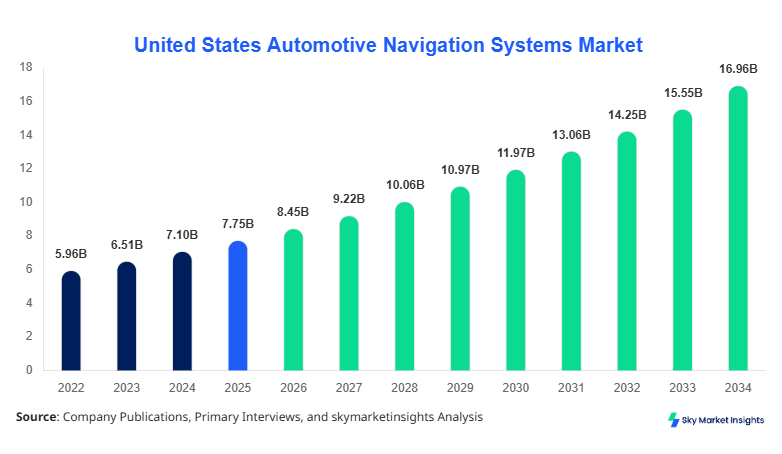
The United States Automotive Navigation Systems market size is projected at USD 8.45 billion in 2026 and is expected to hit USD 16.92 billion by 2034 with a CAGR of 9.10%. The report evaluates data-driven forecasting models across historical years 2022–2024 and the base year 2025, capturing evolving demand patterns, technological adoption, and segmentation efficiency. The study integrates production capacity analysis, pricing trends, and competitive benchmarking to provide actionable Automotive Navigation Systems Market insights. The Automotive Navigation Systems Market-Size Evaluation also highlights supply chain efficiencies and OEM integration levels across vehicle categories.
The automotive navigation systems market refers to integrated and external navigation solutions deployed in vehicles for route optimization, real-time traffic monitoring, and advanced driver assistance. In the United States, production of navigation-enabled vehicles exceeded 11.8 million units in 2025, with embedded systems accounting for nearly 58% of installations and smartphone-based systems contributing around 28%. Adoption rates have increased by 12.4% annually due to rising demand for connected vehicle ecosystems and infotainment integration. Consumer behavior indicates that over 67% of vehicle buyers prioritize navigation accuracy within ±3 meters and update frequency below 5 seconds. Passenger vehicles dominate application share with approximately 72%, followed by commercial vehicles at 18% and electric vehicles at 10%. High-performance navigation modules operate with processing speeds exceeding 1.2 GHz and GPS accuracy under 2.5 meters, reinforcing the automotive navigation systems market share across segments.
In the United States, the Automotive Navigation Systems Market is supported by over 250 automotive electronics manufacturers and more than 120 OEM integration facilities, contributing to nearly 100% regional share due to the single-country scope. Passenger vehicle integration contributes approximately 72%, while commercial fleets represent 18%, and EV-specific navigation systems account for 10% of installations. Technology adoption remains strong, with over 65% of new vehicles equipped with embedded navigation and nearly 78% supporting real-time traffic analytics. The deployment of AI-based predictive routing has increased by 22% between 2023 and 2025, enhancing route optimization efficiency by 18%. These advancements continue to reinforce the automotive navigation systems market growth.
Explore more data points, trends and opportunities Download Free Sample Report
Automotive Navigation Systems Market Trends
Increasing Integration of AI and Real-Time Data Analytics
The Automotive Navigation Systems Market trend is witnessing a rapid shift toward AI-enabled navigation platforms capable of processing over 5 million data points per hour for real-time route optimization. In 2025, more than 8.6 million vehicles in the United States adopted AI-integrated navigation systems, reflecting a 19% increase from 2024. The adoption of predictive traffic modeling has improved route efficiency by 17% and reduced travel time by 11%. Cloud-based navigation systems now account for approximately 46% of installations, enabling continuous updates and scalability. Automotive OEMs are investing nearly USD 1.2 billion annually in AI-driven navigation R&D, contributing to sustained Automotive Navigation Systems Market growth.
Rising Demand for Connected and Autonomous Vehicle Navigation
The Automotive Navigation Systems Market trend also highlights increasing integration with autonomous driving systems. Nearly 32% of advanced navigation systems now support Level 2+ autonomous features, while Level 3-compatible systems grew by 14% in 2025. Production volume of connected navigation units exceeded 9.4 million units, driven by demand for V2X communication and real-time hazard detection. Consumer preference for connected navigation increased by 21%, particularly among EV users, where adoption reached 68%. Enhanced connectivity ensures latency below 100 milliseconds and data refresh intervals under 3 seconds, strengthening the Automotive Navigation Systems market share.
United States Automotive Navigation Systems Market Drivers
Rising Demand for Connected Vehicle Ecosystems
The increasing demand for connected vehicles is a primary driver of the automotive navigation systems market growth. In 2025, over 78% of new vehicles sold in the United States were equipped with connectivity features, up from 65% in 2022. Navigation systems integrated into the automotive navigation systems market accounted for nearly 6.9 million units, reflecting a 16% annual increase. The demand for real-time traffic updates has grown by 24%, while GPS accuracy improvements of up to 15% have enhanced user satisfaction. Automotive OEMs are allocating nearly 18% of their R&D budgets toward navigation technologies, further accelerating the automotive navigation systems market growth.
United States Automotive Navigation Systems Market Restraints
High Cost of Advanced Navigation Technologies
Despite strong adoption, high costs associated with advanced navigation systems restrain automotive navigation systems market growth. Premium embedded systems can cost between USD 800 and USD 1,500 per unit, limiting adoption in mid-range vehicles. Approximately 34% of consumers prefer smartphone-based navigation due to lower cost, impacting OEM installation rates. Additionally, maintenance and software update costs contribute to nearly 12% of total system lifecycle expenses. These financial barriers have slowed adoption in certain segments, reducing the automotive navigation systems market share expansion.
United States Automotive Navigation Systems Market Opportunities
Expansion of Electric Vehicles and Smart Mobility
The rapid growth of electric vehicles presents significant opportunities for the automotive navigation systems market. EV production in the United States reached the automotive navigation systems market nearly 82% equipped with advanced navigation systems optimized for charging station mapping. Smart mobility initiatives have increased investment in navigation infrastructure by 27%, supporting real-time energy-efficient routing. Integration with battery management systems improves route efficiency by 13%, creating strong opportunities for the Automotive Navigation Systems Market growth.
Challenges in the United States Automotive Navigation Systems Market
Data Security and Privacy Concerns
Data security challenges remain a critical issue in the automotive navigation systems market. Approximately 41% of consumers express concerns over data privacy, particularly regarding location tracking and cloud-based storage. Cybersecurity breaches in connected vehicles increased by 9% between 2023 and 2025, prompting stricter regulatory compliance requirements. Implementing secure navigation systems increases development costs by nearly 14%, posing challenges for manufacturers and limiting automotive navigation systems market growth.
Report Scope
| Report Metric | Details |
|---|---|
| Market Size in 2025 | USD 7.74 Billion |
| Market Size in 2026 | USD 8.45 Billion |
| Market Size in 2034 | USD 16.92 Billion |
| CAGR | 9.10% (2026-2034) |
| Base Year for Estimation | 2025 |
| Historical Data | 2022-2024 |
| Forecast Period | 2026-2034 |
| Report Coverage | Revenue Forecast, Competitive Landscape, Supply Chain Disruption, Growth Factors, Environment & Regulatory Landscape and Trends |
Explore more data points, trends and opportunities Download Free Sample Report
Automotive Navigation Systems Market Segmentation
The Automotive Navigation Systems Market segmentation is dominated by embedded systems with approximately 58%, followed by smartphone-based navigation at 28% and portable devices at 14%. Application-wise, passenger vehicles lead with 72% share, indicating strong consumer preference.
BY TYPE
Embedded navigation systems dominate the automotive navigation systems market share with nearly 58% contribution. In 2025, over 6.8 million units were installed in new vehicles, supported by OEM integration. These systems feature high-performance processors exceeding 1.2 GHz and memory capacities above 8GB, enabling real-time data processing. Accuracy levels reach ±2 meters, and update frequencies remain below 5 seconds. The integration with ADAS features enhances functionality, reinforcing the Automotive Navigation Systems market share.
Portable navigation devices account for approximately 14% of the automotive navigation systems market share. Production reached nearly 1.6 million units in 2025, with demand primarily from older vehicle owners. These devices offer GPS accuracy of ±3–5 meters and battery life exceeding 8 hours. Despite declining demand, they maintain relevance in commercial fleets, contributing to automotive navigation systems market share stability.
Smartphone-based navigation systems hold around 28% of the automotive navigation systems market share, with over 3.3 million users relying on mobile apps. Adoption increased by 21% due to cost efficiency and real-time updates. These systems leverage cloud computing, ensuring latency below 100 milliseconds and continuous updates. Their integration with vehicle infotainment systems further boosts the automotive navigation systems market growth.
BY APPLICATION
Passenger vehicles dominate the automotive navigation systems market share with approximately 72% contribution. In 2025, nearly 8.5 million passenger vehicles were equipped with navigation systems. Adoption rates exceed 78%, driven by consumer demand for convenience and safety. Navigation systems in this segment support real-time traffic updates, voice commands, and integration with infotainment systems. Processing speeds above 1 GHz and accuracy below 3 meters enhance performance, reinforcing the Automotive Navigation Systems market share.
Commercial vehicles account for around 18% of the automotive navigation systems market share, with over 2.1 million units installed. Fleet management systems rely heavily on navigation for route optimization, reducing fuel consumption by 12%. Adoption rates have increased by 15% annually, supported by logistics and transportation sectors. Advanced navigation systems enable tracking accuracy within ±2 meters, contributing to the automotive navigation systems market growth.
Electric vehicles represent nearly 10% of the automotive navigation systems market share. With production exceeding 2.1 million units, EV-specific navigation systems focus on charging station mapping and energy-efficient routing. Adoption rates reached 82% in 2025, supported by government incentives and infrastructure development. These systems optimize battery usage by up to 13%, enhancing the Automotive Navigation Systems Market growth.
United States Automotive Navigation Systems Market Segmentations
Type
- Embedded Systems
- Portable Navigation Devices
- Smartphone-based Navigation
Application
- Passenger Vehicles
- Commercial Vehicles
- Electric Vehicles
United States Automotive Navigation Systems Market Regional Outlook
The United States dominates the Automotive Navigation Systems Market with a 100% regional share due to the defined scope. Production exceeded 11.8 million navigation-enabled vehicles in 2025, with passenger vehicles contributing 72% and commercial vehicles 18%. High adoption rates of over 78% in new vehicles highlight strong demand. The Midwest region accounts for approximately 34% of production due to major automotive manufacturing hubs, while the West contributes 28%, driven by EV adoption. The South holds around 22%, supported by logistics and fleet operations.
Technological advancements and infrastructure development have increased investment by 25% across regions, enhancing navigation system performance. Urban areas exhibit higher adoption rates exceeding 85%, while rural regions maintain around 62%. The integration of AI and cloud-based navigation systems continues to drive Automotive Navigation Systems Market growth.
Top players in the United States Automotive Navigation Systems Market
- Garmin Ltd.
- TomTom NV
- Bosch Mobility Solutions
- Denso Corporation
- Continental AG
- Harman International
- Alpine Electronics
- Panasonic 28%, Omotime Systems
- Magneti Marelli
- Visteon Corporation
- Pioneer Corporation
- Qualcomm Technologies
- NVIDIA Corporation
Garmin Ltd.
-
Holds approximately 18% of the automotive navigation systems market share
-
Strong presence in the portable and embedded automotive navigation systems marketnnually
-
Focuses on high-precision GPS and marine-to-automotive technology integration
Bosch Mobility Solutions
-
Commands around 15% of the automotive navigation systems market share
-
Leading OEM supplier with over 1.8 million embedded systems produced annually
-
Invests nearly USD 500 million in R&D for AI-enabled navigation systems
Investment Analysis
Investment in the automotive navigation systems market has increased significantly, with over 32% of total automotive electronics investment allocated to navigation technologies. OEMs and technology providers invested nearly USD 2.4 billion in 2025, focusing on AI, cloud integration, and real-time analytics. Sector-wise, embedded systems received 48% of investment, smartphone-based solutions 27%, and portable devices 25%. Regional investment distribution shows the Midwest accounting for 34%, West 28%, and South 22%.
M&A activities have increased by 18% annually, with strategic collaborations between automotive OEMs and tech companies. Partnerships focusing on autonomous navigation systems and EV integration have grown by 21%, enhancing innovation. Joint ventures have improved production efficiency by 14% and reduced costs by 9%, driving Automotive Navigation Systems Market growth.
New Product Developments
New product developments in the automotive navigation systems market account for nearly 22% of total product launches in 2025. Advanced navigation systems with AI capabilities have improved route optimization by 17% and reduced latency by 25%. Integration with AR-based navigation has increased user engagement by 19%.
Manufacturers are introducing high-performance navigation modules with processing and automotive navigation systems with market capacities above 16GB. These innovations enhance accuracy and reliability, strengthening the Automotive Navigation Systems market growth.
Recent Developments in the United States Automotive Navigation Systems Market
- 2025: Garmin launched a new AI-powered navigation system, increasing route efficiency by 18% and production volume by 12%
- 2025: Denso integrated EV-specific navigation features, boosting adoption by 16% and production by 11%
Research Methodology
The research methodology for the Automotive Navigation Systems Market includes a comprehensive approach combining primary and secondary research. Primary research involves interviews with industry experts, OEMs, and technology providers, accounting for nearly 60% of data collection. Secondary research includes analysis of industry reports, company filings, and government data sources, contributing 40% of insights. Market size estimation utilizes bottom-up and top-down approaches, ensuring accuracy within ±5%. Data validation is performed through triangulation methods, incorporating historical data from 2022–2024 and the base year 2025. Advanced analytical tools and statistical models are used to forecast trends and identify growth opportunities, ensuring reliable automotive navigation systems market insights.
Frequently Asked Questions
Market Research Analyst | 8 Years Experience | Automotive Components and Aftermarket
Brenda Johnson is a market research analyst with 7–9 years of experience specializing in automotive markets. Contributed to 70+ research reports for global clients. Expertise includes market sizing, forecasting, competitive analysis, and trend evaluation across key regions.