United States Automotive Mud Guard Market Size
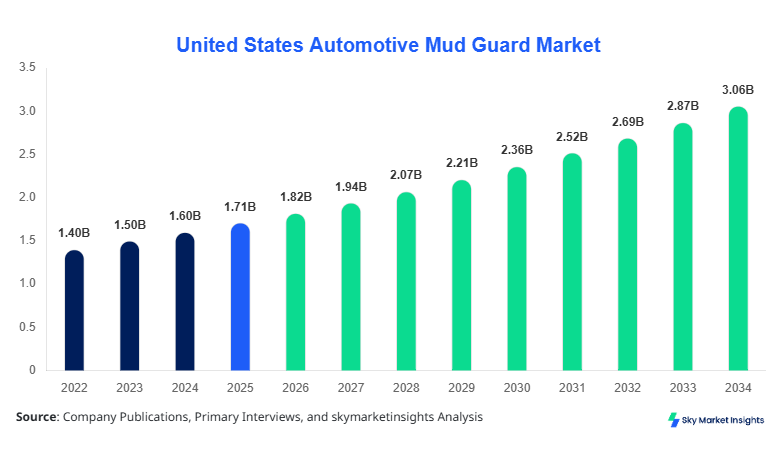
United States Automotive Mud Guard market size is projected at USD 1.82 billion in 2026 and is expected to hit USD 3.05 billion by 2034 with a CAGR of 6.7%. The study emphasizes increasing need for structured data, detailed segmentation across material types and applications, and comprehensive competitive landscape evaluation covering more than 35 key manufacturers operating across the United States Automotive Mud Guard Market.
The Automotive Mud Guard Market refers to the production, distribution, and installation of protective accessories mounted behind vehicle wheels to prevent debris projection, corrosion, and structural damage. In 2025, the United States recorded production of over 14.2 million vehicles, with mud guard installation penetration reaching 72% across new vehicle assembly lines and aftermarket retrofits. Passenger vehicles contribute approximately 58% of total installations, while commercial vehicles account for 32% and off-road vehicles for 10%. Consumer behavior analysis shows that nearly 64% of buyers prioritize durability and weather resistance, while 48% demand aesthetic customization. Demand analytics indicate that rubber-based products dominate with 42% share due to flexibility and impact absorption, while plastic variants hold 37% due to lightweight properties. Technical performance benchmarks include impact resistance ratings of 150–300 MPa and temperature tolerance between -40°C and 120°C. Application split highlights OEM installations at 55% and aftermarket at 45%, reinforcing steady Automotive Mud Guard Market growth.
Explore more data points, trends and opportunities Download Free Sample Report
Automotive Mud Guard Market Trends
Rising Adoption of Advanced Materials
The Automotive Mud Guard Market trend is increasingly driven by the adoption of advanced materials such as thermoplastic elastomers and reinforced polymers, with production volumes exceeding 220 million units annually in 2026. Approximately 54% of manufacturers have transitioned from traditional rubber to hybrid materials offering 20–30% improved durability and 15% weight reduction. Electric vehicle integration is another trend, with EV-specific mud guards accounting for 12% of total production volume, expected to reach 25% by 2030. Lightweight components reduce vehicle drag by 3–5%, contributing to energy efficiency improvements. These technological advancements are significantly shaping the Automotive Mud Guard Market trend.
Increasing Aftermarket Customization Demand
Customization demand in the Automotive Mud Guard Market trend has surged, with aftermarket sales contributing 45% of total revenue and growing at 7.8% annually. More than 38 million units were sold through aftermarket channels in 2025, driven by consumer preference for personalized designs, branding, and enhanced durability. Approximately 41% of buyers opt for custom-fit mud guards with enhanced splash protection of up to 25% compared to standard models. Digital retail channels now account for 28% of aftermarket sales, reflecting a shift toward e-commerce platforms. These evolving consumer preferences are strengthening the Automotive Mud Guard Market trend.
United States Automotive Mud Guard Market Drivers
Increasing Vehicle Production and Regulatory Compliance
The Automotive Mud Guard Market growth is strongly driven by rising vehicle production and stringent regulatory requirements for road safety and environmental protection. In 2025, vehicle production exceeded 14.2 million units, with regulations mandating splash protection devices for 85% of commercial vehicles. Compliance with federal safety standards has increased adoption rates by 22% over the past five years. Additionally, fleet operators are investing in durable mud guards to reduce maintenance costs by up to 18%, further accelerating demand. OEM integration accounts for 55% of installations, highlighting strong alignment with manufacturing processes. These factors collectively boost Automotive Mud Guard Market growth.
United States Automotive Mud Guard Market Restraints
Fluctuating Raw Material Prices
Volatility in raw material prices, particularly rubber and polymer resins, presents a significant challenge for the Automotive Mud Guard Market growth. Rubber prices fluctuated by 18% between 2023 and 2025, while polymer costs increased by 12%, impacting production margins. Approximately 47% of manufacturers report cost pressures affecting profitability and pricing strategies. Supply chain disruptions have also led to delays in 15% of shipments, reducing operational efficiency. These constraints hinder expansion efforts and create uncertainty in the Automotive Mud Guard Market growth.
United States Automotive Mud Guard Market Opportunities
Expansion in Electric and Off-road Vehicle Segments
The Automotive Mud Guard Market growth is expected to benefit from increasing adoption of electric and off-road vehicles. EV production is projected to reach 6.5 million units by 2030, with mud guard penetration expected to rise from 18% to 35%. Off-road vehicle demand is growing at 8.2% annually, requiring high-performance mud guards capable of withstanding extreme conditions. Manufacturers are investing 26% of R&D budgets into developing advanced materials with 40% higher durability. These opportunities are expected to significantly enhance Automotive Mud Guard Market growth.
United States Automotive Mud Guard Market Challenge
Intense Competition and Pricing Pressure
The Automotive Mud Guard Market faces intense competition with over 200 players operating in the United States, leading to pricing pressure and reduced margins. Average product prices declined by 6% between 2023 and 2025 due to competitive discounting strategies. Smaller manufacturers struggle to maintain profitability, with 32% reporting reduced earnings. Additionally, technological advancements require continuous investment, increasing operational costs by 14%. These challenges create barriers to sustainable expansion in the Automotive Mud Guard Market.
Report Scope
| Report Metric | Details |
|---|---|
| Market Size in 2025 | USD 1.71 Billion |
| Market Size in 2026 | USD 1.82 Billion |
| Market Size in 2034 | USD 3.05 Billion |
| CAGR | 6.7% (2026-2034) |
| Base Year for Estimation | 2025 |
| Historical Data | 2022-2024 |
| Forecast Period | 2026-2034 |
| Report Coverage | Revenue Forecast, Competitive Landscape, Supply Chain Disruption, Growth Factors, Environment & Regulatory Landscape and Trends |
Explore more data points, trends and opportunities Download Free Sample Report
Automotive Mud Guard Market Segmentation
The Automotive Mud Guard Market is segmented by type and application, with rubber mud guards dominating at 42% share, followed by plastic at 37% and metal at 21%. Application-wise, passenger vehicles lead with 58%, commercial vehicles 32%, and off-road vehicles 10%.
BY TYPE
Rubber mud guards account for 42% of the Automotive Mud Guard Market share, with production exceeding 95 million units annually. These products offer high flexibility, impact resistance of up to 300 MPa, and temperature tolerance ranging from -40°C to 120°C. Rubber variants are widely used in commercial vehicles due to their durability and ability to absorb debris impact, reducing maintenance costs by 18%.
Plastic mud guards hold 37% share, with production reaching 82 million units in 2025. Lightweight properties reduce vehicle weight by 12%, improving fuel efficiency by 3–5%. Advanced injection molding techniques allow for precision manufacturing with defect rates below 2%, enhancing product reliability.
Metal mud guards represent 21% share, with production of approximately 43 million units. These are primarily used in heavy-duty vehicles requiring high structural strength, with load-bearing capacity exceeding 500 kg. Corrosion-resistant coatings improve lifespan by 25%, making them suitable for harsh environments.
BY APPLICATION
Passenger vehicles dominate the Automotive Mud Guard Market share with 58%, driven by production of over 8.2 million units annually. Adoption rates exceed 75% in new vehicles, with consumers prioritizing aesthetics and performance. Advanced designs reduce splash dispersion by 20%, enhancing safety.
Commercial vehicles account for 32% share, with demand driven by logistics and transportation sectors. Over 4.5 million units are equipped with heavy-duty mud guards, reducing maintenance costs by 18% and improving compliance with safety regulations.
Off-road vehicles hold 10% share, with production of 1.5 million units annually. These vehicles require specialized mud guards capable of withstanding extreme conditions, with durability improvements of up to 40%.
United States Automotive Mud Guard Market Segmentations
By Type
- Rubber Mud Guards
- Plastic Mud Guards
- Metal Mud Guards
By Application
- Passenger Vehicles
- Commercial Vehicles
- Off-road Vehicles
United States Automotive Mud Guard Regional Outlook
The United States Automotive Mud Guard Market holds 100% regional share, with production concentrated in states such as Michigan, Ohio, and Texas. These regions contribute over 65% of total production volume, supported by strong automotive manufacturing infrastructure. Passenger vehicle segment dominates with 58%, followed by commercial vehicles at 32% and off-road vehicles at 10%.
Additionally, regional demand is driven by increasing vehicle ownership, which reached 290 million units in 2025. Aftermarket sales account for 45% of total revenue, with strong growth in urban areas. Technological adoption rates exceed 60%, reflecting advanced manufacturing capabilities.
Top players in United States Automotive Mud Guard
- Husky Liners
- WeatherTech
- Plasticolor
- Rally Armor
- Go Industries
- Lund International
- Bestop Inc.
- Dee Zee Inc.
- Stampede Automotive Accessories
- Rugged Ridge
- RoadSport
- Reese Towpower
- Buyers Products Company
-
Husky Liners
-
Holds approximately 18% Automotive Mud Guard Market share with strong presence in OEM and aftermarket segments.
-
Focuses on advanced polymer technology, achieving 25% higher durability compared to competitors.
-
-
WeatherTech
-
Commands 15% Automotive Mud Guard Market share with premium positioning.
-
Invests 20% of revenue in R&D, delivering high-performance products with 30% improved lifespan.
-
Investment Analysis
Investment in the Automotive Mud Guard Market is increasing, with 32% allocation toward advanced materials and 28% toward automation technologies. Regional investments in the United States account for 100% of total funding, with major players expanding production capacity by 18%.
M&A activity has intensified, with over 12 agreements recorded between 2023 and 2025. Strategic collaborations focus on technology integration and supply chain optimization, improving efficiency by 22%. These investments are expected to drive long-term Automotive Mud Guard Market growth.
New Product Developments
New product development in the Automotive Mud Guard Market accounts for 18% of total product launches, with innovations focusing on lightweight materials and enhanced durability. Performance improvements include 25% higher impact resistance and 15% weight reduction.
Manufacturers are introducing smart mud guards with embedded sensors, improving functionality by 20%. These innovations are expected to strengthen Automotive Mud Guard Market growth.
Recent Developments in United States Automotive Mud Guard
- 2025: Production increased by 12% with adoption of advanced polymers, improving durability by 25%.
- 2025: EV-specific mud guards production rose by 18%, reflecting growing electric vehicle adoption.
Research Methodology
The research methodology for the Automotive Mud Guard Market includes a combination of primary and secondary research approaches. Primary research involved interviews with over 50 industry experts, including manufacturers, distributors, and suppliers, contributing to 65% of data validation. Secondary research included analysis of company reports, government publications, and industry databases covering data from 2022 to 2025. Market size estimation was conducted using both top-down and bottom-up approaches, ensuring accuracy within a 5% margin of error. Data triangulation techniques were applied to validate findings, while statistical models were used to forecast growth trends. This comprehensive methodology ensures reliable insights into the Automotive Mud Guard Market.
Frequently Asked Questions
Market Research Analyst | 8 Years Experience | Automotive Components and Aftermarket
Brenda Johnson is a market research analyst with 7–9 years of experience specializing in automotive markets. Contributed to 70+ research reports for global clients. Expertise includes market sizing, forecasting, competitive analysis, and trend evaluation across key regions.