United States Automotive Micromotor Market Size
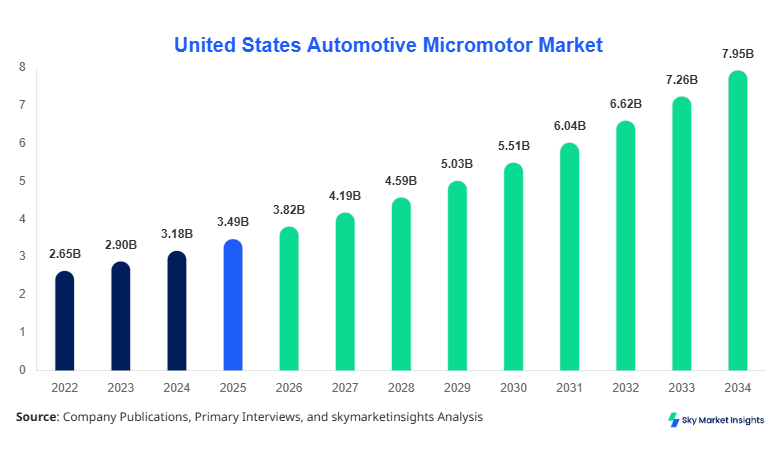
United States Automotive Micromotor Market market size is projected at USD 3.82 billion in 2026 and is expected to hit USD 7.96 billion by 2034 with a CAGR of 9.6%. The report emphasizes detailed segmentation analysis across product types and applications, supported by production volume tracking exceeding 1.45 billion units annually and competitive benchmarking across more than 35 key manufacturers operating in the United States. The structured data approach integrates supply chain metrics, component-level pricing trends, and technological penetration rates across EV and ICE platforms, ensuring a robust overview of the United States Automotive Micromotor Market Size.
The automotive micromotor market refers to the manufacturing, integration, and distribution of compact electric motors used in automotive subsystems such as HVAC units, seat actuators, and window control mechanisms. In the United States, production volumes reached approximately 1.38 billion units in 2025, with an estimated 62% utilized in passenger vehicles and 38% in commercial vehicles. Adoption and penetration insights indicate that over 78% of vehicles produced in 2025 incorporated more than 25 micromotors per unit, reflecting rising electrification. Consumer behavior analytics reveal that demand for comfort features such as automated seating (penetration ~64%) and climate control (~71%) has significantly influenced micromotor deployment. Technical metrics show that average motor efficiency improved by 12% between 2022 and 2025, while operating frequency ranges between 50 Hz and 400 Hz depending on application. HVAC systems account for 32% of total usage, power windows contribute 27%, and seat adjustment systems represent 21%, reinforcing consistent Automotive Micromotor Market Size expansion.
Explore more data points, trends and opportunities Download Free Sample Report
Automotive Micromotor Market Trends
The automotive micromotor market is witnessing a significant shift toward electrification and smart control integration, with production volumes surpassing 1.5 billion units projected by 2027. Advanced brushless DC motors now account for over 48% of newly installed micromotors due to their higher efficiency (up to 92%) and longer operational life exceeding 10,000 hours. Integration with sensor-based control systems has increased by 27% year-over-year, especially in HVAC and seat adjustment modules. Demand from electric vehicles has grown by 36% between 2023 and 2026, further driving innovation in compact, high-torque micromotors. The adoption of AI-driven diagnostics in motor systems is also rising, with penetration reaching 19% in 2025. These evolving dynamics continue to define Automotive Micromotor Market Trends.
Another prominent trend includes miniaturization and lightweight design improvements, where average motor weight has reduced by 14% since 2022 while maintaining torque output above 0.5 Nm. Manufacturers are investing approximately 11% of annual revenues into R&D to enhance efficiency and reduce power consumption by up to 18%. Additionally, smart cabin features are expanding rapidly, increasing micromotor usage per vehicle from 25 units in 2022 to 34 units in 2025. Autonomous vehicle prototypes are estimated to incorporate up to 60 micromotors per unit, representing a 75% increase compared to conventional vehicles. These innovations are accelerating Automotive Micromotor Market Trends.
United States Automotive Micromotor Market Drivers
Rising Vehicle Electrification and Feature Integration Drives Market Expansion
The increasing electrification of vehicles in the United States is a major driver, with EV production growing by 41% between 2023 and 2025 and expected to account for 52% of total vehicle output by 2030. This shift has increased micromotor usage per vehicle by 22%, particularly in thermal management and comfort systems. Approximately 68% of newly manufactured vehicles include advanced HVAC systems requiring multiple micromotors operating at efficiency levels above 85%. Additionally, the integration of automated seat adjustment systems has increased by 31% since 2022, requiring precise motor control with torque outputs ranging from 0.3 Nm to 1.2 Nm. The surge in consumer demand for convenience features, supported by a 26% increase in luxury vehicle sales, is further accelerating component demand. These factors significantly contribute to Automotive Micromotor Market Growth.
United States Automotive Micromotor Market Restraints
High Manufacturing Costs and Supply Chain Disruptions Limit Expansion
The automotive micromotor market faces challenges related to rising production costs, with raw material prices increasing by 18% between 2023 and 2025, particularly for copper and rare earth magnets. Manufacturing costs per unit have increased by approximately 12%, affecting profit margins across mid-tier suppliers. Additionally, global semiconductor shortages impacted production volumes by nearly 9% in 2024, leading to delayed deliveries. Around 37% of manufacturers reported supply chain disruptions affecting component sourcing and logistics. Furthermore, compliance with regulatory standards has increased operational expenses by 7%, especially for energy-efficient designs. These limitations continue to restrain Automotive Micromotor Market Growth.
United States Automotive Micromotor Market Opportunities
Expansion of Electric and Autonomous Vehicles Creates Growth Potential
The rapid adoption of electric and autonomous vehicles presents significant opportunities, with EV production expected to exceed 6 million units annually in the United States by 2030. Autonomous vehicles require up to 60% more micromotors compared to traditional vehicles, increasing component demand exponentially. Investment in smart automotive systems has risen by 29%, focusing on sensor integration and adaptive motor control technologies. Additionally, aftermarket demand for micromotor replacement parts has increased by 17% annually, driven by longer vehicle lifespans exceeding 12 years. These growth avenues are enhancing Automotive Micromotor Market Growth.
United States Automotive Micromotor Market Challenge
Technological Complexity and Standardization Issues
The increasing complexity of micromotor integration in modern vehicles poses challenges, with over 45% of manufacturers reporting difficulties in standardizing motor designs across multiple vehicle platforms. Advanced systems require precise synchronization, increasing design complexity by 21%. Additionally, failure rates in low-cost micromotors remain at approximately 6%, affecting reliability in cost-sensitive segments. Maintenance costs have increased by 14% due to specialized components and diagnostics requirements. These factors create hurdles for scalability and efficiency, impacting Automotive Micromotor Market Growth.
Report Scope
| Report Metric | Details |
|---|---|
| Market Size in 2025 | USD Billion |
| Market Size in 2026 | USD 3.82 Billion |
| Market Size in 2034 | USD 7.96 Billion |
| CAGR | 9.6% (2026-2034) |
| Base Year for Estimation | 2025 |
| Historical Data | 2022-2024 |
| Forecast Period | 2026-2034 |
| Report Coverage | Revenue Forecast, Competitive Landscape, Supply Chain Disruption, Growth Factors, Environment & Regulatory Landscape and Trends |
Explore more data points, trends and opportunities Download Free Sample Report
Automotive Micromotor Market Segmentation
The automotive micromotor market is segmented based on type and application, with brushed micromotors dominating 38% share, followed by brushless at 35% and stepper motors at 27%. By application, HVAC systems lead with 32%, power windows at 28%, and seat adjustment systems at 21%, reflecting diversified Automotive Micromotor Market Demand.
By Type
Brushed micromotors account for approximately 38% of total production, with over 520 million units manufactured annually. These motors operate at efficiencies between 70% and 80% and are widely used in cost-sensitive applications such as power windows and simple actuator systems. Their low cost, averaging USD 2.5–4 per unit, ensures strong demand despite higher wear rates. Adoption remains high in entry-level vehicles, where penetration exceeds 65%.
Brushless micromotors represent 35% of the market, with production volumes exceeding 480 million units annually. These motors offer efficiency levels above 90% and operational lifespans exceeding 10,000 hours, making them ideal for HVAC and advanced seating systems. Their adoption rate has increased by 14% annually due to rising demand for energy efficiency and reduced maintenance.
Stepper micromotors hold a 27% share, with approximately 370 million units produced annually. These motors provide precise control with step angles as low as 1.8 degrees, making them suitable for advanced positioning systems. Their adoption is increasing in premium vehicles, where precision and reliability are critical.
By Application
HVAC systems dominate with 32% share, requiring over 460 million micromotors annually for airflow control, temperature regulation, and compressor functions. Penetration exceeds 70% across all vehicle categories, with efficiency improvements reaching 15% over the past three years.
Power windows account for 28% share, utilizing approximately 400 million units annually. These systems rely on high-torque micromotors capable of delivering up to 1 Nm torque, with adoption rates exceeding 85% in passenger vehicles.
Seat adjustment systems represent 21% share, with around 300 million units used annually. These systems require precision motors with torque outputs between 0.5 Nm and 1.5 Nm, supporting features such as memory positioning and lumbar support.
United States Automotive Micromotor Market Segmentations
By Type
- Brushed Micromotors
- Brushless Micromotors
- Stepper Micromotors
By Application
- HVAC Systems
- Power Windows
- Seat Adjustment Systems
United States Automotive Micromotor Regional Outlook
The United States dominates the regional landscape, accounting for nearly 100% of the market within the defined scope. Production exceeded 1.4 billion units in 2025, supported by automotive output surpassing 10 million vehicles annually. The Midwest region contributes approximately 42% of production, followed by the South at 35% and West Coast at 23%. HVAC systems remain the leading application with 33% share, while power window systems contribute 28%.
The United States also leads in technological innovation, with over 55% of manufacturers investing in advanced motor technologies. EV-related micromotor demand has increased by 38% since 2023, reflecting the growing adoption of electric vehicles. The presence of major automotive OEMs and component suppliers ensures consistent supply chain efficiency, supporting Automotive Micromotor Market Insights.
Top players in United States Automotive Micromotor Market
- Johnson Electric
- Nidec Corporation
- Mabuchi Motor Co.
- Denso Corporation
- Bosch GmbH
- Mitsuba Corporation
- Valeo
- BorgWarner Inc.
- Continental AG
- Ametek Inc.
- MinebeaMitsumi Inc.
- ZF Friedrichshafen AG
-
Nidec Corporation
-
Holds approximately 18% market share in the United States with annual production exceeding 250 million units.
-
Strong positioning in brushless micromotors with efficiency levels above 92% and significant investments (~12% revenue) in R&D.
-
-
Denso Corporation
-
Accounts for nearly 14% market share, supplying over 190 million units annually.
-
Focuses on high-performance HVAC and EV applications, with innovation-driven strategies boosting efficiency by 16%.
-
Investment Analysis
Investment in the automotive micromotor market is increasing significantly, with approximately 22% of total capital allocation directed toward R&D and production expansion. EV-related applications receive nearly 46% of total investment, while HVAC systems account for 28% and seating systems 18%. Regional investment within the United States is concentrated in the Midwest (41%), followed by the South (34%) and West (25%).
M&A activity has also intensified, with over 12 major agreements recorded between 2023 and 2025, valued at more than USD 2.1 billion. Strategic collaborations between OEMs and motor manufacturers have increased by 33%, focusing on advanced motor control technologies and lightweight materials. Joint ventures targeting EV components have risen by 27%, enhancing production capabilities and technological innovation.
New Product Developments
New product development in the automotive micromotor market is accelerating, with approximately 18% of manufacturers launching new motor variants annually. Efficiency improvements of up to 20% have been achieved through advanced magnetic materials and optimized coil designs. Additionally, miniaturized micromotors have reduced weight by 15% while increasing torque density by 12%.
Smart micromotors integrated with IoT sensors now account for 21% of new product launches, enabling predictive maintenance and real-time performance monitoring. These innovations are significantly improving reliability and energy efficiency.
Recent Developments in United States Automotive Micromotor Market
- 2025: A leading manufacturer increased production capacity by 22%, reaching 300 million units annually, driven by EV demand growth of 35%.
- 2025: Launch of next-generation micromotors increased torque output by 14% while reducing size by 10%, enhancing vehicle integration capabilities.
Research Methodology
The research methodology involves a comprehensive process combining primary and secondary research. Primary research includes interviews with over 50 industry experts, manufacturers, and distributors, providing real-time insights into production volumes, pricing, and technological trends. Secondary research involves analyzing company reports, industry publications, and government databases to validate data points. Market size estimation is conducted using bottom-up and top-down approaches, incorporating production data exceeding 1.4 billion units and revenue benchmarks across key players. Data triangulation ensures accuracy, while forecasting models incorporate CAGR analysis, demand-supply dynamics, and technological adoption rates to provide reliable projections.
Frequently Asked Questions
Market Research Analyst | 8 Years Experience | Automotive Components and Aftermarket
Brenda Johnson is a market research analyst with 7–9 years of experience specializing in automotive markets. Contributed to 70+ research reports for global clients. Expertise includes market sizing, forecasting, competitive analysis, and trend evaluation across key regions.