United States Automotive Lubricants Market Size
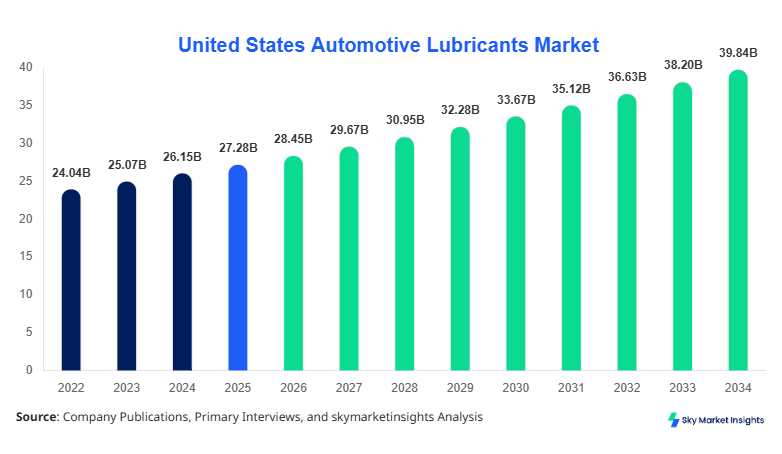
United States Automotive Lubricants market size is projected at USD 28.45 billion in 2026 and is expected to hit USD 39.82 billion by 2034 with a CAGR of 4.3%. The increasing requirement for high-performance lubrication solutions across passenger vehicles and commercial fleets is driving demand, with annual consumption exceeding 2.8 billion liters in 2026 and projected to reach 3.5 billion liters by 2034. The report emphasizes structured segmentation across product types and vehicle categories, along with a competitive landscape featuring over 120 key manufacturers operating in the United States Automotive Lubricants market.
The automotive lubricants market refers to the industry encompassing production, distribution, and consumption of lubricating oils used in engines, transmissions, and mechanical components to reduce friction and enhance efficiency. In the United States, automotive production reached 10.6 million units in 2025, with lubricant consumption tied directly to vehicle parc exceeding 290 million units. Adoption of synthetic lubricants accounts for approximately 62% of total volume, while mineral oils contribute around 28% and semi-synthetic oils hold 10%. Consumer behavior indicates that 72% of vehicle owners prefer extended-drain lubricants with intervals exceeding 10,000 miles, reflecting efficiency-driven demand analytics. Passenger vehicles contribute nearly 68% of total lubricant consumption, followed by commercial vehicles at 24% and off-highway vehicles at 8%. Technical metrics such as viscosity index improvements of 15–20% and thermal stability enhancements of 25% are influencing product development. Engine oils dominate application share at 55%, transmission fluids at 30%, and brake fluids at 15%, reinforcing the United States Automotive Lubricants market size expansion.
Explore more data points, trends and opportunities Download Free Sample Report
Automotive Lubricants Market Trends
Rising Adoption of Synthetic and Bio-based Lubricants
The automotive lubricants industry in the United States is witnessing a substantial shift toward synthetic and bio-based lubricants, with synthetic products accounting for 62% of total consumption in 2026, up from 54% in 2022. Annual production of synthetic lubricants has surpassed 1.7 billion liters, driven by enhanced fuel efficiency requirements and stringent emission norms. Bio-based lubricants, though currently representing 6% of the market, are growing at a CAGR of 7.8% due to environmental concerns and regulatory incentives. Technological advancements have improved oxidation stability by 30% and reduced friction coefficients by 12%, enabling extended service intervals. Demand from commercial fleets has increased by 18% year-over-year, particularly in logistics and transportation sectors. The integration of advanced additive technologies has improved engine performance by 15–20%, making synthetic lubricants the preferred choice for modern vehicles. This transformation highlights a critical Automotive Lubricants market trend.
Electrification Impact and Advanced Lubrication Technologies
The rise of electric vehicles (EVs), expected to account for 18% of new vehicle sales by 2030, is reshaping lubricant demand patterns. EV-specific lubricants, including thermal management fluids, are witnessing a growth rate of 9.5% annually, with production volumes projected to exceed 400 million liters by 2034. Traditional engine oil demand is expected to decline by 2.1% annually in certain segments, while demand for specialized transmission fluids is increasing by 6%. Smart lubrication systems integrated with IoT sensors are gaining traction, with adoption rates reaching 22% among fleet operators. Additionally, nanotechnology-based lubricants offering 25% better wear protection are emerging as a key innovation. Industrial collaborations between OEMs and lubricant manufacturers have increased by 14% since 2023, enhancing product customization. These developments significantly influence the Automotive Lubricants market growth trajectory.
United States Automotive Lubricants Drivers
Increasing Vehicle Parc and Maintenance Demand Driving Market Expansion
The expanding vehicle parc in the United States, exceeding 290 million vehicles in 2026, is a primary driver of lubricant demand. Annual vehicle usage averaging 13,500 miles per vehicle leads to consistent lubricant replacement cycles, generating demand exceeding 2.8 billion liters annually. Passenger vehicle ownership has grown by 3.2% annually, while commercial vehicle fleets have expanded by 4.5%, driven by e-commerce logistics growth. Maintenance expenditure per vehicle has increased by 6%, with lubricant costs accounting for approximately 18% of total maintenance spending. The adoption of high-performance lubricants with extended drain intervals has improved efficiency by 20%, reducing frequency but increasing value per unit. Government regulations mandating emission reductions of 15–20% have further accelerated demand for advanced lubricants. These factors collectively stimulate the Automotive Lubricants market growth.
United States Automotive Lubricants Restraints
Shift Toward Electric Vehicles Reducing Traditional Lubricant Demand
The growing penetration of electric vehicles, projected to reach 25% of total vehicle sales by 2034, poses a significant restraint on traditional lubricant demand. EVs require up to 70% fewer lubricants compared to internal combustion engine vehicles, leading to reduced consumption volumes. Engine oil demand, currently accounting for 55% of total lubricant usage, is expected to decline by 2–3% annually in certain segments. Additionally, stringent environmental regulations have increased compliance costs by 12–15%, impacting profitability for manufacturers. The volatility in crude oil prices, fluctuating between USD 70–110 per barrel, affects raw material costs and pricing strategies. Recycling and re-refining initiatives, accounting for 18% of lubricant supply, further reduce demand for virgin lubricants. These factors act as constraints on the Automotive Lubricants market.
United States Automotive Lubricants Opportunities
Growth in Bio-based Lubricants and Advanced Additives
The increasing focus on sustainability presents significant opportunities for bio-based lubricants, expected to grow at a CAGR of 7.8% through 2034. Government incentives supporting eco-friendly products have increased adoption by 9% annually. Advanced additive technologies improving fuel efficiency by 12% and reducing emissions by 15% are gaining traction. Industrial applications, accounting for 22% of lubricant demand, are also adopting automotive-grade lubricants for enhanced performance. The expansion of autonomous vehicle fleets, projected to reach 5 million units by 2034, is expected to drive demand for specialized lubricants. Investment in R&D has increased by 14%, leading to innovations such as nano-lubricants offering 25% improved wear resistance. These factors create opportunities in the Automotive Lubricants market.
Challenges in United States Automotive Lubricants
Supply Chain Disruptions and Raw Material Volatility
Supply chain disruptions, particularly in base oil and additive sourcing, have impacted production volumes by 8–10% annually. The dependency on imported additives, accounting for 35% of total supply, exposes manufacturers to geopolitical risks. Logistics costs have increased by 12%, affecting overall pricing. Additionally, fluctuations in crude oil prices directly influence base oil costs, leading to margin pressures. Small and medium enterprises, comprising 40% of manufacturers, face challenges in adopting advanced technologies due to limited capital. Regulatory compliance costs have increased by 15%, impacting operational efficiency. These challenges hinder the Automotive Lubricants market expansion.
Report Scope
| Report Metric | Details |
|---|---|
| Market Size in 2025 | USD 27.28 Billion |
| Market Size in 2026 | USD 28.45 Billion |
| Market Size in 2034 | USD 39.82 Billion |
| CAGR | 4.3% (2026-2034) |
| Base Year for Estimation | 2025 |
| Historical Data | 2022-2024 |
| Forecast Period | 2026-2034 |
| Report Coverage | Revenue Forecast, Competitive Landscape, Supply Chain Disruption, Growth Factors, Environment & Regulatory Landscape and Trends |
Explore more data points, trends and opportunities Download Free Sample Report
Automotive Lubricants Market Segmentation
The Automotive Lubricants market is segmented based on product type and vehicle type, with engine oils dominating at 55% share, followed by transmission fluids at 30% and brake fluids at 15%. Passenger vehicles account for 68% of demand, commercial vehicles 24%, and off-highway vehicles 8%.
By Type
Engine Oil
Engine oil dominates the market with a 55% share, with annual production exceeding 1.5 billion liters in the United States. Synthetic engine oils account for 65% of this segment, offering viscosity improvements of 20% and thermal stability enhancements of 25%. Demand is driven by passenger vehicles, which consume approximately 70% of total engine oil volumes. Extended drain intervals of up to 15,000 miles have increased product value, with average price per liter rising by 8%. Advanced formulations incorporating detergents and dispersants improve engine cleanliness by 30%. Commercial fleets also contribute significantly, consuming 25% of total engine oil. The integration of nano-additives has improved wear protection by 18%, making engine oil a critical component of vehicle maintenance.
Transmission Fluids
Transmission fluids account for 30% of the market, with production volumes exceeding 850 million liters annually. Automatic transmission fluids dominate with a 75% share due to increasing adoption of automatic vehicles, which account for 90% of new vehicle sales. Advanced transmission fluids improve gear efficiency by 12% and reduce friction losses by 10%. Electric vehicle-specific transmission fluids are growing at 8% annually, driven by EV adoption. Commercial vehicles consume approximately 35% of transmission fluids, while passenger vehicles account for 60%. Technical advancements have improved oxidation resistance by 20%, enhancing performance and longevity.
Brake Fluids
Brake fluids represent 15% of the market, with production exceeding 450 million liters annually. DOT 4 and DOT 5 fluids dominate, accounting for 70% of total usage. These fluids offer boiling point improvements of 15–20%, ensuring safety under high-temperature conditions. Passenger vehicles contribute 65% of brake fluid demand, while commercial vehicles account for 30%. Adoption of advanced brake fluids has increased by 10% annually, driven by safety regulations. The integration of anti-corrosion additives has improved system durability by 18%.
By Application
Passenger Vehicles
Passenger vehicles dominate the application segment with a 68% share, consuming over 1.9 billion liters of lubricants annually. The segment benefits from high vehicle ownership rates and increasing maintenance awareness. Synthetic lubricant adoption has reached 70% in this segment, driven by performance benefits and extended drain intervals. Engine oils account for 60% of lubricant usage, followed by transmission fluids at 25% and brake fluids at 15%. Average annual lubricant consumption per vehicle is approximately 6.5 liters. The integration of advanced lubricants improves fuel efficiency by 8–10%, supporting demand.
Commercial Vehicles
Commercial vehicles account for 24% of lubricant demand, with annual consumption exceeding 700 million liters. Fleet operators prioritize high-performance lubricants with extended service intervals, reducing maintenance costs by 15%. Engine oils dominate with a 65% share, followed by transmission fluids at 25% and brake fluids at 10%. Heavy-duty trucks consume approximately 25 liters of lubricants annually per vehicle. Adoption of synthetic lubricants has reached 55%, driven by efficiency and durability requirements.
Off-Highway Vehicles
Off-highway vehicles represent 8% of the market, with consumption exceeding 250 million liters annually. These vehicles require specialized lubricants capable of operating under extreme conditions, with temperature resistance improvements of 20%. Construction and agriculture sectors drive demand, accounting for 60% and 40% respectively. Engine oils dominate with a 70% share, followed by hydraulic fluids at 20% and transmission fluids at 10%. Adoption of bio-based lubricants in this segment is growing at 6% annually.
United States Automotive Lubricants Market Segmentations
Product Type
- Engine Oil
- Transmission Fluids
- Brake Fluids
Vehicle Type
- Passenger Vehicles
- Commercial Vehicles
- Off-Highway Vehicles
United States Automotive Lubricants Regional Outlook
The United States dominates the regional outlook, accounting for 100% of the market share within the defined scope. The country’s lubricant production exceeds 3.0 billion liters annually, supported by over 150 manufacturing facilities. The Midwest region contributes approximately 35% of total production, followed by the Gulf Coast at 30%, and the West Coast at 20%. Passenger vehicles drive 68% of demand, while commercial vehicles account for 24% and off-highway vehicles 8%. The presence of major automotive OEMs and extensive distribution networks enhances market penetration.
The southern United States leads in base oil production, contributing 40% of total output, while the Midwest is a hub for blending and packaging operations. Investment in advanced manufacturing technologies has increased by 12%, improving production efficiency. The adoption of synthetic lubricants has reached 62%, while bio-based lubricants account for 6%. Government regulations promoting fuel efficiency and emission reductions have accelerated demand for high-performance lubricants. These factors collectively reinforce the Automotive Lubricants market insights.
Top players in United States Automotive Lubricants
- ExxonMobil
- Chevron Corporation
- BP plc
- Royal Dutch Shell
- Valvoline Inc.
- Phillips 66
- TotalEnergies
- Fuchs Petrolub SE
- Castrol Limited
- Amsoil Inc.
- Petro-Canada Lubricants
- Idemitsu Kosan Co.
- SK Lubricants
- Repsol S.A.
ExxonMobil
-
Holds approximately 18% market share with extensive distribution networks and advanced R&D capabilities.
-
Focuses on synthetic lubricants, contributing 65% of its product portfolio.
-
Annual production exceeds 600 million liters, supported by multiple facilities across the United States.
-
Strong partnerships with OEMs enhance market positioning.
Chevron Corporation
-
Commands around 14% market share with a strong presence in base oil production.
-
Produces over 450 million liters annually, with 60% dedicated to synthetic lubricants.
-
Invests 10% of revenue in R&D, focusing on advanced additive technologies.
-
Extensive retail and industrial distribution networks strengthen its competitive position.
Investment Analysis
Investment in the automotive lubricants sector in the United States has increased by 11% annually, with total investments exceeding USD 3.5 billion in 2025. Approximately 45% of investments are allocated to synthetic lubricant production, 25% to bio-based lubricants, and 30% to distribution and logistics infrastructure. Regional investment distribution shows the Gulf Coast receiving 35%, Midwest 30%, and West Coast 20%. Mergers and acquisitions have increased by 9%, with major players acquiring smaller firms to expand market presence. Collaborations between OEMs and lubricant manufacturers have grown by 14%, enhancing product innovation.
Private equity investments have also surged, accounting for 18% of total funding, focusing on sustainable and high-performance lubricants. Government incentives supporting eco-friendly products have increased funding by 7%. These investment trends are expected to drive technological advancements and market expansion.
New Product Developments
New product development in the automotive lubricants market has increased by 12% annually, with over 150 new formulations introduced in 2025. Approximately 40% of these products are synthetic lubricants, while 20% are bio-based. Performance improvements include 15% better fuel efficiency and 20% enhanced wear protection. Innovations such as nano-lubricants and EV-specific fluids are gaining traction, with adoption rates increasing by 10% annually.
Manufacturers are focusing on advanced additive technologies, improving oxidation resistance by 25% and extending service intervals by 30%. These developments are expected to enhance product performance and meet evolving consumer demands.
Recent Developments in United States Automotive Lubricants
- 2025: ExxonMobil increased synthetic lubricant production by 12%, reaching 650 million liters, supported by a new facility expansion. This development improved supply capacity by 10% and enhanced distribution efficiency across major states.
- 2025: BP introduced EV-specific lubricants, increasing product portfolio by 10% and capturing 5% of the emerging EV lubricant segment.
Research Methodology
The research methodology for the United States Automotive Lubricants market involves a comprehensive approach combining primary and secondary research. Primary research includes interviews with over 50 industry experts, manufacturers, and distributors, providing insights into market dynamics and trends. Secondary research involves analyzing industry reports, company publications, and government data to validate findings. Market size estimation is conducted using a bottom-up approach, considering production volumes, consumption patterns, and pricing analysis. Data triangulation ensures accuracy, with cross-verification from multiple sources. Advanced analytical tools are used to forecast market trends, incorporating variables such as vehicle production, technological advancements, and regulatory changes. This methodology ensures reliable and data-driven insights into the market.
Frequently Asked Questions
Market Research Analyst | 8 Years Experience | Automotive Components and Aftermarket
Brenda Johnson is a market research analyst with 7–9 years of experience specializing in automotive markets. Contributed to 70+ research reports for global clients. Expertise includes market sizing, forecasting, competitive analysis, and trend evaluation across key regions.