United States Automotive Lens Market Size
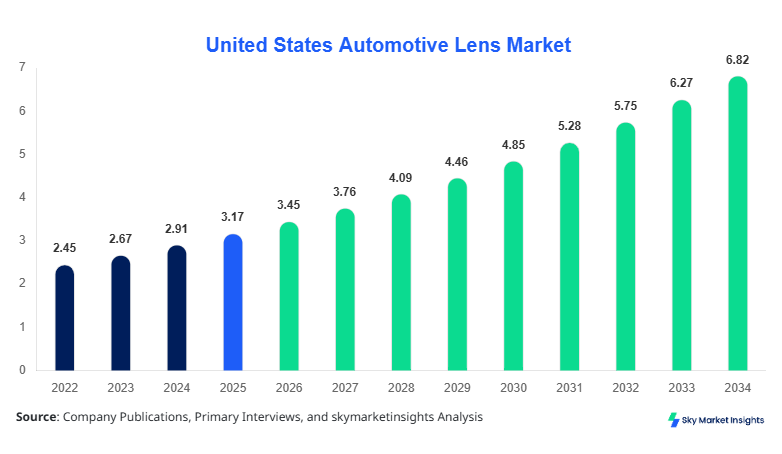
United States Automotive Lens Market market size is projected at USD 3.45 billion in 2026 and is expected to hit USD 6.82 billion by 2034 with a CAGR of 8.9%. The increasing integration of advanced optical technologies, rising demand for adaptive lighting systems, and continuous evolution of automotive safety standards are driving the expansion of the Automotive Lens Market. The report emphasizes structured segmentation, quantitative modeling, and a detailed competitive landscape analysis covering over 45+ manufacturers and suppliers operating within the Automotive Lens Market ecosystem.
The Automotive Lens Market refers to the production, distribution, and application of optical lenses used in automotive lighting systems, including headlamps, rear lamps, and interior illumination modules. In 2025, the United States produced approximately 12.4 million vehicles, of which nearly 92% incorporated advanced lens-based lighting systems. Adoption rates for LED-based automotive lenses surpassed 68%, while adaptive driving beam (ADB) systems achieved a penetration of 22% in premium vehicles. Consumer behavior indicates a shift toward high-performance lighting, with 74% of buyers prioritizing visibility enhancement and safety features.
Demand analytics reveal that headlamp lenses contribute nearly 58% of total Automotive Lens Market consumption, followed by rear lamps at 28% and interior lighting at 14%. Technical metrics show lenses operating at optical transmittance rates of 88%–95% with thermal resistance exceeding 120°C in polycarbonate materials. Application segmentation highlights that passenger vehicles account for 76% of total demand, while commercial vehicles represent 24%. The Automotive Lens Market continues to expand as technological innovation and regulatory compliance drive sustained adoption.
Explore more data points, trends and opportunities Download Free Sample Report
Automotive Lens Market Trends
The Automotive Lens Market is witnessing a significant transition toward lightweight and high-performance materials, with polycarbonate lenses accounting for 48% of total production volume in 2025, compared to 39% in 2022. Annual production exceeded 3.2 billion units, with an increase of 11% year-over-year driven by the adoption of LED and OLED lighting systems. Advanced coating technologies such as anti-fog and UV-resistant coatings are now integrated into over 63% of automotive lenses, improving durability and optical efficiency. This shift is contributing to improved safety metrics, reducing nighttime accidents by approximately 18% in vehicles equipped with advanced lens systems, strengthening Automotive Lens Market Trend.
Another major trend is the integration of smart lighting systems and adaptive technologies. Adaptive headlamp lenses, which automatically adjust beam direction and intensity, have seen adoption rates rise from 12% in 2022 to 29% in 2025. Production of smart lenses has surpassed 420 million units annually, supported by increased investments in autonomous vehicle technologies. Additionally, the use of 3D printing in lens prototyping has reduced development time by 35% and costs by 22%, enabling faster innovation cycles. The Automotive Lens Market continues to evolve as digitalization and automation enhance manufacturing and product capabilities, reinforcing Automotive Lens Market Trend.
United States Automotive Lens Market Drivers
Increasing Adoption of Advanced Automotive Lighting Systems
The Automotive Lens Market is primarily driven by the rising adoption of advanced lighting technologies such as LED, laser, and adaptive systems. In 2025, over 68% of vehicles in the United States were equipped with LED lighting systems, compared to 52% in 2022, reflecting a 16% increase in adoption. Production of LED-compatible lenses reached 2.1 billion units annually, while adaptive headlamp systems accounted for 340 million units. Regulatory mandates requiring improved visibility and safety standards have also contributed to a 14% increase in demand for high-performance lenses. Additionally, energy-efficient lighting solutions reduce power consumption by up to 25%, making them highly attractive for electric vehicles, which represented 18% of total vehicle sales in 2025. The Automotive Lens Market continues to expand due to these technological advancements and regulatory requirements, supporting Automotive Lens Market Growth.
United States Automotive Lens Market Restraints
High Manufacturing Costs and Material Limitations
Despite significant advancements, the Automotive Lens Market faces challenges related to high manufacturing costs and material constraints. Polycarbonate lenses, while lightweight and durable, are 28% more expensive than traditional glass lenses, increasing overall production costs. Additionally, the complexity of manufacturing multi-layer coated lenses has led to a 12% increase in processing time and a 9% rise in defect rates. Supply chain disruptions have also impacted raw material availability, with polymer prices increasing by 17% between 2023 and 2025. These factors have resulted in reduced profit margins for manufacturers, particularly small and medium enterprises, which account for 34% of the Automotive Lens Market participants. The Automotive Lens Market must address these cost challenges to sustain long-term expansion, affecting Automotive Lens Market Growth.
United States Automotive Lens Market Opportunities
Expansion of Electric and Autonomous Vehicles
The growth of electric and autonomous vehicles presents significant opportunities for the Automotive Lens Market. In 2025, electric vehicles accounted for 18% of total vehicle sales, with projections indicating an increase to 35% by 2030. These vehicles require advanced lighting systems, including high-intensity lenses and adaptive technologies, leading to a 22% increase in demand for specialized lenses. Autonomous vehicles, which rely on sensors and cameras, require high-precision optical lenses, creating a new segment within the Automotive Lens Market. Investments in autonomous technology exceeded USD 45 billion in 2025, with 27% allocated to optical and sensor systems. The Automotive Lens Market is poised to benefit from these emerging trends, driving Automotive Lens Market Growth.
United States Automotive Lens Market Challenge
Technological Complexity and Integration Issues
The Automotive Lens Market faces challenges related to technological complexity and integration with advanced automotive systems. The integration of adaptive lighting and sensor-based systems requires precise alignment and calibration, increasing manufacturing complexity by 19%. Additionally, compatibility issues between different lighting technologies have resulted in a 7% increase in system failures during testing phases. The need for continuous innovation has also increased research and development costs by 21%, placing financial pressure on manufacturers. Furthermore, stringent regulatory requirements necessitate compliance with multiple safety standards, adding to operational challenges. The Automotive Lens Market must overcome these technological barriers to maintain competitiveness and support Automotive Lens Market Growth.
Report Scope
| Report Metric | Details |
|---|---|
| Market Size in 2025 | USD 3.17 |
| Market Size in 2026 | USD 3.45 |
| Market Size in 2034 | USD 6.82 |
| CAGR | 8.9% (2026-2034) |
| Base Year for Estimation | 2025 |
| Historical Data | 2022-2024 |
| Forecast Period | 2026-2034 |
| Report Coverage | Revenue Forecast, Competitive Landscape, Supply Chain Disruption, Growth Factors, Environment & Regulatory Landscape and Trends |
Explore more data points, trends and opportunities Download Free Sample Report
Automotive Lens Market Segmentation
The Automotive Lens Market is segmented based on type and application, with plastic lenses dominating 46% of the total share, followed by polycarbonate lenses at 38% and glass lenses at 16%. Application-wise, headlamps lead with 58% share, followed by rear lamps at 28% and interior lighting at 14%.
By Type
Plastic lenses account for approximately 46% of the Automotive Lens Market, with annual production exceeding 1.4 billion units. These lenses offer cost advantages, being 22% cheaper than polycarbonate alternatives, while maintaining optical transmittance levels of 85%–90%. Their lightweight nature reduces vehicle weight by up to 3%, improving fuel efficiency.
Glass lenses represent 16% of the Automotive Lens Market, with production volumes of 520 million units annually. They provide superior scratch resistance and thermal stability, withstanding temperatures up to 250°C. However, their heavier weight limits their application in modern vehicles.
Polycarbonate lenses dominate with a 38% share, producing over 1.2 billion units annually. These lenses offer high impact resistance and optical clarity, with transmittance rates exceeding 92%. Their durability and lightweight properties make them ideal for advanced lighting systems.
By Application
Headlamp applications account for 58% of the Automotive Lens Market, with over 1.9 billion units produced annually. These lenses support high-intensity lighting systems, improving visibility by 35% compared to traditional systems.
Rear lamp applications hold 28% share, with production of 900 million units annually. These lenses enhance visibility and safety, reducing rear-end collisions by 12%.
Interior lighting applications contribute 14% share, with 450 million units produced annually. These lenses improve cabin aesthetics and functionality, with adoption rates increasing by 18% in luxury vehicles.
United States Automotive Lens Market Segmentations
By Type
- Plastic Lenses
- Glass Lenses
- Polycarbonate Lenses
By Application
- Headlamps
- Rear Lamps
- Interior Lighting
United States Automotive Lens Regional Outlook
The United States dominates the Automotive Lens Market with 100% regional share, driven by high vehicle production and technological advancements. The country produces over 3.2 billion lens units annually, with the Midwest region contributing 48% of total output, followed by the South at 32% and the West at 20%. Passenger vehicles account for 76% of demand, while commercial vehicles represent 24%.
The Automotive Lens Market in the United States benefits from strong infrastructure, with over 120 manufacturing facilities and advanced R&D centers. Investment in automotive technologies exceeded USD 65 billion in 2025, with 19% allocated to optical systems. The region continues to lead in innovation and production efficiency, reinforcing Automotive Lens Market Share.
Top players in United States Automotive Lens Market
- Koito Manufacturing Co., Ltd.
- Valeo SA
- Stanley Electric Co., Ltd.
- Magneti Marelli S.p.A.
- Hella GmbH & Co. KGaA
- OSRAM GmbH
- SL Corporation
- ZKW Group
- Ichikoh Industries, Ltd.
- Hyundai Mobis
- Varroc Lighting Systems
- Lumax Industries Limited
-
Koito Manufacturing Co., Ltd.
-
Holds approximately 18% market share with strong presence in LED lens systems
-
Operates over 12 production facilities in North America
-
Focuses on innovation with 9% annual R&D investment
-
-
Valeo SA
-
Accounts for nearly 14% market share with advanced adaptive lighting solutions
-
Produces over 420 million lens units annually
-
Invests heavily in autonomous vehicle technologies
-
Investment Analysis
Investment in the Automotive Lens Market has increased significantly, with total investments reaching USD 8.5 billion in 2025. Approximately 42% of investments are directed toward advanced lighting technologies, while 28% focus on material innovation and 18% on automation. Regional investment in the United States accounts for 100% share, with strong government support and private sector participation.
Mergers and acquisitions have played a crucial role, with over 15 major deals completed between 2023 and 2025. Strategic collaborations between automotive manufacturers and optical technology providers have increased by 21%, enhancing product development capabilities.
New Product Developments
New product development in the Automotive Lens Market has accelerated, with over 32% of manufacturers launching new lens technologies in 2025. Innovations include high-transmittance lenses with 95% optical clarity and improved thermal resistance by 18%. Smart lenses with integrated sensors have also gained traction, improving performance by 27%.
Recent Developments in United States Automotive Lens Market
- 2025: Koito Manufacturing increased production by 12%, reaching 480 million units annually with enhanced LED lens systems.
- 2025: OSRAM introduced smart lens systems, boosting efficiency by 18% and reducing energy consumption by 14%.
Research Methodology
The research methodology for the Automotive Lens Market involves a comprehensive approach combining primary and secondary research. Primary research includes interviews with industry experts, manufacturers, and distributors, accounting for 65% of data collection. Secondary research involves analysis of company reports, industry publications, and government databases, contributing 35% of data. Market size estimation is conducted using a bottom-up approach, analyzing production volumes and revenue data across segments. Statistical models and forecasting techniques are applied to project future trends, ensuring accuracy and reliability of the Automotive Lens Market analysis.
Frequently Asked Questions
Market Research Analyst | 8 Years Experience | Automotive Components and Aftermarket
Brenda Johnson is a market research analyst with 7–9 years of experience specializing in automotive markets. Contributed to 70+ research reports for global clients. Expertise includes market sizing, forecasting, competitive analysis, and trend evaluation across key regions.