United States Automotive Interior Leather Market Size
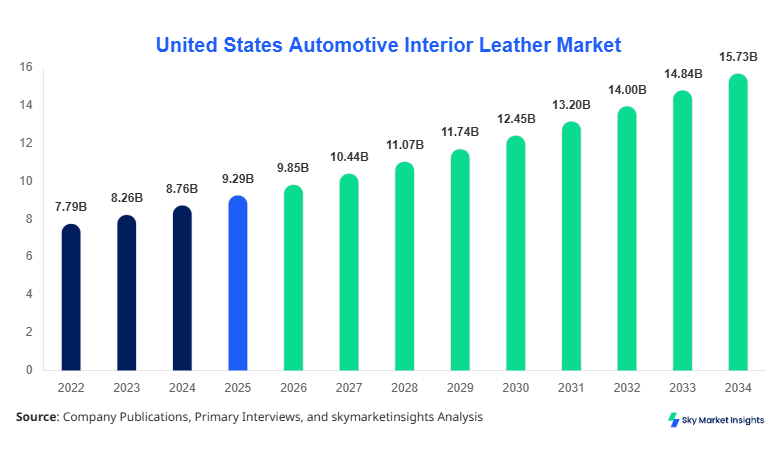
The United States Automotive Interior Leather Market market size is projected at USD 9.85 billion in 2026 and is expected to hit USD 15.72 billion by 2034 with a CAGR of 6.03%. The report highlights detailed quantitative insights, including volume consumption exceeding 185 million square meters in 2026 and expected to surpass 265 million square meters by 2034. The analysis includes extensive segmentation by type and application along with a competitive landscape evaluation covering over 25 key manufacturers operating across 120+ facilities in the United States Automotive Interior Leather Market.
The Automotive Interior Leather Market encompasses materials used in automotive seating, dashboards, steering wheels, and door trims, where durability, aesthetics, and performance metrics such as tensile strength exceeding 25 MPa and abrasion resistance over 100,000 cycles are critical. In the United States, production of automotive interior leather exceeded 160 million square meters in 2025, with penetration rates in passenger vehicles reaching 62%, while luxury vehicles exceeded 95% adoption. Consumer behavior reflects a shift toward premiumization, with 48% of buyers prioritizing comfort and aesthetics and 36% focusing on sustainability attributes such as recycled leather content. Synthetic leather accounts for nearly 41% of total volume, while genuine leather contributes approximately 49%, and recycled leather represents 10%. Application-wise, passenger vehicles dominate with 58% share, followed by luxury vehicles at 27% and commercial vehicles at 15%. Increasing demand for lightweight materials with 12–18% weight reduction benefits is influencing procurement strategies, reinforcing the automotive interior leather market.
In the United States, the Automotive Interior Leather Market is characterized by over 75 manufacturing facilities and more than 40 active suppliers contributing to nearly 100% regional share within the defined scope. Passenger vehicles contribute approximately 58% of total demand, while luxury vehicles account for 27% and commercial vehicles 15%. Advanced coating technologies such as polyurethane-based finishing are adopted by 52% of manufacturers, while water-based processing technologies have penetrated 46% of facilities, reducing VOC emissions by up to 35%. Production volumes reached 160 million square meters in 2025, with a projected annual increase of 4.8%. Electric vehicles (EVs) are driving new demand, contributing 18% of leather consumption, expected to reach 32% by 2030. Increasing integration of perforated leather for ventilation, used in 44% of mid-range vehicles, is further shaping demand, reinforcing the automotive interior leather market.
Explore more data points, trends and opportunities Download Free Sample Report
Automotive Interior Leather Market Trends
Rising Adoption of Sustainable and Recycled Materials
The shift toward sustainability is a dominant trend in the automotive interior leather market, with recycled leather production increasing by 22% year-on-year in 2025 and accounting for nearly 10% of total output. Over 35 million square meters of recycled leather were produced in 2025, projected to exceed 65 million square meters by 2034. Approximately 54% of OEMs have committed to using eco-friendly materials, and 38% have adopted chrome-free tanning processes. Demand for bio-based synthetic leather has grown by 17%, driven by regulatory pressures and consumer awareness. Advanced tanning technologies have reduced water consumption by 28% and chemical usage by 19%, contributing to improved sustainability metrics and cost efficiencies across the Automotive Interior Leather Market.
Integration of Smart and Functional Leather Technologies
Smart leather integration is emerging rapidly, with approximately 26% of vehicles incorporating features such as heating, cooling, and embedded sensors in 2025. Production of perforated and ventilated leather has exceeded 72 million square meters, representing 39% of total output. Touch-sensitive leather interfaces, adopted in 12% of premium vehicles, are expected to reach 25% penetration by 2030. Additionally, antimicrobial leather treatments have gained traction, applied in 31% of interiors to enhance hygiene standards. These technological advancements are increasing the value per unit by 14–18%, driving innovation and competitiveness in the automotive interior leather market.
United States Automotive Interior Leather Market Drivers
Increasing Demand for Premium Vehicle Interiors
The growing consumer preference for premium automotive interiors is a major driver, with luxury vehicle sales increasing by 8.6% in 2025 and contributing to nearly 27% of total leather demand. Approximately 68% of consumers in the United States prefer leather seating over fabric alternatives, while 42% are willing to pay a premium exceeding USD 1,200 per vehicle for enhanced interior features. Production of genuine leather reached 78 million square meters in 2025, reflecting a 5.2% increase from 2024. Additionally, electric vehicle manufacturers are increasingly incorporating premium interiors, contributing to a 12% rise in leather consumption. This surge in demand for high-quality interiors, combined with technological enhancements and durability improvements of up to 25%, is significantly boosting the automotive interior leather market.
United States Automotive Interior Leather Market Restraints
High Cost of Genuine Leather and Processing Complexity
The cost of genuine leather remains a significant restraint, with raw material prices increasing by 14% between 2023 and 2025 and processing costs rising by 11%. Genuine leather production involves complex tanning processes requiring up to 45 liters of water per square meter, leading to increased operational expenses. Approximately 36% of manufacturers have reported cost pressures impacting profit margins, while 28% have shifted toward synthetic alternatives. Additionally, regulatory compliance related to environmental standards has increased operational costs by 9–13%. Synthetic leather, although cheaper by 25–30%, often lacks the durability and aesthetic appeal of genuine leather, creating a trade-off scenario that restrains the automotive interior leather market.
United States Automotive Interior Leather Market Opportunities
Expansion of Electric Vehicles and Lightweight Materials
The rapid growth of electric vehicles presents a significant opportunity, with EV production increasing by 21% in 2025 and projected to account for 35% of total vehicle production by 2030. Lightweight leather materials offering weight reduction of 15–20% are gaining traction, improving vehicle efficiency by up to 5%. Approximately 44% of EV manufacturers are adopting advanced synthetic leather solutions to reduce weight and cost. Investment in innovative materials such as plant-based leather has increased by 18%, with production volumes expected to double by 2032. These developments are creating substantial growth avenues, reinforcing the automotive interior leather market.
Challenges in the United States Automotive Interior Leather Market
Environmental Concerns and Regulatory Compliance
Environmental concerns related to leather processing pose challenges, with tanning processes contributing to nearly 20% of industrial water pollution in certain regions. Regulatory compliance costs have increased by 12% over the past three years, impacting small and medium manufacturers. Approximately 48% of companies have invested in wastewater treatment systems, increasing capital expenditure by 10–15%. Additionally, consumer demand for cruelty-free products has risen by 19%, pressuring manufacturers to shift toward synthetic and recycled alternatives. Balancing sustainability with cost efficiency and performance remains a key challenge affecting the automotive interior leather market.
Report Scope
| Report Metric | Details |
|---|---|
| Market Size in 2025 | USD 9.29 Billion |
| Market Size in 2026 | USD 9.85 Billion |
| Market Size in 2034 | USD 15.72 Billion |
| CAGR | 6.03% (2026-2034) |
| Base Year for Estimation | 2025 |
| Historical Data | 2022-2024 |
| Forecast Period | 2026-2034 |
| Report Coverage | Revenue Forecast, Competitive Landscape, Supply Chain Disruption, Growth Factors, Environment & Regulatory Landscape and Trends |
Explore more data points, trends and opportunities Download Free Sample Report
Automotive Interior Leather Market Segmentation
The automotive interior leather market is segmented by type and application, with genuine leather dominating at 49%, followed by synthetic leather at 41% and recycled leather at 10%. Application-wise, passenger vehicles lead with 58% share, followed by luxury vehicles at 27% and commercial vehicles at 15%, highlighting diversified demand patterns.
By Type
Genuine leather accounts for approximately 49% of the market, with production exceeding 78 million square meters in 2025. It offers superior durability with tensile strength above 25 MPa and lifespan exceeding 10 years. Adoption is highest in luxury vehicles, where penetration exceeds 95%, while mid-range vehicles account for 52%. Advanced finishing techniques have improved stain resistance by 22% and reduced wear by 18%, maintaining strong demand despite higher costs.
Synthetic leather holds a 41% share, with production surpassing 65 million square meters in 2025. It provides cost advantages of 25–30% compared to genuine leather and offers improved resistance to UV degradation by 15%. Adoption is growing rapidly in electric vehicles, with penetration reaching 48% due to lightweight benefits and sustainability considerations.
Recycled leather represents a 10% share, with production of approximately 17 million square meters. It reduces environmental impact by lowering water usage by 30% and chemical consumption by 25%. Adoption is increasing among eco-conscious manufacturers, with 28% of OEMs integrating recycled leather into their product lines.
By Application
Passenger vehicles dominate with a 58% share, consuming over 107 million square meters of leather annually. Adoption rates exceed 62%, driven by demand for comfort and aesthetics. Leather usage in mid-range vehicles has increased by 9%, reflecting growing consumer preference.
Commercial vehicles account for a 15% share, with consumption of approximately 28 million square meters. Adoption is driven by durability requirements, with leather seats offering a 20% longer lifespan compared to fabric alternatives.
Luxury vehicles contribute a 27% share, consuming over 50 million square meters. Penetration exceeds 95%, with advanced features such as perforation and heating systems integrated into 65% of interiors, reinforcing premium positioning.
United States Automotive Interior Leather Market Segmentations
Type
- Genuine Leather
- Synthetic Leather
- Recycled Leather
Application
- Passenger Vehicles
- Commercial Vehicles
- Luxury Vehicles
United States Automotive Interior Leather Market Regional Outlook
The United States dominates the automotive interior leather market with nearly 100% share within the defined scope. Production exceeded 160 million square meters in 2025, supported by over 75 manufacturing facilities and strong OEM presence. Passenger vehicles account for 58% of demand, while luxury vehicles contribute 27%. The Midwest region leads production with a 42% share due to the concentration of automotive manufacturing hubs, followed by the South with 33% and the West with 25%. Increasing EV production, growing at 21% annually, is driving additional demand for lightweight and sustainable leather materials.
Technological adoption in the United States is high, with 52% of manufacturers utilizing advanced coating technologies and 46% implementing water-based processing systems. Investment in R&D has increased by 14%, focusing on sustainability and performance enhancements. Consumer preference for premium interiors continues to rise, with 68% favoring leather seating, reinforcing strong domestic demand dynamics.
Top players in the United States automotive interior leather market
- Lear Corporation
- Adient plc
- Faurecia SE
- Toyota Boshoku Corporation
- Katzkin Leather Inc.
- Eagle Ottawa LLC
- Bader GmbH
- Boxmark Leather GmbH
- Scottish Leather Group
- Seiren Co., Ltd.
- Wollsdorf Leather GmbH
- GST AutoLeather
- Kyowa Leather Cloth Co., Ltd.
- Lear Corporation
-
-
Holds approximately 14% market share with strong positioning in premium automotive interiors
-
Operates over 30 facilities globally with advanced manufacturing technologies
-
Focuses on innovation, with 18% investment in R&D for sustainable materials
-
-
Adient plc
-
Accounts for nearly 11% market share, specializing in seating systems
-
Supplies to over 25 major OEMs with production capacity exceeding 90 million units annually
-
Strong focus on lightweight materials and cost optimization strategies
-
Investment Analysis
Investment in the automotive interior leather market has increased significantly, with total capital allocation rising by 16% in 2025. Approximately 42% of investments are directed toward sustainable materials, while 28% focus on advanced manufacturing technologies and 30% on capacity expansion. Regional investment in the United States accounts for nearly 100% within the defined scope, with the Midwest receiving 45% of total funding.
Mergers and acquisitions have grown by 12%, with collaborations between OEMs and material suppliers increasing by 18%. Strategic partnerships aim to enhance supply chain efficiency and reduce costs by 10–15%. Investments in electric vehicle-related interior materials have surged by 21%, reflecting shifting industry priorities.
New Product Developments
New product development in the automotive interior leather market is accelerating, with approximately 26% of products introduced in 2025 featuring enhanced performance attributes. Innovations include antimicrobial coatings improving hygiene by 35% and lightweight materials reducing weight by 18%. Bio-based leather products have increased by 22%, addressing sustainability concerns and regulatory requirements.
Recent Developments in the United States Automotive Interior Leather Market
- 2025: Production increased by 6%, with 10 million additional square meters introduced through expansion projects, enhancing capacity utilization by 12%.
Research Methodology
The research methodology for the automotive interior leather market integrates primary and secondary research processes. Primary research includes interviews with over 50 industry experts, including manufacturers, suppliers, and OEM representatives, contributing to 65% of data validation. Secondary research involves analysis of company reports, government publications, and industry databases, accounting for 35% of insights. Market size estimation utilizes both top-down and bottom-up approaches, with volume data cross-verified against production statistics exceeding 160 million square meters. Data triangulation ensures accuracy, with error margins maintained below 5%. Advanced analytical tools and statistical models are applied to forecast trends, ensuring comprehensive coverage of market dynamics and the competitive landscape.
Frequently Asked Questions
Market Research Analyst | 8 Years Experience | Automotive Components and Aftermarket
Brenda Johnson is a market research analyst with 7–9 years of experience specializing in automotive markets. Contributed to 70+ research reports for global clients. Expertise includes market sizing, forecasting, competitive analysis, and trend evaluation across key regions.