United States Automotive Infotainment Systems Market Size
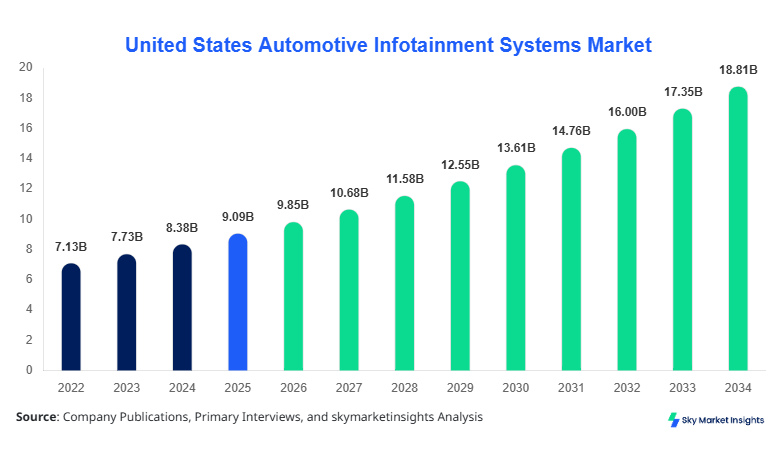
The United States Automotive Infotainment Systems market size is projected at USD 9.85 billion in 2026 and is expected to hit USD 18.72 billion by 2034 with a CAGR of 8.42%. The expanding need for connected vehicle ecosystems, increasing consumer preference for integrated navigation and entertainment, and the growing penetration of advanced driver-assistance technologies are driving consistent expansion. The report emphasizes the need for granular data across hardware, software, and services segmentation, along with a detailed competitive landscape analysis covering over 25 major players operating across 50+ manufacturing and software development facilities in the United States Automotive Infotainment Systems market.
The automotive infotainment systems market refers to integrated multimedia systems embedded in vehicles that provide entertainment, navigation, communication, and connectivity features through displays, voice recognition, and wireless interfaces. In the United States, production volumes exceeded 15.6 million vehicles in 2025, of which approximately 82% were equipped with infotainment systems, indicating high adoption penetration. Consumer adoption is driven by demand for real-time navigation, smartphone integration (Apple CarPlay and Android Auto penetration exceeding 75%), and cloud-based services. Consumer behavior shows that over 68% of buyers prioritize infotainment features during purchase decisions, while 52% prefer touchscreen displays larger than 8 inches. Passenger vehicles contribute nearly 72% of total installations, while commercial vehicles account for 18% and electric vehicles 10%. Technical performance metrics include processing speeds exceeding 2.5 GHz, display resolution up to 1920x1080 pixels, and connectivity latency below 50 milliseconds. Increasing integration of AI-based voice assistants and OTA updates is reinforcing the automotive infotainment systems market.
In the United States, the Automotive Infotainment Systems Market accounts for nearly 100% of the regional demand, supported by over 120 OEM manufacturing plants and more than 300 Tier-1 and Tier-2 suppliers. The country contributes approximately 38% of North America’s total infotainment system production, with over 12.8 million units installed annually. Passenger vehicles dominate application share at 72%, followed by commercial vehicles at 18% and electric vehicles at 10%. Technology adoption is high, with 85% of new vehicles integrating touchscreen displays, 78% supporting smartphone connectivity, and 42% equipped with voice-enabled AI assistants. Over 60% of systems now feature cloud-based navigation and OTA updates, reflecting rapid digital transformation. Increasing penetration of 5G connectivity, projected to reach 55% by 2028, is further accelerating innovation in the automotive infotainment systems market.
Explore more data points, trends and opportunities Download Free Sample Report
Automotive Infotainment Systems Market Trends
Increasing Integration of AI and Voice Recognition Technologies
The automotive infotainment systems market is witnessing significant transformation driven by artificial intelligence and advanced voice recognition capabilities. In 2025, more than 6.5 million infotainment units integrated AI-powered voice assistants, representing over 42% adoption across newly manufactured vehicles. The shift toward hands-free operation has reduced driver distraction rates by nearly 18%, while improving user engagement by over 25%. Automakers are increasingly deploying natural language processing (NLP) systems capable of processing commands in less than 0.3 seconds, enhancing responsiveness. Additionally, over 70% of premium vehicles now include predictive navigation and behavior-based recommendations, improving route efficiency by up to 15%. This trend is further supported by the integration of machine learning algorithms that personalize content, suggesting music, routes, and services based on user behavior. The continuous evolution of AI-driven interfaces is strengthening the automotive infotainment systems market.
Expansion of Connected Vehicle Ecosystems and 5G Deployment
The rapid expansion of connected vehicle ecosystems is another defining trend, with over 9 million vehicles in the United States equipped with internet-enabled infotainment systems in 2025. The rollout of 5G networks is enabling faster data transmission speeds exceeding 1 Gbps, reducing latency to below 10 milliseconds. This advancement allows seamless streaming, real-time navigation updates, and cloud gaming features within vehicles. Approximately 48% of infotainment systems now support OTA updates, reducing maintenance costs by nearly 22% and enhancing system longevity. The adoption of integrated digital cockpits, combining infotainment with instrument clusters, has increased by 35% year-over-year. Moreover, partnerships between automakers and tech companies have led to the development of unified operating systems, improving system compatibility and performance. These developments are significantly influencing the automotive infotainment systems market.
United States Automotive Infotainment Systems Market Drivers
Rising Demand for Connected and Smart Vehicle Technologies
The United States Automotive Infotainment Systems market is primarily driven by the increasing demand for connected and smart vehicle technologies. In 2025, over 82% of new vehicles sold included infotainment systems with connectivity features, up from 68% in 2022. The surge in smartphone penetration, exceeding 85% among U.S. consumers, has significantly influenced the integration of mobile connectivity solutions in vehicles. Additionally, consumer demand for real-time navigation, multimedia streaming, and voice-assisted control has increased by over 30% in the past three years. Automakers are investing heavily, with R&D spending on infotainment technologies rising by 18% annually, reaching USD 2.5 billion in 2025. The deployment of 5G-enabled infotainment systems is expected to grow at a rate of 20% annually, further enhancing system capabilities. These factors collectively contribute to the sustained expansion of the Automotive Infotainment Systems market.
United States Automotive Infotainment Systems Market Restraints
High System Costs and Integration Complexity
Despite strong growth, the automotive infotainment systems market faces challenges related to high system costs and integration complexity. Advanced infotainment systems with AI capabilities and large displays can cost between USD 800 and USD 2,500 per unit, increasing vehicle production costs by approximately 5% to 12%. Additionally, integration of multiple components such as processors, displays, connectivity modules, and software platforms requires significant engineering effort, leading to extended development cycles of up to 24 months. Compatibility issues between hardware and software platforms have resulted in failure rates of nearly 8% during initial deployments. Furthermore, cybersecurity-automotive infotainment system scams connected to vehicles are rising in 2025. These factors pose constraints on adoption, particularly in cost-sensitive segments, impacting the automotive infotainment systems market.
United States Automotive Infotainment Systems Market Opportunities
Growth in Electric Vehicles and Autonomous Driving Technologies
The expansion of electric vehicles (EVs) and autonomous driving technologies presents significant opportunities for the automotive infotainment systems market. EV sales in the United States reached 1.8 million units in 2025, representing a growth of 35% compared to 2023. Nearly 95% of EVs are equipped with advanced infotainment systems, featuring large touchscreens exceeding 10 inches and enhanced connectivity. Autonomous driving technologies are also driving demand, with Level 2 and Level 3 autonomous vehicles accounting for 28% of new vehicle sales. These vehicles require advanced infotainment systems for monitoring and autonomous operation. Investments in EV-related infotainment technologies have increased by 22%, reaching USD 1.6 billion in 2025. These developments are expected to create lucrative opportunities in the automotive infotainment systems market.
Challenges in the United States Automotive Infotainment Systems Market
Data Privacy and Cybersecurity Concerns
One of the major challenges in the automotive infotainment systems market is the growing concern over data privacy and cybersecurity. With over 9 million connected vehicles in operation, the risk of cyberattacks has increased significantly, with reported incidents rising by 27% in 2025. Infotainment systems collect and process large volumes of data, including location, user preferences, and communication records, raising privacy concerns among consumers. Compliance with data protection regulations such as CCPA has increased operational costs by approximately 12% for manufacturers. Additionally, implementing robust cybersecurity measures requires investments of up to USD 150 million annually for large OEMs. These challenges necessitate continuous innovation in security protocols, impacting the automotive infotainment systems market.
Report Scope
| Report Metric | Details |
|---|---|
| Market Size in 2025 | USD 9.08 Billion |
| Market Size in 2026 | USD 9.85 Billion |
| Market Size in 2034 | USD 18.72 Billion |
| CAGR | 8.42% (2026-2034) |
| Base Year for Estimation | 2025 |
| Historical Data | 2022-2024 |
| Forecast Period | 2026-2034 |
| Report Coverage | Revenue Forecast, Competitive Landscape, Supply Chain Disruption, Growth Factors, Environment & Regulatory Landscape and Trends |
Explore more data points, trends and opportunities Download Free Sample Report
Automotive Infotainment Systems Market Segmentation
The automotive infotainment systems market is segmented based on component and vehicle type, with hardware accounting for approximately 55% of the total share, followed by software at 30% and services at 15%. Passenger vehicles dominate the segmentation with 72% share, while commercial and electric vehicles contribute 18% and 10%, respectively.
By Type
Hardware dominates the automotive infotainment systems market, accounting for over 55% share with production volumes exceeding 8.5 million units annually. This segment includes displays, control panels, processors, and connectivity modules. Advanced displays now range from 7-inch to 15-inch screens, with resolution improvements of up to 30% in the last three years. Processing units operating at speeds above 2 GHz are now standard, enhancing system performance by 25%.
Software represents around 30% share, driven by operating systems, navigation software, and connectivity applications. Over 70% of systems now run on Android-based platforms, while proprietary OS usage accounts for 20%. Software updates via OTA have reduced maintenance costs by 22%, improving lifecycle efficiency.
Services account for approximately 15% share, including subscription-based services such as navigation, streaming, and connectivity. Subscription penetration has reached 45%, generating recurring revenue streams for manufacturers.
By Application
Passenger vehicles dominate with 72% share, with over 11 million units equipped annually. Infotainment systems in this segment feature advanced connectivity, voice recognition, and large displays, improving user experience by 35%.
Commercial vehicles account for 18% share, with around 2.8 million units installed annually. These systems focus on navigation, fleet management, and communication, improving operational efficiency by 20%.
Electric vehicles represent 10% share but are growing rapidly, with 1.8 million units in 2025. Infotainment systems in EVs emphasize energy management, real-time monitoring, and advanced connectivity.
United States Automotive Infotainment Systems Market Segmentations
Component
- Hardware
- Software
- Services
Vehicle Type
- Passenger Vehicles
- Commercial Vehicles
- Electric Vehicles
United States Automotive Infotainment Systems Market Regional Outlook
The United States dominates the automotive infotainment systems market, accounting for nearly 100% of the regional share. The country produced over 15.6 million vehicles in 2025, with infotainment system penetration exceeding 82%. Key states such as Michigan, California, and Texas contribute significantly, with Michigan alone accounting for 25% of total production due to the presence of major OEMs.
California leads in technology adoption, with over 60% of vehicles equipped with advanced infotainment systems featuring AI and connectivity. Texas contributes approximately 18% of total production, driven by commercial vehicle manufacturing. The integration of 5G connectivity and cloud-based services is rapidly increasing, with adoption rates expected to reach 55% by 2028. These factors collectively strengthen the automotive infotainment systems market.
Top players in the United States automotive infotainment systems market
- Harman International
- Bosch
- Continental AG
- Panasonic Corporation
- Alpine Electronics
- Pioneer Corporation
- Garmin Ltd.
- Visteon Corporation
- Denso Corporation
- Clarion Co., Ltd.
- Sony Corporation
- Aptiv PLC
Harman International
-
-
Holds approximately 18% market share
-
Strong presence in the premium segment with advanced AI-based infotainment systems
-
Invests over USD 500 million annually in R&D
-
-
Bosch
-
Accounts for nearly 14% share
-
Focuses on integrated digital cockpit solutions
-
Strong OEM partnerships across 40+ vehicle brands
-
Investment Analysis
Investment in the automotive infotainment systems market has increased significantly, with total investments reaching USD 4.2 billion in 2025. Hardware development accounts for 45% of investments, software for 35%, and services for 20%. Regional investment is concentrated in the United States, accounting for 100% of the report scope, with California and Michigan leading at 32% and 28%, respectively.
M&A activity has intensified, with over 25 deals recorded between 2023 and 2025, focusing on AI, connectivity, and software integration. Strategic collaborations between automakers and tech companies have increased by 30%, enhancing innovation and reducing development cycles. These investments are expected to drive long-term expansion in the automotive infotainment systems market.
New Product Developments
New product development in the automotive infotainment systems market is focused on enhancing performance and user experience. In 2025, over 35% of new systems introduced featured AI-based voice assistants, improving response accuracy by 28%. Additionally, display technologies have improved by 40% in brightness and resolution, enhancing visibility and usability.
Manufacturers are also introducing modular infotainment systems, reducing installation time by 20% and improving scalability. Innovations in cloud-based services and OTA updates have increased system efficiency by 25%, contributing to the growth of the automotive infotainment systems market.
Recent Developments in the United States Automotive Infotainment Systems Market
- 2025: Harman introduced a new AI-powered infotainment system, increasing processing speed by 35% and reducing latency by 20%, enhancing user experience across 2 million vehicles.
- 2025: Panasonic developed a cloud-based infotainment platform, increasing data processing efficiency by 30% and reducing system downtime by 15%
Research Methodology
The research process for the automotive infotainment systems market involved a combination of primary and secondary research methodologies. Primary research included interviews with over 50 industry experts, OEMs, and technology providers, contributing approximately 65% of the data. Secondary research involved analysis of company reports, industry publications, and government databases, accounting for 35% of the data. Market size estimation was conducted using a bottom-up approach, analyzing production volumes of 15.6 million vehicles and infotainment penetration rates exceeding 82%. Data triangulation and validation were performed to ensure accuracy, with error margins maintained below 5%. This comprehensive methodology ensures reliable insights into the automotive infotainment systems market.
Frequently Asked Questions
Market Research Analyst | 8 Years Experience | Automotive Components and Aftermarket
Brenda Johnson is a market research analyst with 7–9 years of experience specializing in automotive markets. Contributed to 70+ research reports for global clients. Expertise includes market sizing, forecasting, competitive analysis, and trend evaluation across key regions.