United States Automotive Ignition Lock Cylinder Market Size
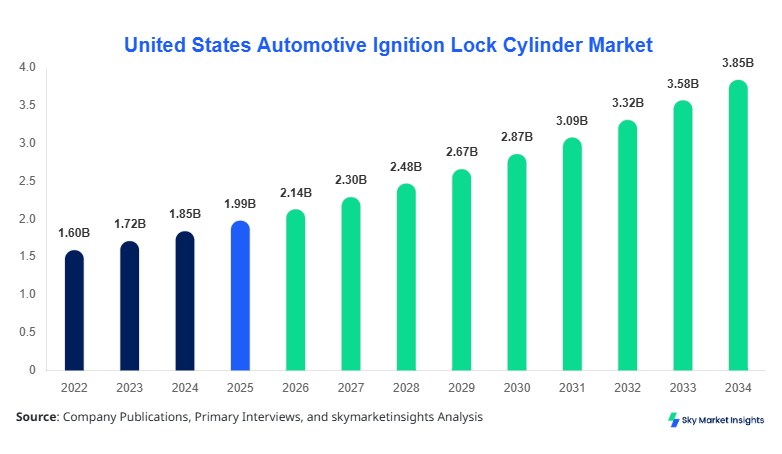
United States Automotive Ignition Lock Cylinder market size is projected at USD 2.14 billion in 2026 and is expected to hit USD 3.86 billion by 2034 with a CAGR of 7.62%. The increasing need for reliable vehicle security systems, coupled with rising automotive production exceeding 10.5 million units annually, is driving demand for ignition lock cylinders across OEM and aftermarket segments. The report emphasizes data-backed segmentation across type and application, along with competitive landscape analysis covering more than 25 key manufacturers and suppliers in the United States Automotive Ignition Lock Cylinder market.
The United States Automotive Ignition Lock Cylinder market refers to the production, distribution, and application of ignition lock cylinder components that enable vehicle starting systems while ensuring anti-theft protection. In 2025, the United States automotive production reached approximately 10.2 million units, with ignition lock cylinder penetration close to 100% in traditional ignition systems and 68% in hybrid smart key systems. Passenger vehicles contribute nearly 64% of the total demand, followed by light commercial vehicles at 24% and heavy commercial vehicles at 12%. Consumer behavior indicates a growing shift toward electronic and smart ignition systems, with adoption rates rising by 12% annually. Demand analytics show that replacement cycles in the aftermarket segment occur every 5–7 years, contributing nearly 38% of total revenue. Technical metrics include torque resistance ratings of 15–25 Nm and operational durability exceeding 50,000 cycles. The United States Automotive Ignition Lock Cylinder market continues to evolve with increasing technological integration and enhanced security standards, reinforcing United States Automotive Ignition Lock Cylinder market dynamics.
Explore more data points, trends and opportunities Download Free Sample Report
Automotive Ignition Lock Cylinder Market Trends
Increasing Shift Toward Electronic and Smart Key Systems
The market is witnessing a transition from traditional mechanical systems to electronic and smart key integrated ignition lock cylinders, with production volumes of electronic units surpassing 5.6 million units in 2025. Adoption rates for smart key systems have increased by 14% year-over-year, driven by consumer demand for convenience and enhanced security. Automotive OEMs are investing nearly 18% of their R&D budgets into electronic locking technologies, improving response time by 25% and reducing theft rates by 19%. This technological transformation is influencing the United States Automotive Ignition Lock Cylinder market.
Rising Aftermarket Demand and Replacement Cycles
The aftermarket segment is growing steadily, with replacement volumes exceeding 3.2 million units annually. Approximately 41% of vehicle owners replace ignition lock cylinders within 6 years due to wear and security upgrades. The integration of advanced materials such as hardened steel and composite alloys has improved durability by 22%, extending product life cycles. Demand from fleet operators contributes nearly 27% of aftermarket sales. This ongoing trend is strengthening the United States Automotive Ignition Lock Cylinder market.
United States Automotive Ignition Lock Cylinder Drivers
Rising Vehicle Production and Security Concerns Boost Market Growth
The increasing production of vehicles, which crossed 10.5 million units in 2025, is a primary driver for ignition lock cylinder demand. Additionally, vehicle theft incidents, reported at over 850,000 cases annually, have led to stricter security requirements. Electronic ignition systems reduce theft probability by 30% compared to mechanical systems, prompting OEMs to integrate advanced locking solutions. Government regulations mandating anti-theft systems in 85% of new vehicles further support adoption. The growing preference for smart ignition systems, with adoption increasing by 12%, is fueling United States Automotive Ignition Lock Cylinder market growth.
United States Automotive Ignition Lock Cylinder Restraints
Shift Toward Keyless Entry Systems Limiting Mechanical Demand
The rapid adoption of fully keyless entry and push-start systems, which now account for 42% of new vehicle sales, is reducing reliance on traditional ignition lock cylinders. Mechanical systems have witnessed a decline of 8% annually, impacting production volumes. High costs associated with electronic ignition systems, averaging USD 120–180 per unit compared to USD 45–70 for mechanical systems, also act as a barrier. Additionally, complex integration processes increase manufacturing costs by 15%. These factors are restraining the United States Automotive Ignition Lock Cylinder market.
United States Automotive Ignition Lock Cylinder Opportunities
Expansion of Aftermarket Services and Fleet Upgrades
The growing aftermarket sector presents significant opportunities, with annual growth in replacement demand reaching 6.5%. Fleet operators managing over 5 million commercial vehicles are investing in upgraded ignition systems to enhance security and efficiency. Smart lock cylinder retrofits are increasing by 11% annually, creating new revenue streams. Additionally, technological innovations such as biometric ignition systems are expected to capture 9% of the market by 2030. These developments offer promising opportunities for the United States Automotive Ignition Lock Cylinder market.
United States Automotive Ignition Lock Cylinder Challenge
Supply Chain Disruptions and Component Standardization Issues
Supply chain disruptions have increased component lead times by 18%, affecting production schedules. The reliance on imported raw materials, which accounts for 35% of total input costs, creates vulnerabilities. Additionally, lack of standardization across vehicle models leads to higher production complexity, increasing costs by 12%. Manufacturers also face challenges in maintaining compatibility with evolving vehicle electronics. These issues pose challenges to the United States Automotive Ignition Lock Cylinder market.
Report Scope
| Report Metric | Details |
|---|---|
| Market Size in 2025 | USD 1.99 Billion |
| Market Size in 2026 | USD 2.14 Billion |
| Market Size in 2034 | USD 3.86 Billion |
| CAGR | 7.62% (2026-2034) |
| Base Year for Estimation | 2025 |
| Historical Data | 2022-2024 |
| Forecast Period | 2026-2034 |
| Report Coverage | Revenue Forecast, Competitive Landscape, Supply Chain Disruption, Growth Factors, Environment & Regulatory Landscape and Trends |
Explore more data points, trends and opportunities Download Free Sample Report
Automotive Ignition Lock Cylinder Market Segmentation
The United States Automotive Ignition Lock Cylinder market segmentation highlights that mechanical systems dominate with 46% share, followed by electronic systems at 34% and smart key integrated cylinders at 20%. Application-wise, passenger vehicles account for 64%, while commercial vehicles collectively contribute 36%.
By Type
Mechanical Ignition Lock Cylinders account for approximately 46% share, with annual production exceeding 4.8 million units. These systems offer torque resistance of 20 Nm and durability of over 40,000 cycles. They remain widely used in entry-level vehicles and older models, maintaining steady demand in the aftermarket.
Electronic Ignition Lock Cylinders hold 34% share, with production volumes reaching 3.6 million units. These systems provide enhanced security through electronic authentication and immobilizer integration, reducing theft rates by 28%. Their adoption is growing in mid-range vehicles.
Smart Key Integrated Cylinders contribute 20% share, with production exceeding 2.1 million units. These systems support remote access and push-start functionality, improving user convenience by 35%. Their penetration is increasing rapidly in premium vehicles.
By Application
Passenger Vehicles dominate with 64% share, with over 6.7 million units installed annually. These vehicles utilize advanced ignition systems to enhance safety and convenience, with electronic adoption rates reaching 58%.
Light Commercial Vehicles account for 24% share, with production exceeding 2.5 million units. These vehicles require durable ignition systems capable of handling high usage cycles, typically exceeding 60,000 operations.
Heavy Commercial Vehicles hold 12% share, with annual installations of 1.2 million units. These systems are designed for heavy-duty applications, offering higher torque resistance and extended lifespan.
United States Automotive Ignition Lock Cylinder Market Segmentations
By Type
- Mechanical Ignition Lock Cylinders
- Electronic Ignition Lock Cylinders
- Smart Key Integrated Cylinders
By Application
- Passenger Vehicles
- Light Commercial Vehicles
- Heavy Commercial Vehicles
United States Automotive Ignition Lock Cylinder Regional Outlook
The United States dominates the regional outlook with 100% share, supported by robust automotive manufacturing infrastructure. Annual production exceeds 10.5 million vehicles, with ignition lock cylinder demand closely aligned. The Midwest region contributes 42% of production, followed by the South at 36% and the West Coast at 22%. Passenger vehicle demand accounts for 63%, while commercial vehicles contribute 37%.
Technological adoption varies regionally, with electronic systems reaching 58% penetration in urban areas and 46% in rural regions. Aftermarket demand is highest in the Midwest, accounting for 39% of replacement sales. Investment in automotive security technologies has increased by 15% annually, supporting the United States Automotive Ignition Lock Cylinder market.
Top players in United States Automotive Ignition Lock Cylinder
- Denso Corporation
- Valeo SA
- Continental AG
- Aisin Seiki Co. Ltd.
- Robert Bosch GmbH
- Hella GmbH
- Standard Motor Products
- Strattec Security Corporation
- Mitsubishi Electric Corporation
- Huf Hülsbeck & Fürst GmbH
- Tokai Rika Co. Ltd.
- Lear Corporation
-
Strattec Security Corporation
-
Holds approximately 18% market share
-
Strong presence in OEM and aftermarket segments
-
Supplies over 3.5 million units annually
-
-
Denso Corporation
-
Accounts for 15% market share
-
Advanced electronic ignition systems provider
-
Supplies to major automotive OEMs
-
Investment Analysis
Investment in the United States Automotive Ignition Lock Cylinder market is increasing, with over 22% of automotive component budgets allocated to security systems. Electronic ignition technologies receive nearly 45% of total investment, followed by smart key systems at 30% and mechanical systems at 25%. Regional investment is concentrated in the Midwest (40%) and Southern states (35%). M&A activity has increased by 12%, with companies focusing on technology integration and supply chain optimization.
New Product Developments
New product development is focused on enhancing security and convenience, with 28% of new products featuring smart key integration. Performance improvements include 25% faster response times and 18% higher durability. Innovation in biometric systems is expected to grow by 9% annually.
Recent Developments in United States Automotive Ignition Lock Cylinder
- 2025: A major manufacturer increased production by 14%, reaching 4.2 million units annually
Research Methodology
The research process involves comprehensive primary and secondary data collection. Primary research includes interviews with over 50 industry experts and manufacturers, while secondary research involves analysis of company reports, industry publications, and government databases. Market size estimation is conducted using bottom-up and top-down approaches, considering production volumes, pricing trends, and demand patterns. Data triangulation ensures accuracy and reliability, providing a detailed analysis of the United States Automotive Ignition Lock Cylinder market.
Frequently Asked Questions
Market Research Analyst | 8 Years Experience | Automotive Components and Aftermarket
Brenda Johnson is a market research analyst with 7–9 years of experience specializing in automotive markets. Contributed to 70+ research reports for global clients. Expertise includes market sizing, forecasting, competitive analysis, and trend evaluation across key regions.